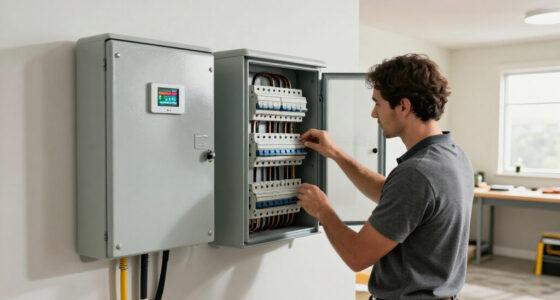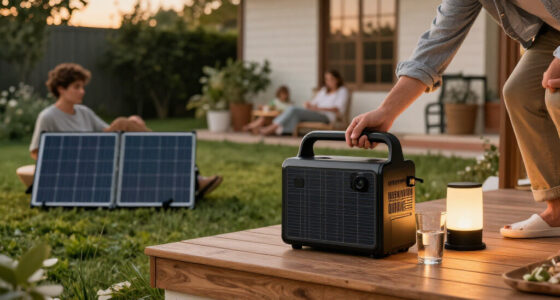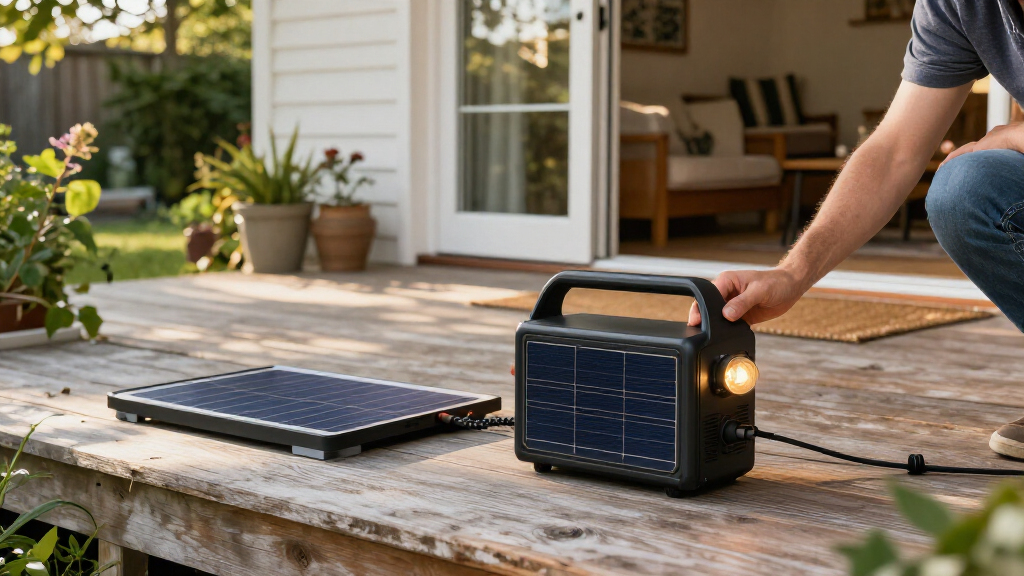
When shopping for solar backup power, the central choice is whether to keep essential devices running wherever you need them or to connect backup power directly to your home. A portable solar power station combines a battery, inverter, and charging inputs in one movable unit. A fixed home battery system is installed with transfer equipment and may connect to rooftop solar, the electrical panel, or both.

Get backup power and energy gear delivered free with Prime
- Fast, free delivery on millions of items
- Prime Video, Amazon Music and more included
- Member-only deals all year

Jackery HomePower 3600 Plus Portable Power Station, 3584Wh, 3600W
- ✔ Capacity: 3,584Wh
- ✔ AC output: 3,600W
- ✔ Parallel output: 7,200W

Jackery Explorer 300 Portable Power Station, 292Wh
- ✔ Capacity: 292Wh
- ✔ Weight: 7.5 pounds
- ✔ Battery chemistry: LiFePO4

ZeroKor 300W Portable Power Station with 60W Solar Panel
- ✔ Maximum output: 300W
- ✔ Solar panel: 60W monocrystalline, included
- ✔ Panel conversion efficiency: 20.5%
The portable option generally costs less to get started and works for camping, travel, and targeted outage needs. The fixed system requires installation and a larger budget, but can provide more capacity, higher output, and smoother backup for selected household circuits. The right choice depends on the loads you need to run, how long outages last, and whether portability or automatic home coverage matters more.
At a Glance
| Criteria | Portable solar power station | Fixed home battery backup system | Winner |
|---|---|---|---|
| Typical cost and setup | Lower initial cost; ready to use with minimal setup | Higher initial cost; professional installation and electrical work commonly needed | A |
| Capacity and output | Small to medium battery capacity; output varies by model | Often larger capacity and higher continuous output; system design determines coverage | B |
| Outage operation | Manual connection of devices; usually no automatic home switchover | Can supply selected circuits and may switch automatically with proper equipment | B |
| Solar charging | Can charge from compatible portable panels; speed depends on sun and input limits | Can integrate with rooftop solar; charging and backup behavior depend on system configuration | B |
| Portability and other uses | Portable for trips, work sites, and room-to-room use | Fixed in place and intended for household backup | A |
| Expansion and integration | Some models accept extra batteries, but home integration is limited | Can be designed around a home’s panel and expanded within product limits | B |
| Best value for | Targeted backup and occasional portable power | Frequent outages and broader household backup | Depends |
Jackery HomePower 3600 Plus Portable Power Station, 3584Wh, 3600W
The HomePower 3600 Plus is the clear choice when “solar backup” means supporting meaningful household loads through an outage. Its 3,584Wh capacity and 3,600W AC output put it well beyond the two compact 300W stations: it can accommodate a broader range of equipment, while greater stored energy can extend operation before recharging is needed. Capacity can expand to as much as 21kWh per unit, or 43kWh with multiple units, giving buyers a way to scale the system over time.Solar is one of four listed charging methods, alongside AC, gas generator and hybrid AC+DC. That variety can be useful when sunlight is intermittent or a fast recharge matters; the stated solar charging time is four hours, though real charging depends on the setup and conditions. The Explorer 300 is much easier to carry for a short trip, and ZeroKor includes a panel in its bundle, but neither offers this model’s output or expansion headroom.There is a practical catch: 77.2 pounds is a lot to move, even with wheels and a telescopic handle. Solar panels are optional, and the listed two outlets may require careful load planning. The unit provides 120V; 240V operation requires units connected in parallel. We’d choose it for a planned home backup setup, not as a lightweight grab-and-go station.
Pros:
- 3,584Wh capacity and 3,600W AC output suit more demanding backup needs than either compact pick.
- Expandable capacity supports a larger system as backup needs change.
- Solar, AC, hybrid AC+DC and gas generator charging provide multiple recharge paths.
- Wheels and a telescopic handle help move the 77.2-pound unit over suitable surfaces.
Cons:
- At 77.2 pounds, it is cumbersome to carry despite its wheels and handle.
- Solar panels are optional, so solar charging requires additional equipment.
- 240V operation requires multiple units connected in parallel.
Best for: Households that need higher-output backup, want room to expand stored capacity and can accommodate a heavy wheeled unit.
Not ideal for: Campers or anyone seeking a lightweight station, and buyers who need 240V from a single unit or expect a solar panel to be included.
Bottom line: For substantial solar-ready home backup, the HomePower 3600 Plus leads this group on capacity, output and expansion, provided its weight and optional panels fit your setup.
“For substantial solar-ready home backup, the HomePower 3600 Plus leads this group on capacity, output and expansion, provided its weight and optional panels fit your setup.”
Jackery Explorer 300 Portable Power Station, 292Wh
For buyers prioritizing a portable battery over an all-in-one solar bundle, the Explorer 300 makes the most balanced small-station choice here. It weighs 7.5 pounds, has an integrated handle and provides six ports, including USB-C PD, USB-A, two AC outlets and a car port. That mix lets us charge several personal devices without carrying a separate adapter for every connection. Its 292Wh capacity and 300W rated output still set a small-load boundary: it is for electronics and compatible low-draw gear, not high-wattage household appliances.Its listed LiFePO4 battery and 4,000-plus cycle rating distinguish it from the ZeroKor bundle, whose description does not specify battery chemistry or cycle life. The Explorer’s USB-C PD output is rated at 100W, useful for compatible devices, while the HomePower is the obvious step up if a buyer needs more power or longer backup. Solar charging is supported, with the product listing 80% charge in about 2.8 hours using a 100W panel, but the panel is sold separately. That makes it less immediately solar-ready than ZeroKor, which includes a 60W panel.We’d pick this model for a portable device-charging kit that can also be recharged by a compatible Jackery panel. Its small capacity limits how long it can sustain loads, and the 300W ceiling rules out many appliances. Buyers who want a panel in the box should consider ZeroKor; those preparing for wider home backup should move up to the HomePower instead.
Pros:
- At 7.5 pounds, it is much easier to carry than the HomePower 3600 Plus.
- Six ports include USB-C PD rated at 100W, alongside AC, USB-A and car connections.
- LiFePO4 battery is rated for over 4,000 cycles to 70% capacity.
- Solar charging is supported, with a stated 80% charge time of about 2.8 hours using a 100W panel.
Cons:
- Solar panel is not included, unlike the ZeroKor bundle.
- 292Wh capacity and 300W rated output restrict it to smaller loads.
- The stated solar charging time depends on using a compatible 100W panel and suitable conditions.
Best for: People who want a lightweight station for phones, laptops and other compatible small devices, and are willing to buy a solar panel separately.
Not ideal for: Buyers who need an included panel, higher output for appliances or enough stored energy for extended home backup.
Bottom line: The Explorer 300 is the most portable, well-connected compact pick, but solar buyers must budget for a separate panel and accept its small-load limits.
“The Explorer 300 is the most portable, well-connected compact pick, but solar buyers must budget for a separate panel and accept its small-load limits.”
ZeroKor 300W Portable Power Station with 60W Solar Panel
ZeroKor’s strongest argument is simple: a 60W monocrystalline panel comes with the station. That makes this the most straightforward entry in the lineup for someone who wants to try solar charging without first sourcing a separate panel. The station offers AC, DC and USB connections, plus a quick-charge USB port and an SOS flashlight with reading mode. Its built-in MPPT solar input and listed electrical protections add practical features to a compact kit.Compared with the Explorer 300, ZeroKor is less compelling on battery longevity: its description does not state capacity, battery chemistry or cycle life, while Jackery specifies a 292Wh LiFePO4 battery rated for over 4,000 cycles. ZeroKor’s panel is an advantage out of the box, but its 300W maximum output makes this a small-device station, not a route to powering substantial household loads. The HomePower 3600 Plus is far more capable for that job, albeit much heavier and without a panel included.We would keep this kit for phones, tablets and compatible laptops, and check each device’s draw before connecting it. The supplied panel’s junction box is not waterproof, so it needs protection from rain and wet conditions. The product description also recommends periodic charging and discharging, and says it is not intended for emergency-only storage. That maintenance guidance matters for a buyer who plans to leave a station untouched until an outage.
Pros:
- Includes a 60W monocrystalline solar panel with 20.5% stated conversion efficiency.
- AC, DC and USB connections cover common small-device charging needs.
- Built-in MPPT solar input and listed protections address charging and overload risks.
- Flashlight includes reading and SOS modes.
Cons:
- Devices drawing more than 300W may damage the station.
- The solar panel junction box is not waterproof.
- Periodic charging and discharging is recommended; it is not intended for emergency-only storage.
Best for: Buyers seeking a compact, small-device backup kit with a solar panel included and who can keep the panel connection dry.
Not ideal for: People who need higher-wattage appliances, a waterproof panel setup or a station that can sit in emergency storage without periodic maintenance.
Bottom line: ZeroKor is the easiest solar bundle to start with, but its 300W ceiling, limited published battery details and panel weather limitation keep it focused on modest loads.
“ZeroKor is the easiest solar bundle to start with, but its 300W ceiling, limited published battery details and panel weather limitation keep it focused on modest loads.”
As an Amazon Associate we earn from qualifying purchases.
Key Differences
The biggest practical difference is how power reaches your appliances. With a portable station, you plug devices directly into the unit. That works well for phones, laptops, lights, networking equipment, and some small appliances, but it may mean running extension cords and deciding which items get power. A fixed battery can feed selected circuits through installed electrical equipment, reducing setup during an outage. Whole-home backup is not automatic: the inverter, battery capacity, panel arrangement, and installation must be designed to support it.
Cost and flexibility pull in opposite directions. A portable unit is easier to buy in stages and take beyond the house, while a fixed system costs more because it includes installation and home electrical integration. The higher price can make sense for households that face outages often, need substantial power, or already have rooftop solar they want to use during blackouts. For occasional short outages, a portable station may cover the most important loads at far lower cost.
Solar charging does not make either system independent of weather or load planning. Portable panels are useful when placed in good sun, but their output, setup space, and daily sunlight limit how much energy they can restore. A fixed system connected to rooftop solar may recharge during an outage if the solar equipment supports islanded operation. Buyers should confirm that capability: many grid-tied solar systems shut down during a grid failure unless configured with compatible backup equipment.
Detailed Comparison
Cost and setup (Portable solar power station wins — major)
The portable station wins by a moderate margin for buyers who need basic backup: it avoids installation and usually has a much lower entry cost. The fixed system’s higher bill covers electrical work and integration, which can be worthwhile when household coverage is the goal. For a few essential devices, paying for a permanent installation is hard to justify.
Capacity and output (Fixed home battery backup system wins — major)
A fixed system usually wins by a moderate to major margin because it can be specified with a larger battery and inverter. That can support more loads or higher-power appliances, though actual coverage depends on system ratings and circuit design. Portable stations vary widely, so check both watt-hours and continuous output; a large capacity number alone does not mean the unit can start a refrigerator or run a high-wattage appliance.
Ease during an outage (Fixed home battery backup system wins — major)
The fixed system wins by a major margin when installed for automatic backup. It can keep selected circuits supplied without moving equipment or plugging in each device. A portable unit requires manual setup and prioritization, but that process is manageable when the outage is brief and the load list is short. Neither option guarantees whole-home power without sufficient capacity and suitable configuration.
Solar recharging (Fixed home battery backup system wins — moderate)
The fixed system has a moderate advantage when paired with compatible rooftop solar, since panels may recharge the battery while supporting household loads. That depends on the inverter and backup configuration, and should be confirmed before purchase. Portable solar stations are simpler to pair with portable panels, but panel placement and limited sunlight can make recharging slow. In cloudy weather or at night, both depend on stored energy or another charging source.
Portability and versatility (Portable solar power station wins — major)
The portable station wins by a major margin: it can move between rooms, travel in a vehicle, or serve at a work site. The fixed battery stays at the property and earns its keep through home backup. If a buyer expects to use power away from home, paying for fixed capacity does not replace the convenience of a portable unit.
Expansion and home integration (Fixed home battery backup system wins — moderate)
The fixed system wins by a moderate margin for a home with defined backup goals. It can be matched to circuits and may integrate with rooftop solar and energy controls. Some portable models accept extra batteries, but they generally do not offer the same panel integration or circuit-level operation. Expansion limits, compatible components, and installer support matter for both, so verify the system’s actual upgrade path.
Value for typical use (moderate difference)
This is a tie because the better value depends on what the system must do. A portable station offers more useful power per dollar for occasional, device-level backup and non-home use. A fixed battery earns its premium for frequent outages, larger loads, and automatic supply to selected circuits. Buying capacity that the household rarely needs reduces the value of either choice.
Portable solar power station: Pros and Cons
Pros:
- Lower purchase cost and little or no installation
- Portable for travel, outdoor use, and backup in different locations
- Straightforward way to power selected devices
Cons:
- Manual setup and device-by-device connections during outages
- Capacity and output may limit larger appliances
- Portable panel charging depends on sunlight, placement, and input limits
Fixed home battery backup system: Pros and Cons
Pros:
- Can support selected home circuits with less intervention
- Often offers greater capacity and output
- May work with rooftop solar during outages when configured for backup
Cons:
- Higher upfront cost, including installation
- Fixed in place and not useful as portable power
- Coverage and solar operation depend on system design and compatibility
Who Should Choose What
Choose Portable solar power station if:
- You mainly need to keep phones, computers, lights, a router, or a few small devices running.
- You want backup for camping, travel, or work away from home as well as occasional outages.
- You prefer a lower-cost system you can start using without electrical installation.
Choose Fixed home battery backup system if:
- Your area has frequent or extended outages and you want selected household circuits backed up.
- You value automatic operation and want to avoid moving a battery or plugging in each device.
- You have rooftop solar and have confirmed that the proposed system can recharge during a grid outage.
Skip both if: You need to run high-demand heating, cooling, or other large loads for long periods but have not sized a system for their power draw and energy use. First define the loads and outage duration, then compare appropriately rated backup options.
Value for Money
Pay more for a fixed home battery when its installation changes the experience in a way you will use: automatic backup, higher output, integration with selected circuits, or solar charging during outages. Those benefits matter most to households with recurring outages, medical or work needs that require steady power, or a clear plan for which circuits must stay on.
For occasional outages affecting a small number of devices, the portable station is usually the stronger value. Its lower cost and flexibility outweigh the convenience of a permanent connection. Compare total installed cost for a home system with the portable capacity you actually need, and account for the loads, expected outage length, and solar charging conditions. Pay for the fixed system only when its added coverage and convenience solve a real household problem.
Final Verdict
For most buyers seeking affordable backup for essential electronics and small appliances, choose a portable solar power station. It is less expensive, easier to deploy, and useful outside the home. Choose a fixed home battery backup system if outages are common or you need selected household circuits to stay powered with minimal intervention. The biggest deciding factor is whether you need power delivered to a handful of devices or integrated into the home’s electrical system. A fixed system’s premium is justified for the latter; otherwise, portability is the better buy.
Frequently Asked Questions
Can a portable solar power station run a refrigerator?
Some can, but check the refrigerator’s running and startup power against the station’s continuous and surge ratings. Estimate daily energy use as well; the battery may run the refrigerator for much less time than expected, especially if other devices share it.
Will rooftop solar work during a grid outage?
Not necessarily. Many grid-tied solar systems shut down when the grid fails. The inverter and battery setup must support backup or islanded operation, so confirm that the complete system can supply power during an outage.
Which option is better for a long outage?
A fixed system is often better for household loads when it has enough capacity and compatible solar recharging. A portable station can still help, but its runtime is limited by battery size and available charging. For either option, match stored energy and recharge rates to the loads and outage length.
Is a solar power station the same as a generator?
A solar power station stores electricity in a battery and can recharge from compatible solar panels or other inputs. A fuel generator produces electricity while running on fuel. They differ in noise, maintenance, runtime, and recharging needs; some households use a battery system alongside a generator for extended outages.
Black Friday Picks

Sonos Beam Gen 2 Dolby Atmos Soundbar, Black
As an affiliate, we earn on qualifying purchases.