Choosing a solar-powered portable charger is really a choice between keeping a small backup battery attached to a solar panel or carrying a larger panel that charges a separate power bank. A solar power bank is simpler to pack and useful when you need occasional emergency top-ups. A portable solar panel and separate battery take more setup and space, but usually make more sense when you need to replenish meaningful power during a camping trip or other time away from outlets.

Get backup power and energy gear delivered free with Prime
- Fast, free delivery on millions of items
- Prime Video, Amazon Music and more included
- Member-only deals all year

YELOMIN 38,800mAh Solar Power Bank with USB-C and Dual LED Flashlights
- ✔ Battery capacity: 38,800mAh
- ✔ Ports: 2 USB-A outputs; 1 USB-C input/output
- ✔ Maximum output current: 2.4A
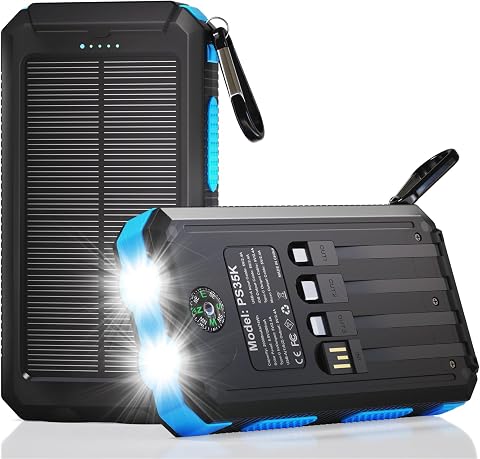
Durecopow 20,000 mAh Solar Power Bank with Built-In Cables and Dual Flashlight
- ✔ Battery capacity: 20,000mAh
- ✔ Built-in cables: Type-C, Lightning, Micro USB output
- ✔ Input: USB-A input; USB-C input/output

BLAVOR 10,000mAh Solar Power Bank with Wireless Charging
- ✔ Battery capacity: 10,000mAh
- ✔ USB-C output: 20W
- ✔ Wireless charging: Qi compatible
The key difference is the role of solar charging. On most compact solar power banks, the built-in panel is best treated as a trickle charger; it can help maintain or slowly top up the battery in good sun, but it is rarely a dependable way to refill it quickly. A separate panel offers more surface area and can be aimed toward the sun, making it the stronger choice for regular off-grid charging. The right fit depends on whether you value a compact emergency reserve or a more capable solar charging setup.
At a Glance
| Criteria | Solar power bank | Portable solar panel with a separate power bank | Winner |
|---|---|---|---|
| Solar charging speed | Usually slow; small built-in panel | Generally faster with a larger panel in suitable sun | B |
| Stored capacity | Battery included in one unit | Choose the separate battery capacity you need | Depends |
| Portability | Compact, though often heavy for its capacity | More pieces and setup; panel may fold for packing | A |
| Ease of use | Simple, with fewer pieces to manage | Requires positioning the panel and connecting the battery | A |
| Reliability off-grid | Useful as backup; sunlight alone may not replenish it quickly | Better for repeated charging when sun and conditions cooperate | B |
| Flexibility | Limited by the built-in panel and ports | Panel and battery can be upgraded or used separately | B |
| Value | Good for occasional backup if priced modestly | Higher upfront cost, often better for frequent off-grid use | Depends |
YELOMIN 38,800mAh Solar Power Bank with USB-C and Dual LED Flashlights
The YELOMIN makes the strongest case when our priority is carrying a large stated reserve: 38,800mAh is nearly double the Durecopow’s listed 20,000mAh and substantially above BLAVOR’s 10,000mAh. That makes it the capacity-first pick for trips when access to an outlet may be limited and we want a larger buffer between planned recharges. It has two USB-A outputs and a USB-C input/output, so it can connect to several devices, though its stated maximum output current is 2.4A rather than a wattage-based fast-charge specification like BLAVOR’s 20W USB-C.Its solar panel needs careful interpretation. The listing describes solar as supplemental backup charging and warns a full solar recharge may take dozens of hours of effective sunlight or longer. That makes the panel useful as a possible trickle of backup energy, not a reliable replacement for charging from USB-C before leaving. Compared with Durecopow, YELOMIN gives us clearer warning about solar limitations; compared with BLAVOR, it trades wireless charging and a higher specified USB-C output for a much larger stated battery.Dual LEDs with steady, SOS, and strobe modes, port covers, and an included carabiner add practical outdoor details. At 9.9 ounces it remains under ten ounces, but the capacity is not free in a pack, and the 12-month warranty is the shortest clearly stated warranty in this group. We would choose it for capacity and accept the slow solar refill, rather than buy it expecting sunlight to rapidly restore a depleted battery.
Pros:
- Largest stated capacity in this comparison at 38,800mAh.
- USB-C input/output plus two USB-A outputs.
- Dual LED lights include steady, SOS, and strobe modes.
- Port covers and a carabiner support outdoor carry.
Cons:
- Solar charging is supplemental and may take dozens of hours of effective sunlight or longer for a full recharge.
- Maximum output is listed as 2.4A without a wattage specification.
- The stated warranty is 12 months.
Best for: Campers or travelers who want the largest stated battery reserve in this comparison and can recharge from USB-C before setting out.
Not ideal for: Buyers who need fast solar recovery, a documented fast-charging wattage, or a longer stated warranty.
Bottom line: Choose the YELOMIN when carrying the largest stated reserve matters more than solar speed or a specified high-wattage output.
“Choose the YELOMIN when carrying the largest stated reserve matters more than solar speed or a specified high-wattage output.”
Durecopow 20,000 mAh Solar Power Bank with Built-In Cables and Dual Flashlight
The Durecopow’s defining advantage is simple: three built-in output cables cover Type-C, Lightning, and Micro USB, reducing the odds that we leave a separate charging lead behind. That convenience distinguishes it from the YELOMIN and BLAVOR, which list ports but not integrated device cables. Its stated 20,000mAh capacity sits between the two: more than BLAVOR’s 10,000mAh, but well below YELOMIN’s 38,800mAh. It is the middle-ground choice for people who value fewer loose accessories over maximum capacity.We get three ports, USB-C input/output, and a claimed ability to recharge from either an outlet or solar panel. However, the listing gives no solar charging time or panel output. Since the YELOMIN explicitly describes solar as slow, we should not assume the Durecopow will refill faster; its solar claim is less specific, not proof of stronger performance. For predictable turnaround, we would plan to use an outlet and consider solar a backup whose usefulness depends on conditions.The outdoor kit includes dual LED lights with steady, SOS, and strobe modes, plus a carabiner and compass. The ABS-PC and silicone construction is described as water-, shock-, and dust-resistant, with reinforced corners. Those traits suit rougher outings, but the description does not supply an IP rating, dimensions, weight, or charging time. Compared with BLAVOR, the Durecopow prioritizes integrated cables and a larger capacity, while BLAVOR documents a 20W USB-C output and Qi wireless charging. The missing size and recharge details make the Durecopow harder to assess before packing.
Pros:
- Built-in Type-C, Lightning, and Micro USB output cables reduce loose accessories.
- 20,000mAh stated capacity is between the other two options.
- USB-C input/output and three ports support multiple connection options.
- Dual light modes, carabiner, compass, and reinforced construction target outdoor use.
Cons:
- Solar charging time and panel performance are not specified.
- Dimensions and weight are not provided, making packability difficult to judge.
- No IP rating or specific protection level is listed.
Best for: Travelers who carry different connector types and want built-in device cables alongside a moderate stated capacity.
Not ideal for: Buyers who need a verified solar recharge time, compactness measurements, or wireless charging.
Bottom line: Choose the Durecopow for integrated cable convenience, provided its unspecified size and solar performance fit your plans.
“Choose the Durecopow for integrated cable convenience, provided its unspecified size and solar performance fit your plans.”
BLAVOR 10,000mAh Solar Power Bank with Wireless Charging
The BLAVOR is the most clearly specified option for buyers who care about how their devices connect. It combines Qi wireless charging with USB-A and a 20W USB-C output, and can charge up to three devices at once. That gives it a more flexible charging mix than YELOMIN’s listed ports, while avoiding the Durecopow’s dependence on built-in cables for connector convenience. The tradeoff is capacity: at 10,000mAh, it has less than either rival, so it is better suited to a compact personal backup than a larger shared reserve.For a solar-focused purchase, the key gap is that the listing provides no solar performance or recharge-time figure. Its battery charge time is listed as four hours, but that figure does not establish how long a solar recharge takes or under what conditions. We should therefore compare its panel cautiously with YELOMIN’s explicitly slow supplemental charging and Durecopow’s unspecified solar performance. None of those details makes the BLAVOR a safe choice for relying on sunshine as the main recharge method.At 9.3 ounces, it is slightly lighter than the YELOMIN’s 9.9 ounces, though it still adds weight for a 10,000mAh pack. Its IPX5-rated, dustproof, and shockproof case, dual flashlights, and compass carabiner give it a well-equipped outdoor profile. The three-year warranty is also longer than YELOMIN’s stated 12 months. We would favor this model when charging flexibility and documented USB-C output matter more than battery size; for maximum reserve, YELOMIN is the clearer fit, while Durecopow carries more capacity and its own cables.
Pros:
- Qi wireless charging alongside USB-A and USB-C.
- Specified 20W USB-C output.
- IPX5-rated, dustproof, and shockproof case with dual flashlights and compass carabiner.
- Three-year stated warranty, longer than YELOMIN’s.
Cons:
- Lowest stated capacity in the lineup at 10,000mAh.
- Solar charging performance and solar recharge time are not specified.
- At 9.3 ounces, it adds weight relative to its capacity.
Best for: Outdoor users who want Qi wireless charging, a specified 20W USB-C output, and a longer stated warranty in one unit.
Not ideal for: Buyers seeking the largest battery, integrated charging cables, or documented solar recharge performance.
Bottom line: Pick the BLAVOR when flexible charging and documented USB-C output outweigh the need for a large battery reserve.
“Pick the BLAVOR when flexible charging and documented USB-C output outweigh the need for a large battery reserve.”
As an Amazon Associate we earn from qualifying purchases.
Key Differences
The biggest practical difference is how much energy the solar hardware can collect. A compact built-in panel keeps the solar power bank self-contained, but its limited area restricts how quickly it can charge. That makes it a handy reserve for small top-ups, especially when a wall outlet is unavailable, but a poor choice if the plan is to regularly recharge a phone or other devices from sunlight alone. A separate panel can be unfolded and positioned toward the sun, then connected to a battery sized for the trip. It takes more attention, yet its larger collecting area gives it a better chance of producing useful power during daylight.
Convenience and value depend on how often the charger will be used. The all-in-one option costs less to manage and is easier to grab for a day hike or emergency kit. The separate setup asks for more packing space and setup, and actual output still depends on sun, shade, angle, temperature, and the panel’s specifications. For a weekend outdoors with several devices, or repeated days without mains power, that added capability may justify the cost. For infrequent backup, paying extra for a panel and battery system can be more gear than the need calls for.
Detailed Comparison
Solar charging speed (Portable solar panel with a separate power bank wins — major)
Portable panel setup wins; the gap is major for regular solar charging. A small panel built into a power bank has limited surface area, so it typically adds charge slowly and should not be relied on to refill a depleted battery in a short stretch of sunshine. A separate panel can capture more light and be positioned for better exposure. In practice, choose the separate panel if sunlight is expected to do meaningful charging work; choose the built-in panel as a backup trickle source.
Stored capacity (moderate difference)
This depends on the battery size and the devices being charged. A solar power bank arrives with its battery integrated, making its capacity easy to understand as one package. With a separate panel, the buyer selects a battery independently, which can suit a larger demand but adds cost and weight. Check the usable output and charging needs of your devices instead of comparing capacity labels alone. Neither format wins for every user.
Portability (Solar power bank wins — moderate)
The all-in-one power bank wins; the gap is moderate. It is a single item with no separate panel cable or battery to organize. But built-in solar models can be bulky or heavy relative to their stored energy, so compact does not always mean light. A panel-and-battery kit has more pieces, although a folding panel may pack neatly. For a short walk and emergency reserve, one unit is easier; for a longer trip, the extra load may buy more useful charging.
Ease of use (Solar power bank wins — moderate)
The solar power bank wins by a moderate margin. It is ready to charge devices from its battery without arranging a panel or connecting separate equipment. The larger setup requires you to unfold and orient the panel, connect it to the battery, and check that charging is taking place. This is a manageable routine at a campsite, but an extra task during a brief stop. Buyers who prioritize grab-and-go simplicity will prefer the all-in-one format.
Reliability off-grid (Portable solar panel with a separate power bank wins — major)
The separate panel setup wins by a major margin when there is dependable daylight. Its larger panel has more potential to collect enough energy for continued use, while the small built-in panel often cannot keep pace with everyday phone charging. Neither option guarantees output in clouds, deep shade, poor positioning, or short winter days. A power bank charged at home remains the reliable immediate reserve in either setup; solar is best viewed as a way to replenish it when conditions allow.
Flexibility (Portable solar panel with a separate power bank wins — moderate)
The separate panel setup wins by a moderate margin. You can select a battery to match your capacity needs, replace or upgrade components, and use the battery away from the panel. The integrated unit keeps everything together but ties its solar area, battery, and ports to one product. That simplicity is useful for occasional use, but less adaptable if your device mix or trip length changes.
Value (moderate difference)
There is no universal winner; frequency of use decides. A modestly priced solar power bank can be good value as an emergency reserve or occasional top-up. A separate panel costs more and requires a compatible battery, but that added spending buys more practical solar collection for people who use it repeatedly. Paying the premium makes sense for frequent off-grid trips, not for someone whose main need is a spare battery on ordinary days.
Solar power bank: Pros and Cons
Pros:
- One-piece design is easy to carry and use
- Battery is included for immediate device charging
- Can provide a slow solar top-up when exposed to sun
- Often costs less than buying a panel and separate battery
Cons:
- Small built-in panel usually charges slowly
- Not a dependable way to refill the battery quickly
- Battery capacity and solar panel are fixed together
- Some models are bulky or heavy for their stored capacity
Portable solar panel with a separate power bank: Pros and Cons
Pros:
- Larger panel can collect more solar energy in good conditions
- Battery capacity can be chosen for the trip
- Components can be used or replaced separately
- Better suited to repeated off-grid charging
Cons:
- Higher combined purchase cost
- More gear to pack, connect, and position
- Charging still varies with sun, shade, and panel orientation
- Requires checking compatibility and charging connections
Who Should Choose What
Choose Solar power bank if:
- You want a simple emergency power bank for a bag, car, or day hike.
- You mainly need stored power for occasional phone top-ups and can recharge from an outlet between uses.
- You value a single compact unit more than meaningful solar replenishment.
Choose Portable solar panel with a separate power bank if:
- You camp or travel off-grid for multiple days and expect to charge devices from sunlight.
- You need more capacity or want to choose a battery that matches several devices.
- You are willing to set up a panel during daylight for more useful solar collection.
Skip both if: You mostly need dependable everyday charging near outlets; a conventional power bank is often simpler and more useful than paying for solar hardware you rarely use.
Value for Money
Pay more for a separate panel and battery only when you will use their greater solar collection repeatedly. For multi-day camping or regular travel away from outlets, the extra cost can buy a more capable way to replenish stored power, provided the panel, battery, and devices are compatible. Check output ratings and realistic use conditions rather than assuming any panel will charge quickly in all weather.
If you need a backup battery for occasional use, a solar power bank is generally the better value when its price is close to a conventional power bank. The built-in panel is a useful secondary feature, but it should not command a large premium if you expect it to be your main charging source. For everyday use near outlets, skip solar and buy a conventional power bank; it usually gives more practical value for the money.
Final Verdict
For most buyers who specifically want solar charging on multi-day trips, choose a portable solar panel paired with a separate power bank. Its larger collecting area and flexible battery choice make it the more capable off-grid system, even though it takes more space, setup, and money. Choose a solar power bank if your priority is a simple backup that can accept a slow trickle of sunlight between regular outlet charges. The deciding factor is whether solar needs to replenish your power regularly or merely provide an occasional assist. If neither applies, a conventional power bank is the clearer buy.
Frequently Asked Questions
Can a solar power bank charge itself fully from its built-in panel?
It may be possible under sustained favorable sunlight, but the small panel commonly takes a long time to add substantial charge. Treat it as a backup top-up and check the manufacturer’s stated solar input and conditions.
Which option is better for a weekend camping trip?
A separate panel and power bank are usually the better fit if you expect to recharge devices during the trip. For a short trip where a fully charged battery is enough, the all-in-one option is easier to pack.
Does a larger portable panel work in cloudy weather?
It can still produce some power, but output generally falls when sunlight is weak or obscured. Keep a charged battery as your immediate reserve and avoid planning around the panel’s best-case output.
Is a solar power bank worth buying for everyday use?
Only if the integrated solar feature is a low-cost bonus or you often spend time away from outlets. For routine charging, a conventional power bank is usually simpler and offers better value.