
TL;DR
Open a free Amazon Business account
Business pricing, bulk buying and tax-exempt orders.
As an affiliate, we earn on qualifying purchases.
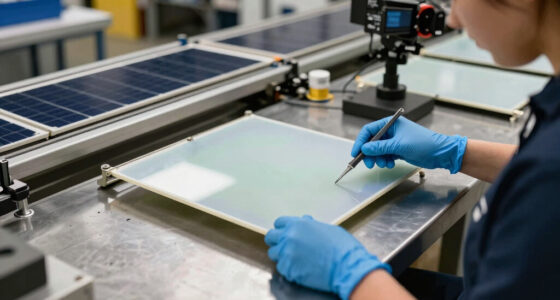
Trinasolar has achieved a new world record for tandem perovskite-silicon solar modules with a 29.2% efficiency. This development signals progress in high-performance, cost-effective solar technology. The record was independently verified and indicates ongoing commercial potential.
Trinasolar has set a new world record for tandem perovskite-silicon solar module efficiency at 29.2%, verified by TÜV SÜD. This achievement marks a significant step forward in solar technology, demonstrating higher efficiency and potential for commercial application.
The Chinese firm Trinasolar announced its latest record on June 9, 2024, with a tandem perovskite-silicon solar module reaching 29.2% conversion efficiency. The module also boasts a power output of 907 watts, up from 808 watts last year, and is designed for industrial-scale deployment. This record, verified independently, underscores the rapid development of perovskite technology, which offers lower-cost, higher-performance solar cells.
Perovskite materials are synthetic optical compounds with promising applications in solar energy due to their affordability and high efficiency. When combined with silicon in tandem setups, they can significantly boost overall conversion rates while reducing costs related to land, installation, and disposal. Trinasolar’s achievement suggests that commercial-scale production of such high-efficiency modules may soon be feasible, potentially transforming the solar industry landscape.
Implications of the Perovskite-Silicon Efficiency Breakthrough
This record demonstrates the rapid progress of perovskite-silicon tandem solar technology, which could lower costs and increase energy output for solar installations worldwide. It supports the industry’s shift toward more efficient, less space-intensive solar solutions, with potential impacts on energy markets, project costs, and renewable energy adoption rates. The achievement also highlights ongoing innovation despite uncertain policy environments, emphasizing the importance of technological advancement in maintaining solar industry momentum.
high efficiency perovskite silicon solar panels
As an affiliate, we earn on qualifying purchases.
As an affiliate, we earn on qualifying purchases.
Recent Advances and Industry Trends in High-Efficiency Solar Cells
Over the past year, the solar industry has seen multiple record-breaking developments, including a 34.2% efficiency for triple III-V germanium modules by Fraunhofer Institute and the ongoing commercial push for perovskite technologies. While U.S. federal policy has faced setbacks, private firms and research institutions continue to push the boundaries of solar efficiency. Notably, Chinese company Trinasolar has claimed a total of 41 industry records, reinforcing its leadership in solar innovation. Meanwhile, U.S.-based startups like Tandem PV are applying perovskite enhancements to silicon cells, showing that innovation persists despite policy uncertainties.
tandem perovskite solar module 29.2% efficiency
As an affiliate, we earn on qualifying purchases.
As an affiliate, we earn on qualifying purchases.
Remaining Challenges and Uncertainties for Commercialization
While the record demonstrates impressive efficiency gains, it is still unclear how quickly such modules can be scaled for mass production and deployment. One-year outdoor testing reveals degradation paths in perovskite tandem solar cells. Durability, long-term stability, and manufacturing costs of perovskite-silicon tandem modules remain areas needing further development. Additionally, regulatory and supply chain factors could influence the timeline for commercial availability.
solar panel with 907 watt output
As an affiliate, we earn on qualifying purchases.
As an affiliate, we earn on qualifying purchases.
Next Steps Toward Market Adoption and Further Innovation
Trinasolar and other industry players are expected to focus on scaling manufacturing processes, improving durability, and conducting long-term testing of tandem modules. Regulatory approvals, cost reductions, and pilot projects will likely follow to validate commercial viability. Continued research and collaboration across sectors are anticipated to accelerate the integration of high-efficiency perovskite-silicon modules into mainstream solar markets.
As an affiliate, we earn on qualifying purchases.
Key Questions
What is the significance of this new efficiency record?
The record indicates that tandem perovskite-silicon solar modules can achieve higher efficiencies, which could lower costs and improve performance for solar energy systems worldwide.
When might these high-efficiency modules become commercially available?
While promising, it is uncertain. Industry experts suggest it could take several years of scaling, testing, and regulatory approval before widespread commercial deployment.
How does perovskite technology compare to traditional silicon solar cells?
Perovskite materials can be manufactured at lower costs and can achieve higher efficiencies when used in tandem with silicon, potentially transforming solar panel performance and economics.
What are the main technical challenges remaining?
Key challenges include ensuring long-term stability, manufacturing at scale, and integrating perovskite layers with existing silicon technology reliably and cost-effectively.
Does this record mean solar energy is now cheaper?
Not directly. While higher efficiency can reduce costs per watt, overall pricing depends on manufacturing, supply chains, and policy factors. However, technological improvements like this are essential steps toward lower-cost solar energy.
Source: CleanTechnica
Fall yard work Picks
leaf blowers
As an affiliate, we earn on qualifying purchases.