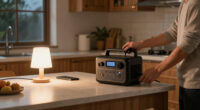
Choosing a portable power station for home backup is a tradeoff between covering a short outage with a manageable, lower-cost unit and buying enough capacity and output to support more of the household for longer. A compact station suits essentials such as phones, lights, a router, and perhaps a small fridge for a limited period, depending on the appliance and model. An expandable high-capacity station costs more and takes up more space, but it can offer longer runtime, higher output, and the option to add batteries.

Get backup power and energy gear delivered free with Prime
- Fast, free delivery on millions of items
- Prime Video, Amazon Music and more included
- Member-only deals all year

Jackery HomePower 3600 Plus Power Station, 3584Wh, 3600W AC Output
- ✔ Battery capacity: 3,584Wh
- ✔ AC output: 3,600W
- ✔ Parallel output: Up to 7,200W stated

BLUETTI Elite 30 V2 Portable Power Station 288Wh 600W LFP Solar Generator
- ✔ Battery capacity: 288Wh
- ✔ Continuous output: 600W
- ✔ Surge / lifting mode: 1,500W stated

Jackery Explorer 300 Portable Power Station,292Wh
- ✔ Battery capacity: 292Wh
- ✔ Continuous output: 300W
- ✔ Peak surge: 600W stated
Neither type replaces a whole-home generator by default. The right choice depends on the appliances you intend to run, how long outages usually last, and whether you can recharge the station during an outage. Choose compact if portability, simple storage, and powering a few essential devices matter most. Choose expandable if you need longer coverage or plan to run larger loads, and confirm the model’s continuous and surge output against those appliances before buying.
At a Glance
| Criteria | Compact portable power station | Expandable high-capacity power station | Winner |
|---|---|---|---|
| Upfront cost | Usually lower; the cost rises with capacity and features. | Usually higher, especially when add-on batteries are included. | A |
| Stored energy and runtime | Lower capacity generally means shorter runtime; actual hours depend on load and conversion losses. | More stored energy can support the same load for longer; exact runtime depends on usable capacity and load. | B |
| Power output | Typically suited to smaller loads; check continuous and surge ratings. | Often supports higher loads, though not every model can start or run major appliances. | B |
| Portability and storage | Usually lighter and easier to move or store. | Heavier and bulkier; some models have wheels or handles. | A |
| Expansion options | Often limited or unavailable; check whether extra batteries are supported. | Often designed for add-on batteries, but compatibility and maximum capacity vary. | B |
| Charging and outage recovery | May recharge faster than larger units, but solar and wall charging times vary by model and conditions. | May accept higher charging input, though a larger battery can still take longer to fill; solar output depends on conditions. | Depends |
| Best backup role | Phones, lights, networking gear, and selected small appliances. | Longer backup for selected household circuits or appliances, subject to output limits. | Depends |
Jackery HomePower 3600 Plus Power Station, 3584Wh, 3600W AC Output
The HomePower 3600 Plus is the only model here built around keeping a meaningful set of household needs going, rather than a few personal electronics. Its 3,584Wh battery and 3,600W AC output give it a substantial advantage over the Elite 30 V2 and Explorer 300, each of which stores under 300Wh. That difference changes the backup plan: we can consider larger appliances and longer use, subject to their actual draw, instead of rationing every phone charge and lamp.Jackery says the unit can expand to 21kWh per unit and supports 120V output, with 240V available in parallel. Those capabilities make it the most flexible foundation in this comparison, but the details matter: parallel operation and home integration require compatible equipment, and the listing describes plug-and-play use paired with an MTS. We should verify what that setup entails before counting on it to power home circuits. The claimed two-week household runtime is not a universal expectation; consumption and backup loads determine real duration.Its rolling suitcase-style design helps move a 77.2-pound power station between storage and a living area, but it is not a grab-and-go battery like either compact model. The stated 2-hour hybrid AC+DC recharge is appealing when time is short, and solar or generator charging offers alternatives. Compared with BLUETTI’s small UPS-ready unit, this is a much larger backup investment in space and planning; compared with the Explorer 300, it serves a completely different scale of need. Choose it for capacity and output, and skip it if your goal is simply to keep a router or laptop alive.
Pros:
- 3,584Wh capacity is far greater than either compact option in this roundup.
- 3,600W AC output supports substantially more demanding loads than the 300W and 600W alternatives.
- Expandable capacity and stated parallel operation offer room to build a larger backup setup.
- Multiple charging paths include hybrid AC+DC, AC, solar, and generator input.
Cons:
- At 77.2 pounds, it is much heavier than the two compact stations despite its wheels and telescoping handle.
- The stated household runtime depends heavily on what is connected and how much power it draws.
- Home circuit use requires buyers to confirm the MTS and other equipment requirements.
Best for: Households seeking backup for multiple essential loads and willing to store and move a large, wheeled unit.
Not ideal for: People who need a lightweight portable battery, only want to protect a router or laptop, or expect whole-home circuit backup without checking transfer equipment and compatibility.
Bottom line: For buyers who need meaningful household backup capacity, the HomePower 3600 Plus is the strongest choice here, provided its weight and integration requirements fit the plan.
“For buyers who need meaningful household backup capacity, the HomePower 3600 Plus is the strongest choice here, provided its weight and integration requirements fit the plan.”
BLUETTI Elite 30 V2 Portable Power Station 288Wh 600W LFP Solar Generator
For keeping a small set of electronics online during a sudden outage, the Elite 30 V2 has the most relevant feature in the compact tier: a stated UPS transfer time of ≤10ms. That makes it a better match than the Explorer 300 for a desktop setup, router, or other electronics where a brief power interruption matters. Its 600W continuous output is also twice the Explorer’s 300W rating, although the two batteries are nearly the same size at 288Wh and 292Wh respectively.The extra output does not create extra stored energy. A 288Wh battery can still run down quickly if we attach a high-draw appliance, and the advertised 1,500W Power Lifting Mode should not be read as 1,500W of ordinary continuous output. It may accommodate certain resistive loads under the maker’s stated mode, but buyers should check device compatibility and runtime expectations. The HomePower 3600 Plus remains the choice for larger loads and longer backup; this BLUETTI is for fast handoff and compact essentials.BLUETTI also claims 0–80% charging in 45 minutes from a 380W wall input, plus solar, car, and other charging modes. Fast recovery is useful if outages are intermittent, but the supplied details do not specify all input conditions or a solar recharge time, so we should confirm those before building a plan around it. At roughly 9.5 pounds, it is still easy to relocate, though Jackery’s Explorer 300 is lighter. Its strongest case is not long runtime; it is the combination of UPS functionality and higher output in a small unit.
Pros:
- Stated ≤10ms UPS switching suits electronics that should stay on through a brief interruption.
- 600W continuous output exceeds the Explorer 300’s 300W rating.
- Fast AC recharge claim can help restore charge between outages.
- Multiple charging modes support use at home, in a vehicle, or with solar.
Cons:
- 288Wh capacity limits runtime despite the higher output rating.
- Power Lifting Mode is not equivalent to 1,500W continuous output.
- At about 9.5 pounds, it is heavier than the Explorer 300 and far less capable than the full-size Jackery for household loads.
Best for: People who want a compact station for a router, laptop, CPAP, or other essential electronics, especially where rapid UPS switching is important.
Not ideal for: Households expecting to run high-draw appliances for long periods or cover multiple rooms; the battery is small compared with the HomePower 3600 Plus.
Bottom line: The Elite 30 V2 is the better compact backup for electronics that need fast UPS handoff, as long as we keep expectations aligned with its small battery.
“The Elite 30 V2 is the better compact backup for electronics that need fast UPS handoff, as long as we keep expectations aligned with its small battery.”
Jackery Explorer 300 Portable Power Station,292Wh
The Explorer 300 makes sense when moving the backup battery matters more than running a broad set of household loads. At about 7.5 pounds, it is the lightest option here, and its 292Wh capacity is nearly the same as the BLUETTI Elite 30 V2. That makes it a portable reserve for phones, a laptop, a lamp, or another modest device during a short interruption. It is easier to lift and store than either competitor, especially the 77.2-pound HomePower 3600 Plus.The limitation is output: at 300W continuous, it offers half the Elite 30 V2’s stated rating and one-twelfth the HomePower’s. The two AC outlets do not change that ceiling, and the battery capacity constrains how long anything can run. We should think of it as a personal-device backup, not a way to operate heating, cooking, refrigeration, or household circuits. The listing mentions CPAP use, but actual compatibility and runtime depend on the device’s power draw and settings.Jackery lists a 100W USB-C PD port and solar charging, with an approximate 2.8-hour charge to 80% using a 100W panel; the panel is not included. Its description also makes a claim of over 4,000 cycles to 70% capacity, though buyers should review the applicable warranty and operating conditions. Compared with BLUETTI, the Explorer gives up UPS switching and output in exchange for a lighter carry; compared with the larger Jackery, it is dramatically easier to transport but cannot provide comparable backup duration. Pick it for portability and small loads, not for resilience across a household.
Pros:
- About 7.5 pounds, making it the easiest model in this group to carry.
- 292Wh capacity is close to the BLUETTI Elite 30 V2 despite its smaller footprint in the lineup.
- 100W USB-C PD and two AC outlets support several small devices.
- Solar charging is supported when paired with a separately purchased panel.
Cons:
- 300W continuous output is the lowest in the comparison.
- Small capacity limits runtime and makes it unsuitable for broad home backup.
- No UPS transfer-time feature is specified, unlike the BLUETTI Elite 30 V2.
Best for: A buyer who wants a light, simple reserve for charging small electronics or supporting one low-power essential during short outages.
Not ideal for: Anyone who needs higher-wattage appliances, automatic UPS switching, extended runtime, or backup for multiple household circuits.
Bottom line: The Explorer 300 is the most convenient carry for a few small essentials, but its low output and limited energy reserve make it the narrowest home-backup choice.
“The Explorer 300 is the most convenient carry for a few small essentials, but its low output and limited energy reserve make it the narrowest home-backup choice.”
As an Amazon Associate we earn from qualifying purchases.
Key Differences
The biggest practical difference is how much energy is available before recharging. A compact station can be a good match for short outages or a small essentials kit, but adding a fridge or other substantial load can use its stored energy quickly. A larger station extends runtime at a given load; it does not guarantee all-day power for every appliance. Estimate your needs from each device’s wattage, expected hours of use, and the station’s usable capacity.
Output and energy capacity solve different problems. Capacity affects how long a station can supply power, while its continuous output and surge rating affect which devices it can run or start. An expandable model often improves both, but model specifications matter more than category labels. Both types also require a plan for recharging: wall charging may not be available during an outage, and solar charging depends on panel compatibility, sunlight, placement, and the station’s input limit.
The compact option is the better value when you only need a few essentials and can accept shorter coverage. The expandable option earns its higher cost when additional runtime, higher output, or later battery expansion will actually be used. If you need automatic transfer, whole-house coverage, or reliable operation of high-demand equipment, compare fixed home backup systems and generators too.
Detailed Comparison
Upfront cost (Compact portable power station wins — moderate)
Compact station wins, usually by a moderate margin. Smaller capacity tends to cost less, which makes it easier to assemble a basic outage kit without paying for unused energy. The larger option’s premium buys more capacity and often higher output; it is worthwhile only if those capabilities match a real load or outage need.
Stored energy and runtime (Expandable high-capacity power station wins — major)
Expandable station wins by a major margin when it has substantially more usable capacity. It can keep the same set of devices running longer, or support more devices for the same period. Actual runtime still depends on appliance draw, inverter losses, temperature, and reserve settings. Compare usable watt-hours and estimate a realistic load rather than relying on a headline runtime.
Power output (Expandable high-capacity power station wins — major)
Expandable station usually wins, with a moderate-to-major practical advantage. Higher continuous output and surge capacity can make more appliances feasible, particularly devices with motors. A compact model may be enough for electronics and lights, but could shut down or fail to start an appliance that exceeds its rating. Check both ratings against the appliance label or manufacturer specifications.
Portability and storage (Compact portable power station wins — major)
Compact station wins by a major margin for frequent carrying. It is generally easier to move between rooms, take in a car, or store on a shelf. A high-capacity unit is heavier and occupies more room; wheels can help but do not make it convenient to lift. If it will stay near a transfer point or in a garage, that disadvantage may matter less.
Expansion options (Expandable high-capacity power station wins — major)
Expandable station wins by a major margin when the model supports compatible add-on batteries. Expansion lets buyers start with a base unit and increase stored energy later. This is useful only if expansion is supported for the exact model and the additional batteries remain available and affordable. A compact station with no expansion path is simpler, but its ceiling is fixed.
Charging and outage recovery (moderate difference)
This is model-dependent, so neither category wins outright. A compact battery may take less time to fill because it stores less energy. A larger station may accept more wall or solar input, which can narrow the gap, but its total fill time can still be longer. Compare charge time at the input you can actually use, and check whether solar panels are compatible and practical at your home.
Best backup role (major difference)
It depends on the household’s outage plan. Compact units are a better fit for phones, lighting, networking, and carefully selected smaller loads. Expandable units make more sense for extended backup and larger appliances within their ratings. Neither guarantees whole-home coverage; running wiring, transfer equipment, or high-demand appliances may require a purpose-built system and qualified installation.
Compact portable power station: Pros and Cons
Pros:
- Lower entry cost for a basic backup kit.
- Easier to carry, store, and reposition.
- Can cover common small electronics and lighting needs.
Cons:
- Limited runtime when supporting larger or multiple loads.
- May lack the output or surge capacity for appliances with motors.
- Some models cannot add batteries later.
Expandable high-capacity power station: Pros and Cons
Pros:
- More stored energy can extend runtime.
- Often offers higher output for a wider range of appliances.
- Expansion can add capacity when the model supports it.
Cons:
- Higher purchase cost, especially with extra batteries.
- Bulk and weight make it harder to move or store.
- More capacity does not guarantee whole-home or indefinite backup.
Who Should Choose What
Choose Compact portable power station if:
- You mainly want to keep phones, lights, a router, and a few small devices running.
- Your outages are usually short and you can recharge the station between them.
- You need a unit that one person can move and store easily.
- You want to limit spending and do not need a later expansion path.
Choose Expandable high-capacity power station if:
- You need longer runtime for a planned set of household essentials.
- Your appliances require more output or startup surge than compact models provide.
- You want the option to add compatible batteries over time.
- You have a suitable storage location and can justify the added cost through actual use.
Skip both if: You need automatic whole-home backup, sustained power for high-demand heating or cooling, or coverage beyond what the stations’ ratings and recharge plan can provide; compare a properly sized home battery system or generator.
Value for Money
Paying more for an expandable station is worth it when its extra usable capacity and output cover specific appliances or a longer outage window. If you cannot name the loads it will run and for how long, the premium may buy capacity that stays unused. A compact station is better value for a small essentials kit, particularly when portability and price matter more than long runtime.
Compare total system cost, including compatible add-on batteries, solar panels, cables, and any transfer equipment needed for your setup. Also check warranty terms and the manufacturer’s limits for charging and output. A cheap unit that cannot start the appliance you rely on is poor value; an expensive unit that exceeds your actual needs is poor value too.
Final Verdict
For most households seeking basic outage coverage, start with a compact station if the goal is to keep communication, lighting, and a few small devices available. It costs less and is easier to handle. Choose an expandable high-capacity station if you have a clear plan to run more demanding appliances or need meaningfully longer runtime, and its specifications meet those loads.
The deciding factor is your measured load and the number of hours you need it powered. Check appliance running watts and startup surge, add the loads you expect to use at the same time, and compare that figure with continuous output. Then estimate energy use against usable capacity. Buy the larger model only when that comparison shows a real coverage gap; for whole-home or high-demand backup, neither category is automatically the right solution.
Frequently Asked Questions
Can a portable power station run a refrigerator during an outage?
Many can, if the refrigerator’s running and startup demands fit the station’s output ratings. Runtime depends on the refrigerator’s duty cycle, ambient temperature, and usable battery capacity. Check the appliance specifications and the station’s continuous and surge ratings before relying on it.
How much capacity do I need for home backup?
List the devices you want to power, their wattage, and how many hours you expect to use them. Multiply watts by hours for a rough energy estimate, then account for conversion losses and reserve capacity. A station’s watt-hour figure alone does not show whether it can start a particular appliance.
Is a larger power station always the better choice?
No. More capacity helps with longer runtime, but adds cost, weight, and storage needs. If you only need to charge phones and run lights for a short outage, a compact model may fit better. Larger capacity makes sense when your backup plan uses it.
Can solar panels recharge a station during an outage?
Often, if the station supports solar input and the panels meet its voltage, connector, and wattage limits. Real charging speed varies with sunlight, panel orientation, shading, and weather. Check the station’s maximum solar input and treat solar as a variable recharge source.
Will either type power my whole house?
Not by default. Whole-home coverage depends on the station’s output, capacity, connection method, and the loads in the house. Many setups cover selected devices or circuits. Have a qualified professional assess transfer equipment and wiring where a home connection is needed.