
TL;DR

Get backup power and energy gear delivered free with Prime
- Fast, free delivery on millions of items
- Prime Video, Amazon Music and more included
- Member-only deals all year
Maryland’s Public Service Commission selected two transmission-connected battery projects totaling 440 MW and 1,760 MWh in the state’s first bulk storage procurement. The awards fall short of the 800-MW first-round target; the commission says it will open the second solicitation by Jan. 1, 2027.
Maryland selected two battery storage projects totaling 440 MW and 1,760 MWh in the first round of its bulk energy storage procurement, the state Public Service Commission announced Oct. 1. The awards cover less than the round’s 800-MW target, as Maryland seeks new resources amid tight regional electricity capacity and rising costs.
The selected projects are Flatiron Energy’s 400-MW/1,600-MWh Chalk Point Storage Project in south-central Maryland and REV Renewables’ 40-MW/160-MWh Jade Meadow III Battery Storage Project in Garrett County, in the state’s far west. Both are transmission-connected and are designed to provide four hours of discharge at full power, consistent with the law’s eligibility requirement.
The commission said the projects will receive flat pricing over 15-year terms. Their combined cost is estimated at 6.98 cents per month for the average Maryland residential customer, according to the commission. The figure is an estimate for these awards, not a general forecast of all household electricity costs.
The commission did not select Oystercatcher Energy Storage’s proposed 500-MW/3,000-MWh project or Flatiron’s requested 135-MW/540-MWh expansion at Chalk Point. The expansion was included in a revised filing after the first-round application window closed. The commission said Flatiron could apply for it in the next round and invited Oystercatcher to consider participating, while pointing to the need for continued engagement with Harford County stakeholders.
Storage Awards Meet Regional Capacity Pressure
The awards add long-duration batteries to Maryland’s supply options at a time when the regional grid operator, PJM Interconnection, is forecasting a capacity shortfall. PJM’s projected deficit is 6.8 GW for the 2028-2029 delivery year, 300 MW above the previous period, according to the source report. Capacity prices have remained at the market cap of $325 per MW-day.
Storage can shift electricity across hours by charging when power is available and discharging when demand is higher. The selected projects could contribute to meeting peak demand and may help limit exposure to regional capacity costs. The extent of any effect on grid reliability or customer bills is not yet established; the projects represent a portion, rather than the full 800-MW first-round target.
Maryland also has longer-term policy goals: a statutory target of net-zero emissions by 2045 and a gubernatorial-order goal of 100% carbon-free electricity by 2035. Battery storage can support the integration of variable renewable generation, but these two awards alone do not establish whether the state will meet those targets.
As an affiliate, we earn on qualifying purchases.
State Law Sets a Two-Round Procurement
Maryland’s Next Generation Energy Act, passed in 2025, requires at least two energy storage solicitations totaling 1.6 GW. Eligible projects must be able to discharge at full power for at least four hours. The commission announced the first-round awards on Oct. 1, the statutory deadline identified in the source report.
The first-round outcome was below the commission’s 800-MW target. Commission Chair Kumar Barve said the next solicitation could draw on more projects in PJM’s Cycle 1 interconnection process. The proposed sites also span different parts of the state: Chalk Point is planned at NRG’s oil- and gas-fired power plant in Prince George’s County, while Jade Meadow III is planned on part of a reclaimed coal mine in Garrett County.
“While we are disappointed that these awards are below our 800-MW target for Round 1, our Round 2 solicitation is expected to attract many more offers due to a pool of over 40 additional energy storage projects from PJM’s Cycle 1 interconnection process.”
— Maryland Public Service Commission Chair Kumar Barve
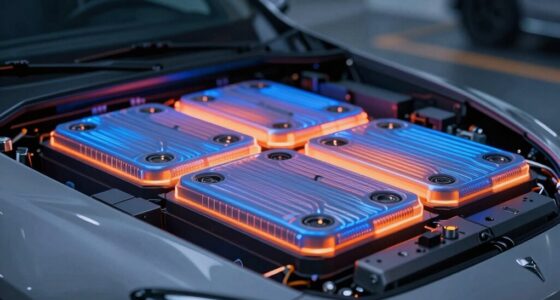
commercial lithium-ion battery pack
As an affiliate, we earn on qualifying purchases.
As an affiliate, we earn on qualifying purchases.
Project Delivery and Round Two Still Pending
The announcement identifies the selected projects and their proposed capacities, but does not provide construction schedules, expected commercial operation dates, or project-specific permitting milestones. It is also unclear how much, if at all, the awards will change PJM capacity prices or Maryland customers’ bills once the facilities are operating.
The commission’s invitation for Oystercatcher to consider a future application is not an award, and Flatiron’s possible Chalk Point expansion remains unselected. The source report also does not specify the final contract details beyond the 15-year flat-pricing terms and the combined monthly customer-cost estimate.
long-duration energy storage batteries
As an affiliate, we earn on qualifying purchases.
As an affiliate, we earn on qualifying purchases.
Second Solicitation Due by January 2027
Under the law, Maryland must open bidding for its second storage round by Jan. 1, 2027, and announce awards by Oct. 1, 2027. The commission expects the next round to attract additional proposals, including from a pool of more than 40 projects in PJM’s Cycle 1 interconnection process, Barve said.
Developers and local stakeholders will have further steps before any proposed facility is built. The commission has specifically identified continued engagement with Harford County as relevant if Oystercatcher pursues its project. The next solicitation and subsequent award decision will show whether Maryland can move closer to the act’s combined 1.6-GW procurement requirement.
As an affiliate, we earn on qualifying purchases.
Key Questions
Which projects did Maryland select?
The commission selected Flatiron Energy’s 400-MW/1,600-MWh Chalk Point Storage Project and REV Renewables’ 40-MW/160-MWh Jade Meadow III project.
Why is the 440-MW award described as below target?
The state set an 800-MW target for the first round. The two selected projects total 440 MW, leaving the first-round awards 360 MW below that target.
What is the estimated cost to residential customers?
The commission said the two awards together correspond to 6.98 cents per month for the average Maryland residential customer, under 15-year flat-pricing terms.
When is Maryland’s next storage procurement?
The state must open bidding for the second round by Jan. 1, 2027, and announce project awards by Oct. 1, 2027.
Were all proposed projects selected?
No. The commission did not select Oystercatcher’s 500-MW proposal or Flatiron’s requested 135-MW Chalk Point expansion. It invited Oystercatcher to consider round two and said Flatiron could reapply for the expansion.
Source: rss
Halloween Picks
halloween
As an affiliate, we earn on qualifying purchases.