TL;DR
A portable solar power bank stores electricity in a rechargeable battery and can top it up from sunlight, but its small panel often charges too slowly to replace a wall outlet. Compare watt-hours, solar input wattage, port output, weight, and weather rating, and treat built-in solar as a backup for phones and small USB devices.
Your phone can sit in bright sunshine for an hour and still come away with barely enough charge to find the trailhead. That’s the catch with many portable solar power banks: the battery can be handy, while its small built-in panel collects energy at a patient, sometimes frustrating pace.

Get backup power and energy gear delivered free with Prime
- Fast, free delivery on millions of items
- Prime Video, Amazon Music and more included
- Member-only deals all year
This guide explains what these devices store, why their capacity labels can mislead, and how to judge the solar panel and ports before you buy. You’ll also get practical advice for camping, travel, emergency kits, and keeping the battery safe.
A portable solar power bank combines a rechargeable battery with one or more small panels. Think of the panel as a slow trickle feeding a pantry: it can replenish what you’ve used, but it may not stock the shelves quickly during a cloudy weekend.
Charge the bank from an outlet before a trip; count its small integrated panel as a backup top-up.
Compare capacity in watt-hours, because mAh figures can hide differences in battery voltage and usable output.
Check solar input wattage, port type, and maximum output against the devices you plan to charge.
Treat water resistance and ruggedness as specific ratings with limits, and keep lithium batteries away from excessive heat.
Choose an integrated panel for light, occasional use; consider a larger separate panel for longer off-grid stays.
Know What a Solar Power Bank Can Actually Do
A solar power bank stores electricity for later use and can recharge from a wall outlet, car charger, or sunlight. Pocket-sized versions usually serve phones and other small USB devices; models with AC outlets are generally larger portable power stations with much more capacity and output.
The label can blur those categories. A slim bank that fits in a jacket pocket may have a light on the side and a small solar strip, while a camping power station could run selected appliances through an AC outlet. They share a name, but they suit different jobs, much like a pocket flashlight and a work lamp both make light without being interchangeable.
For example, a hiker may use a compact bank to top up a phone after taking photos all afternoon. Someone hoping to run a cooler at a remote campsite needs to check a power station’s watt-hours and output instead. An ordinary USB bank won’t become an appliance generator just because it has a solar panel attached.
When you read key facts for a purchase, start with what you’ll charge and where you’ll use it. If your goal is an emergency phone charge during a day outdoors, a small bank may fit. If your goal is several days without grid power, plan around a larger panel and battery setup.
Products Worth Considering

Shark PowerPro Reveal Plus Cordless Stick Vacuum, Charcoal, IZ376H

Philips Hue Play Floor Lamp, RGBWWIC LED, 53 Inch, Black

Bose Smart Dolby Atmos Soundbar with Alexa, Voice Control, and Bluetooth
As an affiliate, we earn on qualifying purchases.
Treat the Built-In Panel as a Backup, Not a Fast Charger
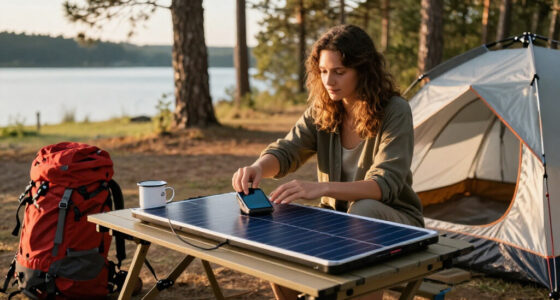
Small integrated panels usually work best as a solar top-up, because their limited area gathers less energy than a larger separate panel. Even in good, direct sunlight, filling a bank can take many hours or days, depending on its capacity, rated panel output, weather, angle, and charging losses.
Panel count alone tells you little. A product with four tiny panels might deliver less solar input than one larger, well-rated panel, so look for the stated solar input in watts and a realistic charging-time estimate. A tiny panel is like a teaspoon catching rain: useful for a slow refill, but not a substitute for a bucket when you need water quickly.
Suppose you’re hiking for three days and leave the bank strapped to your pack. Moving shade, clouds, and changing panel angles can make its output uneven, so don’t count on it to refill fully while you walk. Charging the bank from a wall outlet before departure gives you a dependable starting reserve; sunlight can then extend that reserve when conditions cooperate.
Direct outdoor sun generally beats sun through a window. Glass and the angle of the light can reduce output, and dirt or partial shade can cut it further. If dependable off-grid charging matters, compare an integrated panel with a larger fold-out panel instead of assuming that every product called a portable solar charger works at the same pace.
Compare Watt-Hours So Capacity Labels Make Sense
Watt-hours (Wh) describe stored energy in a way that makes different devices easier to compare; the formula is volts multiplied by amp-hours. A milliamp-hour (mAh) figure alone can give you a distorted picture because brands often measure it at the battery’s internal voltage, not at the voltage your phone receives.
That gap comes from voltage conversion and other charging losses. So a bank advertised at 20,000 mAh won’t necessarily deliver 20,000 mAh to your phone. Treat its label as a starting point, then check watt-hours and your phone’s battery energy for a more useful rough estimate. You’ll still need to allow for lost energy in the conversion from bank to device.
Imagine two shoppers comparing banks in a store. One sees a bigger mAh number and assumes it means twice as many phone charges; the other checks watt-hours, output, and independent testing. The second shopper has a better basis for comparison, though real results still depend on the phone, cable, and how much battery each charge needs.
Use the maker’s stated capacity as a guide, not a promise of a fixed number of full charges. A power bank combines storage with charging electronics, and both affect what reaches your device. If you’re buying for a tablet or laptop, compare the required wattage and compatible USB-C Power Delivery output as well as the stored energy.
Match the Ports to the Phone, Tablet, or Laptop You Carry
The right bank needs a port that matches your device and enough output to charge it at a useful speed. USB-A and USB-C are common, while USB-C Power Delivery (PD) can charge compatible phones and some laptops faster than basic USB connections.
Check the bank’s maximum output, not just the shape of the socket. A USB-C port does not automatically support every fast-charging standard, and a laptop may require more power than a phone. Look at the laptop’s charger rating and the bank’s listed maximum wattage before expecting it to work.
For instance, a traveler might carry a phone, wireless earbuds, and a compact laptop. The bank could top up the first two through ordinary USB ports yet fail to charge the laptop if its output or capacity falls short. A model with a suitable PD port might handle that laptop, but it will usually weigh more and take up more space than a phone-only bank.
Write down the devices you’ll bring and their charging requirements before shopping. Also check how many ports can deliver power at the same time, since some banks reduce output when you plug in several devices. A bright screen, a warm cable, or an extra-long charging session won’t fix a mismatch between device demand and bank output.
Use These Five Checks Before You Buy
Choose a solar bank by checking its stored energy, solar input, ports, build, and size against your trip. Those five details tell you more than a large capacity number or a photograph of panels spread across the product box.
- Check watt-hours. Use Wh to compare storage, then estimate phone charges with room for conversion losses.
- Read the solar input wattage. Look for a specified rating and charging estimate; the number of panels by itself is not a speed rating.
- Match the ports and output. Confirm the cable type, charging standard, and wattage your device needs.
- Inspect durability claims. Read the IP rating and see whether ports need covers; “water-resistant” does not mean safe in every kind of rain or immersion.
- Weigh the whole setup. More battery capacity and larger panels often mean more bulk in your bag.
Picture a weekend camper who mainly needs a phone for maps and an emergency text. A compact USB bank may keep the load light, while a fold-out panel could make sense at a stationary campsite where it can sit in full sun. The best choice changes with your routine, just as a lightweight rain jacket suits a short walk better than a week of exposed mountain travel.
Check the warranty, maker’s safety information, and independent test results when available. A rugged case cannot make low-quality electronics reliable, and a long list of features does not guarantee useful solar performance. The practical combination is enough storage, suitable output, and a panel you can actually expose to sun.
Protect the Battery From Heat, Damage, and Bad Weather
Most solar power banks use lithium-ion or lithium-polymer cells, and high heat, physical damage, or poor-quality electronics can shorten battery life or create safety risks. Follow the maker’s charging and storage instructions, and keep the bank away from excessive heat even when the panel is meant to sit in sunlight.
That can take a little thought outdoors. The panel may need clear sun while the battery sits in a shaded, ventilated place if the design allows it. A parked car can become very hot, so leaving a bank on the dashboard all afternoon can expose its cells to conditions the manufacturer may warn against.
“Rugged” and “water-resistant” need a closer look. Check the product’s IP rating, which describes specified protection against dust or water, and see whether charging ports need their covers closed for that rating to apply. On a rainy hike, a water-resistant label without clear limits isn’t a reason to leave the bank in a puddle beside the tent.
Heat and charging habits also affect lifespan. Follow the product’s guidance for storing it when you won’t use it for a while, and avoid leaving it fully charged or fully depleted for long periods if the manual advises against that. Treat it like a tool with a battery, not an indestructible rock: check it for damage, protect it from water, and use a reputable maker’s charger.
Decide Whether Solar Makes Sense for Your Kind of Trip
A solar bank makes sense when you want a backup source for a phone or small USB device during travel, hikes, or outages. If fast, predictable recharging matters more than sunlight access, a conventional wall charger is usually the simpler choice; extended off-grid use may call for a separate, larger panel.
Think about a family driving between campsites. They can charge a bank from a car outlet during travel, then use it to keep a phone alive at a tent after dark. The small built-in panel might add energy during a sunny break, but the car charger does the dependable refill. That mix can make the bank useful without pretending the panel is a fast source.
At a fixed campsite, a fold-out panel offers more area to catch the sun than a pocket-sized panel, though it adds weight and setup. For a short day hike, that extra kit could feel like carrying a spare tent just to charge a phone. Match the setup to how long you’ll be away from power and whether you can leave a panel positioned in unobstructed sun.
Make your decision by picturing the dullest realistic day, not the brightest product photo. If clouds arrive, will your precharged bank still cover your needs? If your answer depends on a perfect solar day, bring a wall or car charging option when possible. Sunlight is a useful supplement; the best plan gives you a working charge before you depend on it.
Frequently Asked Questions
Can a solar power bank charge a phone directly in sunlight?
Yes, if the panel and charging electronics support the phone, but charging may be slow and uneven. Many people get more reliable results by using sunlight to recharge the bank, then charging the phone by cable.
How long does it take to charge one from the sun?
There is no single charging time: battery capacity, panel wattage, sunlight, angle, temperature, and losses all matter. Manufacturer estimates may assume ideal sun, so real-world charging can take longer.
Can I recharge it through a window?
Usually, but glass and the angle of sunlight can reduce the power reaching the panel. Direct outdoor sunlight generally works better, though keep the battery within its temperature limits.
Can a solar power bank charge a laptop?
Only if it has enough stored energy and a suitable output, such as USB-C Power Delivery or an appropriate AC outlet. Check the laptop’s required wattage and the bank’s maximum output before relying on it.
Can I leave a solar power bank outside or in my car?
Check the maker’s weather and temperature limits, and don’t leave the battery in excessive heat. A parked car can get very hot, and water resistance does not guarantee protection in every outdoor condition.
Conclusion
Buy a solar power bank for the battery and ports you’ll use, then treat its built-in panel as a slow bonus. Before you head out, charge it fully, check that it matches your devices, and give its panel open sunlight when you can.
On the trail, a little stored power can feel like a warm cabin light at dusk. Let the bank carry the reserve; let the sun refill it when the weather and time allow.