
TL;DR

Get backup power and energy gear delivered free with Prime
- Fast, free delivery on millions of items
- Prime Video, Amazon Music and more included
- Member-only deals all year
A prospective tenant in a newly built Los Angeles apartment reported that a Temtop monitor showed higher TVOC and formaldehyde readings after the windows were closed for about 48 hours. The account does not establish that the readings are accurate or that the apartment poses a health risk; the device’s limitations and the absence of professional testing leave those questions unresolved.
A prospective tenant in a newly constructed Los Angeles apartment reported that a consumer air monitor showed higher readings for total volatile organic compounds (TVOCs) and formaldehyde after the windows were closed for about 48 hours. The account raises questions about indoor air quality, but the readings alone do not confirm the apartment’s pollutant concentrations or establish a health risk.
The resident said the apartment had finished construction a few months earlier and still had a noticeable chemical or new-construction smell during an initial tour. Before moving in, the resident kept the windows open for approximately three weeks, arranged post-construction cleaning and HVAC duct cleaning, and used brief air scrubbing.
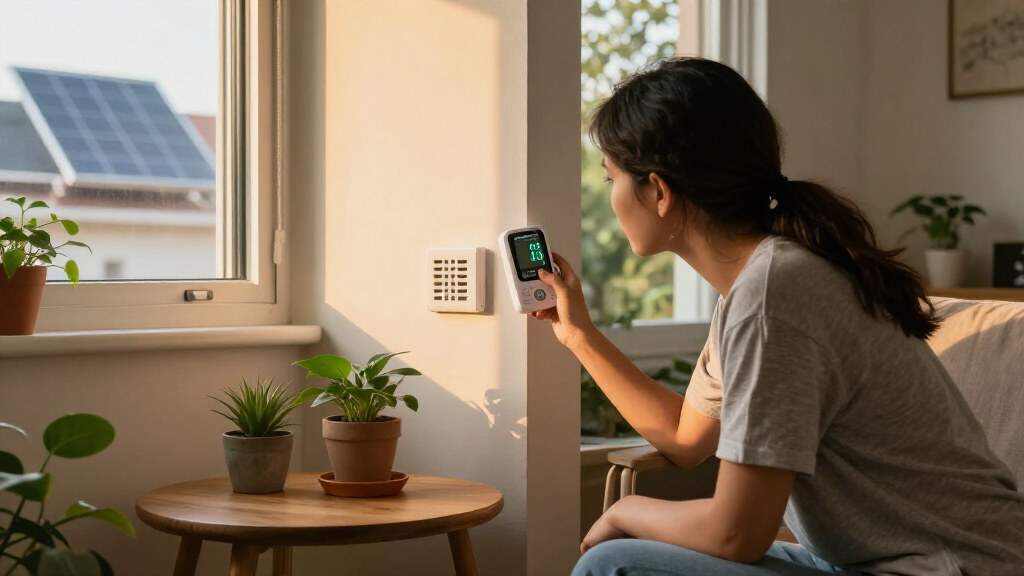
With the windows open, a Temtop LKC-1000S+ showed TVOC of 0.05 mg/m³, formaldehyde (HCHO) of 0.01 mg/m³, and PM2.5 of 3.7 µg/m³, with an indicated AQI of about 15. After roughly 48 hours with windows closed, the resident reported TVOC at 0.38 mg/m³, after a peak of 0.45, and HCHO at 0.08 mg/m³, described as approximately 65 parts per billion. PM2.5 was 2.1 µg/m³.
The resident acknowledged that the monitor was not laboratory-grade and asked whether professional testing was warranted, which sampling methods would be appropriate, and whether ordinary ventilation might be sufficient. The source account supplies no independent measurements, laboratory results, or assessment from an indoor-air-quality professional.
Why Closed-Window Readings Matter
The change in the monitor’s readings after the apartment was closed is relevant to the resident’s practical concern: air concentrations can differ with ventilation conditions, and the odor remained noticeable during the closed-window period. The account may prompt a closer look at indoor air conditions before occupancy, particularly if the resident wants measurements made under representative living conditions.
However, a consumer device reading is not equivalent to a validated laboratory result. The measurements do not identify which compounds contributed to the TVOC number, verify the formaldehyde figure, or show how exposure would vary over time. They also do not, by themselves, determine whether a health threshold has been exceeded. The resident’s reported health anxiety is part of the account, but it does not resolve the environmental measurement questions either way.
Products Worth Considering

Levoit Eleva 300X HEPA Air Purifier for Home and Bedroom

Levoit Core 400S-P Smart Air Purifier for Large Rooms

Coway Airmega 250 Air Purifier for Large Rooms
As an affiliate, we earn on qualifying purchases.
Three Weeks of Ventilation
The measurements followed several steps taken before the tenant moved in: approximately three weeks with windows open, professional post-construction cleaning, HVAC duct cleaning, and brief air scrubbing. The resident then compared the monitor’s results with windows open against readings after about 48 hours with them shut.
The source identifies the instrument as a Temtop LKC-1000S+ and says the resident understood it was not laboratory-grade. It does not provide calibration records, measurement placement, sampling duration beyond the stated window periods, temperature or humidity, or details about the building’s materials and ventilation system. Those missing details limit comparisons and interpretation.
Accuracy and Exposure Remain Unknown
The source does not include laboratory testing or an independent professional assessment, so it is not possible to confirm whether the reported formaldehyde and TVOC values reflect actual concentrations. It also does not identify individual VOCs, establish the accuracy of the consumer monitor in this apartment, or show whether the readings were stable across repeated measurements.
No health outcome or exposure duration after move-in is reported. The account also does not give enough information to compare the results with a specific health-based benchmark. Whether further testing is appropriate, what sampling method would answer the resident’s questions, and whether ventilation alone would address the concern remain unresolved.
Independent Testing Could Clarify Results
The resident asked whether to seek professional laboratory testing and which residential sampling methods would be suitable. The source material does not report a decision, a follow-up test, or advice from an industrial hygienist or indoor-air-quality professional. A professionally designed assessment could clarify what is present and how it was measured, but no particular testing plan or outcome is established in the account.
Any next steps would depend on the resident’s goals and the building conditions. The key unresolved point is whether validated measurements, collected under clearly described conditions, would confirm the consumer monitor’s readings.
Key Questions
What readings did the tenant report?
With windows open, the Temtop showed TVOC of 0.05 mg/m³ and HCHO of 0.01 mg/m³. After about 48 hours with windows closed, the reported values were TVOC of 0.38 mg/m³, following a peak of 0.45, and HCHO of 0.08 mg/m³, or about 65 ppb according to the resident.
Do the measurements confirm a health risk?
No. The account provides readings from a device the resident described as not laboratory-grade, with no independent confirmation or health assessment. The figures alone do not establish a health risk.
Was professional testing performed?
The source says the resident hired companies for post-construction cleaning, HVAC duct cleaning, and brief air scrubbing. It does not report professional laboratory air testing.
What remains unknown about the apartment?
The source does not establish the monitor’s accuracy, identify the compounds behind the TVOC reading, or report repeat laboratory measurements. It also does not describe conditions such as temperature, humidity, or sampling placement.
Source: rss