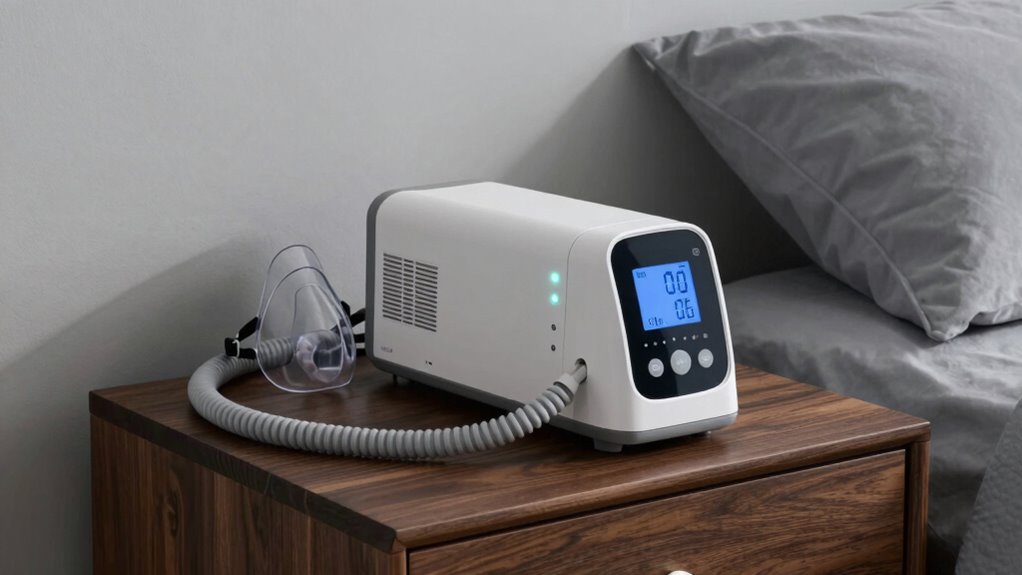
To estimate how many nights your CPAP can run on backup power, first find its typical wattage—usually between 30 to 60 W, higher if you use humidifiers. Multiply this by your nightly usage hours to get daily energy use. Then, check your battery’s watt-hour capacity, account for inverter losses, and include a safety margin. If you keep going, you’ll learn more about choosing the best power solution for your needs.

Get backup power and energy gear delivered free with Prime
- Fast, free delivery on millions of items
- Prime Video, Amazon Music and more included
- Member-only deals all year
Key Takeaways
- Determine your device’s wattage (including humidifier) and multiply by nightly hours to find total watt-hours used.
- Consider inverter efficiency and include a 10–20% safety margin in your calculations.
- Calculate battery capacity (Wh) and divide by your device’s wattage for estimated runtime.
- Use a watt-meter to measure actual power draw during typical use for more accurate estimates.
- Ensure the battery’s peak power capacity exceeds startup surges, especially when humidifiers are used.
Understanding Typical Power Consumption of CPAP Devices
Understanding the typical power consumption of CPAP devices is essential for planning reliable backup power solutions. Most standard CPAP units without humidifiers draw about 30–60 W during operation. When a heated humidifier is added, power consumption increases to roughly 60–90 W per hour. High-end models with heated tubes or advanced humidification can draw between 90–150 W, depending on settings. Travel or battery-optimized CPAPs use considerably less power, around 5–20 W. Keep in mind that startup or peak draws may exceed steady-state wattage, sometimes reaching over 100 W. Knowing your device’s typical wattage helps you estimate nightly energy needs and select an appropriate power source, ensuring you’re prepared for power outages or travel without compromising your therapy. Power efficiency is an important factor to consider when choosing backup solutions for your CPAP. Additionally, understanding energy consumption patterns can help optimize battery life and reduce overall power needs, especially by considering peak load demands during device startup. Being aware of your device’s power fluctuations can further aid in selecting the right backup power system to handle transient surges effectively.
Calculating Energy Use per Night Based on Wattage and Duration
To estimate your nightly energy use, you need to know your CPAP’s wattage and how long you run it each night. Multiply the device’s wattage by the hours of use to find the total energy consumption in watt-hours (Wh). This simple calculation helps you plan for backup power or battery needs effectively. Additionally, understanding free floating systems can assist in optimizing your setup for minimal energy consumption. Being aware of common automotive repair practices can also help you troubleshoot or maintain your device more effectively. Recognizing the importance of smart appliance integration can further enhance efficiency and monitoring of your CPAP device. Considering energy-efficient models may also contribute to reduced power consumption over time. Implementing power management strategies can optimize overall energy use and extend device lifespan.
Wattage and Usage Time
Calculating your CPAP’s energy use per night starts with knowing its wattage and how long you run it each night. Once you have these, you can estimate total energy consumption. Here’s how:
- Find the device’s wattage from the label or manual.
- Determine your average nightly usage in hours.
- Multiply wattage by hours used to get watt-hours (Wh).
- Adjust for additional factors like humidifier power or inefficiencies.
- Remember that device specifications can vary between models, so always check your specific device for the most accurate calculations. Additionally, understanding the energy efficiency of your device can help optimize power usage.
For example, a 50 W machine used for 8 hours consumes 400 Wh. If your device runs at 70 W for 8 hours, it uses 560 Wh. Keep these numbers handy to estimate your power needs accurately.
Calculating Energy Consumption
Once you know your CPAP’s wattage and how many hours you typically use it each night, estimating your energy consumption becomes straightforward. Simply multiply the device’s wattage by your nightly usage hours to get watt-hours (Wh). For example, a 50 W CPAP used for 8 hours consumes about 400 Wh (50 W × 8 h). If your unit includes a heated humidifier, wattage may rise to 60–90 W, increasing nightly Wh accordingly. To estimate monthly use, multiply your nightly Wh by 30. When planning for backup power, consider inverter losses by adding 10–20%. This calculation helps you determine battery capacity needed to run your CPAP overnight and guarantees you select the right portable power solution.
Estimating Battery Runtime for Different CPAP Configurations
To estimate how long your battery can power your CPAP, you need to consider its varying power demands and how much usable capacity you have. Keep in mind that losses from inverters or efficiency factors will reduce actual runtime, so adjust your calculations accordingly. By understanding these points, you can better plan for reliable, portable power solutions. Additionally, knowing the power consumption of your specific CPAP model helps in making more accurate estimations. Remember that battery capacity varies between models and impacts overall runtime, so selecting the right battery is crucial for your needs. It’s also helpful to consider the efficiency of your power system components to refine your runtime estimates. Being aware of power management strategies can further optimize your battery life during use. Considering device settings can also influence how much power your CPAP requires during operation.
Varying Power Demands
Battery runtime for different CPAP setups varies considerably depending on the device’s power draw and configuration. Your power needs can change based on features and accessories. For example:
- A standard CPAP without humidifier typically uses 30–60 W, offering longer runtimes.
- Adding a heated humidifier increases power demand to 60–90 W, reducing runtime.
- High-end models with heated tubes or advanced humidification can draw 90–150 W, requiring larger batteries.
- Travel or low-power CPAP units may only use 5–20 W, providing extended hours on smaller batteries.
Understanding these variations helps you estimate how long your battery will last. Always consider peak startup draws and accessory power when planning your backup power setup.
Calculating Usable Capacity
Estimating how long your CPAP will run on a given battery requires calculating its usable capacity, which involves considering both the battery’s total energy and the device’s power draw. First, determine the battery’s total watt-hour (Wh) capacity. Then, apply a usable depth-of-discharge percentage—typically 80%—to find the effective capacity, accounting for safety margins and battery longevity. For example, a 600 Wh battery with 80% usability provides about 480 Wh. Next, divide this usable capacity by the CPAP’s wattage to estimate runtime. If your device draws 50 W, that’s approximately 9.6 hours (480 Wh ÷ 50 W). Remember, adding a small margin for inverter losses or inefficiencies helps guarantee your calculations are conservative and reliable. Considering the energy capacity of batteries used in camping or emergency preparedness can help optimize your setup for longer runtimes. Additionally, understanding the power consumption of your specific CPAP model can further refine your runtime estimates and ensure you’re prepared for extended outages. Being aware of battery efficiency can also help you make more accurate predictions and improve your setup’s overall reliability. Incorporating smart monitoring tools can assist in tracking real-time power usage and adjusting your setup accordingly, which is especially important given the variability of power draw in different devices and conditions.
Adjusting for Losses
When calculating how long your CPAP will run on a battery, it’s essential to account for various power losses that can reduce actual runtime. These include:
- Inverter inefficiency: Converting DC to AC adds about 10–20% loss.
- Battery discharge: Batteries don’t provide 100% usable capacity; factor in 80% or less.
- Startup surges: Peak wattage during device power-up can exceed steady-state draw.
- Accessory power: Heated humidifiers and tubing increase overall power consumption.
- Device specifications: Referencing the device’s power requirements ensures more accurate runtime estimates.
To get a realistic runtime estimate, multiply your battery’s usable Wh by 0.8–0.9 for efficiency, then divide by your CPAP’s wattage. Always add a safety margin for unforeseen losses or higher power draws.
Factors That Influence Actual Power Draw and Energy Requirements
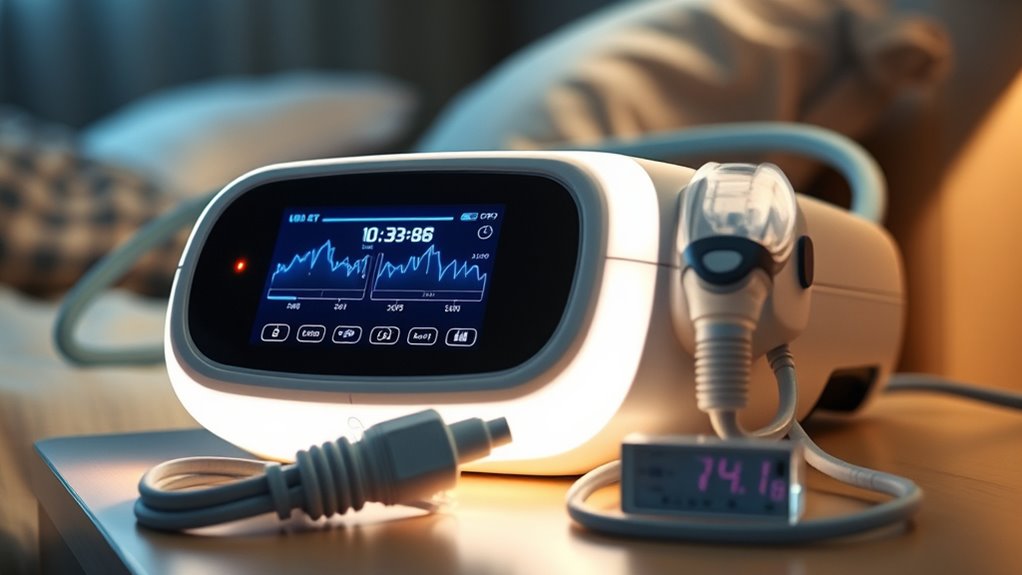
Several factors can cause your CPAP’s actual power draw to differ from its baseline specifications. The presence of a heated humidifier or heated tubing notably increases energy consumption. Higher pressure settings and mask leaks can make the motor work harder, slightly raising power use. Ambient temperature affects humidifier workload; colder environments demand more heating, raising wattage. Different models have varying startup and peak demands, which can temporarily spike power draw. Using a DC output instead of an inverter minimizes losses and improves efficiency. Additionally, device age and maintenance, such as filter cleanliness, can influence performance. Regular maintenance and understanding your device’s features are crucial for accurate energy planning. Being aware of manufacturer specifications helps in better estimating your device’s energy needs and planning accordingly. Understanding these variables helps you better estimate your actual power needs and plan accordingly.
Selecting the Right Portable Power Station for Your Needs
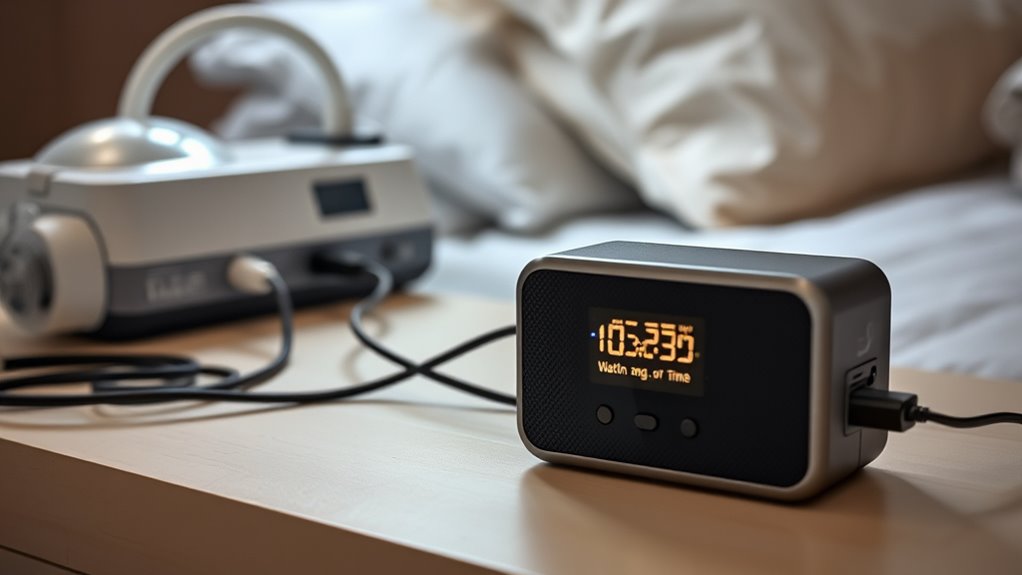
Choosing the right portable power station guarantees your CPAP gear stays powered through the night without interruptions. To select the best option, consider these key factors:
- Capacity (Wh): Match it to your nightly energy needs, adding a safety margin for efficiency losses.
- Output Type: Verify the station provides pure sine wave AC power or suitable DC outputs compatible with your CPAP.
- Peak Power: Check that the surge capacity exceeds your CPAP’s startup wattage, especially if it has a heated humidifier.
- Portability & Size: Balance capacity with weight and size for your travel needs, ensuring it’s easy to carry.
How to Size a Backup Power System for Multiple Nights
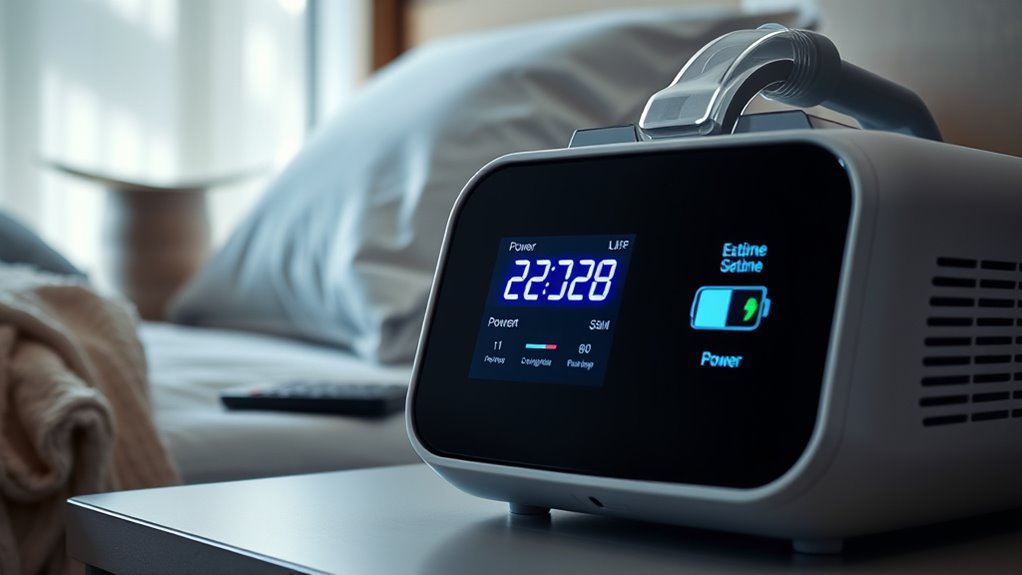
To size a backup power system capable of supporting your CPAP for multiple nights, you need to calculate your total energy requirement and then select a battery capacity that provides enough power with a comfortable margin. Start by estimating your nightly energy use in watt-hours (Wh), based on your device’s wattage and hours of use. Multiply that by the number of nights you want coverage, then add an extra 10–20% to account for inverter losses and inefficiencies. For example, if your nightly use is 400 Wh, and you want three nights, plan for at least 1,320 Wh (400 Wh × 3 × 1.2). Choose a battery with a higher nominal capacity to ensure reliable runtime and future-proofing. Always include a margin to cover unexpected increases in power consumption or system inefficiencies.
Practical Steps to Measure and Confirm Your Device’s Power Use

Accurately gauging your CPAP’s power consumption guarantees you select the right backup power solution. To do this effectively:
- Use a watt-meter: Plug your CPAP into a reliable watt-meter to directly measure real-time power draw during typical use.
- Check manufacturer specs: Review your device’s label or manual for average and peak wattages; compare these to your measurements.
- Record usage patterns: Note how long your device runs each night and whether humidification or heated tubing is active.
- Add safety margins: Increase your measured wattage estimates by 10–20% to account for startup surges, inefficiencies, and variations in power draw.
These steps ensure your backup system provides reliable, real-world runtime without surprises.
Tips for Efficiently Using DC Power and Minimizing Losses
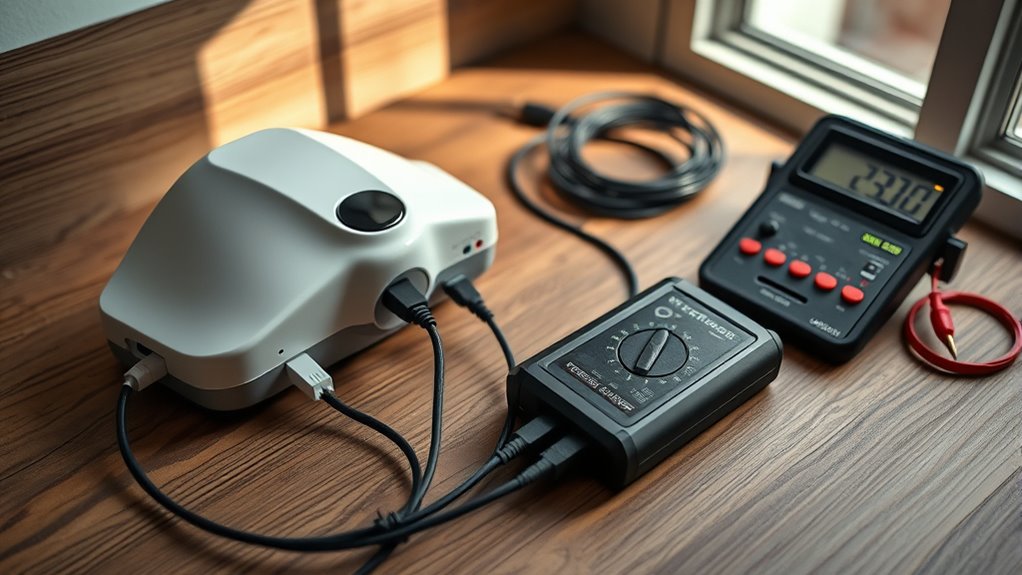
Using DC power directly from a compatible battery or solar source can substantially reduce energy losses compared to running your CPAP through an inverter. To maximize efficiency, guarantee your battery or power station provides the correct voltage and polarity, and use a high-quality DC adapter designed for your device. Avoid unnecessary conversions; connect your CPAP directly to the DC source when possible. Keep cables short and well-insulated to minimize resistance and power loss. Regularly check connections for corrosion or wear. If your CPAP has a heated humidifier or heated tube, consider reducing heat settings to lower power consumption. Properly sizing your power system with some margin helps prevent unexpected shutdowns. Testing your setup before use ensures everything runs smoothly and efficiently during actual nights.
Planning for Safety Margins and System Testing Before Deployment
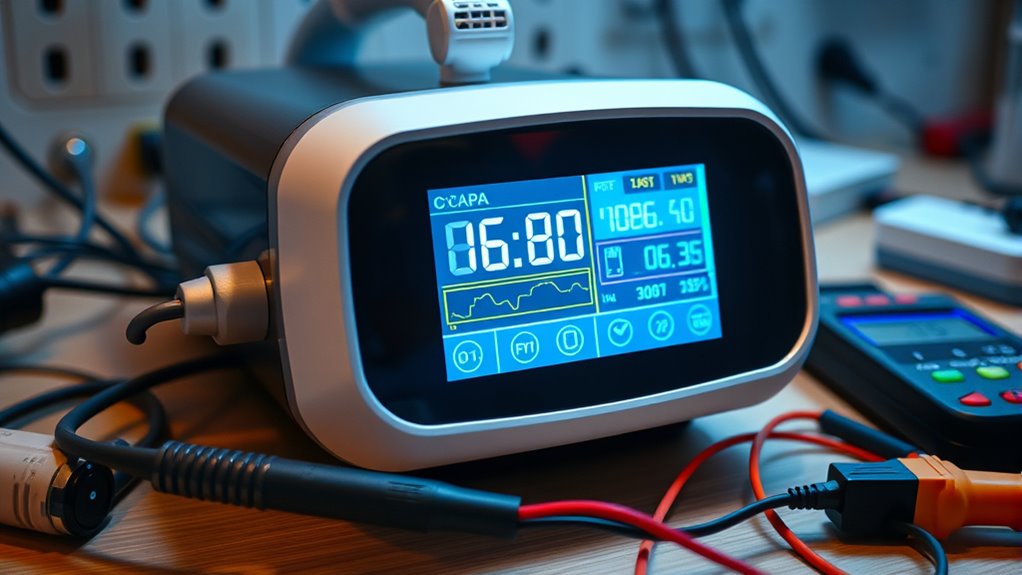
Before deploying your CPAP backup system, it’s important to incorporate safety margins into your size calculations and thoroughly test the setup. This ensures reliable performance during critical times. Consider these steps:
- Add 10–20% extra capacity to your calculated battery size to account for inefficiencies and unexpected power draw increases.
- Test your system for at least one full night to verify actual power consumption matches estimates.
- Confirm device wattage from the label or manual, avoiding broad ranges.
- Check all connections, polarity, and voltage compatibility, especially if using DC power, to prevent damage.
Frequently Asked Questions
How Accurate Are Manufacturer Wattage Ratings for Real-World Power Consumption?
Manufacturer wattage ratings provide a good starting point, but they often aren’t perfectly accurate for real-world use. You might find your CPAP draws more or less power depending on factors like humidifier settings, mask leaks, and ambient temperature. To get a clearer picture, measure actual power draw with a watt-meter under your typical conditions. Always add a safety margin, as peak startup power can temporarily be higher than rated steady-state wattage.
Can I Run My CPAP Directly From a Car Battery or Solar Panel?
Yes, you can run your CPAP directly from a car battery or solar panel if you use a proper DC-DC converter or compatible power supply. Make sure the voltage and current match your device’s requirements, and avoid connecting directly to the battery terminals to prevent damage. Using a quality, regulated power source guarantees safe, reliable operation, and adding a fuse or circuit protection is highly recommended for safety.
What Are the Best Ways to Measure Actual Power Draw at Home?
Did you know a typical CPAP draws around 50 W? To measure your actual power draw at home, plug your device into a watt-meter or energy monitor. Turn it on, run your CPAP as usual, and record the wattage displayed. This method gives you precise data, helping you plan backup power or battery needs effectively. Always check your device’s manual for exact specifications before measuring.
How Do Humidity Settings Affect Overall Power Usage?
Humidity settings directly impact your CPAP’s power consumption. When you increase humidity levels, the device heats water more intensely, drawing more wattage. Heated humidifiers and heated tubing require additional energy, which extends your nightly power use. To estimate runtime accurately, consider how much humidification you use. Lowering humidity reduces power draw, helping your device last longer on a single charge, while higher settings increase energy needs.
Is It Safe to Use a Backup Battery During Extended Power Outages?
Yes, it’s safe to use a backup battery during extended power outages, provided you follow manufacturer guidelines. Make sure your battery has enough capacity to power your CPAP for the needed duration, and check that it’s compatible with your device’s voltage and connectors. Always test your setup beforehand, keep the battery fully charged, and avoid overusing or improperly handling it to maintain safety and device performance.
Conclusion
By understanding your CPAP’s power needs and measuring its actual consumption, you can better prepare for unexpected outages. As you estimate battery runtimes and select the right backup system, remember that real-world conditions often surprise you—so plan with safety margins. Sometimes, it’s the smallest adjustments that ensure nights of uninterrupted sleep, highlighting how coincidence and careful planning can align seamlessly, turning uncertainty into reliable comfort when you require it most.
Fall Picks
fall essentials
As an affiliate, we earn on qualifying purchases.