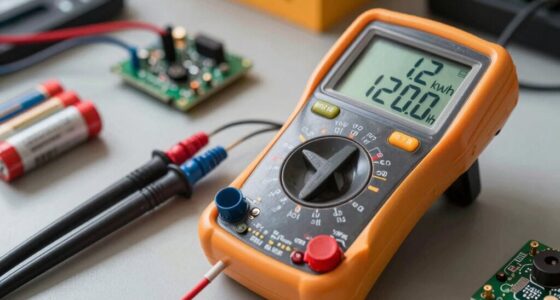
To convert amps to watts in your U.S. home, remember that watts = amps × voltage, typically 120V. For example, a 15A circuit handles around 1,800W, and a 20A circuit handles about 2,400W. Knowing this helps you stay within safe limits when using appliances or planning electrical projects. If you want to master these calculations and avoid overloads, you’ll find essential tips and examples to guide you every step of the way.

Get backup power and energy gear delivered free with Prime
- Fast, free delivery on millions of items
- Prime Video, Amazon Music and more included
- Member-only deals all year
Key Takeaways
- Power in U.S. homes is calculated by multiplying amperage by voltage (W = A × V), typically with 120V supply.
- A 15A circuit at 120V can handle up to 1,800W; a 20A circuit up to 2,400W safely.
- To convert amps to watts, multiply the current (A) by the household voltage (V).
- Understanding appliance labels (amperage and wattage) helps prevent overloads and ensures safety.
- Managing power involves ensuring total appliance wattage stays within circuit limits to avoid hazards.
Understanding the Basics: Amps, Watts, and Voltage
To understand how your electrical devices use power, knowing the relationship between amps, watts, and voltage is vital. Your circuit breaker ratings help protect your home by ensuring circuits aren’t overloaded, which ties directly to electrical safety guidelines. Amps measure the current flowing through a wire, while watts indicate the power consumption of your devices. Voltage, typically 120V in U.S. homes, drives the current. When you know these basics, you can better assess whether your electrical system can handle your appliances’ demands. Proper understanding prevents overloads and potential hazards. Additionally, essential oils for electrical safety can help in maintaining safe home environments. Maintaining awareness of electrical load calculations is crucial for safe and efficient power use. Performing load calculations allows you to determine the total electrical demand of your household appliances and avoid exceeding circuit capacity. For example, understanding how to perform these calculations can help prevent overloading circuits, which is a common cause of electrical fires. Being familiar with circuit breaker ratings ensures you select the correct protection for your system, further enhancing safety. Always follow electrical safety guidelines, including adhering to circuit breaker ratings, to keep your home safe while managing power efficiently. This foundational knowledge is essential for safe, effective electrical use.
The Power Formula: How to Convert Amps to Watts
Understanding how to convert amps to watts is fundamental for managing your home’s electrical load. The basic power formula is watts = amps x volts. By knowing your circuit’s voltage, you can easily calculate the wattage. Keep in mind, voltage fluctuations can affect this calculation, so using a stable voltage reading ensures accuracy. This formula helps you determine if your appliances are compatible with your outlets and prevents overloads. For example, if an appliance draws 10 amps on a 120-volt circuit, it uses 1,200 watts. Always verify your voltage before performing conversions. Additionally, understanding the power formula aids in selecting appropriate electrical devices and avoiding potential hazards. This simple calculation is a crucial tool for understanding your home’s electrical capacity and ensuring safe, efficient appliance operation. Remember, proper conversions prevent electrical issues and improve appliance longevity.
Typical U.S. Household Voltage and Its Impact on Power Calculations
In the United States, most residential electrical systems operate at a standard voltage of around 120 volts, though some appliances and circuits may use 240 volts for higher power needs. Your household voltage typically stays close to this standard, but voltage fluctuations can occur due to demand, distance from the transformer, or wiring issues. These fluctuations impact power calculations because even small changes in voltage can alter the wattage your appliances draw. Understanding your household voltage helps you accurately estimate power use and avoid issues like overloading circuits. Additionally, electrical safety is crucial when monitoring voltage levels to prevent potential hazards. If voltage drops considerably, appliances might underperform; if it spikes, they risk damage. Knowing the typical household voltage and being aware of voltage fluctuations ensures safe and efficient energy management in your home. Monitoring voltage levels can help identify potential electrical problems early and improve overall energy efficiency. Regularly checking for voltage fluctuations can also extend the lifespan of your appliances and reduce energy waste, especially since power consumption can be significantly affected by even minor voltage changes. Being aware of factors like electrical demand and wiring quality can help maintain consistent voltage levels and protect your electrical devices.
Calculating Wattage for Common Household Appliances

Understanding how much power your appliances use helps you manage energy bills and guarantee safety. You’ll learn how to estimate wattage based on typical power ratings and what labels tell you. This knowledge makes it easier to calculate the actual energy consumption of your household devices. Additionally, incorporating information about air purifier maintenance can help you ensure your appliances operate efficiently and safely, reducing unnecessary energy use. Regularly checking and cleaning filters can also extend appliance lifespan and improve overall energy efficiency, especially when considering the importance of proper filtration and pump protection for tools like Graco spray guns.
Typical Appliance Power Use
Many common household appliances have specific wattage ratings that help you estimate their energy consumption. For example, a refrigerator typically uses around 100-800 watts, depending on size and age. A microwave may run at about 600-1,200 watts when in use. Dishwashers often consume 1,200-1,500 watts during cycles, while TVs vary from 50-400 watts based on size and technology. It’s also important to consider standby power usage—many devices draw small amounts of power even when off, contributing to overall energy use. Understanding these typical appliance power uses enables you to estimate your household’s energy consumption more accurately and manage your electricity costs effectively. Energy monitoring tools can provide real-time insights into your appliance usage, helping you make informed decisions about energy efficiency. This knowledge is vital for calculating the total wattage your home appliances draw daily, especially when considering electric bikes or other electric-powered devices. Additionally, being aware of ventilation considerations can help optimize energy efficiency and safety in your home.
Calculating Wattage Accurately
To accurately calculate the wattage of your household appliances, you need to look beyond just their labels and understand how to interpret their electrical ratings. One key factor is the power factor, which indicates how efficiently an appliance uses electricity. A lower power factor means you’re using more power than necessary, affecting your total wattage calculation. Additionally, consider peak demand, which is the maximum power an appliance draws during operation. For precise wattage estimates, multiply the current (amps) by the voltage and adjust for the power factor. This approach guarantees you account for real power consumption, not just the apparent power. By understanding these elements, you’ll get a more accurate picture of how much wattage your appliances actually use, helping optimize energy use and manage your electrical load effectively.
Power Ratings on Labels
Most household appliances display their power ratings directly on labels, making it easier to estimate their energy use. These labels provide vital information about the appliance specifications, including wattage, voltage, and current. To interpret this data effectively: 1. Look for the wattage (W) or power consumption figure, usually listed prominently. 2. Check the voltage (V) to understand the electrical requirements. 3. Note the amperage (A) if wattage isn’t listed; you can calculate wattage by multiplying voltage and current. 4. Understand that labels may also include operational details, like energy efficiency ratings, which impact overall energy consumption. 5. Being aware of energy consumption metrics can help you compare appliances more accurately and make more energy-efficient choices. Additionally, understanding power ratings can assist in planning electrical loads safely in your home. Recognizing common appliance power ranges can help you gauge how different devices impact your energy bill. Being familiar with power calculation methods enables you to estimate energy use even when labels lack explicit wattage information. By reviewing label information carefully, you can accurately gauge how much power your appliances draw, helping you make informed decisions about usage and energy savings.
How Circuit Capacity Relates to Amps and Watts
Your home’s circuit capacity sets the limit for how much power you can use at once. This capacity depends on both the amperage and the wattage your circuit can handle safely. Understanding how amps and watts are linked helps you avoid overloads and keep your electrical system running smoothly. Knowing your circuit’s capacity is essential for safe and efficient energy use in your home. Proper knowledge of electrical safety standards ensures that you stay within safe operating limits and prevent potential hazards. Additionally, understanding power calculation methods allows you to accurately determine your home’s energy needs and avoid overloading circuits. Recognizing vetted wave and wind sources of power can promote more sustainable energy consumption. Being aware of astrological influences on energy patterns can also guide optimal usage times for appliances to improve efficiency.
Power Limits Defined
Have you ever wondered how the capacity of a circuit limits the amount of power your home can handle? Power limits are set by circuit breaker ratings, which determine maximum safe load. These ratings prevent issues like voltage fluctuations and potential fires. Here’s how it works:
- Circuit breakers are rated in amps, typically 15 or 20 amps for standard circuits.
- The maximum wattage is calculated by multiplying the breaker’s amps by the voltage (usually 120V).
- Exceeding this wattage causes the breaker to trip, protecting your home.
- Proper understanding ensures you don’t overload circuits, reducing risks from voltage fluctuations.
- Familiarity with electrical safety and related topics can help you better understand how electrical devices and music equipment require appropriate power considerations.
Knowing these power limits helps you safely manage appliances and avoid tripping breakers, keeping your home secure and efficient.
Amps and Watts Link
Understanding the relationship between amps and watts is key to managing your home’s electrical capacity. Your circuit breaker protects your wiring by limiting the amps flowing through the circuit, ensuring electrical safety. Watts measure the power your devices use, which depends on both voltage and current (amps). For example, a 15-amp circuit at 120 volts can handle up to 1,800 watts safely. Knowing this link helps you avoid overloads that trip circuit breakers or cause electrical hazards. When adding new appliances or fixtures, always check their wattage and compare it to your circuit’s capacity. This awareness guarantees you don’t push your system beyond safe limits, maintaining electrical safety and preventing potential damage or fire risks.
Practical Examples: Estimating Power Usage in Your Home
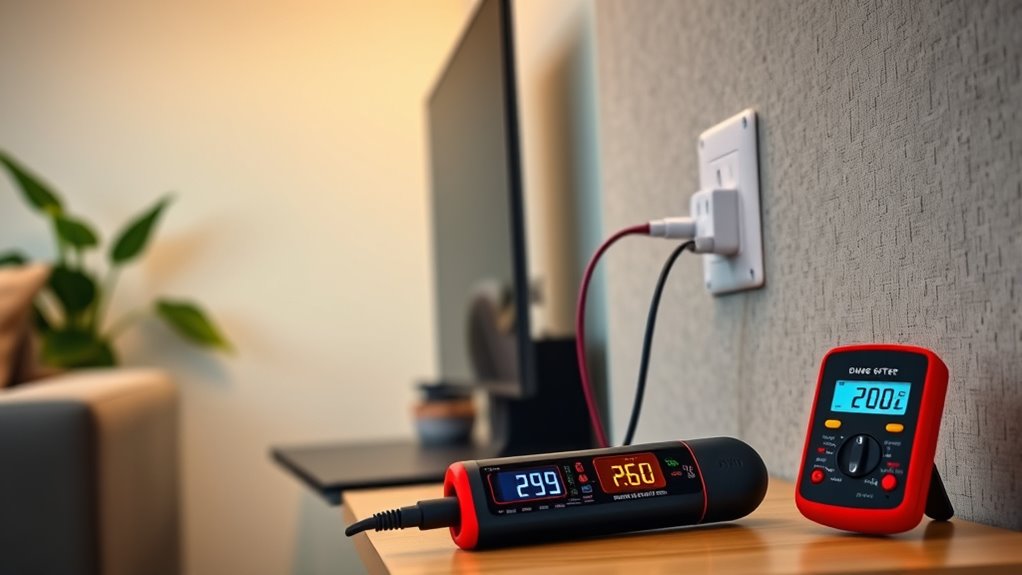
Ever wondered how to estimate the power consumption of household appliances? Knowing this helps with energy conservation and choosing efficient appliances. To estimate, follow these steps:
- Check the appliance’s label for voltage (V) and current (A).
- Multiply voltage by current to find wattage (W): V × A = W.
- Record the average daily usage in hours.
- Multiply wattage by hours used to get daily energy consumption in watt-hours (Wh).
For example, a 120V, 10A dryer used for 1 hour consumes 1,200 Wh. Understanding these calculations helps you identify high-energy devices and prioritize appliance efficiency, saving money and reducing your environmental impact.
Energy Efficiency Tips Using Amps and Watts Data
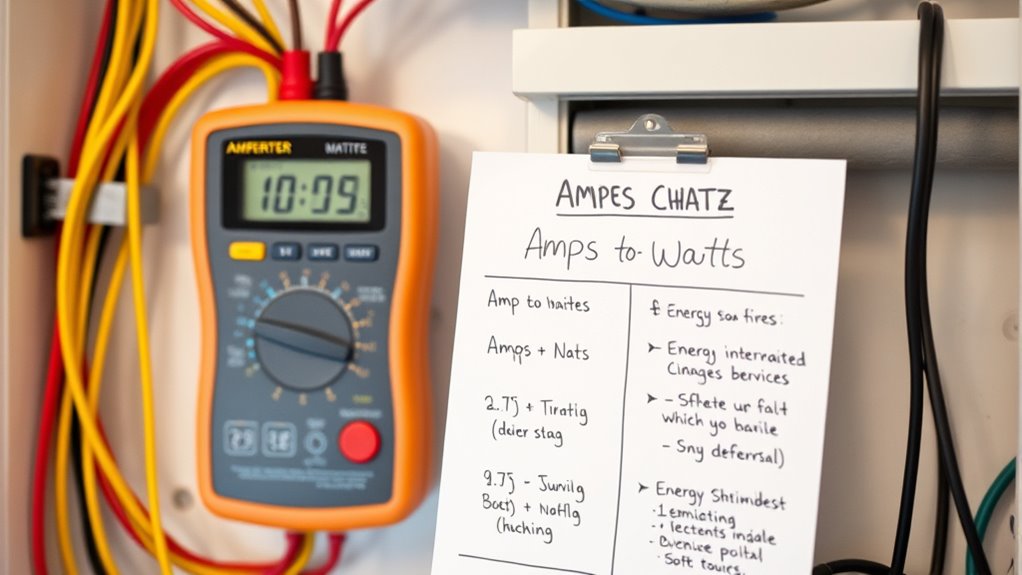
By analyzing the amps and watts ratings of your household appliances, you can identify which devices consume the most energy and take steps to reduce their usage. Focus on high-wattage tools, especially those with large battery capacities, to cut unnecessary power drain. Upgrading to energy-efficient appliances can boost your savings and support solar panel efficiency. Use this table to compare devices:
| Device | Power Consumption | Efficiency Tip |
|---|---|---|
| Refrigerator | 150W | Maintain door seals |
| Space Heater | 1500W | Use only when needed |
| LED Lights | 10W | Switch to LEDs |
| Microwave | 1000W | Avoid standby mode |
| Laptop | 50W | Use power-saving settings |
Reducing their usage helps lower energy bills and minimizes your carbon footprint.
Common Mistakes When Converting Amps to Watts and How to Avoid Them

Converting amps to watts might seem straightforward, but many people make common mistakes that can lead to inaccurate results. One mistake is ignoring voltage fluctuations, which can cause your calculations to be off. Another is not checking circuit breaker ratings, risking overloads or misjudging your system’s capacity. Additionally, people often forget to account for power factor, especially with inductive loads, skewing the watt estimate. Finally, using the wrong voltage value—such as assuming 120V when the supply is higher—leads to errors. To avoid these mistakes, always verify the actual voltage supply, consider voltage fluctuations, check your circuit breaker ratings, and include power factor in your calculations. These steps ensure your conversions are precise and safe.
Tools and Resources for Monitoring Your Household Electricity

Monitoring your household electricity accurately requires the right tools and resources. Smart meters are essential because they provide real-time data on your energy consumption, helping you identify patterns and spot inefficiencies. These devices transmit information automatically to your utility company and often allow you to track usage through apps or online portals. Energy monitors are another valuable resource; they plug into outlets or circuits to give detailed insights into individual appliances’ power use. With these tools, you can make informed decisions about reducing your electricity bills and improving efficiency. Both smart meters and energy monitors are user-friendly and can be installed with minimal fuss. Investing in these tools empowers you to stay on top of your household’s energy habits and optimize your power consumption.
Frequently Asked Questions
How Do I Determine the Amperage Rating of My Home’s Circuit Breakers?
You can determine your home’s circuit breaker amperage rating by checking the circuit breaker labels directly on each panel. These labels usually indicate the amperage, like 15A or 20A. If labels aren’t clear, you might need to perform amperage testing with a multimeter, but be cautious and turn off power first. Always guarantee you understand safety procedures before inspecting or testing electrical components.
Can Different Appliances Operate at the Same Time Without Overloading?
Yes, different appliances can operate simultaneously without overloading your circuit if you guarantee proper appliance compatibility and effective circuit load management. Avoid running high-wattage appliances together on the same circuit, and spread out your usage to prevent overloads. Use a circuit breaker to protect against overloads and check your breaker’s capacity. Monitoring your appliances’ power needs helps keep your electrical system safe and functioning smoothly.
How Does Wiring Length Affect Wattage Calculations?
Wire length impacts wattage calculations because longer wire runs cause increased resistance, leading to voltage drop. As voltage drops, the appliance may draw more current to compensate, affecting wattage. You need to take into account wire length and gauge to ensure proper power delivery. Shorter wires reduce resistance and voltage drop, maintaining the correct wattage. Always choose appropriate wire size for longer runs to prevent performance issues and ensure safety.
What Safety Precautions Should I Take When Measuring Household Current?
Are you aware of the risks involved? When measuring household current, always prioritize grounding safety to prevent electrical shocks. Wear personal protective equipment like insulated gloves and safety goggles to protect yourself. Turn off power at the breaker before starting, and use insulated tools. Have a clear understanding of your system, and never work alone. These precautions keep you safe while accurately evaluating electrical current in your home.
Are There Smart Devices to Automatically Monitor Household Power Usage?
Yes, you can find smart devices designed for automatic energy monitoring in your smart home. These devices connect to your electrical system or appliances, tracking power usage in real-time. They provide detailed insights through apps, helping you manage energy efficiency easily. With these tools, you can identify high consumption areas, save on bills, and optimize your household’s power usage effortlessly, making your home smarter and more energy-efficient.
Conclusion
Think of understanding amps and watts as mastering the language of your home’s electrical heartbeat. Once you get the hang of it, you’ll navigate your energy use like a seasoned conductor guiding an orchestra. This knowledge helps you spot inefficiencies, prevent overloads, and keep your household running smoothly. With these tools in hand, you’re empowered to control your energy flow, turning your home into a well-tuned symphony of comfort and savings.
Halloween Picks
halloween
As an affiliate, we earn on qualifying purchases.