TL;DR

Get backup power and energy gear delivered free with Prime
- Fast, free delivery on millions of items
- Prime Video, Amazon Music and more included
- Member-only deals all year
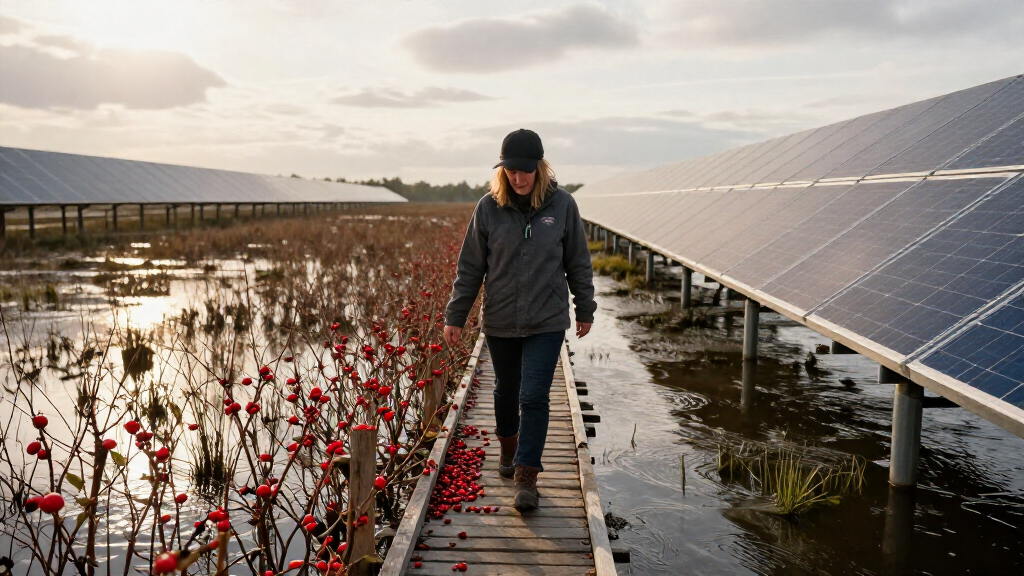
Two cranberry farms in Kingston and Plymouth, Massachusetts, have harvested berries for a second season beneath operating solar panels. The projects pair active cranberry production with community solar, offering one approach to siting renewable energy on land that remains in agricultural use.
Two Massachusetts cranberry bogs have completed a second season of harvesting berries beneath operating solar panels, a pairing that lets the farms produce cranberries and electricity on the same land. The Kingston and Plymouth projects are described by their developer as the first operating installations of their kind in the country, though whether they are the first worldwide is less certain.
The projects are in Kingston and neighboring Plymouth, in southeastern Massachusetts. Distributed Energy Infrastructure built both installations: a 4.4-megawatt solar array with a 13.5-megawatt-hour battery in Kingston and a 1-megawatt array in Plymouth. The report says this fall’s crop was the second harvested beneath the panels.
Greenbacker Renewables bought the land from farmers who were ready to leave cranberry production, then worked with Distributed Energy Infrastructure on construction. Solar consultant and longtime local cranberry farmer Iain Ward manages the growing operations. The farms use a community solar model, selling electricity to customers interested in renewable power and lower prices, according to the report.
The arrays were designed around the needs of bog farming. Their panels sit about 10 feet above the ground and can tilt to follow the sun. Pilings are spaced farther apart than in conventional installations so harvesting equipment can pass through. Because bog soil is wet and unstable, the project team had to drive foundations deeper to reach more stable ground; electrical wiring was hung overhead rather than buried.
Solar Sharing Working Cranberry Land
The projects offer a practical example of agrivoltaics—using the same land for agriculture and solar power—at a time when communities are debating where renewable energy can be built. Rooftops and parking areas may be costly or constrained, while proposals on undeveloped land can face local opposition and environmental concerns. Solar development on farmland can also prompt worries about removing acreage from food production.
Cranberry bogs have a particular constraint: they are protected wetlands and cannot simply be converted to housing or commercial development when farming stops. For bog owners whose property can connect to the electricity grid, solar could provide another source of income while production continues. Ward described the approach as “a farm viability opportunity,” a characterization of its potential rather than a published financial assessment of these two farms.
The installations also show that dual-use projects require more than placing standard panels over crops. The height, spacing, foundations and wiring had to accommodate wet ground and farm machinery. Whether the model can work elsewhere will depend on local conditions, grid access, crop needs and project economics.
Products Worth Considering

Bose TV Speaker Compact Soundbar with Bluetooth and HDMI-ARC, Black

Ring Floodlight Cam 4K Pro (2nd Gen), Wired Outdoor Security Camera, Black

Dyson Car+Boat Cordless Handheld Vacuum
As an affiliate, we earn on qualifying purchases.
Massachusetts Incentives and Siting
Massachusetts has pursued solar development as part of its goal of reaching net-zero carbon emissions by 2050. But in a densely populated, heavily wooded state, finding suitable sites has been contentious. The state has encouraged agrivoltaics as one way to produce electricity without ending agricultural activity on the land.
In 2018, Massachusetts became the first state to offer a financial incentive for dual-use solar, according to the source report. The state’s incentive program pays for electricity generated, with an added payment for qualifying agrivoltaic projects. The report gives a current base rate of 23.17 cents per kilowatt-hour for arrays between 1 and 5 megawatts and an additional 9 cents per kilowatt-hour for agrivoltaics. These figures describe the program rates cited in the report, not the specific revenue earned by the Kingston or Plymouth farms.
The state is a major cranberry producer, second only to Wisconsin, according to the report. The two installations are among a wider set of agrivoltaic work by Distributed Energy Infrastructure, which has also pursued projects involving apple orchards, cattle pasture and a Christmas tree farm. Preliminary work is underway at another cranberry bog.
““We are literally proving it can be done.””
— Prateek Tare, co-founder and executive vice president of Distributed Energy Infrastructure
Project Economics and Global First
The report identifies the Kingston and Plymouth sites as the first operating cranberry-under-solar projects in the United States, while qualifying the possibility that they may also be first worldwide. It does not provide evidence establishing a global first. The projects’ crop yields, operating costs, electricity revenues and financial returns are also not reported, so their economic performance cannot be assessed from the available details.
It is also unclear how widely the design can be applied to other bogs. Grid connection is a limiting factor for some sites, and the report does not give a count of eligible farms or a timeline for the additional bog project. The Carver arrays remain a separate case: they were built and crops are growing beneath them, but the company behind the project went bankrupt before they started operating.
More Bogs and Carver’s Restart
Distributed Energy Infrastructure is doing preliminary work on another cranberry bog project, but the report gives no construction schedule or expected start date. The developer’s work on orchards, pasture and Christmas tree farmland may provide further examples of how dual-use solar designs are being adapted, though details and timelines for those projects are not supplied.
In Carver, Ward said the new owner of the bogs has “every intention to finish” the stalled installations. The source does not specify what remains to be done, whether the projects have secured financing or permits, or when they might begin operating. For now, Kingston and Plymouth remain the reported examples of cranberry farms harvesting crops beneath operating solar arrays.
Key Questions
Where are the cranberry bogs with solar panels?
The operating projects are in Kingston and Plymouth, Massachusetts, in the southeastern part of the state.
Are cranberries still being grown under the panels?
Yes. The report says the farms completed a second season of cranberry harvesting beneath the operating arrays.
How large are the solar installations?
Kingston has a 4.4-megawatt array paired with a 13.5-megawatt-hour battery. Plymouth has a 1-megawatt array.
Do the panels interfere with harvesting?
The installations were designed to allow farm work. Panels sit about 10 feet above the bog, and wider gaps between supports leave room for harvesting equipment.
Will the stalled Carver project start operating?
Ward said the new bog owner intends to finish the project, but no operating date or completion details were provided.
Source: canarymedia.com