
TL;DR

Get backup power and energy gear delivered free with Prime
- Fast, free delivery on millions of items
- Prime Video, Amazon Music and more included
- Member-only deals all year
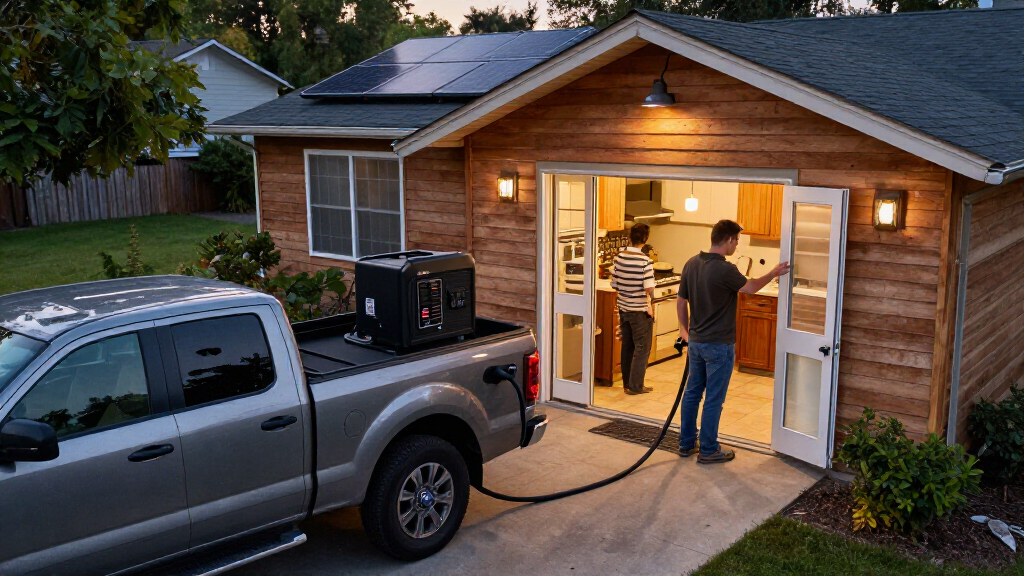
Ford says its Fathom electric pickup will be able to send power from its battery to a home using an onboard inverter and lower-cost AC bidirectional charging equipment. Ford has not set the equipment’s final price; its stated comparisons exclude installation, and utility rules may limit where the system can be connected.
Ford says its forthcoming Fathom electric pickup, which is expected to start below $30,000, will be able to supply power to a home through AC bidirectional charging equipment designed to cost less than the company’s current system. The approach uses an inverter built into the truck, potentially avoiding the expensive external bidirectional charger required by many current electric vehicles.
Ford’s system converts the truck battery’s direct-current (DC) power into alternating current (AC) that can be used by a home. The vehicle’s onboard inverter is designed to work with a compatible charger and home power equipment. For backup during an outage, owners will also need a home backup power panel; the truck alone does not make a house outage-ready.
Ford said the AC-capable bidirectional charger for the Fathom will cost about half the $1,300 price of its Charge Station Pro, the system developed for the F-150 Lightning. The company also said the combined equipment needed for home backup will cost 60% less than $5,200 for the Charge Station Pro and home integration system. Those figures exclude installation, and Ford has not finalized the Fathom system’s exact price.
The equipment can also help a home manage electricity use while the grid remains operational, Ford said. The company developed its inverter technology with engineers at Auto Motive Power, a startup it acquired in 2023. Ford says other vehicles built on its Universal EV Platform will also have AC bidirectional charging capability, though it did not identify those models or give their launch dates.
Lowering the Cost of Home Backup
Home backup has been a possible benefit of electric vehicles, but the cost of the supporting equipment can undermine that appeal. The report puts current bidirectional systems at just under $7,000 to more than $10,000 for some setups, before installation. Ford’s proposed lower-cost arrangement could make vehicle-to-home backup more attainable for buyers who would not pay for a more expensive DC-based system.
The advertised reductions are comparisons against Ford’s own equipment prices, not a guarantee of a particular installed cost or savings for every household. Buyers will still need compatible home hardware, installation and permission to connect the system under local utility rules. The practical value will depend on the final equipment price, the home’s electrical setup and whether the utility allows the connection.
The announcement could also put pressure on other automakers to consider designing power conversion into vehicles from the start. That is a potential industry effect, not a confirmed response from competitors. Lower equipment costs alone will not make the technology widely usable if local connection requirements remain difficult to navigate.
Products Worth Considering

Blueair Blue Pure 511i Max Air Purifier for Home and Bedroom

Ring Outdoor Cam 4K Plus Battery Security Camera, 3-Pack, White

LG C2 Series 65-Inch OLED evo 4K Smart TV (OLED65C2PUA, 2022)
As an affiliate, we earn on qualifying purchases.
How Ford’s AC System Differs
Many existing vehicle-to-home systems use an external device to convert a vehicle’s DC battery output into household AC power. Ford’s plan instead puts the inverter in the vehicle, with the company arguing that integration on a newly designed platform can reduce equipment costs. Ford developed the Fathom and Universal EV Platform technology with Auto Motive Power engineers.
Ford’s system uses communications technology based on SAE J3068, a standard certified by the automotive standards organization SAE International. The report says this communication supports safety coordination between the vehicle and home system. A source quoted in the report estimated that designing AC power capability into a vehicle from the outset could add $200 to $300; that figure is an estimate, not Ford’s disclosed cost for the Fathom hardware.
Ford’s stated price comparison is with its F-150 Lightning equipment. The report also cites a $6,748 sale price for General Motors’ DC vehicle-to-home bundle, illustrating that rival systems may carry substantial equipment costs. These are not necessarily like-for-like comparisons: equipment configurations, installation and vehicle compatibility can differ.
““One of the most central points of this whole story is the cost piece.””
— Dave McCreadie, Ford’s director of grid and energy services
Prices and Utility Approval Remain Open
Ford has not announced the Fathom system’s final equipment price, availability date or installation costs. Its percentage savings compare equipment packages and do not establish what a particular customer will pay after labor, home upgrades or other charges.
Utility approval is another unresolved factor. The report says only California and Maryland had established utility regulations for AC bidirectional charging outside pilot projects, while rules elsewhere vary. A compatible vehicle and home panel may not be enough if local interconnection requirements are unclear or restrictive.
Ford said it has been engaging with utilities and regulators, but the report does not establish that common rules have been adopted nationwide. It is also not yet clear which Fathom configurations will include the necessary capability, what homes will qualify, or how much backup power the system can provide during an outage.
Ford and Utilities Set Next Steps
Ford said it has been working since July with American Electric Power, BC Hydro, Consumers Energy, Exelon and Pacific Gas & Electric on common standards for integrating its AC vehicle-to-home system into utility interconnection rules. The company also said it has engaged regulators and utilities in states including Michigan and Colorado.
The next useful details for customers will be Ford’s final equipment pricing, product availability, installation requirements and instructions for checking local utility approval. Until those are published, the announced price reductions remain Ford’s comparison with its existing equipment rather than a complete estimate of an installed home-backup system.
Key Questions
How will the Ford Fathom power a home?
Ford says an onboard inverter will convert the pickup’s battery power into household AC power. The system requires compatible charging equipment, and outage backup also requires a home backup power panel.
How much will the Fathom home-backup equipment cost?
Ford has not provided a final price. It says the compatible charger will cost about half of its $1,300 Charge Station Pro and that the backup equipment combination will cost 60% less than its $5,200 Lightning setup. The cited figures exclude installation.
Can the Fathom provide backup power during an outage?
Ford says the system is intended to support home backup, but customers will need a home backup power panel as well as the compatible vehicle equipment. The report does not specify backup duration or the amount of power available.
Will the system work everywhere in the United States?
Not necessarily. Utility interconnection rules vary, and the report says only California and Maryland had regulations for AC bidirectional charging outside pilot projects. Ford is working with utilities on common standards, but nationwide rules have not been confirmed.
Source: canarymedia.com