
TL;DR

Get backup power and energy gear delivered free — and shop member deals
- Fast, free delivery on millions of items
- Access to Prime Big Deal Days deals on October 6–7
- Prime Video, Amazon Music and more included
A homeowner with gaps of up to about 2 inches around Marvin triple-pane Elevate windows asked whether leftover XPS strips, sealed with Meltell, could be used to extend the air barrier. The cited GreenBuildingAdvisor question does not provide a verified response, so the approach’s suitability and installation details remain unresolved.
A homeowner installing Marvin triple-pane Elevate windows asked GreenBuildingAdvisor whether leftover strips of extruded polystyrene (XPS), sealed with Meltell, could help close rough-opening gaps reported as wide as about 2 inches. The question describes an air-sealing problem and a proposed workaround, but the supplied source contains no expert answer confirming whether the method is appropriate.
The homeowner reported a mix of fixed, awning and casement windows with unusually large spaces between the window frames and rough openings. They said they had brought Intello and Tescon tape into the openings and packed Rockwool into the gaps, following guidance they said they had received on the site. Their next task was joining the air barrier to the windows.
They had considered backer rod and Meltell, but said the gap would require very large backer rod and substantial sealant. Siga Fentrim tape was another trial: the homeowner said it worked, but was difficult to apply because the window-frame face was narrow. They described trouble spanning the insulated gap, handling corners and keeping pieces of insulation from catching on the tape. They also cited the tape’s cost and the number of large windows as concerns.
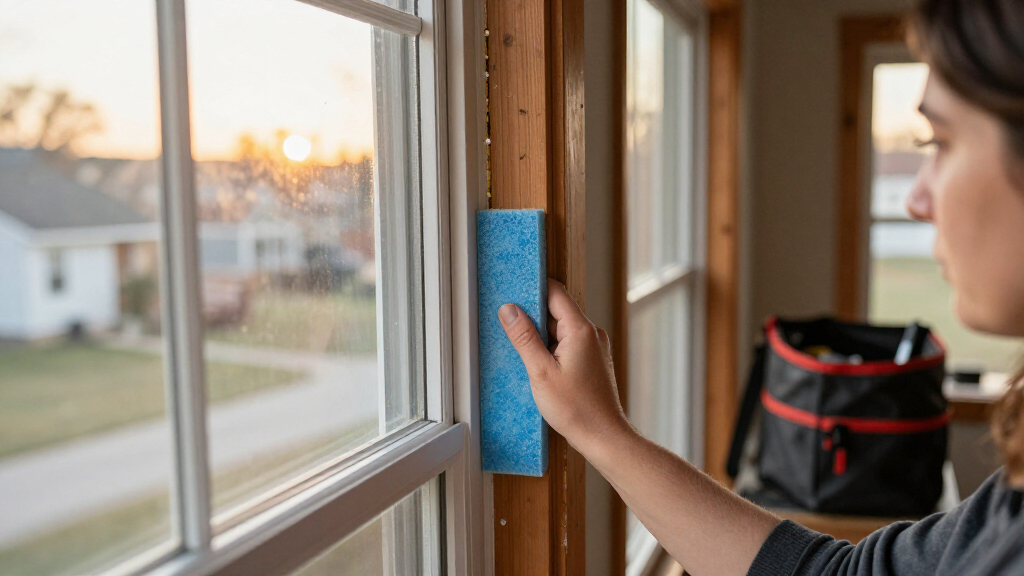
The proposed alternative was to glue leftover XPS strips to the sides of the rough openings and apply Meltell along the edges where the foam meets the opening and window. The homeowner reasoned that XPS could serve as an air barrier if sealed at both interfaces. That is the homeowner’s proposed method, not a recommendation established by the supplied source. It does not specify the adhesive, exact joint design or product compatibility.
Air Sealing Wide Window Gaps
Window-perimeter air leaks can undermine the performance of an otherwise insulated wall, while a difficult or improvised installation may leave gaps around frames or corners. For a homeowner dealing with many large windows, the question also has a practical cost dimension: the post contrasts using material already on hand with buying more tape or backer rod.
But a material described as an air barrier does not, by itself, establish that a particular assembly will work. The proposed strips would need to connect continuously to the window and rough-opening air-control layers. The source offers no testing or professional assessment of that detail, so readers should not treat the question as confirmation that XPS and Meltell are a suitable substitute for a tested window-installation method.
XPS foam insulation strips for windows
As an affiliate, we earn on qualifying purchases.
As an affiliate, we earn on qualifying purchases.
The Proposed Window-Sealing Detail
The issue arises at the junction between the window frame and rough opening, where the homeowner says the clearances are much larger than expected. They had already placed Rockwool in the opening and brought the Intello and Tescon materials into it; their remaining concern was connecting the air barrier to each window.
The question compares three approaches: backer rod with Meltell, Siga Fentrim tape, and strips of leftover XPS sealed with Meltell. The account records the homeowner’s experience and reasoning only. It does not establish why the openings are so wide, whether the windows were installed to the manufacturer’s requirements, or whether any of the proposed materials are approved for this exact assembly. The source also provides no response from the window maker, product manufacturers or a building professional.
“The gaps between the windows and the rough openings are really big (like upwards of 2″ in many places).”
— Homeowner, in the GreenBuildingAdvisor question
As an affiliate, we earn on qualifying purchases.
Compatibility and Installation Remain Unverified
The supplied source does not include an answer to the homeowner’s question. It therefore does not confirm whether XPS strips bonded to the rough opening and sealed with Meltell will provide a durable, continuous air barrier around these windows.
Other details are also missing: the size and shape of the gaps at each window, the exact XPS and Meltell products, the proposed adhesive, and the relevant installation requirements for the Marvin units. The source does not say whether the gaps affect structural support, water management, insulation continuity or warranty conditions. Those points cannot be settled from the question alone.
As an affiliate, we earn on qualifying purchases.
Verify the Assembly Before Installation
The next step is to obtain a response from a qualified building professional and check the window and sealant manufacturers’ installation guidance for the specific products and opening conditions. The homeowner’s account does not report whether that has happened, or whether the XPS proposal was installed. Until a supported detail is available, the method should be treated as an open question rather than a confirmed recommendation.
A complete review would need to address the continuity of the air barrier at the frame, rough opening and corners, as well as product compatibility and any applicable installation requirements. No further test results, manufacturer guidance or project outcome appear in the source material provided here.
As an affiliate, we earn on qualifying purchases.
Key Questions
What is the homeowner proposing?
The proposal is to glue leftover XPS strips to the sides of the rough opening and seal the edges between the foam, opening and window with Meltell. The source does not confirm that the detail is suitable.
How large are the reported gaps?
The homeowner said some gaps between the window frames and rough openings were upwards of 2 inches. The supplied material gives no independent measurements.
Did GreenBuildingAdvisor endorse using XPS?
No endorsement or expert reply is included in the source material. It presents the homeowner’s question and proposed approach, not a confirmed installation recommendation.
What other methods had the homeowner considered?
The homeowner described trying Siga Fentrim tape and considering backer rod with Meltell. They said the tape was challenging to apply around the narrow frame faces and corners, and viewed the other option as requiring unusually large backer rod.
What should be checked before choosing a sealing method?
The source leaves product compatibility, installation requirements and the details of the window-to-wall air-barrier connection unresolved. The homeowner should seek guidance from a qualified building professional and consult the relevant product manufacturers before relying on the proposed assembly.
Source: rss
Halloween Picks
halloween
As an affiliate, we earn on qualifying purchases.