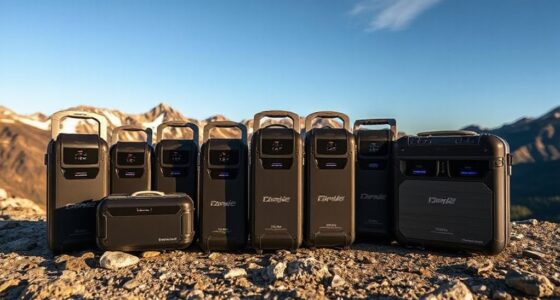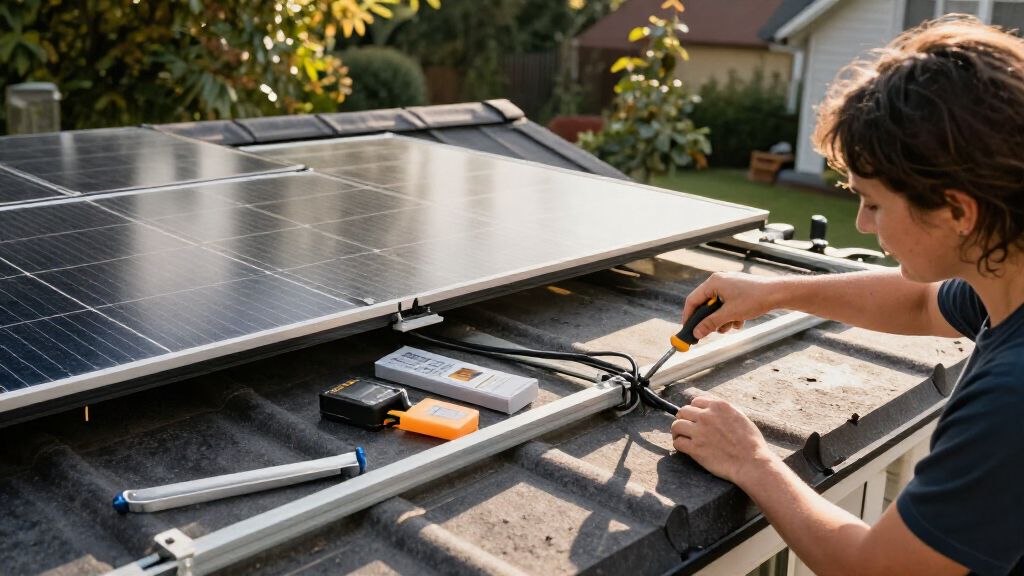

Among these solar panel kits for home, I’d choose the ECO-WORTHY 10 kW kit with a 16.1 kWh battery as the best overall starting point for substantial off-grid power. The SUNGOLDPOWER 5000W kit stands out for buyers seeking a 48V system, while Renogy’s 400W kit is a simpler fit for smaller loads and a more approachable setup. The main tradeoffs are system capacity, battery storage, included components, and the installation work a home-scale system demands. A compact 12V kit can suit limited needs, but it is not a substitute for a whole-home system. Read on for the full breakdown and help matching system size to your plans.

Get backup power and energy gear delivered free with Prime
- Fast, free delivery on millions of items
- Prime Video, Amazon Music and more included
- Member-only deals all year
Key Takeaways
- The 10 kW kits are not interchangeable: battery storage ranges from 9.36 kWh to 32.2 kWh, changing how long a home can draw power after sunlight fades.
- Panel wattage alone does not define a home system: inverter capacity, battery size, and split-phase output matter just as much for running household loads.
- Compact 12V kits serve a different job: the 200W and 400W options fit modest or targeted loads better than whole-home backup.
- Included equipment changes the setup burden: several kits bundle panels, batteries, and inverters, while the 400W Bluetooth model centers on a controller and monitoring.
- System scale brings installation tradeoffs: 48V and 10 kW options offer more capacity, but call for greater attention to wiring, placement, electrical compatibility, and permitting.
| ECO-WORTHY 10 kW Off-Grid Solar System Kit with Split-Phase Inverter, Batteries, and Solar Panels |  | Best for High-Capacity Off-Grid Homes | Inverter continuous output: 10,000 W | Inverter peak output: 20,000 W | Output voltage: 120 V/240 V split-phase | VIEW LATEST PRICE | See Our Full Breakdown |
| ECO-WORTHY 10 kW Off-Grid Solar Panel Kit with 16.1 kWh Battery |  | Best for Expandable Off-Grid Storage | Solar panels: 5 × 590 W | Total PV capacity: 2,950 W | Estimated daily generation: Up to 11.8 kWh under optimal conditions | VIEW LATEST PRICE | See Our Full Breakdown |
| ECO-WORTHY 10 kW Off-Grid Solar System Kit with 9.36 kWh Daily Output |  | Best for Compact, Expandable Panel Layouts | System type: Off-grid solar system | Maximum inverter output: 10,000 W continuous | AC output: 120 V/240 V | VIEW LATEST PRICE | See Our Full Breakdown |
| ECO-WORTHY 400W 12V Complete Solar Panel Kit with Lithium Batteries and 2000W Inverter | 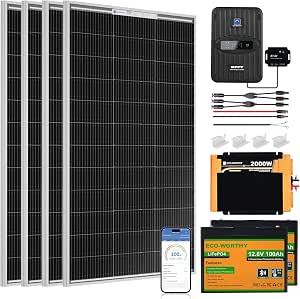 | Best Complete Small-System Kit | Solar panel output: 400 W | Panels: 4 × 100 W bifacial panels | Battery capacity: 2 × 12 V 100 Ah lithium batteries | VIEW LATEST PRICE | See Our Full Breakdown |
| ECO-WORTHY 400W 12V Solar Panel Kit with MPPT Controller and Bluetooth |  | Best for Adding Solar to an Existing 12 V Setup | Total power: 400 W | System voltage: 12 V | Included panels: 4 × 100 W monocrystalline panels | VIEW LATEST PRICE | See Our Full Breakdown |
| ECO-WORTHY 5 kW Off-Grid Solar System Kit with 2,340 W Panels |  | Best for Higher Solar Harvest | Solar panels: 12 × 195 W; 2,340 W total | Panel type: N-type monocrystalline | Panel efficiency: 25% | VIEW LATEST PRICE | See Our Full Breakdown |
| ECO-WORTHY 1170W Solar Power System with 48V 50Ah Battery and 3500W Inverter |  | Best for Monitoring and Backup Switching | Solar panels: 6 × 195 W; 1,170 W total | Panel type: N-type bifacial, 18 busbars | Panel efficiency: 25% | VIEW LATEST PRICE | See Our Full Breakdown |
| SUNGOLDPOWER 5000W 48V Off-Grid Solar Kit with Inverter, Panels, and LiFePO4 Battery |  | Best for Expandable 48 V Systems | Solar panels: 6 × 200 W; 1,200 W total | Inverter: 5,000 W, 48 V system | AC output: 120 V | VIEW LATEST PRICE | See Our Full Breakdown |
| ECO-WORTHY 200W 12V/24V Monocrystalline Solar Panel Kit with 30A PWM Charge Controller |  | Best for Small 12 V or 24 V Setups | Solar panels: 2 × 100 W; 200 W total | Panel type: Monocrystalline | System voltage: 12 V or 24 V | VIEW LATEST PRICE | See Our Full Breakdown |
| ECO-WORTHY 1200W Complete Solar Panel Kit with 48V 100Ah LiFePO4 Battery and 3500W Inverter |  | Best for a Balanced Home Backup System | Solar panels: 6 × 195 W N-type bifacial | Total solar panel power: 1,200 W | Daily output: Approximately 4.68 kWh | VIEW LATEST PRICE | See Our Full Breakdown |
| ECO-WORTHY 400W 12V Solar Panel Kit with 100Ah Lithium Battery |  | Best All-in-One Starter Kit | Solar panel output: 400W total (4 × 100W) | Daily power output: Up to 1.6kWh under ideal conditions | Battery: 12V 100Ah lithium | VIEW LATEST PRICE | See Our Full Breakdown |
| Renogy 400W 12V Premium Solar Kit with 40A MPPT Charge Controller |  | Best for Building a Custom System | Total power: 400W | Panel configuration: 4 × 100W | Output voltage: 12V | VIEW LATEST PRICE | See Our Full Breakdown |
| ECO-WORTHY 10 kW Off-Grid Solar Panel Kit with Split-Phase Inverter and 32.2 kWh Battery Storage |  | Best for High-Capacity Off-Grid Homes | Solar panels: 18 monocrystalline panels | Total PV capacity: 10,620W | Battery storage: 32.2kWh total | VIEW LATEST PRICE | See Our Full Breakdown |
| solar panel kits for home | Solar panels |
|---|---|
| ECO-WORTHY 10 kW Off-Grid Sola | 9 × 590 W |
| ECO-WORTHY 10 kW Off-Grid Sola | 5 × 590 W |
| ECO-WORTHY 10 kW Off-Grid Sola | 12 × 195 W N-type bifacial |
| ECO-WORTHY 400W 12V Complete S | — |
| ECO-WORTHY 400W 12V Solar Pane | — |
| ECO-WORTHY 5 kW Off-Grid Solar | 12 × 195 W; 2,340 W total |
| ECO-WORTHY 1170W Solar Power S | 6 × 195 W; 1,170 W total |
| SUNGOLDPOWER 5000W 48V Off-Gri | 6 × 200 W; 1,200 W total |
| ECO-WORTHY 200W 12V/24V Monocr | 2 × 100 W; 200 W total |
| ECO-WORTHY 1200W Complete Sola | 6 × 195 W N-type bifacial |
| ECO-WORTHY 400W 12V Solar Pane | — |
| Renogy 400W 12V Premium Solar | — |
| ECO-WORTHY 10 kW Off-Grid Sola | 18 monocrystalline panels |
More Details on Our Top Picks
ECO-WORTHY 10 kW Off-Grid Solar System Kit with Split-Phase Inverter, Batteries, and Solar Panels
I’d rank this kit highest for a home that needs substantial off-grid storage as well as 120 V/240 V power. Its 10,000 W split-phase inverter, nine 590 W panels, and 20.48 kWh of LiFePO₄ storage make it a more complete high-demand package than the five-panel ECO-WORTHY 10 kW kit, which has less solar capacity and 16.1 kWh of storage. Bifacial, dual-glass panels may gain output from reflected light, while dual MPPT controllers and battery monitoring add flexibility for system management. The tradeoff is a large, substantial installation: the panels are nearly 90 inches long, ship on a pallet, and professional installation is recommended. I’d choose it for a property with room for the array and serious backup or off-grid needs, not as a casual starter kit.
Pros:- Combines inverter, nine panels, batteries, and cables in one system.
- 20.48 kWh of LiFePO₄ storage provides more capacity than the lineup’s five-panel ECO-WORTHY 10 kW kit.
- Split-phase 120 V/240 V output suits a broader range of home circuits.
- Dual MPPT controllers and Wi-Fi or Bluetooth battery monitoring support system management.
Cons:- Professional installation is recommended, adding coordination and installation work.
- Panels are large and heavy and arrive on a pallet.
- The 5,310 W array is smaller than the 10,000 W inverter rating, so inverter capacity does not mean the panels can supply that much solar power.
Best for: Homeowners planning a professionally installed off-grid system who need 120 V/240 V output and sizable battery storage.
Not ideal for: DIY beginners, small properties, or buyers seeking a compact starter setup; the large panels and high-capacity electrical system call for space and professional installation.
- Inverter continuous output:10,000 W
- Inverter peak output:20,000 W
- Output voltage:120 V/240 V split-phase
- Solar panels:9 × 590 W
- Total solar capacity:5,310 W
- Battery storage capacity:20.48 kWh
- Battery configuration:4 × 48 V 100 Ah LiFePO₄
- Panel type and efficiency:N-type monocrystalline, bifacial, dual-glass; 23.23%
Our verdict“Choose this kit for a spacious, professionally installed off-grid home that prioritizes battery capacity and split-phase power.”
ECO-WORTHY 10 kW Off-Grid Solar Panel Kit with 16.1 kWh Battery
This kit pairs a 10,000 W split-phase inverter with a 48 V, 314 Ah battery, making it a fit for buyers who want strong inverter capacity and a battery system that can expand. Compared with the other ECO-WORTHY 10 kW kit in this group, it starts with 16.076 kWh of storage and five 590 W panels, rather than 20.48 kWh and nine panels. That means less included solar generation and stored energy, but its battery can be expanded through parallel connections, and monitoring is unusually flexible, with a display plus Bluetooth, Wi-Fi, and PC connectivity. I’d favor this option when expansion and system visibility matter more than maximizing the initial panel count. The large glass panels and truck delivery still make it a substantial project, and professional installation is recommended.
Pros:- 10,000 W inverter supports 120 V or 120/240 V split-phase output.
- Battery capacity can expand through parallel connections, with support for up to 15 batteries.
- Seven-inch display, Bluetooth, Wi-Fi, and PC connectivity provide multiple monitoring options.
- Includes panels, inverter, battery, and cables as a bundled system.
Cons:- Its 2,950 W solar array has fewer panels and less solar capacity than the other ECO-WORTHY 10 kW kit in this group.
- Professional installation is recommended.
- Panels and battery ship by truck on a pallet, so the delivery site must accommodate truck access.
Best for: Homeowners building an off-grid system in stages who want battery expansion options and several ways to monitor performance.
Not ideal for: Buyers who need the most included panel capacity or battery storage from the outset; the nine-panel, 20.48 kWh ECO-WORTHY kit provides more of both.
- Solar panels:5 × 590 W
- Total PV capacity:2,950 W
- Estimated daily generation:Up to 11.8 kWh under optimal conditions
- Inverter continuous output:10,000 W
- Inverter peak output:20,000 W
- Output voltage:120 V or 120/240 V split-phase
- Battery:48 V, 314 Ah LiFePO₄; 16.076 kWh
- Battery monitoring:7-inch display, Bluetooth, Wi-Fi, and PC connectivity
Our verdict“Pick this kit if you want a 10 kW inverter and a monitorable battery system that can grow, and can accept a smaller initial array.”
ECO-WORTHY 10 kW Off-Grid Solar System Kit with 9.36 kWh Daily Output
This system is a distinctive middle ground: it includes a 10,000 W inverter and 10.24 kWh of battery storage, but its 2,340 W array is built from twelve smaller panels. At 58.86 inches long and 21.9 lb each, the panels are easier to handle than the nearly 90-inch panels in the two larger ECO-WORTHY 10 kW kits. Under the stated four hours of full sunlight, the array is designed to produce 9.36 kWh per day; actual output depends on conditions. Its 120 V/240 V output, app-based battery monitoring, and several charging modes add flexibility. Compared with the 400 W ECO-WORTHY kits, it serves far more demanding home loads, but its large inverter rating should not be mistaken for high solar production. Professional installation is recommended.
Pros:- Twelve smaller panels are lighter and shorter than the 590 W panels in the other two ECO-WORTHY 10 kW kits.
- 10,000 W inverter supplies 120 V and 240 V AC output.
- Includes 10.24 kWh of lithium battery storage and app-based monitoring.
- Multiple charging modes allow different solar and mains charging priorities.
Cons:- The 2,340 W panel array is modest relative to the 10,000 W inverter rating.
- The stated 9.36 kWh daily output assumes four hours of full sunlight.
- Professional installation is recommended; novice installation may create safety risks or reduce performance.
Best for: Homeowners who need split-phase output and want a panel array made up of smaller, lighter modules for a more adaptable installation.
Not ideal for: Buyers who want high daily solar production from the included panels; the 2,340 W array is smaller than either other 10 kW ECO-WORTHY kit’s array.
- System type:Off-grid solar system
- Maximum inverter output:10,000 W continuous
- AC output:120 V/240 V
- Solar panels:12 × 195 W N-type bifacial
- Solar panel system power:2,340 W
- Daily energy output:9.36 kWh under four hours of full sunlight
- Battery capacity:2 × 48 V 100 Ah lithium batteries; 10.24 kWh total
- Panel dimensions and weight:58.86 × 26.18 × 1.18 in; 21.9 lb each
Our verdict“Choose this kit when smaller panels and split-phase capability matter more than maximizing the included solar array.”
ECO-WORTHY 400W 12V Complete Solar Panel Kit with Lithium Batteries and 2000W Inverter
For a small off-grid setup, this is the more complete choice than the ECO-WORTHY 400 W kit that includes a controller and Bluetooth but no batteries or inverter. This package brings together four 100 W bifacial panels, two lithium batteries, an MPPT controller, and a 2,000 W pure sine wave inverter, so buyers have the main components for storing energy and powering compatible AC devices. The stated daily output is up to 1.6 kWh under four hours of sunlight, which points to modest use rather than whole-home power. Its 12 V design and 2,000 W inverter ceiling put a firm limit on what it can support; it is not a smaller version of the 10 kW systems. I’d consider it for a cabin, RV, or limited off-grid loads, while buyers planning home-scale circuits should choose a larger system.
Pros:- Includes panels, two lithium batteries, MPPT controller, inverter, and accessories.
- Pure sine wave inverter supports compatible AC devices rated under 2,000 W.
- Batteries include a built-in battery management system and are rated for more than 3,000 deep cycles.
- Bluetooth module provides system monitoring.
Cons:- The 12 V system and 2,000 W inverter limit the size and range of supported loads.
- The stated daily output of up to 1.6 kWh depends on ideal sunlight conditions.
- A 400 W array is far below the solar capacity of the off-grid 10 kW kits in this roundup.
Best for: RV owners or cabin users who want a bundled 12 V setup with panels, lithium storage, charge control, and an inverter.
Not ideal for: Homeowners seeking whole-home backup, 120 V/240 V split-phase output, or more than 2,000 W of inverter power.
- Solar panel output:400 W
- Panels:4 × 100 W bifacial panels
- Battery capacity:2 × 12 V 100 Ah lithium batteries
- Charge controller:40 A MPPT
- Inverter:12 V, 2,000 W pure sine wave
- Daily energy output:Up to 1.6 kWh under stated ideal conditions
- Panel conversion rate:23%
- Panel dimensions:35.63 × 23.03 × 1.18 in
Our verdict“Choose this bundled kit for modest RV or cabin loads when having batteries and an inverter included matters more than home-scale capacity.”
ECO-WORTHY 400W 12V Solar Panel Kit with MPPT Controller and Bluetooth
I’d pick this kit for someone who already has a compatible 12 V battery and inverter, or who wants to choose those components separately. Unlike the other ECO-WORTHY 400 W kit here, it does not include batteries or an inverter; that keeps the package focused on generation, charge control, and monitoring rather than providing a ready-to-run system. Four 100 W monocrystalline panels, a 40 A MPPT controller, mounting brackets, and Bluetooth monitoring give a clear starting point for a small off-grid array. The stated average of 1.6 kWh per day depends on sunlight, so it is not a dependable measure for every home or site. Compared with the complete 400 W kit, this one offers more freedom to select storage and conversion gear, but buyers must source and match those parts themselves.
Pros:- Four 100 W panels provide 400 W of rated solar capacity.
- 40 A MPPT controller offers stated tracking efficiency of up to 99% and system protection.
- Bluetooth monitoring works at a stated range of up to 82 feet.
- Panels include bypass diodes and are rated for stated wind and snow loads.
Cons:- Batteries and an inverter are not included, so buyers must source compatible components.
- The 12 V, 400 W system is intended for modest off-grid needs rather than whole-home power.
- The stated average daily generation depends on sunlight, and the Bluetooth range is limited to up to 82 feet.
Best for: DIY owners with an existing 12 V battery and inverter who need panels, charge control, mounting brackets, and Bluetooth monitoring.
Not ideal for: Beginners looking for an all-in-one package; unlike the other 400 W ECO-WORTHY kit, this one omits batteries and an inverter.
- Total power:400 W
- System voltage:12 V
- Included panels:4 × 100 W monocrystalline panels
- Charge controller:40 A MPPT
- Panel efficiency:21%
- Daily energy generation:Average 1.6 kWh, depending on sunlight
- Bluetooth range:Up to 82 feet
- Maximum wind and snow load:2,400 Pa wind; 5,400 Pa snow
Our verdict“Choose this panel-and-controller package if you already have compatible 12 V storage and conversion equipment and want to select the rest yourself.”
ECO-WORTHY 5 kW Off-Grid Solar System Kit with 2,340 W Panels
For a home or cabin that needs a substantial off-grid setup, this kit pairs 2,340 W of panels with a 5,000 W inverter and a 51.2 V, 100 Ah LiFePO4 battery. Its larger panel array gives it an advantage over the SUNGOLDPOWER 5000W kit, which has a similarly rated inverter but only 1,200 W of listed panels. That difference may help this ECO-WORTHY kit replenish stored energy more quickly when sunlight is available, though actual production depends on site and weather. The tradeoff is installation: twelve panels measuring nearly 59 inches long take planning, roof area, and careful handling. I’d choose it for buyers prioritizing panel capacity in a complete package, not for anyone seeking a small, simple starter system.
Pros:- Includes twelve panels, a 5,000 W inverter, a LiFePO4 battery, cables, and Z brackets.
- The 2,340 W panel array is larger than the arrays in the other 5,000 W-inverter kits here.
- LiFePO4 battery stores energy for use beyond daylight hours.
- Inverter supplies 120 V AC for household essentials.
Cons:- Twelve large panels require significant installation space and handling effort.
- Off-grid wiring and mounting call for DIY skill or professional installation.
- The listed package does not specify a daily energy estimate or battery usable capacity.
Best for: Off-grid homeowners or cabin owners with room for twelve panels who want a complete system with a large panel array and battery storage.
Not ideal for: Buyers with limited roof or ground space, or anyone unwilling to handle system wiring and mounting work.
- Solar panels:12 × 195 W; 2,340 W total
- Panel type:N-type monocrystalline
- Panel efficiency:25%
- Inverter:48 V, 5,000 W off-grid
- Battery:51.2 V, 100 Ah Cubix LiFePO4
- AC output:120 V
- Panel dimensions:58.86 × 26.18 × 1.18 in each
- Included components:Inverter, battery, 12 panels, cables, and Z brackets
Our verdict“Choose this kit if you have installation space and want more panel capacity than the other 5,000 W-inverter options in this group.”
ECO-WORTHY 1170W Solar Power System with 48V 50Ah Battery and 3500W Inverter
This kit suits buyers who want a complete 48 V system with useful inverter features, but do not need the larger battery in the ECO-WORTHY 1200W Complete Solar Panel Kit. Its six bifacial panels total 1,170 W, while the 48 V, 50 Ah battery provides 2,560 Wh of usable energy; that makes storage the main limit for households running appliances for long stretches. The WiFi monitoring, 80 A MPPT controller, and 20 ms UPS switching add visibility and a backup-power function in one package. Compared with the 1200W ECO-WORTHY kit, this model has half the listed battery capacity, so I’d favor it for modest loads and monitoring features over longer backup duration. Battery charging is specified for temperatures of 32°F and above.
Pros:- Includes panels, battery, inverter, cables, mounts, and accessories.
- WiFi monitoring works alongside an 80 A MPPT controller.
- UPS switching is specified at 20 ms for backup use.
- Bifacial N-type panels have a stated 25% conversion efficiency.
Cons:- The 2,560 Wh usable battery capacity is smaller than the 100 Ah battery in the ECO-WORTHY 1200W kit.
- Battery charging is specified for temperatures of 32°F and above.
- The kit arrives in multiple packages, so buyers need to verify all components are present.
Best for: Cabin and small-home owners who want inverter monitoring and UPS switching for modest essential loads.
Not ideal for: Households seeking longer battery runtime or charging in freezing conditions; the battery is 50 Ah and charging is specified from 32°F.
- Solar panels:6 × 195 W; 1,170 W total
- Panel type:N-type bifacial, 18 busbars
- Panel efficiency:25%
- Battery:48 V, 50 Ah LiFePO4
- Usable battery energy:2,560 Wh
- Inverter:3,500 W output; 7,000 W surge
- MPPT controller:80 A
- UPS switching:20 ms
Our verdict“Pick this model for a monitored, feature-rich system serving modest loads, but choose the ECO-WORTHY 1200W kit if you need more stored energy.”
SUNGOLDPOWER 5000W 48V Off-Grid Solar Kit with Inverter, Panels, and LiFePO4 Battery
The SUNGOLDPOWER kit is built around a 5,000 W, 48 V inverter and supports parallel connection of up to six units, giving expansion-minded off-grid buyers a clear reason to look beyond its six-panel starter array. The package includes a 51.2 V, 100 Ah LiFePO4 battery, six 200 W panels, extension cables, and Z-bracket mounts. Compared with the ECO-WORTHY 5 kW kit, it starts with only 1,200 W of panel capacity rather than 2,340 W, so buyers should not confuse inverter rating with solar harvesting capacity. Its stated 4.8 kWh daily estimate assumes four hours of full sunlight. I’d shortlist it for a 48 V setup where future inverter expansion matters, but less so for a buyer who wants the largest panel array included from the start.
Pros:- Includes a 5,000 W inverter, 100 Ah LiFePO4 battery, six panels, cables, and Z-bracket mounts.
- Supports parallel connection of up to six units.
- Inverter supports up to 5,500 W of PV input.
- Battery supports RS485 communication and wall mounting.
Cons:- The included 1,200 W panel array is smaller than the ECO-WORTHY 5 kW kit’s array.
- The 4.8 kWh daily output estimate depends on four hours of full sunlight.
- Designed for 48 V off-grid use rather than direct integration as a conventional grid-tied home system.
Best for: Off-grid buyers planning a 48 V system that may expand through parallel inverters and who value included cables and mounts.
Not ideal for: Buyers who want a large panel array out of the box; its six panels total 1,200 W, well below the ECO-WORTHY 5 kW kit’s 2,340 W.
- Solar panels:6 × 200 W; 1,200 W total
- Inverter:5,000 W, 48 V system
- AC output:120 V
- Battery:51.2 V, 100 Ah LiFePO4
- Maximum PV input:5,500 W, 500 V
- Battery charging:Up to 100 A
- Estimated daily output:Approximately 4.8 kWh with four hours of full sunlight
- Parallel connection:Up to 6 units
- Certifications:Inverter ETL listed to UL1741; battery UL1973
Our verdict“Choose this kit if 48 V expansion flexibility matters more than maximizing the panel capacity included in the initial package.”
ECO-WORTHY 200W 12V/24V Monocrystalline Solar Panel Kit with 30A PWM Charge Controller
This is the most modest home-oriented kit in the group: 200 W of panels, a 30 A PWM controller, and the basic mounting and wiring parts for a small off-grid installation. Its series-or-parallel wiring lets buyers configure the panels for 24 V or 12 V setups, which can suit a shed, small cabin, or a limited DC load. That flexibility is useful, but it is not a substitute for the inverter, battery, and larger generation capacity included in the ECO-WORTHY 1170W system. The claimed 800 Wh daily output assumes four hours of full sunshine, and a PWM controller is a simpler approach than the MPPT controller in that larger kit. I’d choose this for a small system or an existing battery setup, not as a whole-home power package.
Pros:- Panels can be wired in parallel for 12 V or series for 24 V systems.
- Includes a 30 A PWM controller, brackets, and cables.
- Aluminum alloy frames and an IP65-rated junction box suit outdoor installation.
- Panels have a stated maximum efficiency of 21.5%.
Cons:- The 200 W array is not sized for substantial household loads.
- A PWM controller is a simpler option than the 80 A MPPT controller included with the ECO-WORTHY 1170W system.
- The 31.6 lb kit and four-hour-sunlight output estimate call for realistic planning around handling and site conditions.
Best for: DIY owners powering a small shed or cabin, or adding solar charging to an existing 12 V or 24 V battery setup.
Not ideal for: Homeowners expecting to run multiple household appliances or wanting a complete system with battery and AC inverter included.
- Solar panels:2 × 100 W; 200 W total
- Panel type:Monocrystalline
- System voltage:12 V or 24 V
- Charge controller:30 A PWM
- Maximum efficiency:21.5%
- Estimated daily output:800 Wh under four hours of full sunshine
- Panel dimensions:35.2 × 23.1 × 1.3 in
- Kit weight:31.6 lb
Our verdict“Choose this kit for small 12 V or 24 V loads or an existing battery setup, not for whole-home off-grid power.”
ECO-WORTHY 1200W Complete Solar Panel Kit with 48V 100Ah LiFePO4 Battery and 3500W Inverter
Among the mid-size kits here, this one balances a 1,170 W panel array with a 48 V, 100 Ah LiFePO4 battery and a 3,500 W hybrid inverter. That battery capacity is twice the 50 Ah battery in the ECO-WORTHY 1170W system, making this the more appealing choice for buyers who want more stored energy for essential loads after daylight. The six N-type bifacial panels and built-in 80 A MPPT controller round out a useful off-grid package, while WiFi monitoring offers remote visibility. Against the ECO-WORTHY 5 kW kit, it has a smaller inverter and panel array, but its 100 Ah battery offers a more substantial storage base than the smaller ECO-WORTHY system. The tradeoffs are a one-year warranty and delivery in multiple packages.
Pros:- Includes panels, a 100 Ah LiFePO4 battery, hybrid inverter, and MPPT controller.
- The 100 Ah battery provides more listed capacity than the ECO-WORTHY 1170W kit’s 50 Ah battery.
- WiFi monitoring supports remote system visibility.
- N-type bifacial panels have a stated 25% conversion rate.
Cons:- Its 3,500 W inverter is smaller than the 5,000 W units in the ECO-WORTHY and SUNGOLDPOWER kits.
- The one-year manufacturer warranty is short for a complete home energy system.
- Multiple-package delivery means buyers need to check that all system components arrive.
Best for: Homeowners or cabin owners seeking a mid-size off-grid backup setup with a 100 Ah battery, WiFi monitoring, and standard AC output.
Not ideal for: Buyers needing a 5,000 W inverter, a larger panel array, or a longer stated warranty; this package lists a 3,500 W inverter and one-year warranty.
- Solar panels:6 × 195 W N-type bifacial
- Total solar panel power:1,200 W
- Daily output:Approximately 4.68 kWh
- Battery:48 V, 100 Ah LiFePO4
- Inverter:3,500 W rated; 7,000 W peak
- Charge controller:80 A MPPT
- Connectivity:WiFi, CAN/RS485
- Warranty:1 year
Our verdict“Choose this kit over the ECO-WORTHY 1170W system if you want the same general panel scale with a larger listed battery for backup storage.”
ECO-WORTHY 400W 12V Solar Panel Kit with 100Ah Lithium Battery
For a buyer who wants a small off-grid setup without sourcing the battery and inverter separately, this 400W all-in-one kit is the most turnkey choice here. It pairs four panels with a 100Ah lithium battery, a 40A MPPT controller, and an 1100W pure sine wave inverter, so it can supply 110V AC to suitable small or medium devices. The included Bluetooth module also adds system monitoring, while the battery’s BMS and stated cycle rating support repeated use.
Compared with the Renogy 400W 12V Premium Solar Kit, this ECO-WORTHY kit includes storage and AC conversion rather than just panels and a controller. That convenience comes with a ceiling: the claimed daily output of up to 1.6kWh assumes ideal sunlight, and the 1100W inverter is not a basis for powering larger household loads. It suits modest backup or off-grid needs, not a whole-home system.
Pros:- Includes four panels, a lithium battery, MPPT controller, inverter, Bluetooth module, mounting brackets, and accessories.
- 100Ah lithium battery includes a BMS and is rated for more than 3,000 deep cycles.
- Pure sine wave inverter provides 110V AC for compatible devices.
- 40A MPPT controller is specified with up to 99% tracking efficiency.
Cons:- The stated daily output of up to 1.6kWh depends on ideal sunlight conditions.
- The 1100W inverter and small-to-medium-device guidance do not establish suitability for larger household loads.
- A 12V, 100Ah battery offers a more limited storage reserve than the large 48V systems in this roundup.
Best for: Buyers building a compact off-grid or backup setup who want panels, a lithium battery, an inverter, and monitoring in one package.
Not ideal for: Households seeking to run large appliances or cover most home electricity use; its 1100W inverter and stated small-to-medium-device focus limit the system’s scope.
- Solar panel output:400W total (4 × 100W)
- Daily power output:Up to 1.6kWh under ideal conditions
- Battery:12V 100Ah lithium
- Charge controller:40A MPPT
- Inverter:1100W pure sine wave
- AC output:110V
- Panel conversion rate:23%
- Panel dimensions:35.63 × 23.03 × 1.18 in
Our verdict“Choose this kit for a compact, mostly complete 12V system for modest loads, but look to a larger 48V setup for broader home backup.”
Renogy 400W 12V Premium Solar Kit with 40A MPPT Charge Controller
This Renogy kit makes more sense for a buyer who already has a battery and inverter, or who wants to select those parts separately. Its four 100W monocrystalline panels and 40A MPPT controller provide the core charging hardware, while the Bluetooth module supports phone-based monitoring and adjustment. Z-brackets, cables, and an adaptor kit reduce the number of separate setup parts to source.
Unlike the ECO-WORTHY 400W 12V Solar Panel Kit with 100Ah Lithium Battery, this package does not include storage or an inverter; that keeps the system more customizable but leaves more decisions and purchases to the buyer. The 56.4-pound listed panel weight and 41.8 × 20.9-inch dimensions also call for a suitable mounting area and careful installation planning. Its stated five-year materials-and-workmanship panel warranty adds a defined coverage period, but this remains a component kit rather than a ready-to-use home backup system.
Pros:- Four monocrystalline panels provide 400W of total rated output.
- Includes a 40A MPPT charge controller and Bluetooth monitoring module.
- Z-brackets, cables, and an adaptor kit are included for system setup.
- Panel materials and workmanship carry a stated five-year warranty.
Cons:- Battery and inverter are not included, so the buyer must build out the rest of the system.
- The listed panel weight is 56.4 pounds, which can make handling and mounting more demanding.
- Panel dimensions of 41.8 × 20.9 × 1.38 inches require substantial installation space.
Best for: DIY homeowners who already own a compatible 12V battery and inverter and want a 400W panel-and-controller foundation with phone monitoring.
Not ideal for: Buyers who want a ready-to-run kit with battery storage and AC output included, or who lack room and help to mount the panels.
- Total power:400W
- Panel configuration:4 × 100W
- Output voltage:12V
- Maximum battery voltage:32V
- Charge controller:40A MPPT
- Connector type:MC4
- Panel dimensions:41.8 × 20.9 × 1.38 in
- Item weight:56.4 lb
- Panel warranty:5 years for materials and workmanship
Our verdict“Pick the Renogy kit when you want to choose your own battery and inverter; choose the ECO-WORTHY all-in-one instead for a more complete small system.”
ECO-WORTHY 10 kW Off-Grid Solar Panel Kit with Split-Phase Inverter and 32.2 kWh Battery Storage
This is the lineup’s most substantial option for a home planned around off-grid power: it combines 10,620W of solar panels, a 10,000W continuous inverter, and 32.2kWh of LiFePO₄ storage. The inverter supports 120V or 120/240V split-phase output, a useful distinction for buyers whose household plan includes compatible 240V equipment. Dual MPPT controllers and Wi-Fi monitoring add system-level management features.
Compared with the ECO-WORTHY 10 kW Off-Grid Solar Panel Kit with 16.1 kWh Battery, this model provides twice the stated storage capacity, favoring longer energy reserves when generation is limited. That scale also makes it a different commitment from the 400W kits: the panels measure nearly 90 inches long, professional installation is recommended, and delivery requires a suitable truck-accessible address. It is a poor fit for a small backup project or a buyer looking for a simple DIY installation.
Pros:- Combines 10,620W of PV capacity with 32.2kWh of total LiFePO₄ storage.
- 10,000W continuous inverter supports 120V or 120/240V split-phase output.
- Dual MPPT controllers and Wi-Fi monitoring are included.
- Batteries include a 200A BMS and dual breakers, with Bluetooth, Wi-Fi, and PC monitoring support.
Cons:- Professional installation is recommended, making it a poor match for a simple DIY project.
- Panels measure 89.68 × 44.65 inches each, demanding substantial space and careful handling.
- The large, heavy shipment requires truck delivery and an appropriate delivery address.
Best for: Homeowners planning a professionally installed off-grid system who need substantial battery storage and 120/240V split-phase capability.
Not ideal for: Renters, small-space users, and buyers seeking a lightweight DIY backup kit; the large panels, system scale, and recommended professional installation are mismatched to those needs.
- Solar panels:18 monocrystalline panels
- Total PV capacity:10,620W
- Battery storage:32.2kWh total
- Battery configuration:2 × 48V 314Ah LiFePO₄ batteries
- Inverter continuous output:10,000W
- Inverter peak output:20,000W
- Output voltage:120V or 120/240V split phase
- Maximum voltage:500V
- Panel dimensions:89.68 × 44.65 × 1.18 in
Our verdict“Choose this system for a professionally planned off-grid home needing deep storage and split-phase output, not for modest backup or limited installation space.”

How We Picked
I compared the 13 kits as home-use systems, not as a single contest in panel wattage. The main criteria were usable generation potential, battery storage, inverter capacity and output format, included components, system voltage, and how clearly each configuration suits a real household use case. I also weighed flexibility and setup complexity: a kit that bundles major components can reduce sourcing work, but it does not remove the need to plan wiring, mounting, and electrical protection.
The ranking gives priority to options that balance capacity with a clear role for home use. Larger 48V and 10 kW systems rank ahead for substantial off-grid demand, with battery storage and split-phase capability separating them. Smaller 12V kits appear lower for whole-home use, but can be better matched to modest loads, cabins, or targeted backup. Product names provide the listed capacities and included parts; actual output depends on sunlight, site conditions, installation, and load patterns.
Factors to Consider When Choosing Solar Panel Kits For Home
Before choosing a kit, I’d start with the home’s loads and the role solar will play. A system for daily off-grid living has different requirements from one meant to keep a few essentials running during outages. These factors help prevent paying for capacity you cannot use—or buying a kit that cannot support the appliances you expect.
Match System Size to Your Actual Loads
List the appliances you want to power, their wattage, and how many hours each runs on a typical day. Add the daily energy use, then separately identify the largest loads that may run at the same time. That second number matters because an inverter can be overwhelmed even when the battery has plenty of stored energy. Heating, cooking, pumps, and air conditioning can push a modest kit beyond its intended role. A common mistake is sizing from panel wattage alone without checking inverter output and battery capacity. If your usage changes by season, plan around the higher-demand period rather than an unusually mild month.
Read Battery Capacity as Runtime, Not Just a Headline
Battery storage affects how much energy you can use when panels are not producing, but the advertised capacity does not translate directly into hours of backup. Your runtime depends on the loads, usable battery capacity, conversion losses, and any battery-management limits. Compare storage figures alongside inverter power and the appliances you need to keep running. A large array paired with limited storage may produce plenty during the day but provide less overnight reserve than expected. Conversely, extra battery capacity will not fix an undersized array that cannot recharge it during available sun. Decide whether you need a few hours of essential backup or sustained off-grid operation before paying for more storage.
Check Inverter Output and Household Compatibility
Confirm the inverter’s continuous output, surge capability, voltage, and whether it supplies the type of power your household equipment needs. Split-phase output can matter for certain 240V appliances, while many smaller 12V kits are aimed at modest loads rather than whole-home circuits. Do not assume that a high wattage label means every appliance can start or run together; motors and compressors may draw a brief surge above their normal operating demand. Make a list of loads that must operate simultaneously and compare their combined draw with the inverter specifications. If you expect to connect a system to household wiring, have a qualified electrician review the plan and applicable local rules.
Account for Roof, Ground Space, and Sun Exposure
A kit’s stated panel capacity is only useful if you have a suitable place to install the array. Check roof condition, usable area, orientation, shading, and structural suitability before buying panels for a permanent home system. Trees, neighboring buildings, and seasonal shadows can reduce production, even when the panels have a clear view of the sky for part of the day. Ground mounting may give more flexibility but needs room, suitable foundations, and protection from damage. Leave space for access and maintenance rather than packing panels into every available area. If your site is shaded or roof space is limited, a larger nominal array may not solve the underlying constraint.
Compare What the Kit Includes—and What It Leaves Out
“Complete kit” can refer to different bundles, so check the bill of materials rather than relying on the label. Confirm whether panels, charge controller, inverter, batteries, mounting hardware, cables, fuses, and disconnects are included and compatible. Missing balance-of-system parts can add work and require careful matching, while bundled components may still need separate mounting equipment or electrical protection. Also check connector types, cable lengths, and whether the system voltage matches the battery and inverter arrangement. A kit with Bluetooth monitoring may make basic system status easier to view, but monitoring does not replace correct commissioning or routine inspection. Choose a bundle for compatibility and reduced sourcing effort, not just the number of parts in the box.
Plan for Permits, Installation, and Future Changes
Large home systems can involve electrical permits, utility rules, inspections, and requirements for licensed installation. Off-grid equipment does not automatically remove local building or electrical obligations, so check requirements before ordering. Installation complexity rises with system voltage, battery banks, split-phase output, and the number of circuits involved. Leave room in your plan for safe disconnects, ventilation requirements, cable routing, and service access. If you expect to add panels or batteries later, verify that the inverter and charge controller support the expansion you have in mind. Paying for a system that can grow may be useful, but only when its components and wiring plan support that growth.
Frequently Asked Questions
Can a 400W solar kit power an entire home?
A 400W kit is generally better suited to modest, targeted loads than to running an entire home. Actual energy production varies with sunlight, shading, panel angle, and system losses, while household demand can include large appliances that exceed a small inverter’s output. It may fit a small cabin, a limited backup circuit, or selected devices when paired with compatible storage. Before buying, total the daily energy needs and check both inverter output and battery capacity. For broad household coverage, compare larger systems and plan around your peak loads.
Should I choose a larger battery or more solar panels first?
That depends on whether your main problem is insufficient daytime production or insufficient stored energy after sunset. If the panels cannot cover daily use and recharge the battery in available sunlight, adding storage alone can leave the same energy shortfall. If the array meets daytime needs but you run out of power overnight, more battery capacity may help. Use a daily energy estimate and a record of when loads occur to identify the constraint. Check charge-controller and inverter compatibility before adding either component.
Do I need a 48V kit for home use?
No single system voltage is right for every home, but 48V kits are often a better fit for higher-capacity systems than small 12V setups. Higher-voltage battery configurations can reduce current for a given power level, which affects cable and system design. They also require components and wiring compatible with that voltage, so they are not a simple upgrade to a 12V kit. For modest loads or a small standalone setup, 12V may be more suitable. Choose based on the inverter, battery arrangement, expected loads, and qualified installation guidance.
Can an off-grid solar kit connect to my home’s electrical panel?
Some systems may be configured to supply household circuits, but a kit should not be connected to a home panel without checking the inverter design, transfer equipment, wiring, and local electrical requirements. A safe setup must prevent unintended backfeed and match the loads and circuit arrangement. Split-phase output can be relevant for homes with 240V appliances, but it does not by itself make a kit ready for panel connection. Ask a licensed electrician to review the equipment and installation plan before purchase. Permits or inspections may apply even when the system is off-grid.
How much battery storage do I need for overnight backup?
Start with the energy your essential loads use between the time the panels stop producing and the next expected charging period. Add up each device’s wattage and hours of use, then account for inverter losses and the battery’s usable capacity. A refrigerator, communications gear, lights, and medical equipment can have very different daily energy demands. Plan for less favorable charging conditions if you need reliable backup through cloudy weather, rather than assuming the next day will fully recharge the system. Battery capacity should be matched to both the array’s charging ability and the loads you intend to keep on.
Conclusion
For substantial off-grid household use, I’d make the ECO-WORTHY 10 kW kit with 16.1 kWh storage my best overall pick because it pairs a large system rating with meaningful battery capacity. For buyers prioritizing a 48V setup, the SUNGOLDPOWER 5000W kit is the best value-style choice among the larger systems, while the 32.2 kWh ECO-WORTHY 10 kW kit is my best premium fit for buyers who need more storage. Beginners with modest needs should start by comparing the Renogy 400W kit or a compact ECO-WORTHY 400W bundle, while recognizing that neither is a whole-home solution. For limited loads, the 200W ECO-WORTHY kit suits a smaller-scale setup; for a larger but still targeted system, compare the 1170W and 1200W options. Choose the kit that matches your loads, battery runtime, and installation plan—not the biggest number on the label.