
TL;DR
India’s assessed floating solar PV potential is now over 102 GW, according to a NISE report. This significantly increases the country’s total solar potential to 3,445 GW, with plans underway to accelerate floating solar deployment.
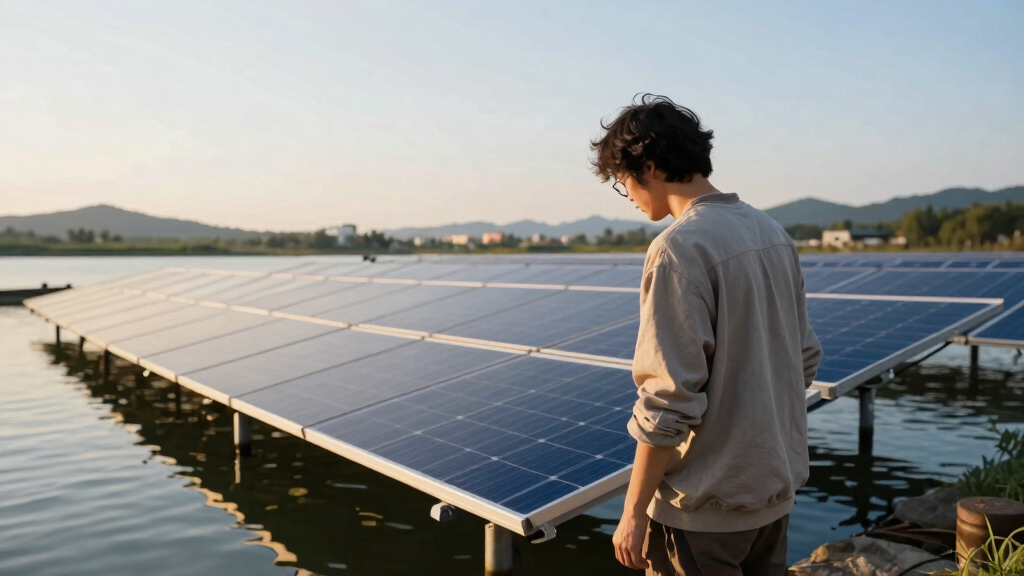
India’s assessed floating solar PV potential has been estimated at more than 102 GW, according to a new report from the National Institute of Solar Energy (NISE). This development raises India’s total solar energy potential, including ground-mounted and floating PV, to 3,445 GW. The Ministry of New and Renewable Energy is preparing a dedicated scheme to accelerate floating solar deployment across the country.
The NISE assessment applied specific screening criteria to identify suitable water bodies for floating solar projects, focusing on hydro-lake water bodies larger than 10 hectares with year-round water availability, depths between 3 and 30 meters, and proximity to road networks and electrical substations. Using assumptions of 545 W modules with 21% efficiency installed at a 5-degree tilt, the study estimated that 0.019 km² of water surface is needed to deploy 1 MW of capacity.
Out of 10,725.99 km² of mapped water bodies across India, 4,546.01 km² were deemed suitable after applying ecological and usability constraints, including a cap of 20% surface utilization per water body. This yields a maximum floating solar potential of approximately 102 GW nationally. The states with the highest potential include Maharashtra (16.28 GW), Madhya Pradesh (14.89 GW), Karnataka (13.69 GW), Odisha (12.81 GW), and Telangana (10.72 GW).
Implications for India’s Renewable Energy Goals
This assessment underscores India’s vast untapped renewable energy resources, particularly in floating solar, which can help meet the country’s ambitious climate commitments. The potential of over 102 GW in floating solar alone complements ground-mounted projects, offering a pathway to diversify and expand India’s clean energy portfolio. The Ministry’s plan to introduce a dedicated scheme could accelerate deployment, reduce land use conflicts, and foster technological innovation.

Aisdan Solar Powered Pool Maintenance System, Upgraded High-Efficiency Solar Panel Copper Pool Floater with LED Night Light for Above Ground, Inground Pool up to 45,000 Gal
- Large Solar Panel: 5.9×5.9 inches for efficient charging
- Long Working Time: 24 hours with 4 hours of sunlight
- Pure Copper Construction: 99.95% pure copper for durability
As an affiliate, we earn on qualifying purchases.
As an affiliate, we earn on qualifying purchases.
India’s Growing Solar Capacity and Policy Initiatives
India has been rapidly expanding its solar capacity, with previous assessments estimating over 3,343 GW of ground-mounted solar potential. The government’s push for renewables includes targets for 280 GW of solar capacity by 2030. The recent NISE report adds a new dimension by highlighting floating solar as a significant, underutilized resource, aligning with global trends toward floating PV deployment to optimize water surface use and reduce land competition.
Earlier projects and pilot schemes have demonstrated the viability of floating solar in India, but large-scale deployment has been limited. The new assessment provides a comprehensive framework to identify suitable water bodies and guide future investments.
“The assessment indicates a vast potential for floating solar in India, which could significantly contribute to the country’s renewable energy targets.”
— an anonymous researcher

Tinduo Solar Panel Cleaning Kit with 5-20ft Telescoping Pole, Water Fed Pole Window Cleaning System with Soap-Dispenser, Brush, 11″Squeegee & Cobweb Duster for Snow Removal, Windows, RVs, Decks
- Telescoping Pole Length: Extends from 5 to 20 feet for versatile cleaning
- Adjustable Brush Head: Swivels 180° for optimal angle and coverage
- Solar Panel Cleaning Brush: Soft brush removes dirt and bird droppings effectively
As an affiliate, we earn on qualifying purchases.
As an affiliate, we earn on qualifying purchases.
Uncertainties Around Deployment and Ecological Impact
While the potential has been estimated, the actual deployment of floating solar across India remains uncertain. Details about specific project pipelines, regulatory approvals, ecological safeguards, and ecological impact mitigation are still emerging. The assessment also caps floating solar at 20% of water body surface area, but the ecological and social impacts of large-scale projects need further evaluation.

Badafaci 2pcs 5V 500mA Solar Panel Power Module Solar Cell Module Energy for DIY Projects with 100cm Cable Low Light Effect High Conversion Efficiency
- High Conversion Efficiency: Polycrystalline silicon with excellent low light performance
- Weatherproof and Durable: Snow and wind proof for outdoor use
- Lightweight and Easy to Install: Approx. 2mm thick for DIY projects
As an affiliate, we earn on qualifying purchases.
As an affiliate, we earn on qualifying purchases.
Next Steps in Policy and Project Development
The Ministry of New and Renewable Energy is expected to announce a dedicated floating solar scheme soon, aimed at incentivizing project development. Further feasibility studies, pilot projects, and environmental assessments are likely to follow, alongside the development of financing mechanisms and technical standards. Monitoring of initial deployments will inform scaling efforts and policy adjustments.

SUMRY Hybrid Solar Inverter Charger 3600W DC24V to AC110V Voltage Converter
- All-in-One Inverter Charger: 3600W rated, 7200W peak power with MPPT controller
- Built-in MPPT Solar Charge Controller: 120A MPPT for efficient solar charging
- AC Battery Charger Included: 100A charging capacity for batteries
As an affiliate, we earn on qualifying purchases.
As an affiliate, we earn on qualifying purchases.
Key Questions
How was the 102 GW potential for floating solar estimated?
The estimate was based on screening criteria applied to water bodies larger than 10 hectares, considering water availability, depth, irradiation levels, and proximity to infrastructure. The study used assumptions about module efficiency and installation parameters to calculate capacity potential.
Which states in India have the highest floating solar potential?
Maharashtra leads with an estimated potential of 16.28 GW, followed by Madhya Pradesh (14.89 GW), Karnataka (13.69 GW), Odisha (12.81 GW), and Telangana (10.72 GW).
What are the main challenges to deploying floating solar at scale in India?
Challenges include ecological impact assessments, regulatory approvals, ecological and social safeguards, project financing, and technological deployment at large scales. Further studies are needed to address environmental and community concerns.
When might we see large-scale floating solar projects in India?
Deployment is likely to accelerate following government scheme announcements and pilot project successes, with large-scale projects potentially operational within the next 3-5 years, depending on policy and investment flows.
Source: PV Magazine