
To convert VA to Watts for UPS sizing, you need to know the power factor (PF). If PF is close to 1.0, Watts roughly equal VA, making calculations simple. Otherwise, multiply VA by PF to get Watts. For example, 1000 VA at 0.8 PF equals 800 Watts. Recognizing the role of PF helps avoid underestimating your needs. Keep going to uncover the hidden math trick that simplifies this process even further.
Key Takeaways
- Watts = VA × Power Factor; multiplying VA by PF gives the real power in Watts.
- When PF is unknown, assume 0.8 for typical calculations to estimate Watts from VA.
- To convert Watts to VA, divide Watts by the power factor: VA = Watts ÷ PF.
- When PF approaches 1.0, VA and Watts are nearly equal, simplifying calculations.
- Proper UPS sizing requires understanding both VA and Watts, considering the power factor for accuracy.

Anker SOLIX C1000 Gen 2 Portable Power Station, 2,000W (Peak 3,000W) Solar Generator, Full Charge in 49 Min, 1,024Wh LiFePO4 Battery for Home Backup, Power Outages, and Camping (Optional Solar Panel)
49 Min UltraFast Recharging: With upgraded HyperFlash tech, fully recharge at 1,600W—for outage prepping, camping trips, or tailgating...
As an affiliate, we earn on qualifying purchases.
Understanding Apparent Power and Real Power

Understanding the difference between apparent power and real power is crucial for properly sizing and using UPS systems and other electrical equipment. Apparent power, measured in volt-amperes (VA), represents the total power flowing through the circuit, combining both useful and reactive components. Real power, measured in watts (W), is the actual energy used to perform work, like powering your devices. When you connect equipment, some power is lost to reactive elements such as motors or transformers, which don’t perform work but still draw current. This distinction matters because a UPS rated solely in VA might not deliver the actual wattage your devices need. By understanding how apparent power and real power relate, you ensure your equipment operates efficiently and safely without risk of undersizing or overload. Recognizing the power factor can help you optimize the performance of your electrical setup and avoid unexpected issues. Furthermore, being aware of power factor correction can lead to more efficient energy use and cost savings.
Additionally, understanding the reactive power component can help in designing systems that minimize energy waste and improve overall efficiency.

Jackery Portable Power Station Explorer 300, 293Wh Backup Lithium Battery, Solar Generator for Outdoors Camping Travel Hunting Blackout (Solar Panel Optional)
SPEED UP YOUR RECHARGEABILITY: It takes only 2 hours to recharge 80% battery of the power station through...
As an affiliate, we earn on qualifying purchases.
The Role of Power Factor in Power Calculations

Power factor plays a vital role in how we calculate and interpret power in AC circuits. It indicates how efficiently your equipment uses electrical power. A higher power factor (closer to 1.0) means more of the apparent power (VA) is converted into real power (Watts). When PF is low, you need more VA to deliver the same amount of Watts, which affects sizing and efficiency. For example, a device with 1000 VA at PF 0.8 provides only 800 Watts of real power. Ignoring PF can lead to undersized UPS systems or inefficient power use. Understanding this relationship helps you select the right equipment and avoid unnecessary costs. Power factor effectively bridges apparent power and real power, ensuring accurate calculations and ideal performance. Additionally, circuit efficiency is impacted by power factor, influencing overall energy consumption and operational costs. A poor power factor can cause increased energy losses, which reduces overall system efficiency and may lead to higher utility bills. Optimizing your power factor through power factor correction can result in significant cost savings by reducing energy consumption and extending equipment lifespan. Improving your power quality can also help prevent equipment malfunctions and extend the lifespan of electrical components.

Jackery Solar Generator 1000 v2 with 200W Solar Panel,1070Wh Portable Power Station LiFePO4 Battery,1500W AC/100W USB-C Output, 1Hr Fast Charge for Outdoor,Off-Grid Living,RV,Emergency
Powerful yet Compact: Boasting a 1,500W AC output and a 3,000W surge peak, the Solar Generator 1000 V2...
As an affiliate, we earn on qualifying purchases.
How VA and Watts Interact in AC Circuits
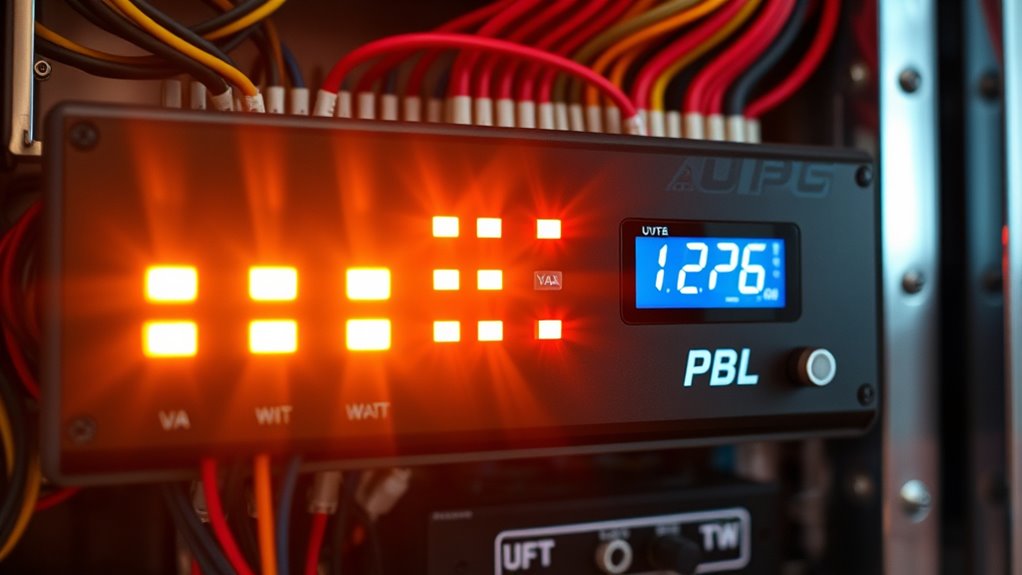
Understanding how VA and Watts relate helps you grasp AC circuit efficiency and UPS sizing. Power factor plays a key role by linking apparent power to real power, showing how effectively electrical energy is used. By calculating apparent power, you can make certain your equipment receives the right capacity without undersizing or overspending. Additionally, considering European cloud innovation can influence energy-efficient and sustainable power management strategies in data centers. Recognizing the importance of contrast ratio in projector image quality can guide you in optimizing your home cinema setup for better viewing experiences. Monitoring energyLast can also provide insights into the overall efficiency and long-term performance of your power systems. Proper understanding of power factor correction techniques can further enhance the efficiency of your electrical systems and reduce energy costs, especially when incorporating wave and wind energy sources for sustainable power generation.
Power Factor’s Role
Have you ever wondered how VA and Watts relate in AC circuits? The key is the power factor (PF), which measures efficiency. In AC systems, VA represents apparent power, while Watts is real power used to do work. The higher the PF, the more efficient your device is at converting apparent power into actual work. When PF is 1.0, VA equals Watts, meaning no power is wasted. But if PF drops below 1, VA increases while Watts stay the same, indicating some power isn’t doing useful work. This impacts sizing because a device with a low PF needs more VA to deliver the same Watts. Understanding this helps you pick the right UPS or generator, ensuring that your equipment gets the power it needs without overspending or undersizing. Power factor is a crucial concept in optimizing electrical systems and avoiding unnecessary costs. Additionally, considering the efficiency of power conversion can lead to better energy management and cost savings over time.
Calculating Apparent Power
Apparent power, measured in volt-amperes (VA), represents the total amount of electrical power supplied to a device in an AC circuit. You calculate it by multiplying the voltage by the current: VA = Voltage × Current. This value includes both the real power used by the device and the reactive power caused by inductance or capacitance. To determine apparent power, you need to know the circuit’s voltage and current ratings. If you have these, just multiply them directly. For example, with a 120V circuit drawing 10A, the apparent power is 120V × 10A = 1200 VA. Keep in mind, this calculation assumes a single-phase AC system. Apparent power sets the upper limit for the power your UPS or generator must handle, regardless of the actual power your device consumes. Understanding the power factor helps you interpret how much of that apparent power is effectively used by the device. Recognizing the difference between VA and Watts is crucial for proper sizing of electrical equipment and ensuring efficiency. Additionally, noting the reactive power component can help in understanding how phase differences impact overall system performance.
Real vs. Apparent Power
In AC circuits, real power (watts) and apparent power (volt-amperes) are related but not the same, which can sometimes cause confusion. Real power measures the actual energy used to do work, like lighting or running a computer. Apparent power combines voltage and current, representing the total power supplied by the source. The key difference lies in the power factor—if it’s less than 1, some energy is stored temporarily in the circuit’s reactive elements, not doing useful work. This means VA can be higher than watts. When sizing equipment like UPS units, you need to account for both, since a high VA rating doesn’t necessarily mean high real power. Understanding this distinction helps you avoid undersizing your equipment and ensures your system operates efficiently. Reactive power is another important aspect that influences the relationship between VA and watts in AC circuits.

OUPES Mega 1 Portable Power Station 2000W (Surge 4500W), 1024Wh LiFePO4 Battery Solar Generator, Expandable to 5kWh, UPS, for Home Backup Power, Camping & Road Trips (Solar Panel Optional)
REVOLUTIONARY FAST-CHARGING TECHNOLOGY: Experience industry-leading recharge speeds with 0-80% capacity in just 36 minutes via AC, or an...
As an affiliate, we earn on qualifying purchases.
Simplifying the Conversion: When to Use 1.0 PF

You can simplify your power calculations by using a 1.0 PF when dealing with resistive loads like heaters or incandescent lighting. When the PF approaches one, it makes VA equal to Watts, reducing complexity. This passive voice detection technique helps you avoid unnecessary errors in your UPS sizing and power assessments. Additionally, understanding the power factor concept can improve the accuracy of your calculations and ensure proper sizing of your UPS system. Recognizing the load types involved is crucial for selecting the appropriate power factor correction methods, which can further optimize system performance. Analyzing the harmonic distortion in your system can also help in achieving more precise sizing and reliable operation. Staying informed about AI job roles and the evolving tech landscape can help professionals better adapt their skills to meet future demands, ensuring they remain valuable in an automated world. This approach saves time and reduces errors in your UPS sizing and power assessments.
Ideal for Resistive Loads
When dealing with resistive loads, using a power factor of 1.0 simplifies the conversion between watts and volt-amperes because it assumes maximum efficiency with no reactive power. In these cases, VA equals Watts directly, making calculations straightforward. Resistive loads, like heating elements, incandescent bulbs, and certain appliances, typically operate at or near PF 1.0, so you don’t need to account for reactive power. When the PF is 1.0, the apparent power (VA) and real power (Watts) are identical, eliminating the need for conversion formulas. This simplifies selecting UPS systems, batteries, or generators, ensuring you size equipment accurately based on real power requirements. Using PF 1.0 for resistive loads provides a clear, direct understanding of power needs without extra calculations.
Simplifies Power Calculations
Ever wonder how to make power calculations simpler? When the power factor is close to 1.0, you can assume PF equals 1.0 to speed up your calculations. This is especially helpful for modern IT equipment and appliances with high efficiency. By treating VA as Watts directly, you avoid unnecessary math steps. For example, if you know your load is 1000 VA and PF is near 1.0, you can confidently say it’s roughly 1000 Watts. This approximation works well when PF is above 0.95. Using 1.0 PF simplifies calculations and reduces errors, making it easier to size UPS systems, batteries, and generators. Just remember, this assumption isn’t perfect for older or legacy devices with lower PF, but it’s a handy shortcut for most modern equipment.
When PF Approaches One
As the power factor (PF) approaches 1.0, simplifying conversions from VA to Watts becomes more precise and efficient. When PF is near unity, VA and Watts are almost equal, so you can treat them as interchangeable. This simplifies calculations, especially for modern equipment with PFs of 0.95 or higher, common in IT gear and appliances. Using 1.0 PF reduces the need for detailed adjustments, saving time and avoiding errors. However, be cautious with older or less efficient devices that might have markedly lower PFs. For those, using the actual PF ensures accurate sizing and power calculations. But for typical modern equipment with PF close to 1, assuming PF = 1.0 is a practical and reliable approximation.
Calculating Watts From VA: Step-By-Step Examples

Calculating watts from VA is straightforward once you understand the role of the Power Factor (PF). To find the real power in watts, multiply the apparent power in VA by the PF: Watts = VA × PF. For example, if you have a 1000 VA UPS with a PF of 0.8, the watt capacity is 1000 × 0.8 = 800 Watts. Conversely, if you know the wattage and want VA, divide watts by PF: VA = Watts ÷ PF. For instance, a 500W load at PF 0.9 requires 500 ÷ 0.9 ≈ 556 VA. These step-by-step calculations help you match your equipment to the right UPS capacity, considering efficiency and power usage. Remember, the PF adjusts VA to reflect actual power consumption in watts.
Why Power Factor Matters for UPS Sizing

Understanding power factor is key to sizing your UPS correctly because it impacts efficiency and energy use. If you ignore PF, you might select a unit that doesn’t provide enough capacity, leading to potential overloads. Accurate UPS sizing ensures reliable backup and ideal energy performance.
Efficiency and Energy Use
Ever wondered why power factor is crucial when sizing a UPS? It directly impacts efficiency and energy use. A low power factor means more apparent power (VA) is needed to deliver the same real power (Watts). This causes the UPS to work harder, consuming more energy and generating more heat. If you size your UPS based solely on Wattage, neglecting the power factor, you might underestimate the required capacity. This leads to inefficiencies, increased electricity bills, and potential equipment stress or failure. A higher power factor means less apparent power is needed for the same load, boosting efficiency. By understanding and accounting for power factor, you ensure your UPS operates effectively, reduces energy waste, and minimizes operational costs.
Accurate UPS Sizing
When sizing a UPS, ignoring the power factor can lead to significant underestimation of the required capacity. Power factor reflects how efficiently your equipment uses electricity, affecting the real power you need. For example, a device with 1000 VA at a PF of 0.8 consumes only 800 Watts, but if you size your UPS based solely on VA, you might choose a 1000 VA unit that’s insufficient for the actual load. Conversely, a device with a high PF (close to 1.0) means VA and Watts are nearly equal, simplifying sizing. To guarantee reliable backup, always convert Watts to VA using the correct PF. Proper sizing accounts for the difference between apparent power (VA) and real power (Watts), avoiding overloads and ensuring your equipment runs smoothly during outages.
Common Mistakes When Converting VA to Watts

Are you often mistaken about converting VA to Watts? Many overlook key details, leading to errors. One common mistake is assuming VA equals Watts without considering the Power Factor. For example, using VA directly as Watts ignores efficiency differences. Another mistake is neglecting the actual PF value—assuming 1.0 when it’s lower results in underestimating power needs. Some also forget to adjust VA based on load type; resistive loads have PF close to 1, but others don’t. Here’s a quick comparison:
| Load Type | Typical PF | Conversion Tip |
|---|---|---|
| Resistive (heaters) | 1.0 | VA = Watts |
| Modern IT equipment | 0.9+ | Watts = VA × PF |
| Legacy PCs | 0.75 | Use actual PF to avoid under-sizing |
| Appliances | 0.8–0.85 | Check specs for accuracy |
| General rule | 1.0 | Don’t assume PF unless specified |
Avoid these mistakes to size your UPS correctly.
Tools and Tables to Make the Math Easier
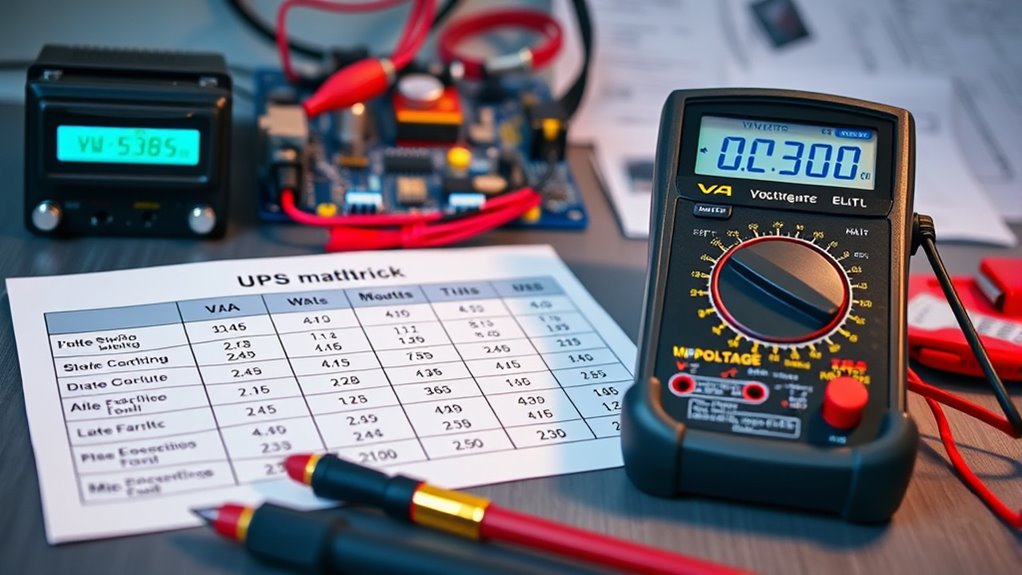
To simplify VA to Watts conversions, you can rely on a variety of tools and tables designed to save time and reduce errors. Conversion tables are the easiest way to quickly find the watts for common VA ratings at specific power factors, such as 0.8 or 0.9. These tables show you at a glance how VA translates into watts without needing to perform calculations each time. Online calculators also help by automating the math; you input VA and PF, and they give you the watts instantly. Smartphone apps and spreadsheets can store these conversions for future use, ensuring accuracy and speed. Using these tools, you avoid mistakes and streamline your power planning, making it easier to size UPS systems and understand power requirements effectively.
Practical Tips for Accurate Power Planning

Accurate power planning starts with understanding the relationship between VA and Watts, and knowing how to account for power factor variations. Always check the equipment’s specified power factor to guarantee you size your UPS correctly. If the PF isn’t provided, assume a conservative value like 0.8 for most appliances and IT gear. When calculating needed capacity, convert Watts to VA by dividing Watts by the PF. For example, a 1000W load at PF 0.8 requires 1250 VA. Remember, sizing your UPS at about 75% of its capacity helps avoid overloads and allows for future expansion. Keep in mind that power factor can fluctuate with load conditions, so overestimating slightly provides a buffer for real-world usage and prevents unexpected shutdowns.
Real-World Scenarios and Conversion Strategies

Ever wondered how to apply UPS sizing and power conversions in real-world situations? Let’s say you have a 1500W server with a power factor of 0.85. To find the required VA, divide the wattage by the PF: 1500W ÷ 0.85 ≈ 1765 VA. When selecting a UPS, size it at about 75% of its capacity to ensure reliability, so choose a UPS around 2350 VA. For a legacy PC drawing 200W at a PF of 0.75, the VA requirement is 200W ÷ 0.75 ≈ 267 VA. Always consider the PF to avoid undersizing. Converting between VA and Watts in real situations helps you match your equipment’s needs precisely, ensuring your backup power system performs when you need it most.
Frequently Asked Questions
How Does Power Factor Affect UPS Capacity Planning?
Power factor impacts UPS capacity planning because it determines how much real power your equipment uses versus apparent power. If your device has a low power factor, you’ll need a larger UPS in VA to support the actual wattage. Ignoring PF risks undersizing your UPS, which can cause it to overload and fail during an outage. Always consider the PF to size your UPS correctly and ensure reliable backup power.
What Is the Difference Between Apparent Power and Real Power?
Apparent power is the total power your device draws from the power source, measured in volt-amperes (VA). Real power, measured in watts, is the actual energy your device uses to perform work. The difference lies in power factor; if it’s less than 1, apparent power is higher than real power. You need to take into account both when sizing UPS systems, ensuring they handle the true energy load efficiently.
When Should I Assume a Power Factor of 1.0?
You should assume a power factor of 1.0 when dealing with DC circuits or resistive loads where reactive power is negligible. For example, if you’re working with DC equipment or pure resistive appliances like heaters, the power factor is fundamentally 1.0, making VA equal to Watts. In most AC circuits with inductive or capacitive loads, you’ll need to use the actual power factor for accurate calculations.
How Do I Convert VA to Watts for Three-Phase Systems?
You can’t just wing it when converting VA to Watts in three-phase systems; it’s like trying to navigate a storm without a compass! To do it right, multiply the VA rating by 1.732 (the square root of 3), then multiply that by the power factor. This gives you the real Watts! Always double-check your power factor to avoid underestimating your system’s true power needs.
Why Is It Important to Consider Power Factor in Backup Systems?
You need to take into account power factor in backup systems because it determines how efficiently your equipment uses electrical power. Ignoring PF can lead to underestimating the actual power your devices need, risking insufficient backup capacity. For example, a device with a low PF consumes more apparent power (VA) than real power (Watts). Properly accounting for PF ensures your UPS or batteries can handle the true load, preventing unexpected shutdowns.
Conclusion
Think of converting VA to watts like tuning a musical instrument. When you understand the right strings to pluck—power factor and circuit details—you get a harmonious result. With a little practice and the right tools, you’ll master the melody of accurate power calculations. Soon, this math will feel natural, helping you avoid dissonant surprises and keep your electrical projects in perfect pitch.