To estimate your overnight power needs without a spreadsheet, list all devices you’ll run at night, note their wattages, and track how many hours each runs. Multiply each device’s wattage by its hours of use to get watt-hours, then add them all together for total energy consumption. Remember to include some extra buffer for unexpected needs. If you keep going, you’ll discover simple ways to refine your calculations and guarantee your power setup is reliable.

Get backup power and energy gear delivered free with Prime
- Fast, free delivery on millions of items
- Prime Video, Amazon Music and more included
- Member-only deals all year
Key Takeaways
- List all devices you’ll run overnight and note their wattage ratings from labels.
- Record the hours each device operates during the night to calculate energy use.
- Multiply each device’s wattage by its operating hours to determine individual energy consumption.
- Sum all device energy values to find your total overnight power requirement.
- Add a safety margin of 20-30% to account for inefficiencies and future power needs.
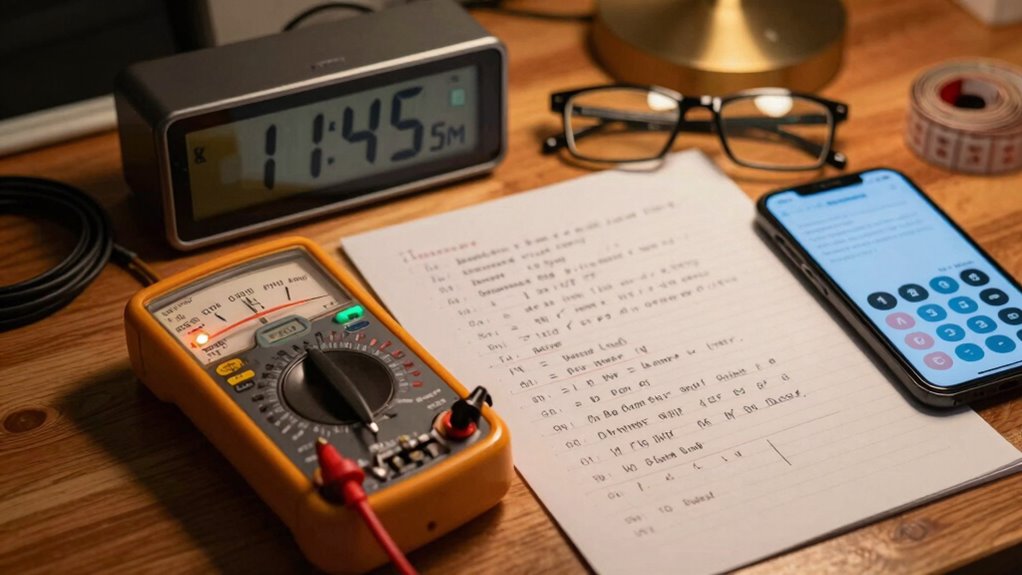
Estimating your overnight power needs is essential for ensuring your devices stay powered without overloading your system. To do this effectively, you need to understand the energy consumption of your devices and how much energy your renewable system can generate or store. One of the key factors here is solar panel efficiency, which determines how well your panels convert sunlight into usable electricity. Knowing this helps you estimate how much energy your panels can produce during the day, which then influences your battery capacity planning for overnight use.
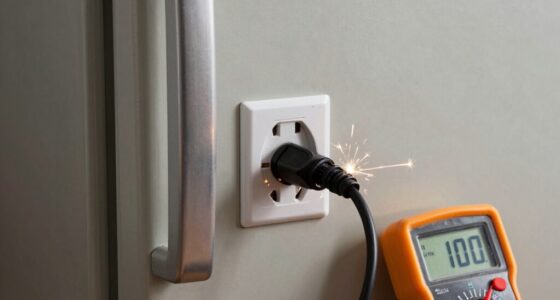
Start by listing all the devices you’ll need to power overnight. Check each device’s wattage rating—usually found on the label—and note how many hours you’ll run it during the night. Multiplying wattage by hours gives you the total energy consumption in watt-hours for each device. Add up these numbers to find your total nightly energy requirement. This step is straightforward but critical, as it sets the foundation for your entire power estimation.
List devices, note wattage and hours, then sum to determine your total nightly energy needs.
Next, consider the solar panel efficiency. If your panels are highly effective, they’ll produce more energy in less space, meaning you’ll need fewer panels or can rely on smaller setups. Conversely, less effective panels require larger arrays to generate the same amount of energy. Knowing the average sunlight hours your location receives helps refine this estimate further. For example, if your area gets about five hours of peak sunlight daily, and your panels have an efficiency of 20%, you can calculate the total energy output per day. This calculation guides your decisions on how many panels to install or whether your existing setup will suffice for both daytime and overnight needs.
Additionally, understanding the solar panel efficiency can help you optimize your entire renewable energy system for maximum performance and reliability. Accurately estimating your energy needs also involves considering potential system losses, such as inverter inefficiency or cable resistance, which can slightly reduce overall energy availability. Battery capacity planning is the next crucial step. You need a battery bank capable of storing enough energy to cover your nightly consumption, with some extra margin for cloudy days or unexpected power demands. To determine the right capacity, take your total nightly energy requirement and add a buffer—typically 20-30%—to account for inefficiencies and future growth. Divide this adjusted number by the battery voltage to find the amp-hour capacity you’ll need. Ensuring your batteries are properly sized prevents power shortages and prolongs their lifespan.
portable solar panel for camping
As an affiliate, we earn on qualifying purchases.
As an affiliate, we earn on qualifying purchases.
Frequently Asked Questions
Can I Estimate Power Needs Without Any Tools at All?
Yes, you can estimate your overnight power needs without tools by focusing on energy conservation and power efficiency. You start by listing devices you’ll use overnight, noting their wattage, and estimating how long they’ll run. Keep in mind that minimizing device usage and choosing energy-efficient appliances reduces power consumption. This simple approach helps you estimate your needs accurately, saving energy and lowering your electricity bill without relying on any tools.
How Accurate Are Rough Estimates Compared to Detailed Calculations?
Rough estimates of power consumption can be surprisingly close to detailed calculations, but their accuracy varies. You might get a decent idea of your overnight power needs, but factors like device efficiency and usage patterns can impact the estimation accuracy. For better precision, detailed calculations are essential. Still, rough estimates are useful as a quick, general guide, especially when you lack tools or detailed data.
What Common Mistakes Should I Avoid When Estimating Power?
You should avoid underestimating power consumption, as it affects your estimation accuracy. Don’t forget to include all devices you’ll use overnight, even small ones, since they add up. Relying solely on rough guesses can lead to errors, so double-check your assumptions. Prevent ignoring real-world factors like device efficiency or power fluctuations, which can skew your estimates. Being thorough will guarantee your power needs are accurately calculated without a spreadsheet.
Is It Necessary to Include Standby or Backup Power in Estimates?
Yes, including standby or backup power in your estimates is essential for emergency preparedness and ensuring power redundancy. You want to be prepared for unexpected outages, so factoring in backup systems helps you plan effectively. Determine the additional power capacity needed for backup generators or batteries. This way, you maintain continuous operation and prevent disruptions, especially during critical overnight hours when access to external power sources might be limited.
How Do I Adjust Estimates for Different Devices or Appliances?
Imagine adjusting a recipe to taste; you tweak ingredients based on their strength and efficiency. Similarly, for device variability and appliance efficiency, you modify your power estimates. Check each device’s wattage and usage hours, then scale your calculations accordingly. More efficient appliances use less power, so reduce estimates. For less efficient ones, increase your baseline. This tailored approach guarantees your overnight power needs are accurate, just like a well-balanced recipe.
deep cycle battery for off-grid power
As an affiliate, we earn on qualifying purchases.
As an affiliate, we earn on qualifying purchases.
Conclusion
By understanding how to estimate your overnight power needs, you’re fundamentally charting a course through the dark, guiding your energy use with confidence. Remember, a simple calculation can illuminate the way, preventing surprises when morning comes. Think of it as planting a seed—you nurture it tonight, and tomorrow, you’ll reap the benefits of a well-planned energy strategy. With these tips, you’re better equipped to keep your power flowing smoothly, even in the quiet hours.
As an affiliate, we earn on qualifying purchases.
As an affiliate, we earn on qualifying purchases.
Halloween Picks
halloween
As an affiliate, we earn on qualifying purchases.