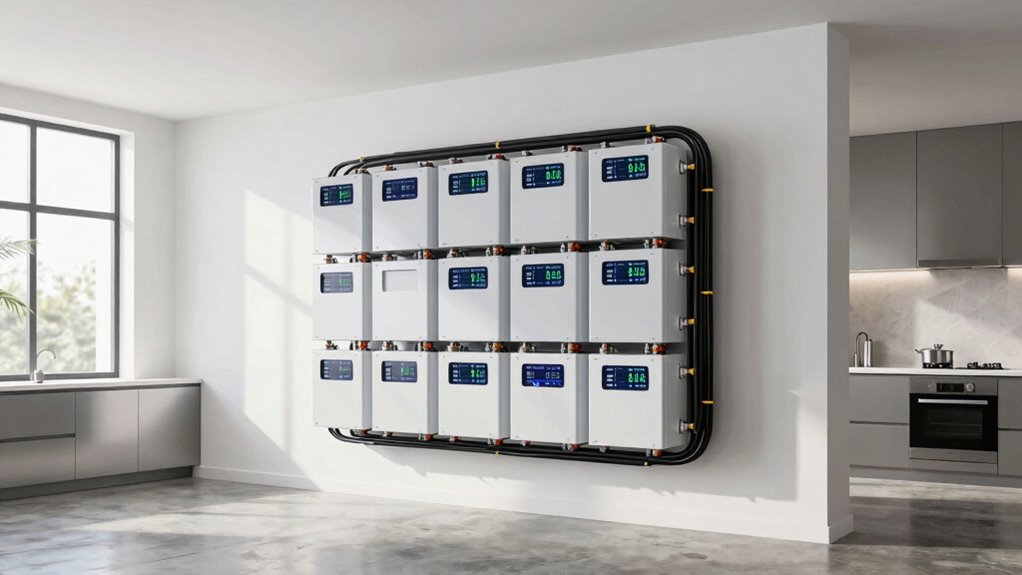

To size your whole house battery backup system accurately, start by listing your essential appliances and estimating their daily energy use. Understand your chosen battery chemistry’s capacity, cycle life, and discharge limits. Balance your current needs with future expansion, and consider temperature impacts. Properly matching battery size to your household demands helps avoid over- or under-sizing, ensuring reliable backup power. Keep these factors in mind, and you’ll discover how to make smarter choices for your system.

Get backup power and energy gear delivered free with Prime
- Fast, free delivery on millions of items
- Prime Video, Amazon Music and more included
- Member-only deals all year
Key Takeaways
- Calculate your total essential load by listing critical appliances and their power consumption during outages.
- Determine daily energy needs to identify the required battery capacity for reliable backup.
- Choose a battery chemistry that balances lifespan, cost, and maintenance suited to your usage patterns.
- Size the system to handle current demands with room for future expansion, avoiding over or under-sizing.
- Consider temperature effects and battery lifespan to ensure long-term performance and optimal system resilience.
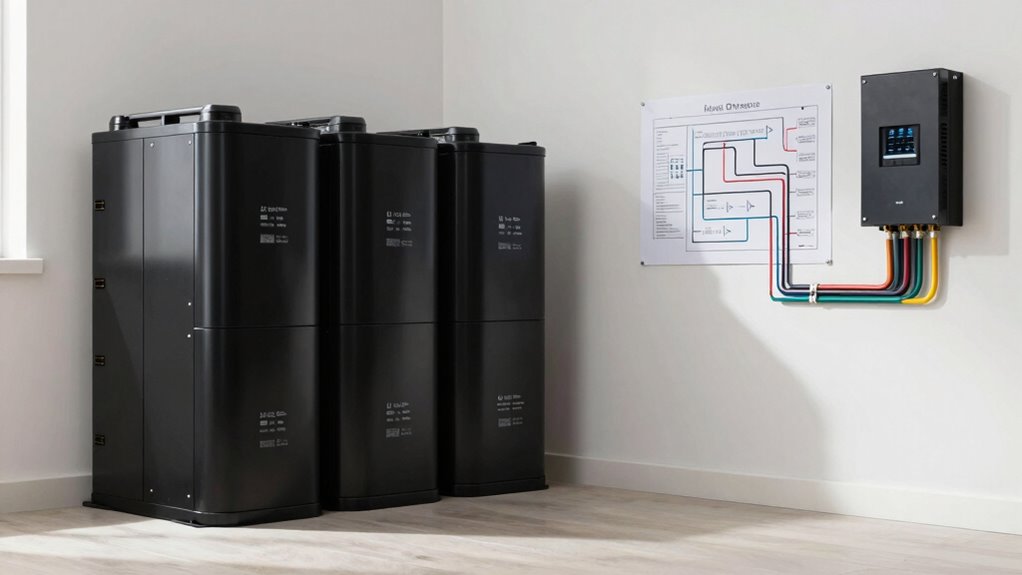
When planning a whole house battery backup system, understanding your energy needs is essential. You need to determine how much power you’ll require during an outage to keep your essential appliances and systems running smoothly. This involves calculating your daily energy consumption, which can be done by reviewing your utility bills or creating a list of critical devices you want to keep operational. Once you have a clear sense of your total energy needs, you can start considering the type of battery chemistry best suited for your backup system. Different battery chemistries, like lithium-ion or lead-acid, have unique characteristics, so knowing their benefits and limitations will help you make an informed choice.
Battery chemistry impacts not just the cost and lifespan but also how you manage charge cycles. Charge cycles refer to the number of complete charge and discharge cycles a battery can handle before its capacity considerably diminishes. For instance, lithium-ion batteries typically offer hundreds to thousands of charge cycles, making them more durable over time, especially if you plan to use your backup system frequently. Lead-acid batteries, on the other hand, usually have fewer charge cycles, which means they might need replacement sooner, but they often come at a lower initial cost. When sizing your system, you should also consider not just your current needs but also the long-term maintenance and replacement costs associated with the battery chemistry you choose.
To accurately size your system, you should also consider how often you expect outages and how deeply you plan to discharge your batteries. Deep discharging can shorten a battery’s lifespan, especially for chemistries with fewer charge cycles. Consequently, if you experience frequent outages, you might want to select a battery chemistry that offers more charge cycles and can handle deeper discharges without significant wear. Balancing your daily energy consumption with the battery’s capacity and longevity is critical to avoid over-investing or under-sizing your backup system. An oversized system might be more costly than necessary, while an undersized one won’t meet your needs during an outage.
Ultimately, the key to sizing a whole house battery backup system without guessing is to carefully analyze your energy needs, understand the implications of different battery chemistries, and account for charge cycle durability. By doing this, you guarantee your investment provides reliable power when you need it most, without unexpected costs or system failures. Taking the time upfront to assess these factors will help you build a resilient, efficient backup system tailored specifically to your household’s demands. Additionally, understanding the energy storage capacity of different batteries can help optimize your system’s size and performance. Recognizing the importance of battery lifespan in your planning process ensures your system remains effective over its intended lifetime. Moreover, considering battery management is essential to maximize performance and extend the overall longevity of your backup system. A thorough understanding of these key factors will enable you to make more informed decisions and enhance your system’s reliability. It’s also beneficial to evaluate how temperature variations can influence battery performance and lifespan, ensuring your system remains dependable in different weather conditions.
whole house battery backup system
As an affiliate, we earn on qualifying purchases.
As an affiliate, we earn on qualifying purchases.
Frequently Asked Questions
How Long Can a Battery Backup Power My Home?
On average, a well-sized battery backup can power your home for 4 to 12 hours, depending on your energy use. Battery chemistry, like lithium-ion, offers higher efficiency and longer-lasting power, while lead-acid batteries may need replacement sooner. Keep in mind, installation costs vary based on system size, but a properly sized system guarantees you stay powered during outages without guesswork, providing peace of mind.
What’s the Lifespan of a Typical Home Battery System?
A typical home battery system lasts between 5 to 15 years, depending on battery chemistry and maintenance. Lithium-ion batteries, common in home backups, usually offer around 10-15 years with proper care. You need to monitor their health and perform regular maintenance, like keeping them cool and avoiding deep discharges. Proper upkeep can extend your system’s lifespan, ensuring reliable backup power when you need it most.
Are There Government Incentives for Installing Backup Batteries?
Yes, government programs and tax credits often make installing backup batteries more affordable. Think of these incentives as your home’s superhero, saving you money while boosting energy resilience. You might qualify for federal or state tax credits, which can substantially offset installation costs. Check local policies, because federal programs like the Investment Tax Credit (ITC) often cover solar and battery systems, turning your backup power dream into reality with less financial strain.
How Do Seasonal Changes Affect Battery Performance?
Seasonal temperature changes directly impact your battery efficiency. In colder weather, batteries tend to perform less effectively because low temperatures reduce chemical reactions, decreasing capacity and runtime. Conversely, higher temperatures can boost efficiency but may also accelerate battery degradation over time. To maintain peak performance year-round, guarantee your battery system is properly rated for seasonal temperature fluctuations and consider installing insulation or cooling solutions to stabilize temperatures.
Can I Upgrade My Battery System Later?
Yes, you can upgrade your battery system later, but you should consider battery capacity and system compatibility first. Make sure your existing setup can handle additional capacity or new components. Upgrading might involve adding more batteries or replacing current ones, so check if your inverter and wiring support these changes. Planning ahead now makes future upgrades smoother and more efficient, helping you maintain reliable backup power without unnecessary hassle.
lithium-ion battery for home backup
As an affiliate, we earn on qualifying purchases.
As an affiliate, we earn on qualifying purchases.
Conclusion
Sizing your whole house battery backup isn’t just math; it’s crafting a shield that stands firm against power outages. Think of it as tuning a musical instrument—you want every string to be just right. When you carefully measure your needs, you’re building a fortress of reliability, not a fragile glass castle. With the right size, your home becomes a steadfast ship, ready to brave any storm that comes its way, keeping your life running smoothly no matter what.
As an affiliate, we earn on qualifying purchases.
As an affiliate, we earn on qualifying purchases.
Fall Picks
fall essentials
As an affiliate, we earn on qualifying purchases.