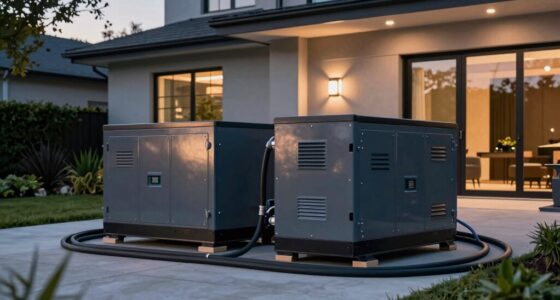
You’ll see that proper placement is key to reducing generator noise because it directly influences how sound and vibrations travel. Even the best barriers and isolators can’t fully block noise if the generator is placed poorly—close to your home or neighbors. Strategic positioning minimizes sound transmission and enhances the effectiveness of accessories. If you want to learn how to position your generator for maximum quietness and what other steps can help, keep exploring how placement sets the foundation.
Get ready for Prime Big Deal Days — try Prime free
Exclusive member deals on October 6–7, plus fast free delivery. Cancel anytime.
As an affiliate, we earn on qualifying purchases.
Key Takeaways
- Proper placement minimizes sound transmission before additional noise-reducing accessories are even considered.
- Incorrect positioning can negate the effectiveness of barriers and vibration isolators.
- Strategic location reduces the need for extensive accessories by addressing noise at its source.
- Sound and vibration behavior are primarily influenced by placement, forming the foundation for effective noise control.
- Accessories like barriers and isolators enhance but cannot replace the benefits of optimal generator placement.
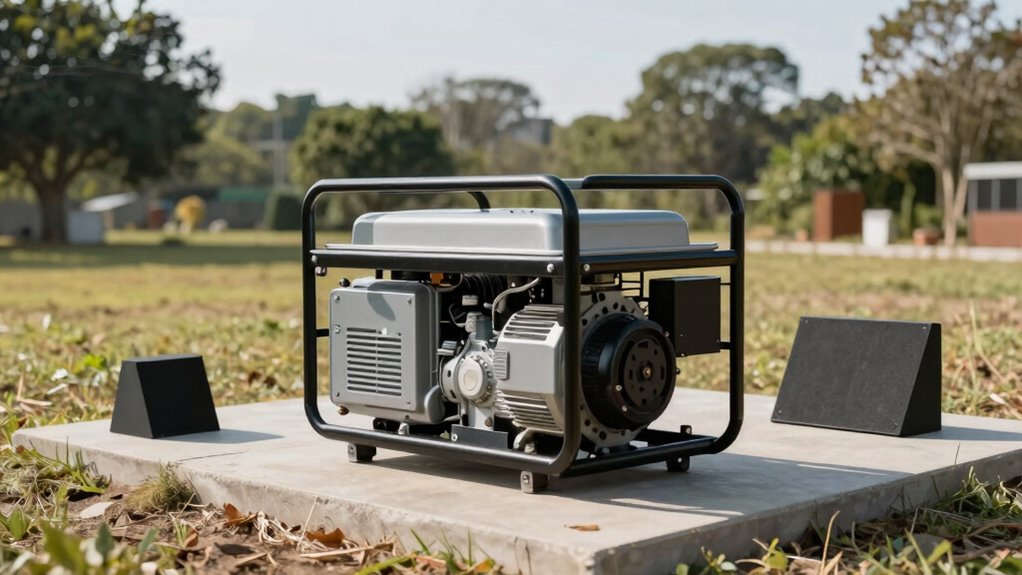
Generators are essential for supplying power during outages or in remote locations, but their noise can be a major nuisance. The key to effectively reducing that noise doesn’t start with fancy accessories or soundproof covers; it begins with proper placement. If you position your generator in the wrong spot, no amount of soundproof barriers or vibration isolators will fully eliminate the noise. Instead, you need to think strategically about where you set it up, considering the environment and how sound travels.
Proper generator placement is key to minimizing noise and maximizing effectiveness.
The first step is to locate your generator away from living spaces, windows, and outdoor gathering areas. An open space or a spot behind natural barriers like trees or hills can help absorb and deflect sound waves. This simple move can greatly reduce the noise reaching your home or nearby neighbors. Avoid placing it in confined areas like sheds or small enclosures, as these can trap sound and amplify vibrations. Proper placement is about creating an ideal distance and orientation that minimizes sound transmission. Additionally, understanding the sound propagation process can help you make more informed placement decisions. Recognizing how vibrations travel through the ground and structures is also crucial in planning effective noise control strategies.
Once your generator is correctly positioned, you can then think about additional measures like soundproof barriers. These barriers act as physical shields to absorb and block noise, but their effectiveness depends on their placement. They’re most useful when installed between the generator and the noise-sensitive areas. Pairing soundproof barriers with strategic placement maximizes noise reduction. Remember, the goal isn’t just to block sound but to divert it away from where it can cause disruption.
Vibration isolators also play an important role. Generators produce vibrations that can travel through the ground and structures, amplifying noise levels. Installing vibration isolators under the generator helps absorb these vibrations, preventing them from transferring to the surrounding surfaces. This reduces the overall noise footprint and prevents vibrations from resonating through the ground or nearby structures. When combined with proper placement and soundproof barriers, vibration isolators create a complete approach to noise reduction. By understanding the environmental impact of noise pollution, you can better tailor your setup to minimize disruption.
In essence, your best bet for controlling generator noise starts with thoughtful placement. It’s about understanding how sound and vibrations behave in your environment and acting accordingly. Accessories like soundproof barriers and vibration isolators are valuable tools, but they’re most effective when used in conjunction with a well-planned setup. By paying attention to where you put your generator first, you set the foundation for a quieter, more neighbor-friendly operation.
generator placement noise reduction
As an affiliate, we earn on qualifying purchases.
As an affiliate, we earn on qualifying purchases.
Frequently Asked Questions
How Does Generator Placement Affect Overall Noise Levels?
Your generator placement considerably impacts noise levels by minimizing sound transmission. Position it away from living spaces and use generator soundproofing techniques like acoustic barriers to block noise. Proper placement reduces vibrations and direct sound travel, making soundproofing more effective. When you combine strategic placement with acoustic barriers, you create a quieter environment, preventing noise from disturbing your surroundings and ensuring your generator operates more discreetly.
What Are the Best Locations for Minimizing Generator Noise?
You should place your generator in a location that minimizes noise impact, such as away from living spaces. Studies show that proper placement can reduce noise levels by up to 50%. Use vibration isolation pads to dampen sound and install soundproof barriers around the generator to block noise transmission. Position it on elevated, stable ground, and behind natural or constructed barriers to effectively minimize generator noise for peace and quiet.
Can Landscaping Help Reduce Generator Noise?
Yes, landscaping can help reduce generator noise. You can plant landscaping barriers like shrubs or trees to absorb sound, and install soundproof fencing around your generator. These barriers act as natural sound shields, dampening noise before it reaches nearby areas. Combining strategic landscaping with soundproof fencing creates an effective noise barrier, making your generator operation much quieter, especially in residential areas.
How Important Is Distance From Living Spaces?
Distance from living spaces is vital for reducing generator noise. As you place your generator, make sure it’s far enough away to minimize sound transmission, using soundproof barriers for added protection. Vibration isolation helps prevent noise from traveling through the ground or structure. You should position the generator strategically, considering both distance and barriers, to keep noise levels comfortable and avoid disturbing your living environment.
Do Noise-Reducing Accessories Work Better Than Strategic Placement?
Noise-reducing accessories are like band-aids—they help, but don’t target the root problem. Strategic placement is more effective because it considers sound absorption and vibration isolation directly at the source. When you position your generator properly, it minimizes noise traveling through the air and structure, making accessories less necessary. Proper placement reduces overall noise more markedly, ensuring your generator stays quieter and less disruptive.
As an affiliate, we earn on qualifying purchases.
Conclusion
Now that you understand how vital placement is, imagine the quiet oasis you could create just by choosing the right spot for your generator. The right placement can turn a noisy nuisance into a distant hum, but what if there’s an even smarter move waiting just beyond your current knowledge? Stay tuned—you might be surprised how the smallest shift could release the peace and quiet you’ve been craving, all starting with where you put it.
As an affiliate, we earn on qualifying purchases.
best location for portable generator
As an affiliate, we earn on qualifying purchases.
As an affiliate, we earn on qualifying purchases.
Flea & tick season Picks
flea and tick prevention
As an affiliate, we earn on qualifying purchases.