TL;DR
Listen free for 30 days with Audible
Thousands of audiobooks and originals — cancel anytime.
Start your free trialAs an affiliate, we earn on qualifying purchases.
Acoustic dampening is about controlling reflections inside a space, while soundproofing blocks noise transfer. Proper placement of panels at reflection points and smart closet ventilation make a huge difference. Moving your rig into a closet can isolate noise but requires careful airflow to prevent overheating.
Ever wonder how some creators get pristine recordings in tiny closets while others struggle with echoes and noise? The secret isn’t just about adding foam or blankets—it’s about strategic placement, understanding what noise is, and controlling heat. You can turn a cramped closet into a quiet, professional-sounding studio with a few smart tricks. This guide breaks down how to dampen sound, where to place treatments, and how to keep your rig cool—without blowing the budget.
Whether you’re building a vocal booth or just trying to silence a noisy gaming rig, the principles are the same. You’ll learn how to treat reflections, block noise leaks, and set up your closet rig for both sound quality and safety. Ready to make your small space work for you? Let’s go.
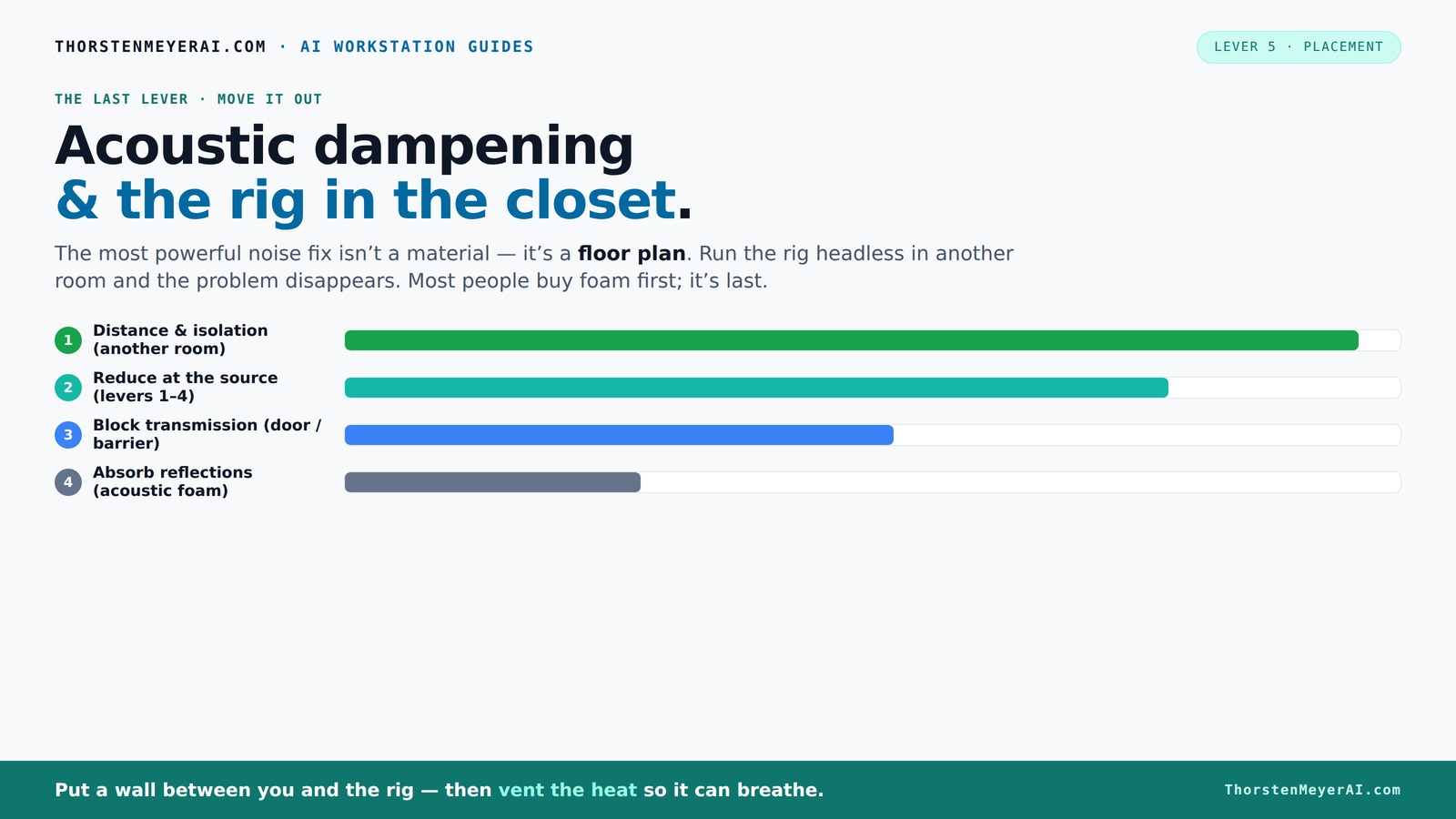
Acoustic dampening
& the rig in the closet.
The most powerful noise fix isn’t a material — it’s a floor plan. A rig you can’t hear because it’s in another room beats any amount of foam. Tap the approaches in Part 1 to see what actually works.
(another room)
(levers 1–4)
(door / barrier)
(acoustic foam)
Contain the noise, not the heat
Key Takeaways
- Always distinguish between acoustic treatment (for sound clarity) and soundproofing (for noise isolation).
- Place panels at the first reflection points—use a mirror to find these spots easily.
- Sealing gaps around doors, vents, and outlets is crucial for noise control.
- In small closets, partial coverage (~20–30%) with thick panels balances echo reduction and natural sound. For more tips, see acoustic dampening techniques.
- Ventilation is critical; don’t trap heat, especially in sealed or semi-sealed closet setups.

Focusound 52 Pack Acoustic Foam Panels 1" x 12" x 12" Sound Proof Foam Panles Soundproofing Noise Cancelling Wedge Panels for Home Office Recoding Studio with 300PCS Double-Side Adhesive
- Soundproofing Design: Triangular grooves for noise absorption
- Includes Adhesive Tape: 300pcs double-sided adhesive for easy installation
- Easy Shape Recovery: Soak in water to restore shape within 48 hours
As an affiliate, we earn on qualifying purchases.
As an affiliate, we earn on qualifying purchases.
The real difference: acoustic treatment vs soundproofing — what you need to know
Acoustic treatment and soundproofing aren’t the same thing, but people often mix them up. Treatment is about improving sound quality inside your space—reducing echoes and controlling reflections. Soundproofing blocks noise from escaping or entering the room—think of it as noise armor.
Understanding this distinction is crucial because it influences your choices. Treatment can make your recordings clearer and more professional by reducing internal echo, but it doesn’t stop noise from outside. Learn more about home decor and acoustic considerations. Conversely, soundproofing is essential if your environment is noisy or you don’t want sound to leak—like recording vocals in a shared space. The tradeoff is that soundproofing often requires more substantial modifications, like adding mass or decoupling structures, which can be costly and complex. Prioritizing treatment first is usually more practical for improving sound clarity, but without soundproofing, noise leaks may persist. Recognizing what you need helps you allocate your budget wisely and avoid unnecessary over-treatment.

HomeProtect Door Draft Stopper 36 Inch Under Door Draft Blocker Door Sweep for Bottom of Door Reduce Cold Air, Soundproof, Light, Odor, Weather Stripping Door Seal Strip Fit for Interior/Exterior
- Cost-effective Draft Prevention: Affordable single-side door draft stopper
- Easy Installation: Simple to measure, cut, and stick
- Universal Fit: Fits doors up to 36 inches wide
As an affiliate, we earn on qualifying purchases.
As an affiliate, we earn on qualifying purchases.
What makes closet-specific problems different? Reflections, standing waves, and noise leaks
Closets present unique challenges because their small, often parallel surfaces create conditions that amplify reflections and standing waves. Imagine shouting in a narrow hallway versus an open field; in the closet, sound bounces back and forth, causing echoes and muddiness, especially noticeable with vocals or delicate instruments. For instance, if you record singing in a tiny closet, you might notice a boxy sound—this is due to reflections bouncing between the walls. Standing waves can cause certain low frequencies to be overly loud or boomy, making your mix sound unbalanced. Additionally, gaps around doors, vents, and outlets act as noise leaks, like tiny holes in a barrier, allowing external sounds (like street noise or neighbors) to seep in and internal sounds to escape. Recognizing these issues helps you target your treatment effectively.
For example, if your microphone picks up a humming noise when you record, it might be coming through a gap around the door or an unsealed vent. Sealing these leaks is as important as adding foam panels. To address reflections, use the mirror trick: position yourself at your recording spot and hold a small mirror against the wall. For more DIY tips, visit the DIY Greenhouse. Wherever you see a reflection of your mic or speakers, consider placing acoustic panels there. Over-treating the space can deaden it, making recordings sound dull and unnatural, so focus on the main reflection points and problem areas. You might find useful insights on home improvement and acoustic treatment.

Sound Addicted - Studio Monitor Isolation Pads for 5 Inch Monitors, Pair of Two High Density Acoustic Foam which Fits Most Speaker Stands | SMPad 5
- Material: High-density acoustical foam (50kg/m^3)
- Dimensions: 7.5'' x 11'' x 1.6''
- Weight Capacity: Holds up to 24 lb per pad
As an affiliate, we earn on qualifying purchases.
As an affiliate, we earn on qualifying purchases.
Frequently Asked Questions
Do I need bass traps in a tiny closet for vocals?
Bass traps can help if your closet has noticeable low-end buildup or standing waves, but usually, broad absorption panels and strategic placement address most issues. In small spaces, focus on treating reflection points first. The tradeoff is that bass traps are more expensive and take up space, so prioritize treating mid and high frequencies unless low-end issues are severe.Where should I place acoustic panels—on the walls or the ceiling?
Start with wall placement at the first reflection points, as these are the spots where sound bounces directly to your ears or mic, causing muddiness. Adding panels behind your mic or speakers can further reduce rear or side reflections. Ceiling treatment can be beneficial if sound bounces down from above, but in small closets, wall placement often yields the most noticeable improvement. Over-treating the ceiling can deaden the space if not balanced properly.Can blankets or moving pads really help reduce noise leaks?
Yes. Heavy blankets or moving pads are effective for sealing gaps, covering reflective surfaces, and muffling sound. They are especially useful for quick fixes or low-budget setups, but they may not provide as consistent or long-term results as specialized acoustic treatments. Their main advantage is flexibility—they can be moved or adjusted as needed—and they help prevent external noise from entering and internal noise from escaping, which is critical in shared spaces.Is it better to face the mic toward the wall or away from it?
Generally, position the mic away from reflective surfaces and toward the sound source to minimize room coloration. Placing the mic facing a wall can cause unwanted reflections that muddy the recording. Using a reflection filter or shield behind the mic can significantly reduce rear reflections, improving clarity. The tradeoff is that some room tone may be lost, so it’s about balancing direct sound with controlled reflections.How do I keep my rig cool in a sealed closet?
Proper ventilation is essential to prevent overheating. Use passive vents, quiet exhaust fans, or ducted cooling systems that move heat outside without introducing noise. Consider high-quality, low-noise fans or even small ducted AIO liquid coolers that export heat externally. The tradeoff is that increased airflow can introduce noise if not carefully managed, so selecting quiet fans and designing an effective ventilation path is key to maintaining both cool temperatures and acoustic integrity.
8" Room to Room Air Transfer Fan for Quietly Circulating Air, Reversible Airflow Design, 320 CFM Programmable Through Wall Fan, Durable Build Quality, 10 Speed Thru Wall Exhaust Fan for Closet,Laundry
- Quiet air circulation: Circulates air quietly between rooms
- Powerful airflow: 320 CFM for effective air movement
- Reversible airflow: Easily switch airflow direction
As an affiliate, we earn on qualifying purchases.
As an affiliate, we earn on qualifying purchases.
Conclusion
Turning a closet into a quiet, effective recording space is about smart placement, strategic treatment, and thoughtful ventilation. You don’t need a full construction project—just focus on the critical points and keep heat in mind.
Remember, the best setup is one that balances sound quality with safety and practicality. Your closet rig can become your secret weapon for clean, focused recordings—just make sure it doesn’t turn into a hot, noisy mess.
College move-in / dorm season Picks
dorm essentials
As an affiliate, we earn on qualifying purchases.