
TL;DR
A solar backup power bank stores electricity for later use and can recharge from a wall outlet, vehicle, or solar panel. Small banks with built-in panels usually add charge slowly, while portable power stations paired with larger panels can support more devices. Compare usable watt-hours, output limits, and realistic charging conditions before you buy.
A solar panel on a pocket power bank can look reassuring in a blackout, but a strip of sunlight on its casing may take hours to add a modest amount of charge. The word solar tells you how a battery can recharge, not how much backup power it holds or how quickly it can refill.

Get backup power and energy gear delivered free with Prime
- Fast, free delivery on millions of items
- Prime Video, Amazon Music and more included
- Member-only deals all year
This guide explains the two products often sold under the same name: small solar power banks and larger portable power stations. You’ll learn how to compare capacity, estimate runtime, understand solar charging limits, and check whether a unit can run the devices you care about. Picture a rainy evening with a phone at 8% and a fridge humming in the kitchen: those needs call for very different batteries.
Choose between a pocket-sized USB bank and a portable power station by listing the devices you need to run.
Use Wh as a practical comparison point, and allow for conversion losses when estimating runtime.
Treat advertised solar wattage as a peak figure; shade, angle, temperature, weather, and input limits affect charging.
Check ports, voltage, continuous and surge wattage, and charging standards before matching a battery to an appliance.
Confirm safety protections, water-resistance ratings, pass-through limits, and current airline rules for your exact model.
Know Which Kind of Solar Backup Power Bank You’re Buying
A solar backup power bank is a rechargeable battery that stores electricity and can be replenished from a wall outlet, a vehicle, or solar panels. The label covers both pocket-sized USB chargers and larger portable power stations, whose size, charging speed, and intended jobs differ substantially.
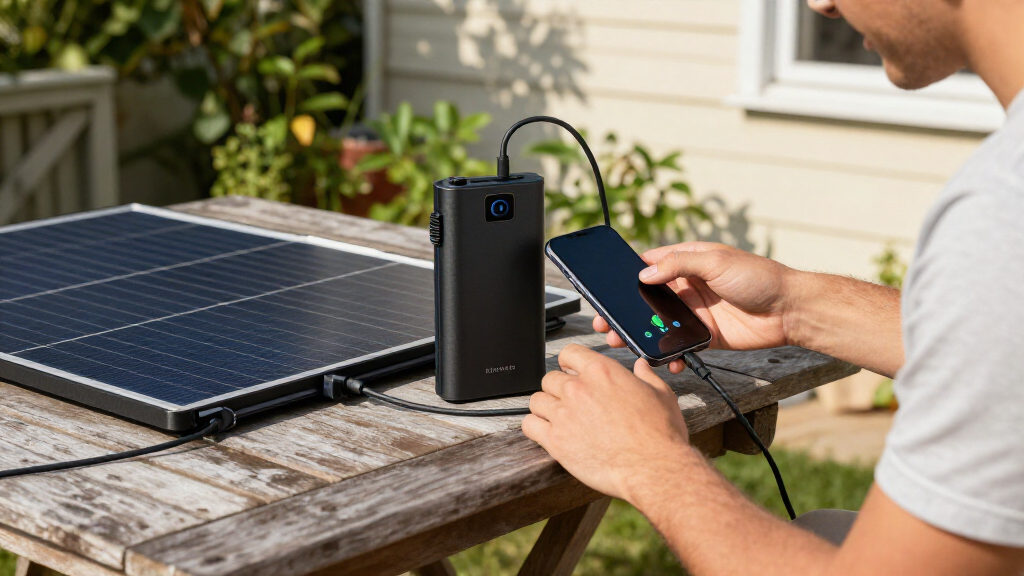
A small bank may fit in a jacket pocket and include a panel on its shell. That panel can help top up the battery during a long hike, but it’s usually meant for emergency trickle charging, not a fast refill. A portable power station is closer to a compact battery box: it often has USB ports, an AC outlet, a larger battery, and a connection for folding solar panels.
For example, imagine you’re spending one night in a tent and mainly need to recharge a phone. A compact bank may be enough if you charge it fully before leaving. If you want to run a laptop, lights, or a medical device through a longer outage, a station with a separate panel may suit the job better. The extra capacity also brings more weight and bulk.
Ask what you need powered, for how long, and where you’ll carry the battery. The answer will usually tell you which category to compare. A pocket bank’s solar panel and a station’s folding array may both use sunlight, but they don’t offer the same amount of backup.
Products Worth Considering

Levoit Core 400S-P Smart Air Purifier for Large Rooms

eufy Security eufyCam C37 4-Camera Kit with 360° Pan and Tilt, Auto Tracking, 2K Video, and Solar Panels

Shark Pet Cordless Stick Vacuum, Up to 40-Minute Runtime, Lightweight, Ocean Blue, IX141
As an affiliate, we earn on qualifying purchases.
Use Watt-Hours to Estimate How Long Your Devices Will Run
Watt-hours (Wh) offer a useful way to compare battery capacity and estimate how long it might power a device. For a rough estimate, divide usable battery energy by the device’s power draw in watts; actual runtime will be shorter because of conversion losses, battery reserves, and changing device use.
Suppose a power station has 500 Wh of rated capacity and your laptop draws 50 watts. A simple calculation gives 10 hours, but that number assumes all stored energy reaches the laptop. An AC inverter, which converts battery power into the form an outlet uses, loses some energy along the way. A more cautious estimate leaves room for those losses and avoids draining the battery completely.
Small banks often list capacity in milliamp-hours (mAh), but that figure can be awkward to compare because it doesn’t always describe the usable energy at the output. A bank’s voltage and the device being charged matter. Wh gives you a more consistent starting point for comparing batteries of different sizes.
Before buying, list the devices you expect to use. If a 10-watt light runs for five hours, it needs about 50 Wh on paper; if you also want to charge a phone and laptop, add their energy needs and allow for losses. That quick calculation is more useful than choosing a battery because its capacity number sounds large.
See Why Solar Charging Takes Longer Than the Package Suggests
Solar charging time depends on the panel’s output, sunlight, angle, shade, temperature, and the battery’s input limit. A panel’s advertised wattage is a peak rating, so it describes a best-case moment rather than a steady stream of energy from dawn to dusk.
Think of setting a folding panel beside a tent. If you angle it toward bright midday sun and move it as the sun shifts, it may collect far more energy than if you leave it flat under a tree. Passing clouds, dust, heat, and even a shadow from a branch can reduce output. The battery may also cap how quickly it accepts incoming power.
A built-in panel on a pocket power bank is usually small, so it can be handy for slowly adding charge during an outdoor trip without a wall outlet. It’s a poor plan to count on that panel to refill an empty battery before you need your phone for navigation. A portable station connected to a larger panel gives you a more practical setup for recharging, though it still depends on daylight and panel conditions.
Use manufacturer charging estimates as best-case guidance, then leave extra time in your plan. For a blackout, charge the battery from the grid ahead of time if you can. Treat sunlight as a way to extend your supply, especially when weather or shade makes the next few hours unpredictable.
Match the Outputs to the Devices You Need to Power
Capacity alone doesn’t determine compatibility: your battery also needs the right port, voltage, charging standard, and power output for each device. Check continuous wattage for normal operation and surge wattage for the brief extra demand some appliances draw when they start.
For instance, a station may have enough stored energy to run a small fridge for a while, yet its inverter may not handle the fridge’s startup surge. A laptop might charge through a USB-C Power Delivery port, but only if that port supports the laptop’s required wattage. USB-A, USB-C, and AC outlets each have different limits; a port that fits the plug may still deliver too little power.
Build a short checklist before you shop. Find the wattage on the device label or in its manual, note its plug type, and check the battery’s output specifications. If you’re planning for a CPAP machine, follow its manufacturer’s backup-power advice and account for the intended runtime. Medical equipment needs a dependable plan that fits the specific device.
Here’s a useful distinction: energy capacity tells you how long a battery may last, while output power tells you whether it can run the device at all. A large battery with a low output limit may fail to power an appliance; a powerful outlet paired with a small battery may run it only briefly.
Compare Chemistry, Durability, and Safety Before You Buy
Battery chemistry can affect weight, cost, thermal behavior, and how many charge cycles a battery can handle. Lithium-ion batteries are common in compact banks, while many current power stations use lithium iron phosphate, or LiFePO₄, which typically offers longer cycle life and better thermal stability but can add weight and cost.
Those tradeoffs matter when you choose a battery for a specific routine. A camper who carries a station between the car and campsite may prefer lower weight; someone setting up backup power at home may place more value on cycle life. Cycle-life figures come from tests under stated conditions, so they don’t guarantee an exact number of years in your home.
Check for credible safety certifications, overcurrent and temperature protections, clear operating limits, and a useful warranty. If a product says “rugged,” look for an actual water-resistance rating instead of assuming it can survive rain or submersion. Keep ports dry and follow the manual’s instructions, particularly when charging outdoors.
Newer models may offer USB-C Power Delivery, higher-wattage charging, app monitoring, expandable batteries, or pass-through operation while charging. Those features can help, but they don’t make every new model better. Compare the input limits, panel quality, warranty, and specifications for the exact unit you’re considering, not just the feature list.
Make a Backup Plan That Still Works After the Sun Sets
A solar backup plan works best when you match stored energy to a short list of priorities, then treat sunlight as a way to replenish that supply. A charged battery can keep selected devices running during an outage, but not every model can switch safely and without interruption between grid and battery power.
- List the essentials: Write down the devices you need, their wattage, and the hours you expect to use them.
- Estimate the energy: Multiply watts by hours for a rough Wh total, then leave room for conversion losses and a reserve.
- Check the ports and limits: Confirm continuous and surge output, voltage, connector type, and the device’s charging requirements.
- Plan your recharge: Check solar input limits and panel requirements, and consider a wall or vehicle recharge before an outage.
- Read the operating instructions: Check whether pass-through charging is supported and how the battery handles high loads.
For a weekend camper, the plan might mean one precharged bank for a phone and headlamp, plus a larger station if a laptop matters. At home, someone may prioritize a router, a few lights, and phone charging rather than trying to run every appliance. Those plans also need enough daylight and safe places to put panels.
Air travel adds another constraint: battery energy limits and airline rules apply, and large power stations generally can’t travel as ordinary consumer power banks. Check current rules for your specific battery and airline before flying. A compact bank for a backpack and a station for a car camping trip call for different travel plans.
Frequently Asked Questions
Can a solar power bank charge itself in sunlight?
Usually, if it has a built-in panel, but the small panel may add charge slowly. For example, a pocket bank left in shifting shade may gain little before evening, so charge it fully from a wall outlet before a trip.
How long does solar charging take?
There’s no single charging time: battery size, panel output, sunlight, shade, temperature, and the unit’s input limit all matter. Manufacturer estimates are best-case guidance, so allow extra time if clouds or shadows are likely.
Can a solar power bank run a fridge, CPAP machine, or laptop?
Possibly, if its output rating, ports, and stored energy fit the device. Check continuous and startup wattage for a fridge, and follow the medical-device maker’s backup-power guidance for a CPAP machine.
How big a battery do I need?
Add up the energy needs of your intended devices and allow room for conversion losses and a reserve. As a rough estimate, multiply each device’s watts by the hours you’ll use it, then compare the total with the battery’s usable Wh.
Are solar backup power banks useful during a blackout?
They can keep selected devices charged or powered within their capacity. A precharged battery can help right away; solar replenishment depends on daylight, and not every model supports uninterrupted switching between grid and battery power.
Conclusion
Choose your battery around the devices you need, the hours you need them, and how you’ll recharge. A small solar panel on a pocket bank can lend a hand, but it shouldn’t be your only plan for refilling an empty battery; a larger panel and station can support more, with extra weight and cost.
Do the watt-hour math, check the outputs, and charge the battery before the sky turns dark. In an outage, a careful plan beats a glossy solar symbol.