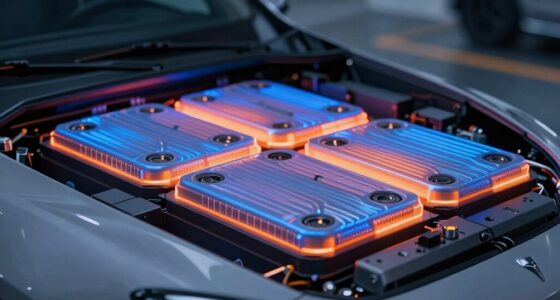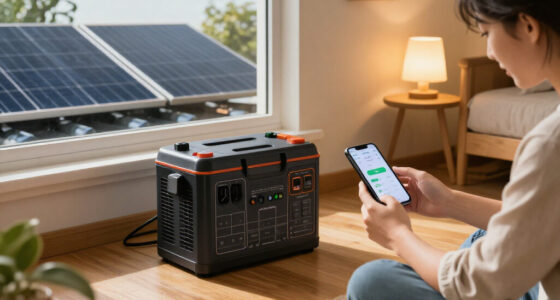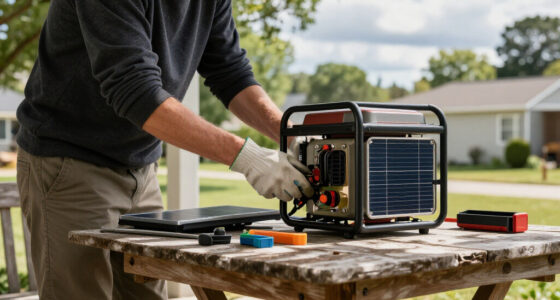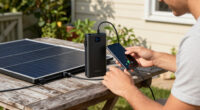
Shopping for a solar backup power bank often means choosing between two products sold under similar labels but built for different jobs: a compact power bank with a small integrated solar panel, or a larger battery station that accepts one or more external solar panels. The compact option is for topping up phones and small devices while traveling; the station is for storing useful backup power at home, at a campsite, or during an extended outage.

Get backup power and energy gear delivered free with Prime
- Fast, free delivery on millions of items
- Prime Video, Amazon Music and more included
- Member-only deals all year

YELOMIN 38,800mAh Solar Power Bank with USB-C and Dual LED Flashlights
- ✔ Battery capacity: 38,800mAh
- ✔ Weight: 9.9 oz
- ✔ Ports: 2 USB-A outputs; 1 USB-C input/output

BLAVOR 20,000mAh Solar Power Bank with Wireless Charging
- ✔ Battery capacity: 20,000mAh
- ✔ Built-in cables: 4: 2 USB-C, 1 iOS, 1 USB-A
- ✔ Charging ports: 3: USB-C, USB-A, iOS

BLAVOR 10,000mAh Solar Power Bank with Wireless Charging
- ✔ Battery capacity: 10,000mAh
- ✔ USB-C output: Up to 20W
- ✔ Number of ports: 3
The central tradeoff is portability and low upfront cost versus usable capacity, charging speed, and the ability to power more than USB devices. Small built-in panels can add charge over time, but they are rarely a fast way to refill a depleted battery. A battery station costs more and takes up more space, yet a compatible panel can make it a more practical source of replenishable backup power. Choose A for a lightweight phone-charging backup; choose B if you need meaningful household or multi-device power.
At a Glance
| Criteria | Compact solar power bank | Expandable solar battery station | Winner |
|---|---|---|---|
| Portability | Pocket-sized; easy to carry | Larger and heavier; often needs a vehicle or dedicated carrying space | A |
| Stored capacity | Low; suited to small electronics | Higher; varies widely by model and expansion setup | B |
| Solar charging | Small built-in panel; typically slow | External panels can provide more practical charging when conditions and compatibility allow | B |
| Devices supported | Phones, earbuds, and some small USB devices | USB devices plus selected AC or DC devices, within rated limits | B |
| Outage usefulness | Useful for keeping communication devices charged | Can support multiple devices and some small appliances for a limited time | B |
| Upfront cost | Usually lower | Higher, with panel costs sometimes separate | A |
| Best setting | Day trips, travel, and personal emergency kits | Home backup, car camping, and longer off-grid stays | Depends |
YELOMIN 38,800mAh Solar Power Bank with USB-C and Dual LED Flashlights
Among these three, YELOMIN puts the most emphasis on stored backup capacity: its stated 38,800mAh is nearly twice the 20,000mAh BLAVOR and well above the 10,000mAh model. That makes it the capacity-first choice for someone who wants a larger reserve for several devices or a longer outing. Its USB-C input/output port and two USB-A outputs offer a straightforward wired setup, though the listed maximum output current is 2.4A and no wattage is supplied for comparison with BLAVOR’s stated USB-C fast charging.The solar claim is more carefully qualified than the BLAVOR listings. YELOMIN says the panel provides supplemental charging in direct sunlight, and warns that a full recharge may take dozens of hours of effective sunlight or longer. That transparency is useful, but it also sets expectations: we would buy it for the battery reserve and consider solar a slow top-up, not a way to restore a depleted bank during a short break outdoors.At 9.9 oz, it is only slightly heavier than the 9.3 oz BLAVOR 10,000mAh despite its much higher stated capacity. It trades away BLAVOR’s wireless charging and built-in cable assortment for that capacity advantage. The dual lights, SOS and strobe modes, carabiner, and port covers make it more clearly geared to an outdoor kit, but buyers who need rapid charging, a known solar rate, or convenient wireless top-ups should look at the BLAVOR options or a different class of solar charger.
Pros:
- Largest stated capacity in this lineup at 38,800mAh.
- Two USB-A outputs plus a USB-C input/output port support multiple wired devices.
- Dual LED lights include steady, SOS, and strobe modes.
- Port covers and a carabiner suit a basic outdoor carry kit.
Cons:
- Solar charging is described as slow and supplemental; a full solar recharge may take dozens of hours of effective sunlight or longer.
- Maximum output is given as 2.4A, without a wattage figure for direct comparison to the BLAVOR USB-C outputs.
- No wireless charging or built-in cable set is listed.
Best for: Campers or travelers who prioritize the largest stated battery reserve and want basic solar input as a slow supplemental feature.
Not ideal for: Buyers relying on solar to quickly refill the bank, or those who want wireless charging, several built-in cable types, or a specified high-wattage USB-C output.
Bottom line: Choose YELOMIN for the lineup’s largest stated reserve, provided we treat sunlight as a slow backup input rather than a dependable full recharge.
“Choose YELOMIN for the lineup’s largest stated reserve, provided we treat sunlight as a slow backup input rather than a dependable full recharge.”
BLAVOR 20,000mAh Solar Power Bank with Wireless Charging
The 20,000mAh BLAVOR is the lineup’s most flexible option when a backup bank needs to serve devices with different connectors. Its four built-in cables—two USB-C, one iOS, and one USB-A—reduce the chance of needing to pack separate leads, while three charging ports and Qi wireless charging add more ways to share power. Compared with the YELOMIN, it gives up some stated capacity but adds wireless charging and a much broader connection setup; compared with the 10,000mAh BLAVOR, it doubles the stated capacity and includes the larger cable assortment.That versatility comes with a larger footprint: its dimensions are 1.5 × 3.85 × 7.28 inches, and the listed battery weight is 29g. Since that weight seems unusually low for a complete 20,000mAh power bank, we would verify it with the seller before using it to plan a strict carry-weight limit. It also has an unresolved output discrepancy: one specification says 18W while the description says up to 20W. Buyers who need a particular fast-charge rate should confirm the correct figure before choosing it.The outdoor extras are extensive, including a three-mode flashlight, camping light, red indicator, compass, thermometer, carabiner, and rope, alongside an IPX5 rating and protective housing. Those features make it more of an all-in-one kit than the YELOMIN’s simpler port-and-light design. But its solar performance is not quantified, so all that convenience does not establish that it can meaningfully recharge itself in sunlight. We would rank it first for device compatibility and convenience, not for proven solar capability.
Pros:
- Four built-in cables cover USB-C, iOS, and USB-A device connections.
- Three ports and Qi wireless charging provide several charging options.
- Outdoor kit includes multiple lights, a compass, thermometer, carabiner, and rope.
- IPX5 rating and protected housing are intended for outdoor use.
Cons:
- Solar charging rate is not specified, so sunlight recharge expectations are unclear.
- Maximum output is inconsistently listed as 18W and 20W.
- The 29g battery-weight listing appears unusually low for this stated capacity and merits confirmation.
Best for: Households or small groups carrying a mix of USB-C, iOS, and USB-A devices who value built-in cables, wireless charging, and outdoor accessories.
Not ideal for: Buyers who need a verified solar recharge rate, a confirmed 20W output, or a compact, clearly documented carry weight.
Bottom line: Pick the 20,000mAh BLAVOR when cable variety and shared-device convenience matter more than a documented solar rate.
“Pick the 20,000mAh BLAVOR when cable variety and shared-device convenience matter more than a documented solar rate.”
BLAVOR 10,000mAh Solar Power Bank with Wireless Charging
This BLAVOR keeps much of the convenience of the larger model in a lower-capacity package. At 10,000mAh, it has half the stated capacity of the 20,000mAh BLAVOR and far less than YELOMIN, so it suits shorter outings or a lighter backup role better than extended power needs. Its listed 9.3 oz weight is not especially light, which means the appeal is more about having a smaller bank with useful features than minimizing every ounce.Charging flexibility remains a strength: the product lists three ports, Qi wireless charging, and up to 20W USB-C output. That puts it ahead of YELOMIN for wireless top-ups and specified USB-C power, while the 20,000mAh BLAVOR goes further for groups through its four built-in cables. The 10,000mAh model does not list those cables, so buyers will need to bring their own and should check which port configuration matches their devices.Its IPX5 rating, described dustproof and shockproof case, dual flashlights, and compass carabiner support outdoor use without the larger BLAVOR’s extra thermometer, camping light, and rope. This is the simplest fit for someone who wants those basics and accepts the smaller reserve. As with the other BLAVOR, solar charging performance is unspecified; a solar panel is not enough information to estimate how quickly this bank can recover. We would choose it for a modest wired or wireless backup, not for a long period away from a reliable recharge source.
Pros:
- Qi wireless charging and up to 20W USB-C output.
- Three ports can support charging multiple devices.
- IPX5-rated case is described as dustproof and shockproof.
- Dual flashlights and a compass carabiner add practical outdoor features.
Cons:
- 10,000mAh is the smallest stated capacity in the group.
- At 9.3 oz, it may feel bulky for a compact backup bank.
- Solar charging rate and expected sunlight recharge time are not specified.
Best for: Day hikers and occasional travelers who want wireless charging, outdoor lights, and a smaller stated capacity than the 20,000mAh BLAVOR.
Not ideal for: People needing a large multi-day reserve, a particularly low carry weight, or a solar charging rate they can plan around.
Bottom line: Choose the 10,000mAh BLAVOR for a feature-rich, lower-capacity backup when wireless charging matters more than maximizing stored power.
“Choose the 10,000mAh BLAVOR for a feature-rich, lower-capacity backup when wireless charging matters more than maximizing stored power.”
As an Amazon Associate we earn from qualifying purchases.
Key Differences
The largest difference is the amount of useful energy available and how it can be replenished. A compact power bank may help keep a phone alive, but its small solar surface generally limits how quickly it can collect energy. It is best treated as a battery you charge ahead of time, with solar as a slow top-up. A battery station holds more energy and can pair with larger external panels, which makes solar charging more practical when the station and panel are compatible and sunlight is adequate.
That added capability has costs beyond purchase price: a station is heavier, takes more storage space, and may require separate panels and cables. Its AC outlets also do not mean it can run every appliance; output limits, battery capacity, and device startup demands matter. For a person who mainly needs emergency phone power, the station may be more equipment than necessary. For a household preparing to charge several devices or run a modest load during an outage, a compact bank is likely to fall short.
Detailed Comparison
Portability (Compact solar power bank wins — major)
A is the clear winner for carrying on foot: it fits a bag or emergency kit and is simple to keep on hand. B is heavier and bulkier, and its panels add more gear. This is a major difference for hikers and travelers, but less important for a home backup unit that can stay in one place.
Stored capacity (Expandable solar battery station wins — major)
B generally stores much more energy, with some models accepting expansion batteries. That gives it more ability to recharge several devices or sustain a small load. A is better suited to a limited number of phone or accessory charges. The capacity gap is major, though actual runtime depends on the specific model and devices.
Solar charging (Expandable solar battery station wins — major)
B usually has the advantage because compatible external panels can collect more sunlight than a small panel built into A. A’s panel may help in an emergency, but charging can be slow and depends heavily on placement, weather, and exposure. The gap is major if solar replenishment is central to the purchase; otherwise it is moderate.
Devices supported (Expandable solar battery station wins — major)
A keeps USB-powered essentials simple: phones, earbuds, and similar small electronics. B may offer USB, DC, and AC outputs, letting it serve a broader set of devices within its rated power limits. That flexibility matters for camping or outages, but check wattage and surge ratings before relying on it for an appliance. B wins by a major margin for mixed device needs.
Outage usefulness (Expandable solar battery station wins — major)
A offers dependable personal-scale backup if charged beforehand, especially for keeping a phone available. B can support several people or selected small devices for longer, so it is more useful when an outage affects a household. Neither should be assumed to power major appliances or provide indefinite energy. B wins by a moderate to major margin depending on the outage plan.
Upfront cost and value (moderate difference)
A usually costs less and is the better value when the real need is one small, ready-to-carry reserve. B costs substantially more, and a useful solar setup may require a separately purchased panel. The premium is worthwhile when its capacity, outputs, and panel compatibility solve a real backup need; it is poor value if it will only charge a phone. A wins on initial cost, while value depends on the intended load.
Setup and storage (Compact solar power bank wins — minor)
A is straightforward to store and use, with little setup beyond charging it and connecting a cable. B requires more planning: confirm panel compatibility, keep the cables accessible, and store the unit and panels where they can be moved safely. A has a minor advantage for simplicity; B’s added setup buys broader capability.
Compact solar power bank: Pros and Cons
Pros:
- Lightweight and easy to carry
- Lower purchase cost
- Simple way to keep a phone or small USB device charged
- Convenient for travel and personal emergency kits
Cons:
- Limited stored energy
- Small built-in solar panels often recharge slowly
- Usually cannot power AC appliances
- Not a substitute for household-scale outage backup
Expandable solar battery station: Pros and Cons
Pros:
- Higher capacity, with expansion available on some models
- Can support more device types and multiple users
- External compatible panels can make solar replenishment more practical
- More useful for home outages and longer camping trips
Cons:
- Higher cost, with panels sometimes sold separately
- Heavy and less convenient to carry
- Runtime and device support depend on capacity and output ratings
- Requires more storage and setup planning
Who Should Choose What
Choose Compact solar power bank if:
- You want a compact backup for phone calls, messages, and small USB devices.
- You travel light or want a power bank that fits in a day bag or emergency kit.
- You mainly want a lower-cost reserve and can recharge it from a wall outlet before use.
Choose Expandable solar battery station if:
- You need to charge several devices or support more than one person during an outage.
- You camp or work off-grid and can carry the station and compatible external panels.
- You have identified the devices you need to run and their power requirements fit the station.
Skip both if: You need dependable, long-duration power for high-demand appliances such as central heating, an electric cooker, or whole-home backup; compare appropriately sized systems and professional backup options instead.
Value for Money
Pay more for B only when its larger capacity, broader output options, or compatibility with external solar panels will be used. For a phone and a few accessories, A gives better value because the station’s extra capacity and weight add little benefit. For planned outages, car camping, or charging several devices, B’s higher cost can be justified, but compare the station and panel as a complete system. Check usable capacity, rated output, panel input limits, charging time, and any expansion costs before deciding. A low-priced station without a suitable panel may not deliver the solar backup you expect.
Final Verdict
Choose A if your priority is a small, inexpensive reserve for phones and other USB essentials. Choose B if you need to store more energy, serve multiple devices, or use compatible external panels for longer backup. The biggest deciding factor is the size and type of load you need to support: a compact bank is the practical personal charger, while a battery station is the more capable backup system. For most buyers seeking actual outage support beyond a phone, B is the stronger choice; pay its premium only after checking that its capacity and output match your intended devices.
Frequently Asked Questions
Can a compact solar power bank recharge itself quickly in sunlight?
Usually not. Its built-in panel is small, so solar charging is best viewed as a slow top-up under good conditions. Charge the bank before a trip or expected outage and treat sunlight as supplemental.
Can an expandable battery station run a refrigerator?
It depends on the refrigerator’s running and startup power, the station’s output rating, and how long it must run. Compare those figures with the station’s specifications and usable capacity; a larger appliance may need a larger system.
Are solar panels included with a battery station?
Sometimes, but often they are sold separately. Check the package contents and confirm the panel’s voltage, connector, and input rating match the station before buying.
Which option makes more sense for an emergency kit?
Choose A for a lightweight kit centered on keeping a phone available. Choose B if you can store and move the extra equipment and need backup for multiple devices or a longer outage.