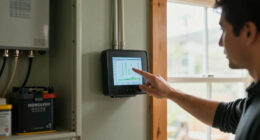

This checklist is for anyone planning an off-grid solar cabin and choosing the core equipment for charging, storing, converting, and monitoring power. It can also help you review a setup you already have and spot compatibility questions to resolve before connecting components.

Get backup power and energy gear delivered free with Prime
- Fast, free delivery on millions of items
- Prime Video, Amazon Music and more included
- Member-only deals all year
The sections follow the power system’s main roles: charge control, battery storage, AC conversion, panel mounting, circuit protection, and battery monitoring. Each section focuses on one named pick and the details to confirm for your own system.
Use the checklist to compare each product’s documented specifications with your system plan. Confirm voltage, current, connections, and intended use across components, and get qualified help when wiring or protection requirements are unclear.
Solar charge controller
A charge controller is the link between the solar array and the battery bank, so matching it to the rest of the system is essential. The Renogy Rover MPPT Solar Charge Controller 60A 12/24/36/48V names four supported system voltages and a 60A rating; use the product documentation to confirm what those ratings mean for your panel configuration and battery chemistry.
A common buying mistake is choosing a controller based only on its headline current or assuming a listed voltage range guarantees compatibility with every array and battery. Check the controller’s allowable solar input voltage, charging limits, battery profile options, and any required temperature sensing or accessories. Confirm the battery bank’s nominal voltage and the array’s electrical configuration before deciding.
For a cabin installation, consider how the controller will be mounted, accessed, and protected from the elements according to its instructions. Verify wire size, terminals, and overcurrent protection with the system design, and make sure the chosen model can handle the array’s expected output. Match the full specifications, not just the product name, before purchase.
What to look for:
- Confirm the battery bank voltage matches a supported 12V, 24V, 36V, or 48V setting.
- Check the maximum solar input voltage against the array’s configuration.
- Verify the 60A rating suits the planned panel output and charging setup.
- Confirm supported battery chemistries and available charge profiles.
- Review terminal, wire, mounting, and protection requirements in the manual.
Renogy Rover MPPT Solar Charge Controller 60A 12/24/36/48V
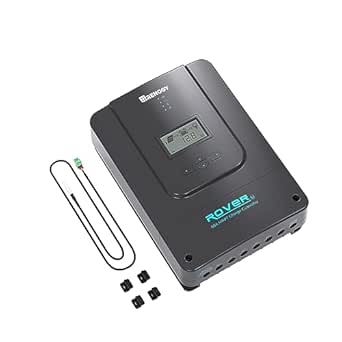
The Renogy Rover MPPT Solar Charge Controller is a versatile 60A device designed for demanding solar systems in RVs, off-grid cabins, and marine setups. It features high efficiency, multi-stage charging, lithium battery recovery, and remote monitoring capabilities, ensuring optimal energy harvest and system protection.
Pros:
- High efficiency with 99.9% multi-peak tracking
- Compatible with various battery types including lithium
- Advanced protection features against surges and temperature extremes
- Remote monitoring and data logging capabilities
Cons:
- Requires separate Bluetooth modules for app monitoring
- Complex setup may be challenging for beginners
- Limited to 60A maximum current
Best for: Cabin plans using a supported system voltage, pending specification checks
Not ideal for: Buyers who cannot confirm array and battery compatibility
Bottom line: Choose this controller only after matching its documented input and charging limits to the complete system.
Deep-cycle batteries
Battery storage determines how much energy a cabin can keep available when solar production is limited. The named pick, 48V 100Ah LiFePO4 Battery – 51.2V Lithium Server Rack Battery, identifies a LiFePO4 chemistry, a 100Ah capacity, and both 48V and 51.2V wording. Check the manufacturer’s documentation to understand the nominal voltage and confirm the exact model specifications.
One frequent mistake is treating capacity or voltage labels as sufficient evidence that a battery will work with a particular controller, inverter, or other batteries. Confirm the operating voltage range, continuous and peak current limits, built-in battery management features, charging requirements, and approved series or parallel configurations. If expanding an existing bank, verify that the manufacturer permits the planned combination and specifies how to configure it.
Think about where the battery will sit, how it will be secured, and whether its environmental and installation requirements suit the cabin. Check the rack dimensions and connection arrangement against the intended enclosure and wiring plan. Compare the battery’s usable capacity and discharge limits with the loads and backup duration you expect. Plan around documented limits and compatibility, rather than relying on a voltage label alone.
What to look for:
- Confirm the exact nominal voltage and operating range for the model.
- Check continuous and peak discharge current against inverter and load demands.
- Review battery management, charging, and temperature requirements.
- Verify manufacturer-approved series or parallel expansion rules.
- Measure rack dimensions and confirm secure installation and connection needs.
48V 100Ah LiFePO4 Battery – 51.2V Lithium Server Rack Battery

This 48V 100Ah LiFePO4 battery is designed for residential energy storage, solar systems, and backup power. It features a high capacity of 5.12kWh, a smart LCD display, and supports expansion up to 315kWh with multiple units.
Pros:
- High-capacity 5.12kWh for reliable energy storage
- Supports expansion for large-scale applications
- Long-lasting with over 6,000 cycles and 10-year warranty
- Built-in advanced safety features with Smart BMS
Cons:
- Requires compatible inverter and installation setup
- Heavy and space-consuming without rack support
- Price not specified in the description
Best for: Cabins whose system is designed for this battery’s verified specifications
Not ideal for: Setups that require unconfirmed voltage or expansion compatibility
Bottom line: Verify the model’s voltage, current, charging, and installation requirements before building around it.
Pure sine wave inverter
An inverter converts battery power into AC power for compatible cabin equipment. The listing Ampinvt 3000W Peak 9000W Pure Sine Wave Inverter, DC 24V to 120V AC wi includes a 24V DC input and 120V AC output, but its truncated ending and the relationship between the 3000W and 9000W figures need clarification from the full product documentation.
A common mistake is sizing an inverter from a peak figure without checking its continuous rating, surge duration, and the startup demands of connected appliances. Confirm that the inverter’s input voltage matches the battery bank, and review output frequency, waveform specifications, grounding instructions, and protection features. Check whether the loads can operate from its output and whether the battery and wiring can supply the required current.
Before choosing this pick, make a load list that accounts for appliances running at the same time and motors or compressors that draw extra power at startup. Review installation clearances, ventilation, cable requirements, and the recommended protective devices. The product name alone does not establish that a 48V battery system can power a 24V-input inverter; resolve voltage matching and the complete ratings before purchasing or wiring.
What to look for:
- Confirm the full model name and the meaning of the listed 3000W and 9000W ratings.
- Match the inverter’s 24V DC input to the battery system or an approved configuration.
- Check continuous output, surge capacity, and surge duration against the load list.
- Verify AC output details and appliance compatibility in the documentation.
- Review cable, ventilation, grounding, and protective-device requirements.
Ampinvt 3000W Peak 9000W Pure Sine Wave Inverter, DC 24V to 120V AC with Battery

This pure sine wave inverter functions as an inverter, battery charger, and AC auto-transfer switch, providing high efficiency and stable power output. It supports various battery types including SLA, AGM, GEL, and Lithium, with multiple working modes and comprehensive protections for reliable operation in trucks, boats, and homes.
Pros:
- High peak and continuous power output suitable for heavy loads
- Supports multiple battery types with adjustable charging
- Multiple working modes and comprehensive protection features
Cons:
- Complex setup with many features may be overwhelming for beginners
- Relatively high power consumption during operation
- Limited detailed user instructions in the description
Best for: A planned 24V system with verified load and inverter specifications
Not ideal for: A 48V bank without an approved way to match the 24V input
Bottom line: Resolve the full ratings and battery-voltage match before selecting this inverter.
Solar panel mounting brackets
Panel mounting affects how an array is positioned and secured, so the product’s actual mounting design must fit the installation. The supplied pick is SolarPlay Q3600 Portable Power Station with 400W Solar Panel. Its name describes a portable power station and a 400W solar panel, but it does not identify a bracket product or establish what mounting hardware is included.
A key buying mistake is assuming a solar panel listing includes brackets suitable for a permanent cabin installation. Check the full product details for panel dimensions, attachment points, included hardware, and whether the panel is intended to be portable or fixed. For a roof, ground mount, or other support, confirm that the mounting system is compatible with the panel and the installation surface.
Before treating this as the mounting pick, clarify whether the article should feature a separate bracket product or whether this portable power station and panel are intended for a different checklist slot. If using the panel, follow its instructions for setup and secure positioning, and account for the location’s conditions and access needs. Confirm what is included and how the panel is meant to be supported; the product name alone cannot answer those questions.
What to look for:
- Confirm whether mounting brackets are included or sold separately.
- Check panel dimensions, weight, and attachment points against the mount.
- Verify the mount is intended for the installation surface and panel type.
- Review setup and securing instructions for the panel’s intended use.
- Clarify whether this portable power station and panel fit the mounting-bracket slot.
SolarPlay Q3600 Portable Power Station with 400W Solar Panel
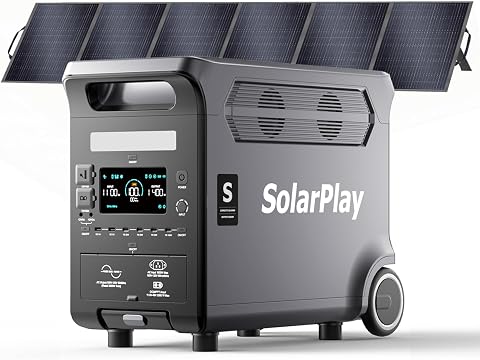
The SolarPlay Q3600 is a high-capacity portable power station featuring a 3840Wh LiFePO4 battery and 3600W continuous AC output (5500W surge). It includes a 400W solar panel and supports ultra-fast charging, reaching full capacity in just 1.5 hours via combined AC and solar input.
Pros:
- Extremely fast charging capability, reaching 100% in 1.5 hours with combined inputs
- High continuous output of 3600W allows operation of heavy-duty appliances like air conditioners
- Long-lasting LiFePO4 battery rated for over 3500 charge cycles
- Quiet operation at ≤30dB makes it suitable for indoor use and campsites
Cons:
- Heavy at 93.7 lbs, requiring wheels and a handle for transport
- Large physical footprint may be difficult to store in compact spaces
- Included solar panel is 400W, which is less than the 2000W max input capability, potentially slowing solar-only charging
Best for: Readers considering the named portable power station and panel
Not ideal for: Permanent installations needing confirmed bracket specifications
Bottom line: Confirm the included hardware and intended mounting method, or choose a separately specified bracket product.
DC circuit breakers
DC circuit protection must be selected to suit the circuit it protects and installed according to the system design. The named pick is 400 Amp Disconnect Knife Switch 3-Pole Circuit Breaker Backup Generato, whose product name provides a 400A figure and three-pole wording but is truncated. Confirm from the complete listing and documentation whether it is a breaker, a disconnect switch, or a combined device.
A common mistake is choosing protection by amperage alone. Verify the device’s DC voltage rating, interrupting capacity, pole configuration, trip characteristics, and suitability for the specific battery or solar circuit. The 400A label does not establish that it is appropriate for a given conductor or equipment. Protection must be coordinated with the wiring and connected components, with the manufacturer’s instructions and applicable requirements in view.
Before buying, identify which circuit needs protection and have its operating voltage and expected fault conditions assessed. Confirm the terminal style, conductor range, enclosure needs, and whether the device can be safely operated in the intended location. Because the listed name is incomplete and the product category is unclear, verify the exact device and ratings rather than relying on the title when planning a cabin system.
What to look for:
- Confirm the full product identity and whether it is a breaker, disconnect, or both.
- Check the DC voltage rating and interrupting capacity for the circuit.
- Verify pole configuration and trip characteristics against the design.
- Coordinate device rating with conductor size and connected equipment.
- Review terminal, enclosure, installation, and operating requirements.
400 Amp Disconnect Knife Switch 3-Pole Circuit Breaker Backup Generator

This 400A 3-pole knife switch features two positions with 9 terminals, suitable for AC or DC applications. It provides a reliable disconnect solution for backup generators and electrical systems.
Pros:
- High current capacity suitable for heavy-duty applications
- Versatile for AC and DC systems
- Reliable disconnect switch for backup generators
Cons:
- Limited information on durability and material quality
- No detailed installation instructions provided
Best for: A circuit whose design explicitly calls for a matching rated device
Not ideal for: Buyers selecting protection from the 400A title alone
Bottom line: Confirm the device type and complete DC ratings with the circuit design before using this pick.
Battery monitor shunt
A battery monitor can help track system use, but its readings depend on correct installation and configuration. The named option, LiTime 500A Bluetooth Battery Monitor for 8V-120V Systems, states a 500A rating and an 8V-120V system range. Check the product documentation to confirm the measurement limits, included components, and supported battery types.
A common mistake is assuming the monitor will report useful capacity without setting its parameters to match the battery bank. Verify how the shunt is installed in the circuit, which conductors must pass through it, and how the monitor is configured for capacity and charge behavior. Confirm its voltage range covers the actual bank and its current rating suits the system’s expected load and charging currents.
Also check the Bluetooth app or display requirements, connection range expectations, and whether the monitor needs a particular phone or software setup. Follow the manufacturer’s wiring instructions so the shunt can measure the intended current paths. Compare the monitor’s specifications with the battery and inverter plan before ordering. Correct installation and setup matter as much as the headline voltage and current range for readings you can use.
What to look for:
- Confirm the battery bank falls within the stated 8V-120V range.
- Check that the 500A shunt rating suits expected charging and load currents.
- Verify supported battery types and configuration settings.
- Review wiring instructions to ensure all relevant current paths are measured.
- Confirm Bluetooth, app, display, and device compatibility requirements.
LiTime 500A Bluetooth Battery Monitor for 8V-120V Systems

The LiTime 500A Bluetooth Battery Monitor allows real-time tracking of battery parameters via a mobile app, supporting various battery types and voltages. It offers customizable alerts, historical data analysis, and reliable protection features for RV, marine, and backup systems.
Pros:
- Real-time monitoring via mobile app
- Supports multiple battery types and voltages
- Customizable alerts for early issue detection
- Provides historical data for performance analysis
Cons:
- Requires smartphone app for full functionality
- Limited to 1-year warranty
Best for: Cabins needing a shunt monitor within its verified voltage and current limits
Not ideal for: Users who cannot follow the shunt wiring and setup requirements
Bottom line: Match the shunt rating and installation plan to the battery bank before relying on its readings.
Set your buying order by the system design: first establish the battery-bank voltage and expected loads, then match the controller, storage, and inverter. Next specify the protection devices and monitoring equipment for those circuits. Resolve the mounting approach alongside the panel choice, especially when a listed product does not clearly identify brackets.
You do not need to settle every equipment choice at once. Work through each specification, keep the product manuals with your plan, and ask a qualified installer to review wiring or protection questions. With compatibility confirmed step by step, you can build a checklist that fits your cabin’s actual power needs.