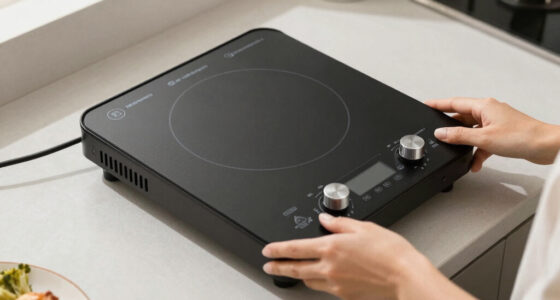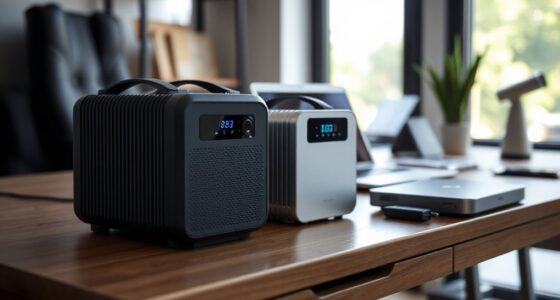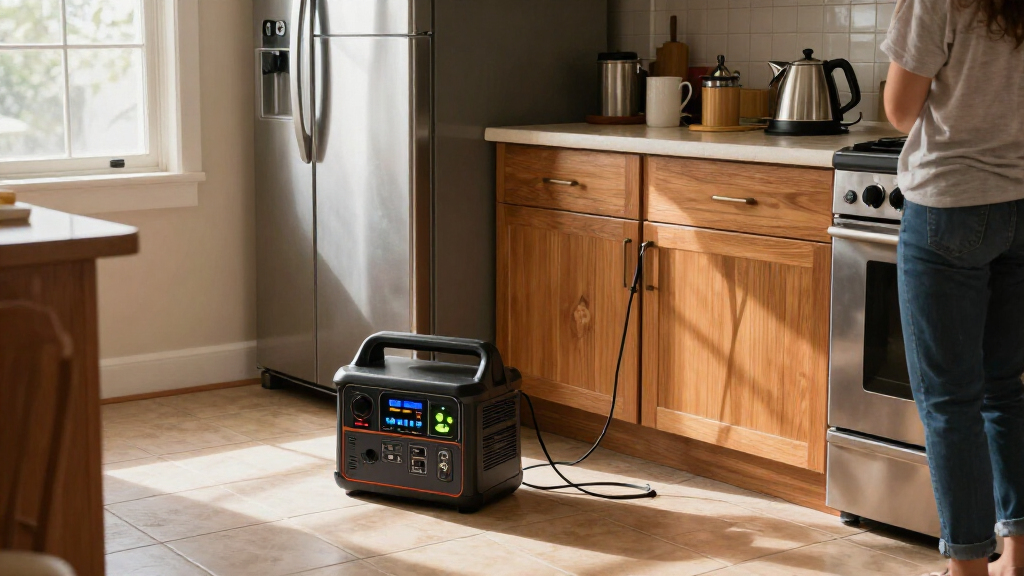
For backup power for kitchen appliances, my best overall pick is the EF ECOFLOW DELTA 3 Classic: its 1,024Wh capacity and 1,800W output balance everyday fridge support with the ability to run more than low-draw essentials. The BLUETTI FridgePower with BC200 stands out for expandable storage, while the Jackery Explorer 2000 v2 suits buyers who want more capacity and output headroom. The key tradeoff is between portability and enough stored energy to keep a refrigerator running through a long outage; rated watts alone do not tell you how long a unit will last. You also need to match inverter output to appliance startup demand and check how each system handles charging and backup switching. Continue reading for the full breakdown of where each option fits and what to verify before choosing.

Get backup power and energy gear delivered free with Prime
- Fast, free delivery on millions of items
- Prime Video, Amazon Music and more included
- Member-only deals all year
Key Takeaways
- The 1,024Wh, 1,800W class is the strongest middle ground in this lineup: the EF ECOFLOW DELTA 3 Classic and CTOLITY XP1000 pair substantial output with more capacity than the compact 292Wh Jackery Explorer 300.
- Large capacity does not automatically mean the best fridge backup: BLUETTI FridgePower is purpose-built and expandable, while the Anker SOLIX S2000 and Jackery Explorer 2000 v2 are general-purpose stations with high capacity.
- Appliance startup demand is a separate hurdle from running watts: a refrigerator can draw a brief surge when its compressor starts, so buyers should compare surge ratings as well as continuous output.
- Specialized systems trade flexibility for a more tailored setup: LiTime Lares K1 and BLUETTI FridgePower are aimed at refrigerator backup, while portable stations can serve more kitchen and household devices.
- The smallest units are for selective backup, not whole-kitchen coverage: Jackery Explorer 300 and LIBRIDS 640Wh make more sense for limited loads than for powering several appliances through an extended outage.
| Jackery Fridge Guard 1024Wh Backup Power Station |  | Best for Refrigerator-Side Backup | Capacity: 1024Wh, expandable to 2048Wh | Maximum output: 800W | Peak output: 1600W | VIEW LATEST PRICE | See Our Full Breakdown |
| EF ECOFLOW DELTA 3 Classic Portable Power Station, 1024Wh, 1800W |  | Best for Mixed Kitchen Loads | Battery capacity and chemistry: 1024Wh; LiFePO4 | Output power: 1800W | Surge power: 3600W | VIEW LATEST PRICE | See Our Full Breakdown |
| BLUETTI Elite 100 Mini Portable Power Station, 1004.8Wh, 700W |  | Best Compact Footprint | Battery capacity: 1004.8Wh | Battery type and cycle life: LiFePO4; 6,000+ cycles | AC output and surge: 700W; 1400W surge | VIEW LATEST PRICE | See Our Full Breakdown |
| Anker SOLIX S2000 Portable Power Station, 2,010 Wh, 1,500 W |  | Best for Longer Refrigerator Runtime | Capacity: 2010Wh | Battery chemistry and capacity: LFP; 314Ah | Continuous and peak output: 1500W continuous; 3000W peak | VIEW LATEST PRICE | See Our Full Breakdown |
| LiTime Lares K1 Fridge Backup System with Inverter Charger |  | Best Expandable Installed System | Capacity: 2304Wh | Continuous and peak output: 2000W continuous; 4000W peak | UPS switchover: ≤10ms | VIEW LATEST PRICE | See Our Full Breakdown |
| Jackery Explorer 300 Portable Power Station, 292Wh |  | Best Compact Pick | Capacity: 292Wh | Peak surge: 600W | Weight: 7.5 lbs | VIEW LATEST PRICE | See Our Full Breakdown |
| LIBRIDS 640Wh Portable Power Station with 600W Output |  | Best for Short Outages and UPS Backup | Capacity: 640Wh | Running output: 600W | Surge output: 1200W | VIEW LATEST PRICE | See Our Full Breakdown |
| CTOLITY XP1000 Portable Power Station, 1024Wh LiFePO4 Battery, 1800W Output |  | Best Fast-Charging Mid-Size Pick | Capacity: 1024Wh | Continuous AC output: 1800W | Peak output: 3600W | VIEW LATEST PRICE | See Our Full Breakdown |
| BLUETTI FridgePower Backup System with BC200 Expansion Battery, 2016Wh Expandable to 4032Wh |  | Best Expandable Refrigerator Backup | Battery capacity: 2016Wh, expandable to 4032Wh | Output wattage: 1800W | Surge wattage: 3600W | VIEW LATEST PRICE | See Our Full Breakdown |
| Jackery Explorer 2000 v2 Portable Power Station, 2042Wh, 2200W |  | Best High-Output Portable Pick | Battery capacity: 2042Wh | Output wattage: 2200W | AC ports: 3 | VIEW LATEST PRICE | See Our Full Breakdown |
| backup power for kitchen appliance | Capacity |
|---|---|
| Jackery Fridge Guard 1024Wh Ba | 1024Wh, expandable to 2048Wh |
| EF ECOFLOW DELTA 3 Classic Por | — |
| BLUETTI Elite 100 Mini Portabl | — |
| Anker SOLIX S2000 Portable Pow | 2010Wh |
| LiTime Lares K1 Fridge Backup | 2304Wh |
| Jackery Explorer 300 Portable | 292Wh |
| LIBRIDS 640Wh Portable Power S | 640Wh |
| CTOLITY XP1000 Portable Power | 1024Wh |
| BLUETTI FridgePower Backup Sys | — |
| Jackery Explorer 2000 v2 Porta | — |
More Details on Our Top Picks
Jackery Fridge Guard 1024Wh Backup Power Station
The Jackery Fridge Guard is the most purpose-built pick here for keeping a refrigerator powered: its slim 2.6-inch profile and included mounting hardware make placement beside or behind an appliance easier than with a conventional portable station. Its 10ms automatic switchover is aimed at maintaining power through an outage, while AC bypass supports normal plugged-in use. At 800W continuous output, it is a better fit for a fridge than for running several kitchen appliances at once; the EcoFlow DELTA 3 Classic offers much more output for broader loads. Jackery lists up to 15 hours of fridge runtime, but actual duration depends on the refrigerator. Capacity can double to 2048Wh, though that requires an additional battery, so the longer-runtime setup takes extra investment and space.
Pros:- Slim profile and included mounting bracket and floor stand suit refrigerator-side placement.
- 10ms UPS switchover helps limit interruptions when utility power fails.
- LiFePO4 battery is rated to retain over 70% capacity after 6,000 full cycles.
- AC bypass and solar charging up to 500W support regular use and backup recharging.
Cons:- 800W continuous output limits use with higher-power kitchen appliances.
- The stated runtime of up to 15 hours varies with refrigerator consumption.
- Reaching 2048Wh requires an additional capacity unit.
Best for: Households seeking a slim, dedicated backup unit that can stay near a refrigerator and switch over automatically during outages.
Not ideal for: Buyers who want to run a high-wattage kitchen appliance or several appliances together; its 800W continuous output is lower than the EcoFlow DELTA 3 Classic’s 1800W.
- Capacity:1024Wh, expandable to 2048Wh
- Maximum output:800W
- Peak output:1600W
- Listed refrigerator runtime:Up to 15 hours; up to 30 hours when expanded
- UPS switching time:10ms
- Solar charging:Up to 500W
- Battery chemistry and cycle life:LiFePO4; retains over 70% capacity after 6,000 full cycles
- Dimensions and weight:5.04 × 16.85 × 29.33 in; 23.2 lb
- Warranty:5 years
Our verdict“Choose the Fridge Guard if refrigerator continuity and a slim, appliance-side installation matter more than high output for multiple kitchen loads.”
EF ECOFLOW DELTA 3 Classic Portable Power Station, 1024Wh, 1800W
For buyers who may need more than refrigerator backup, the EcoFlow DELTA 3 Classic stands out with 1800W continuous output and 3600W surge capacity from a 1024Wh battery. That gives it more room for kitchen appliances with demanding startup draws than the 800W Jackery Fridge Guard, though runtime still depends on what is connected and how it is used. Six AC outlets, app-based monitoring, and under-10ms UPS backup make it flexible for household outage duty. Its fast AC charging can reach 80% in 45 minutes, helping restore reserve between interruptions. The tradeoff is that its extra-battery compatibility is restricted: it does not work with the listed DELTA 2 or DELTA 3 Series Smart Extra Batteries. Solar panels are also optional, not included.
Pros:- 1800W continuous output and 3600W surge capacity suit a wider range of kitchen loads than the Jackery Fridge Guard.
- AC charging reaches 80% in 45 minutes, allowing quicker recovery between outages.
- Under-10ms UPS switching and app controls support outage monitoring and backup settings.
- Six AC outlets and 100W USB-C provide several ways to power household devices.
Cons:- Not compatible with DELTA 2 Smart Extra Battery or DELTA 3 Series Smart Extra Battery.
- The 500W solar panel is optional.
- At 26.7 lb, it is heavier than the Jackery Fridge Guard.
Best for: Households that want one portable station for a refrigerator plus other moderate kitchen or household loads, and value fast recharging and app controls.
Not ideal for: Buyers planning to expand capacity with a DELTA 2 or DELTA 3 Series Smart Extra Battery, or those expecting solar charging equipment to come in the box.
- Battery capacity and chemistry:1024Wh; LiFePO4
- Output power:1800W
- Surge power:3600W
- X-Boost output:Up to 2600W
- AC charging:0–80% in 45 minutes
- UPS switching time:Under 10ms
- Outlets and USB-C:6 outlets; 100W USB-C
- Dimensions and weight:7.9 × 11.1 × 15.7 in; 26.7 lb
- Warranty:5 years
Our verdict“Pick the DELTA 3 Classic if higher output and versatile household use matter more than expandable capacity through the listed EcoFlow batteries.”
BLUETTI Elite 100 Mini Portable Power Station, 1004.8Wh, 700W
The BLUETTI Elite 100 Mini is the space-conscious choice in this group: its compact, upright body takes up less floor area than the Jackery Fridge Guard, which is much taller despite its slim depth. Its 1004.8Wh battery is close in capacity to the 1024Wh units here, but the 700W AC output is the limiting factor for kitchen use. It can suit a refrigerator or lower-draw devices within the output limit, while the EcoFlow DELTA 3 Classic is a stronger match for appliances with higher running or startup demands. Three AC outlets, 140W USB-C, and UPS switching of up to 10ms add flexibility for smaller loads. The compact form does not make it especially light at 23.5 pounds, and the output ceiling narrows its role.
Pros:- Compact dimensions and vertical design occupy a small footprint.
- 1004.8Wh LiFePO4 battery is rated for 6,000+ cycles.
- Three AC outlets plus 140W USB-C and multiple DC ports support varied smaller devices.
- UPS switchover is rated at 10ms or less.
Cons:- 700W AC output can rule out higher-power kitchen appliances.
- 23.5 lb is still a substantial load to move despite the compact body.
- Its three AC outlets offer fewer connection points than the EcoFlow DELTA 3 Classic’s six.
Best for: Apartment dwellers or cooks with limited floor space who need backup for a compatible refrigerator and smaller electronics rather than several high-draw appliances.
Not ideal for: Households needing to power appliances above 700W or wanting more headroom for simultaneous kitchen loads; the EcoFlow DELTA 3 Classic supplies substantially higher output.
- Battery capacity:1004.8Wh
- Battery type and cycle life:LiFePO4; 6,000+ cycles
- AC output and surge:700W; 1400W surge
- AC outlets:3
- USB-C output:140W
- UPS switchover:≤10ms
- Charging sources:Solar, AC, car, lead-acid, and generator
- Dimensions and weight:9.2 × 8.4 × 11.5 in; 23.5 lb
Our verdict“Choose the Elite 100 Mini when a small footprint matters most and your refrigerator and other backup loads stay within its 700W output limit.”
Anker SOLIX S2000 Portable Power Station, 2,010 Wh, 1,500 W
The Anker SOLIX S2000 prioritizes stored energy: its 2010Wh capacity is nearly double the Jackery Fridge Guard’s base capacity, making it a stronger fit when a refrigerator needs backup for a longer stretch. Anker lists up to 35 hours of fridge runtime, though actual time changes with appliance use and conditions. Its 1500W continuous output also gives it more kitchen flexibility than the Jackery, while remaining below the EcoFlow DELTA 3 Classic’s 1800W rating. Eight outlets and under-10ms UPS switching support several connected devices, and the LFP battery is rated for 10,000 charge cycles. The unit weighs 35.7 lb, so it is less convenient to move than the smaller 1024Wh options. It also lacks a 12V DC port.
Pros:- 2010Wh capacity and listed fridge runtime up to 35 hours provide more stored energy than the 1024Wh Jackery Fridge Guard.
- 1500W continuous and 3000W peak output support more than basic refrigerator loads.
- Eight outlets and under-10ms UPS switching serve multiple connected devices during outages.
- LFP battery is rated for 10,000 charge cycles.
Cons:- At 35.7 lb, it is heavier to reposition than the 1024Wh options.
- No 12V DC port for appliances or accessories that require that connection.
- Actual refrigerator runtime varies with usage and conditions.
Best for: Households seeking a higher-capacity station for extended refrigerator backup and several connected devices, with less emphasis on frequent carrying.
Not ideal for: Buyers who need a lightweight portable unit or a 12V DC connection; the Jackery Fridge Guard is lighter, and the Anker has no 12V DC port.
- Capacity:2010Wh
- Battery chemistry and capacity:LFP; 314Ah
- Continuous and peak output:1500W continuous; 3000W peak
- Listed refrigerator runtime:Up to 35 hours
- Solar input:Up to 400W
- Charging methods:AC, solar, wall outlet, generator, alternator charger, and car outlet
- Outlets and UPS:8 outlets; switchover under 10ms
- Dimensions and weight:8.19 × 11.1 × 12.7 in; 35.7 lb
- Warranty:5 years
Our verdict“Choose the SOLIX S2000 for more stored energy and longer fridge-focused backup, provided its weight and lack of a 12V DC port suit your setup.”
LiTime Lares K1 Fridge Backup System with Inverter Charger
The LiTime Lares K1 is the most installation-oriented choice here, combining a 2304Wh battery with a 2000W inverter and support for expansion to 9216Wh. That gives it a stronger path to extended outages than the self-contained 2010Wh Anker SOLIX S2000, and its 4000W peak output offers extra headroom for refrigerator compressor startup. A ≤10ms UPS switchover, touchscreen and app monitoring, plus AC and solar charging make it suited to a planned home backup setup rather than casual portability. It can be mounted on a wall or placed on the floor, but its 26 × 26 × 22-inch dimensions call for dedicated space. At 22kg, repositioning is also a project, so this is less convenient than the more compact portable stations.
Pros:- 2304Wh base capacity can expand to 9216Wh with four batteries in parallel.
- 2000W continuous and 4000W peak output provide more appliance headroom than the Anker SOLIX S2000.
- UPS switching of 10ms or less supports automatic backup during a power interruption.
- AC and solar charging, plus touchscreen and app monitoring, suit a planned home setup.
Cons:- 26 × 26 × 22-inch dimensions require substantial installation space.
- At 22kg, the system is difficult to move regularly.
- Around 40 dB operating noise may be noticeable in a quiet kitchen or nearby living area.
Best for: Homeowners planning a dedicated refrigerator backup installation who may later add batteries for longer outages or broader household coverage.
Not ideal for: Renters, frequent travelers, or anyone without room for a large wall- or floor-mounted system; its dimensions and 22kg weight make it less portable than the Anker SOLIX S2000.
- Capacity:2304Wh
- Continuous and peak output:2000W continuous; 4000W peak
- UPS switchover:≤10ms
- Expansion capacity:Up to 9216Wh with four batteries in parallel
- AC recharge input:Up to 1500W
- Solar input:Up to 800W
- Installation and dimensions:Wall or floor installation; 26 × 26 × 22 in
- Weight and noise:22kg; around 40 dB
- Connectivity and warranty:Wi‑Fi and Bluetooth 5.0; 5-year battery warranty
Our verdict“Choose the Lares K1 if you want an expandable, installed-style refrigerator backup system and have space for its larger footprint.”
Jackery Explorer 300 Portable Power Station, 292Wh
The Explorer 300 is the lightest, smallest-capacity choice here, so I’d pick it for keeping phones, a router, or other low-draw kitchen essentials available—not for running a refrigerator or cooking appliance. Its 7.5-pound weight and integrated handle make it easier to move or store than the 37.5-pound CTOLITY XP1000, while the 292Wh capacity and 300W output impose a much lower ceiling on runtime and appliance choice. Two AC outlets and USB-C PD let it serve several small devices at once, and its LiFePO4 battery is rated for over 4,000 cycles to 70% capacity. Solar charging is supported, but panels are sold separately. The main tradeoff is clear: portability comes at the cost of the output and stored energy needed for substantial kitchen backup.
Pros:- At 7.5 pounds, it is far easier to carry and store than the larger stations in this group
- Six ports, including USB-C PD and two AC outlets, support several small devices
- LiFePO4 battery rated for over 4,000 cycles to 70% capacity
- Can recharge from compatible solar panels
Cons:- 292Wh capacity offers limited runtime for sustained household backup
- 300W rated output rules out many kitchen appliances
- Solar panel is not included
Best for: Apartment dwellers or households seeking a lightweight backup for phones, a router, and other low-wattage essentials during short outages
Not ideal for: Anyone who needs to start or run a refrigerator, microwave, kettle, or other high-draw kitchen appliance
- Capacity:292Wh
- Peak surge:600W
- Weight:7.5 lbs
- AC outlets:2
- Ports:2 AC outlets, 1 USB-C PD, 2 USB-A, 1 car port
- USB-C PD output:100W
Our verdict“Choose the Explorer 300 for portable backup of small electronics, but skip it if kitchen appliances are the priority.”
LIBRIDS 640Wh Portable Power Station with 600W Output
The LIBRIDS stands apart from the Jackery Explorer 300 by offering 640Wh capacity, 600W continuous output, and four AC outlets, making it better suited to several modest loads or a short backup window. Its 10ms UPS switchover is useful for keeping compatible connected equipment powered through an outage, though it does not make the station suitable for appliances that draw more than 600W. A pure sine wave inverter, LCD status display, and eight total ports give the setup practical flexibility, while the stated 1.5-hour AC recharge helps reduce downtime. The tradeoff against the much more powerful CTOLITY XP1000 is lower output and capacity; this is a smaller backup tier, not a refrigerator solution for every household. The metal enclosure is described for indoor and dry, well-ventilated outdoor use only, so moisture exposure is a real limitation.
Pros:- 10ms UPS switchover supports backup for connected devices during an outage
- Four AC outlets and eight total ports accommodate multiple devices
- LiFePO₄ battery rated for 4,000+ cycles
- AC charging is specified at about 1.5 hours
Cons:- 600W continuous output limits the appliances it can run
- 640Wh capacity may provide only a short window for continuous loads
- Must be kept away from rain, moisture, and wet conditions
Best for: Households that want UPS-style backup for low-to-moderate draw devices and several AC connections in a compact station
Not ideal for: Buyers planning to power high-wattage kitchen appliances or use a station outdoors where rain or moisture is possible
- Capacity:640Wh
- Running output:600W
- Surge output:1200W
- Battery type:LiFePO₄
- AC charging time:About 1.5 hours
- UPS switchover:10ms
- Ports:8 total, including 4 AC outlets
- Dimensions:8.3 × 6.9 × 8.2 in
Our verdict“Pick the LIBRIDS for quick-switched backup across modest loads, not for higher-power kitchen appliances.”
CTOLITY XP1000 Portable Power Station, 1024Wh LiFePO4 Battery, 1800W Output
For buyers who need meaningful appliance output without stepping up to a roughly 2,000Wh system, the CTOLITY XP1000 offers a useful middle ground: 1024Wh capacity and 1800W continuous output. That is a major step up from the 600W LIBRIDS, giving it a wider range of potential kitchen loads, while its 37.5-pound weight makes it less convenient to move than the 7.5-pound Jackery Explorer 300. The 1000W AC charging input is specified to fill the battery in an hour, and the 20ms UPS switching adds backup support for connected essentials. Ten ports, including 100W USB-C PD, help serve more than one device. Its limits are practical: capacity still constrains runtime, fast charging needs an AC source, and the substantial weight makes frequent repositioning less appealing.
Pros:- 1800W continuous output supports a broader range of appliances than the LIBRIDS 600W station
- 1024Wh LiFePO4 battery is rated for 4,000+ cycles
- 1000W AC input is specified for a full charge in one hour
- Ten output ports include a 100W USB-C PD port
Cons:- At 37.5 pounds, it is not an easy unit to carry frequently
- 1024Wh capacity offers less stored energy than the BLUETTI FridgePower system
- 20ms UPS switching is slower than the 10ms transfer listed for the BLUETTI FridgePower
Best for: Households seeking a mid-capacity station with enough output for selected kitchen appliances and fast AC recharging between outages
Not ideal for: Buyers who need extended refrigerator backup, a lightweight unit to carry often, or a station whose solar panel is included
- Capacity:1024Wh
- Continuous AC output:1800W
- Peak output:3600W
- Battery type:LiFePO4
- AC charging input:1000W
- Charging time:Full charge in 1 hour; 80% in 45 minutes
- UPS switching time:20ms
- Weight:37.5 pounds
- Output ports:10
Our verdict“Choose the XP1000 for a fast-recharging 1800W station, but look to a higher-capacity system for longer appliance runtime.”
BLUETTI FridgePower Backup System with BC200 Expansion Battery, 2016Wh Expandable to 4032Wh
The BLUETTI system is the clearest fit here for buyers focused on protecting a refrigerator or freezer: it starts at 2016Wh and can expand to 4032Wh, giving it substantially more stored energy than the CTOLITY XP1000. Its 1800W output and 3600W surge capacity offer headroom for appliance startup, while the 10ms UPS transfer is designed to keep connected equipment from dropping out during an outage. Multiple charging options—including solar, car, generator, and lead-acid battery—make it more adaptable to a prolonged disruption than a basic AC-only plan. There are costs in convenience: at 41.9 pounds, moving it is a job, and its 4W standby draw consumes some stored energy even when idle. The listed runtime is only two minutes, so I would not treat that figure as a promise of refrigerator runtime; actual duration depends on load and conditions.
Pros:- 2016Wh capacity can expand to 4032Wh with the included battery system
- 1800W output and 3600W surge capacity are suited to a wider range of appliance demands than the LIBRIDS
- 10ms UPS transfer supports connected appliances during a power interruption
- Supports solar, AC, car, lead-acid battery, and generator charging
Cons:- At 41.9 pounds, it is difficult to move between rooms or carry outdoors
- The listed runtime is only two minutes, so buyers should confirm appliance-specific runtime before relying on it
- 4W standby power draw uses some stored energy while the unit is idle
Best for: Homeowners prioritizing refrigerator or freezer continuity who want a UPS-style system with room to add battery capacity
Not ideal for: People who need a lightweight backup, a simple grab-and-go station, or a clearly stated long runtime for a specific appliance
- Battery capacity:2016Wh, expandable to 4032Wh
- Output wattage:1800W
- Surge wattage:3600W
- UPS transfer time:10ms
- Standby power draw:4W
- Charging sources:Solar, AC, car, lead-acid battery, generator
- Weight:41.9 lbs
- Dimensions:13.78 × 22.83 × 2.95 in
Our verdict“Choose the BLUETTI for expandable, multi-source refrigerator backup, but verify expected runtime for your appliance before depending on it.”
Jackery Explorer 2000 v2 Portable Power Station, 2042Wh, 2200W
The Explorer 2000 v2 pairs 2042Wh of capacity with 2200W output, making it a stronger general-purpose portable option than the CTOLITY XP1000 when an appliance needs more output headroom. It also holds a similar amount of energy to the BLUETTI FridgePower system’s base capacity, but has three AC ports and no stated expansion path, while BLUETTI can grow to 4032Wh. At 39.5 pounds, it is still a substantial lift, though slightly lighter than the 41.9-pound BLUETTI package. AC charging reaches 80% in 66 minutes, and solar charging is supported with compatible panels; neither those panels nor a quiet full recharge are immediate shortcuts, since silent charging takes five hours. Its 20ms backup switching and under-30dB silent mode suit home use, but the stated runtime of 1 hour 7 minutes should be read as load-dependent, not a universal appliance estimate.
Pros:- 2200W output provides more headroom than the 1800W CTOLITY XP1000
- 2042Wh LiFePO4 battery offers substantial stored energy for a portable station
- AC charging reaches 80% in 66 minutes, with solar charging also supported
- Silent charging stays below 30dB
Cons:- At 39.5 pounds, it is heavy to carry regularly
- Capacity is not expandable like the BLUETTI FridgePower system
- Solar panels are optional, and silent charging takes five hours for a full charge
Best for: Households wanting a portable 2200W station for selected kitchen appliances and other essentials, with AC and solar recharging options
Not ideal for: Buyers who need expandable capacity, a light unit to move often, or included solar panels for off-grid recharging
- Battery capacity:2042Wh
- Output wattage:2200W
- AC ports:3
- USB-C PD output:100W
- Battery type:LiFePO4
- Weight:39.5 lbs
- AC charging time:0–80% in 66 minutes
- Backup switching time:20ms
- Silent charging noise:Less than 30dB
Our verdict“Pick the Explorer 2000 v2 for strong portable output and quiet charging, but choose the expandable BLUETTI if growing capacity is the priority.”
How We Picked
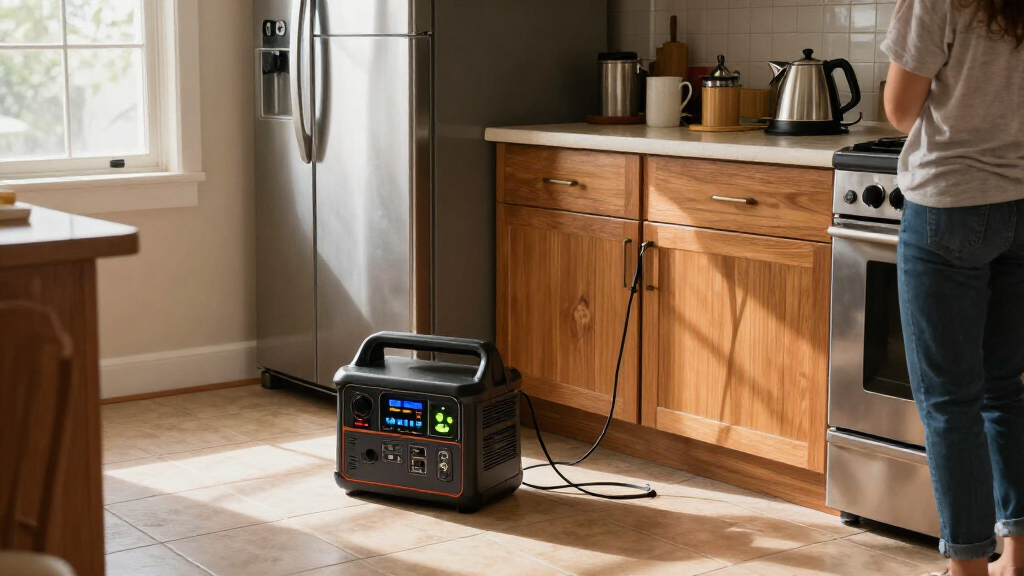
I compared these options by how well their stated capacity and inverter output align with common kitchen loads, especially refrigerators, rather than treating a high wattage figure as a complete measure of usefulness. I also weighed portability, expansion potential, and whether a product is designed as a dedicated fridge backup system or as a flexible portable power station. Since actual runtime depends on the appliance, its duty cycle, and operating conditions, I avoided assuming a fixed number of hours from battery capacity alone.
The ranking favors a practical balance of usable capacity, output headroom, and versatility for typical outage needs. Purpose-built systems gain value for buyers prioritizing refrigerator continuity, while larger stations rank well for longer outages or multiple loads but carry a portability tradeoff. Compact and lower-output models sit lower for broad kitchen backup, though they can still suit buyers with modest, clearly defined needs. I also treated product-specific details such as surge output, transfer behavior, charging options, and expansion compatibility as items to verify before purchase.
Factors to Consider When Choosing Backup Power For Kitchen Appliances
Choosing kitchen backup power starts with the appliances you need to keep running and how you plan to connect them. Capacity, inverter output, and backup behavior solve different problems, so a larger number in one specification cannot compensate for a mismatch elsewhere.
Match Continuous And Surge Output To The Appliance
Start with the appliance label or manual and identify its running wattage, then look for startup or surge requirements. Refrigerator compressors can briefly draw more power as they start, so a station that handles normal operation may still struggle at startup. Add up the running loads only if you plan to operate appliances at the same time, and account for the possibility that a compressor cycles on while another device is active. Heating appliances such as kettles and toaster ovens can consume far more power than a fridge, making simultaneous use a poor assumption on many portable stations. Avoid choosing by the headline wattage alone; check continuous output and surge capability in the product specifications. If the figures are unclear, contact the manufacturer before relying on the unit for critical food storage.
Estimate Runtime From Energy Use, Not Battery Capacity Alone
Watt-hours describe stored energy, not a guaranteed runtime for a particular appliance. A refrigerator’s compressor cycles, and its energy use changes with room temperature, door openings, condition, and settings. For a rough planning estimate, divide the station’s usable watt-hours by the appliance’s average watt draw, then allow for conversion losses and other loads. Treat that result as a planning range, not a promise. Buyers often overestimate runtime by dividing battery capacity by the refrigerator’s rated running watts, which assumes constant operation and ignores losses. If food preservation is the priority, plan for a reserve and decide how you will reduce consumption during an outage.
Decide Whether You Need Automatic Backup Or Manual Plug-In
A portable power station that you connect manually can be a straightforward choice for occasional outages, but it may leave a gap while you move the refrigerator plug. A dedicated backup system may offer a more appliance-focused setup, though the exact switching behavior depends on the model and installation. Verify whether a product provides automatic transfer, how quickly it switches, and whether the refrigerator can restart reliably afterward. Do not assume that a product described as a fridge backup system has every feature of a permanently installed UPS. Check outlet type, installation needs, and instructions for the specific configuration you plan to use. Buyers who need unattended continuity should prioritize verified transfer behavior over portability.
Choose Between A Dedicated Fridge System And A General-Purpose Station
A dedicated system can make sense when the refrigerator is the clear priority and a tailored connection is more useful than a broad collection of outlets. A portable station gives more flexibility for lights, communication devices, and other small loads, but may require manual setup and careful load management. Expansion support matters if you want to add battery capacity later, yet compatibility is not universal: confirm the exact supported battery and configuration. A common mistake is paying for a large general-purpose unit when only one refrigerator needs backup, or buying a narrow fridge system when several household loads matter. Think through normal outage behavior before choosing the product format. The right choice depends on whether flexibility or a dedicated backup arrangement solves the larger problem.
Treat Charging And Recharging As Part Of The Backup Plan
Battery capacity only helps if the unit is charged when an outage begins and can be replenished when needed. Check the available charging methods, input limits, and whether solar charging is practical for your location and outage conditions. A solar panel’s advertised output does not mean it will deliver that power consistently; daylight, placement, and weather all affect replenishment. If grid power may return intermittently, find out how the station behaves while charging and supplying loads. Also review how long a full recharge can take under the method you expect to use. Buyers planning for multi-day outages should weigh recharging options alongside battery size.
Account For Safety, Placement, And Kitchen Loads
Keep a power station in a dry, ventilated location and follow its manual for operating temperature, clearance, and cable use. Do not place it where spills, heat from cooking, or blocked vents could create a hazard. Check whether its outlets and cables reach the refrigerator without creating a trip path or requiring unsafe extension arrangements. Never connect a portable station to a home’s wiring through an improvised method; household circuits require properly rated equipment and installation. Refrigerators are not the only kitchen loads to plan around: microwaves and heating appliances may exceed the output available from compact models. Prioritize food preservation first, then add other devices only after checking their power needs.
Frequently Asked Questions
Can a 1,000Wh power station keep my refrigerator running overnight?
It may, but capacity alone cannot confirm overnight runtime. The answer depends on the refrigerator’s average energy use, compressor cycling, ambient temperature, and conversion losses in the power station. Compare the appliance’s energy label or measured consumption with the station’s usable capacity, then leave a margin rather than planning to drain the battery completely. Minimize door openings and avoid adding high-draw kitchen appliances to the same unit. If uninterrupted food storage is essential, test the setup during a controlled period before relying on it during an outage.
Is a dedicated fridge backup system better than a portable power station?
Neither format is automatically better; they suit different backup habits. A dedicated system may offer a more refrigerator-focused connection or backup arrangement, while a portable station is easier to repurpose for lights and other devices. Check the specific model’s transfer behavior, outlet setup, and installation requirements instead of relying on the product category name. If you want automatic operation, verify that feature directly. If you expect to move power between appliances, flexibility may matter more than a dedicated setup.
Can I run a refrigerator and microwave from the same backup unit?
Only if the combined load and each appliance’s startup demand fit within the station’s output limits. Microwaves can draw substantial power, and their electrical input may differ from the cooking wattage shown in marketing materials. A refrigerator compressor can also start while the microwave is running, creating a brief combined demand. Check the appliance labels and the power station’s continuous and surge ratings before attempting simultaneous use. When the figures are close, run the microwave separately and preserve capacity for the refrigerator.
Should I buy more battery capacity or higher inverter output?
Choose based on the problem that limits your setup. More watt-hours can extend runtime for a suitable load, while higher inverter output helps run appliances with larger running or startup demands. A large battery with insufficient output may not start a refrigerator, and a powerful inverter paired with a small battery may run it for a limited period. Check both specifications against your appliance needs before choosing. For longer outages, also ask how the unit can be recharged or expanded.
Can I leave a power station connected to my refrigerator all the time?
That depends on the station’s design, charging behavior, and backup-switching features, so follow the manufacturer’s instructions for the exact model. A portable unit may require manual connection or may not provide seamless power when grid electricity fails. A product intended for fridge backup still needs its transfer behavior and operating limits verified. Check whether continuous pass-through operation is supported and whether the setup is suitable for unattended use. If automatic continuity is a requirement, confirm it in official documentation before purchase.
Conclusion
For most buyers who want a balance of refrigerator support and broader kitchen flexibility, I recommend the EF ECOFLOW DELTA 3 Classic as the best overall. The LIBRIDS 640Wh is my best value direction for a buyer with modest loads and shorter backup needs, while the Jackery Explorer 300 is the best beginner-friendly choice for simple, selective backup rather than a full kitchen. For a premium capacity-first setup, the Jackery Explorer 2000 v2 offers substantially more stored energy and output headroom than the compact options. Buyers with a specific fridge-first requirement should compare the BLUETTI FridgePower and LiTime Lares K1 on transfer behavior, installation, and expansion details; choose the expandable FridgePower configuration if added battery capacity is a priority. Before deciding, match the unit’s continuous and surge output to your appliances and estimate runtime from actual energy use, not capacity alone.