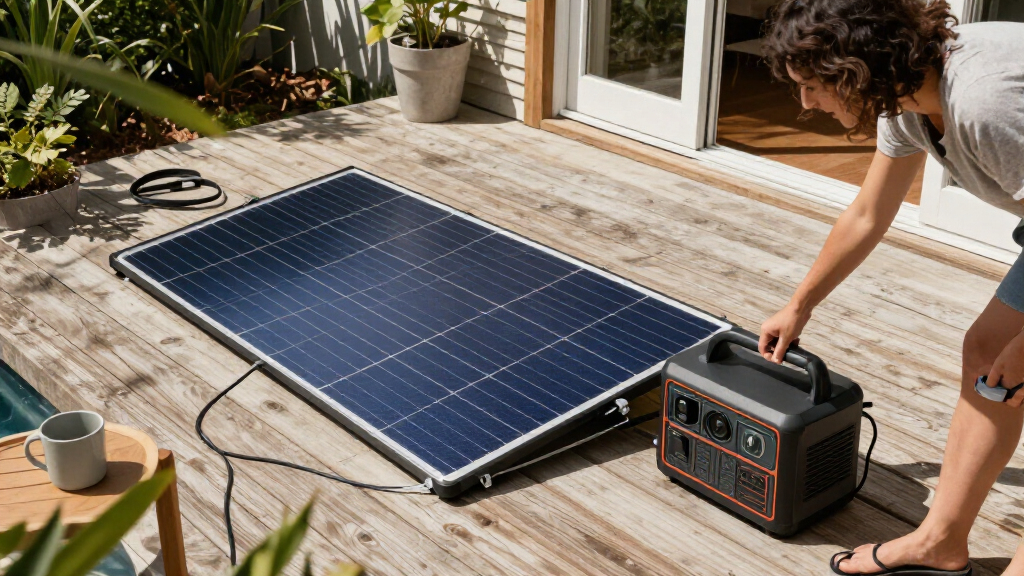
For a strong balance of output and portability, I’d put the ZOUPW 450W Portable Solar Panel at the top of this portable home solar panels roundup. The Renogy 200W is a more manageable choice for buyers who value a smaller setup, while the Twelseavan 400W with ETFE construction suits those seeking higher output in a foldable format. The central tradeoff is simple: larger panels can collect more power, but they take more space to carry, set up, and aim at the sun. Connector compatibility, real-world placement, and the capacity of your power station matter just as much as the wattage printed on the panel. Read on for the full breakdown and help matching a panel to your home backup or portable power needs.

Get backup power and energy gear delivered free with Prime
- Fast, free delivery on millions of items
- Prime Video, Amazon Music and more included
- Member-only deals all year
Key Takeaways
- The roundup’s strongest middle ground is the ZOUPW 450W: it offers more rated output than the 200W options without being the highest-output, largest-format choice in the lineup.
- The Renogy 200W and Sunivora 200W show why buyers may prefer a moderate panel: easier handling can matter more than headline wattage when the panel must be moved and repositioned often.
- The Twelseavan 400W pairs a high output class with ETFE construction and an IP65 rating, making it a feature-led pick for buyers who prioritize panel materials and stated weather protection.
- The two ZOUPW high-output options are not interchangeable: the 480W model is bifacial, while the 450W model uses N-Type 16BB technology; buyers should check the manufacturer’s setup and compatibility details before choosing.
- The DOKIO 300W suitcase kit and SOKIOVOLA 100W panel serve different jobs: the former favors a bundled, portable format, while the latter makes more sense when compactness matters more than charging speed.
| ZOUPW 450W Portable Solar Panel with N-Type 16BB Technology |  | Best for High-Output Portable Home Backup | Cell type: N-Type monocrystalline, 16BB | Efficiency: 25% | Open-circuit voltage: 45.9V | VIEW LATEST PRICE | See Our Full Breakdown |
| Renogy 200W Portable Solar Panel with N-Type Cells and Kickstands |  | Best for Direct Device Charging | Maximum power: 200W | Cell type: 16BB N-Type monocrystalline silicon | Efficiency: 25% | VIEW LATEST PRICE | See Our Full Breakdown |
| Sunivora 200W Foldable Portable Solar Panel with MC4 Output |  | Best for Flexible Power-Station Connections | Maximum power: 200W | Cell type: Monocrystalline | Conversion efficiency: 22.5% | VIEW LATEST PRICE | See Our Full Breakdown |
| CTOLITY 400W Portable Foldable Solar Panel for Power Stations |  | Best High-Output Alternative to the ZOUPW | Maximum power: 400W | Output voltage: 40V DC | Conversion efficiency: 23.4% | VIEW LATEST PRICE | See Our Full Breakdown |
| SOKIOVOLA 100W Portable Foldable Solar Panel Charger with MC4 Connectors |  | Best Compact Panel for Small Loads | Power output: 100W | Voltage: 18V DC | Amperage: 5.56A | VIEW LATEST PRICE | See Our Full Breakdown |
| Twelseavan 200W Portable Foldable Solar Panel Charger |  | Best for Direct Device Charging | Cell type: Monocrystalline silicon | Conversion efficiency: 24% | USB-C output: 60W PD | VIEW LATEST PRICE | See Our Full Breakdown |
| DOKIO 300W 18V Portable Foldable Solar Panel Suitcase Kit |  | Best Complete Kit for RV Setups | Model: FSP-300MPro | Maximum power: 300W | Output voltage: 18V | VIEW LATEST PRICE | See Our Full Breakdown |
| Twelseavan 400W Foldable Portable Solar Panel, 24% Efficiency, ETFE, MC4 Output, IP65 |  | Best High-Output Foldable Panel | Maximum power: 400W | Conversion efficiency: 24% | Cell type: Monocrystalline silicon | VIEW LATEST PRICE | See Our Full Breakdown |
| ZOUPW 480W Bifacial Foldable Portable Solar Panel |  | Best for Bifacial Sun Capture | Maximum power: 480W | Cell type: N-type monocrystalline, 16BB | Conversion efficiency: 25%+ | VIEW LATEST PRICE | See Our Full Breakdown |
| portable home solar panel | Weight | Cell type | Maximum power | Maximum voltage |
|---|---|---|---|---|
| ZOUPW 450W Portable Solar Pane | 29.5 lb | N-Type monocrystalline, 16BB | — | — |
| Renogy 200W Portable Solar Pan | 13.9 lb | 16BB N-Type monocrystalline silicon | 200W | 21.6V |
| Sunivora 200W Foldable Portabl | 15.9 lb | Monocrystalline | 200W | 21.83V |
| CTOLITY 400W Portable Foldable | — | — | 400W | — |
| SOKIOVOLA 100W Portable Foldab | 4.6 lb | — | — | — |
| Twelseavan 200W Portable Folda | 15.7 lb | Monocrystalline silicon | — | — |
| DOKIO 300W 18V Portable Foldab | 27.9 lb | N-type monocrystalline, 16BB | 300W | 22.5V |
| Twelseavan 400W Foldable Porta | About 22.7 lb | Monocrystalline silicon | 400W | 46.9V |
| ZOUPW 480W Bifacial Foldable P | 22.5 lb | N-type monocrystalline, 16BB | 480W | 42.5V |
More Details on Our Top Picks
ZOUPW 450W Portable Solar Panel with N-Type 16BB Technology
For buyers who want substantial solar input without installing fixed panels, the ZOUPW 450W offers the most listed wattage in this group. Its 25% N-Type cell efficiency and 16-busbar design are aimed at drawing more power from available sunlight, while the four connector options simplify pairing with compatible high-capacity power stations. Compared with the CTOLITY 400W, it adds rated output and a broader adapter kit, but weighs 29.5 pounds and sprawls more than 10 feet when unfolded. That footprint makes it better for a driveway, campsite, or clear emergency setup area than a small patio. The IP68 rating and bypass diodes support outdoor use, but this is not a low-voltage universal panel: check your power station’s input range before buying, and note the maker advises against permanent installation.
Pros:- 450W rated output is the highest among these five products.
- 25% efficient N-Type 16BB cells are designed to limit degradation and make use of available sunlight.
- IP68 waterproofing and smart bypass diodes support outdoor use and shade tolerance.
- Includes XT-60, Anderson, DC7909, and DC8020 connectors plus extension cables and ground stakes.
Cons:- At 29.5 lb, it is much heavier than the Renogy 200W and SOKIOVOLA 100W options.
- Unfolded length exceeds 10 feet, requiring a large clear area for placement.
- Not suitable for power stations with input below 30V, and the maker advises against fixed installation or series/parallel connections.
Best for: Homeowners with a compatible high-capacity power station who can set up a large panel in a yard, driveway, or open campsite.
Not ideal for: Owners of power stations with input below 30V, including the listed Jackery 1000/500/300 and Bluetti EB70S examples, or buyers with limited setup space.
- Cell type:N-Type monocrystalline, 16BB
- Efficiency:25%
- Open-circuit voltage:45.9V
- Operating voltage:38.3V
- Weight:29.5 lb
- Unfolded dimensions:121.85 × 34.57 × 0.79 in
- Connectors:XT-60, Anderson, DC7909, DC8020
- Warranty:36 months
Our verdict“Choose the ZOUPW if high portable output matters more than low weight or a compact setup area and your power station accepts its voltage.”
Renogy 200W Portable Solar Panel with N-Type Cells and Kickstands
The Renogy 200W is the most self-contained choice here for people who want to charge small devices as well as a power station. Its USB-C PD 45W and dual USB-A ports let you connect phones, tablets, and some laptops directly, avoiding a separate battery station for everyday device charging. Four kickstands offer several angles, which helps when the sun moves and the panel needs repositioning. Compared with the Sunivora 200W, Renogy adds direct USB charging and weighs two pounds less, but it provides only MC4 output for power-station connections, so some setups need a separately purchased adapter. Its 13.9-pound carry weight is manageable for car camping or RV use, not a strong fit for backpackers. I’d choose it for flexible campsite charging, rather than maximum home-backup output.
Pros:- USB-C PD 45W and dual USB-A ports allow direct charging of compatible devices.
- Four kickstands provide 40°, 50°, and 60° positioning options.
- 25% efficient 16BB N-Type cells are designed for effective solar collection.
- Magnetic closure and a folded size of about 24 × 23 inches simplify storage.
Cons:- MC4 is the only listed solar output, and an adapter for some power stations is sold separately.
- At 13.9 lb, it is a car-camping panel rather than a lightweight backpacking choice.
- Its 200W rating is far below the ZOUPW 450W and CTOLITY 400W for larger backup needs.
Best for: Car campers and RV owners who want one foldable panel for a power station and direct USB charging of personal devices.
Not ideal for: Backpackers prioritizing minimal carry weight or power-station owners who need included adapters beyond MC4.
- Maximum power:200W
- Cell type:16BB N-Type monocrystalline silicon
- Efficiency:25%
- Maximum voltage:21.6V
- Amperage capacity:11.3A
- Weight:13.9 lb
- Folded dimensions:23.72 × 22.99 × 1.97 in
- Connections:MC4, USB-C PD 45W, dual USB-A
- Warranty:2 years
Our verdict“Pick the Renogy for a portable 200W setup that can charge devices directly, provided its weight and MC4 connection suit your plans.”
Sunivora 200W Foldable Portable Solar Panel with MC4 Output
The Sunivora 200W makes the most sense for buyers who want a foldable panel with several common power-station connector options already in the cable kit. Its 9.8-foot MC4 cable ends in DC5521, DC5525, DC7909, and XT60 options, giving it more connection flexibility out of the box than the Renogy 200W, whose listed solar output is MC4 only. The tradeoff is lower stated efficiency—22.5% versus Renogy’s 25%—and a 15.9-pound weight. Its ETFE surface and IP65 water resistance suit outdoor setups, while the adjustable angle helps direct the panel toward the sun. This is a practical mid-size option for compatible power stations, but input limits and connector protocols can still restrict charging, and some stations may need another adapter.
Pros:- Included 9.8-foot MC4 cable comes with DC5521, DC5525, DC7909, and XT60 options.
- Foldable format and carrying handle make it easier to transport than a fixed panel.
- ETFE laminated surface and IP65 water resistance are suited to outdoor use.
- Adjustable positioning helps users aim the panel at available sunlight.
Cons:- Its 22.5% stated efficiency is below the Renogy 200W’s 25%.
- At 15.9 lb, it is heavier than Renogy’s 13.9-pound 200W panel.
- A power station’s input limits may cap charging, and some models may require an additional adapter.
Best for: Power-station owners who want a 200W foldable panel and several common connector choices included with its MC4 cable.
Not ideal for: Buyers seeking direct USB device charging, the higher stated efficiency of the Renogy 200W, or a panel with a longer warranty.
- Maximum power:200W
- Cell type:Monocrystalline
- Conversion efficiency:22.5%
- Output voltage:18.5V
- Maximum voltage:21.83V
- Amperage capacity:12A
- Weight:15.9 lb
- Folded size:24 × 21 in
- Water resistance:IP65
Our verdict“Choose the Sunivora if included connector options matter more to your 200W setup than lower weight or direct USB charging.”
CTOLITY 400W Portable Foldable Solar Panel for Power Stations
The CTOLITY 400W targets buyers who want a large amount of portable solar input but prefer a foldable panel with broad connection options. Its listed MC4, XT60, and Anderson connectors suit a range of power-station setups, and adjustable kickstands help position the panel without relying on a separate stand. Compared with the ZOUPW 450W, it gives up 50W of rated output and has a lower stated efficiency of 23.4% versus 25%, but it remains a substantial alternative for RV trips or home backup. Its ETFE surface and IP65 rating support outdoor use. The tradeoff is sparse product data: no weight, folded dimensions, cable length, or warranty is provided here, making portability and long-term ownership harder to judge before purchase.
Pros:- 400W rated output suits larger power-station charging needs better than the 200W panels.
- MC4, XT60, and Anderson connections offer several common hookup options.
- 23.4% conversion efficiency and ETFE lamination support outdoor solar collection and surface durability.
- Adjustable kickstands make angle positioning easier.
Cons:- Rated output and stated efficiency are below the ZOUPW 450W.
- IP65 water resistance is below the ZOUPW’s IP68 rating.
- Weight, folded dimensions, cable details, and warranty are not supplied in the product data.
Best for: RV owners and households with a compatible power station who want a foldable panel rated at 400W and multiple connector types.
Not ideal for: Buyers who need documented carry weight, folded dimensions, warranty details, or the highest listed output in this group.
- Maximum power:400W
- Output voltage:40V DC
- Conversion efficiency:23.4%
- Cell and surface:Monocrystalline cells with ETFE lamination
- Connectors:MC4, XT60, Anderson
- Water resistance:IP65
- Model number:HYX-SP400WNEW-US-FBM
Our verdict“Choose the CTOLITY for a 400W foldable setup with multiple connector types, but verify its fit and carry requirements before buying.”
SOKIOVOLA 100W Portable Foldable Solar Panel Charger with MC4 Connectors
For readers who value easy carrying over fast power-station charging, the SOKIOVOLA 100W is the most compact choice in this set. At 4.6 pounds with a folded size of 14.69 × 8.67 inches, it is far easier to pack than the Renogy 200W or either large-output panel. Its included four-in-one cable offers XT60, DC5521, DC8MM, and Anderson options, reducing connector guesswork for compatible power stations. The compromise is the 100W output: it is better suited to topping up a small battery or supporting light camping needs than replenishing a large home-backup station quickly. IP68 waterproofing and ETFE construction support outdoor use, but charging still depends on sun and the connected station’s input limits. I’d pick this for portability, not as a substitute for a high-output backup array.
Pros:- At 4.6 lb, it is much lighter than the other listed panels.
- Compact folded dimensions make it easier to pack for hiking and small-vehicle trips.
- IP68 waterproofing and ETFE material are designed for outdoor use.
- Included four-in-one cable offers XT60, DC5521, DC8MM, and Anderson connectors.
Cons:- 100W output is substantially lower than the 200W, 400W, and 450W alternatives.
- Charging speed depends on sunlight and the connected power station’s input limit.
- The 12-month warranty is shorter than the listed warranties for the ZOUPW and Renogy.
Best for: Hikers and minimalist campers with a compatible power station who want a light panel for modest charging needs.
Not ideal for: Households trying to recharge a large backup battery quickly or buyers who need high solar output for RV appliances.
- Power output:100W
- Voltage:18V DC
- Amperage:5.56A
- Weight:4.6 lb
- Folded dimensions:14.69 × 8.67 × 1.78 in
- Material:ETFE and high-efficiency solar cells
- Connectors:MC4 four-in-one: XT60, DC5521, DC8MM, Anderson
- Warranty:12 months
Our verdict“Choose the SOKIOVOLA when low carry weight and compact storage matter more than charging a power station quickly.”
Twelseavan 200W Portable Foldable Solar Panel Charger
The Twelseavan 200W is the most flexible pick here for buyers who want to charge small devices directly as well as feed a compatible power station. Its 60W USB-C PD and QC3.0 USB-A ports can reduce the need to carry a separate charging hub, while MC4, Anderson, and XT60 connections broaden power-station compatibility. The listed 24% cell efficiency and adjustable kickstands help make use of available sun, though they cannot overcome cloudy conditions.
Compared with the much larger DOKIO 300W suitcase kit, this panel is lighter and easier to carry, but gives up 100W of rated output and the DOKIO’s included charge controller. At 15.7 pounds, it suits car camping and emergency setups better than backpacking. Its IP65 rating helps with outdoor exposure, but it is not a reason to leave the panel in harsh weather unattended.
Pros:- 60W USB-C PD and QC3.0 USB-A outputs allow direct charging of compatible devices.
- MC4, Anderson, XT60, and DC adapter connections support a range of power stations.
- Adjustable kickstands help position the panel toward the sun.
- ETFE lamination and an IP65 rating suit outdoor use.
Cons:- At 15.7 pounds, it is heavy for hiking or backpacking.
- Maximum output depends on strong, direct sunlight.
- The 200W rating provides less charging capacity than the 300W and 400W options in this group.
Best for: Car campers and emergency-kit owners who want a foldable panel that can charge USB-C devices directly and connect to different power stations.
Not ideal for: Backpackers seeking a light panel, or buyers who need higher rated output or an included charge controller for a larger off-grid setup.
- Cell type:Monocrystalline silicon
- Conversion efficiency:24%
- USB-C output:60W PD
- USB-A outputs:18W QC3.0 and 5V/3A
- Connectors:MC4, Anderson, XT60, and DC adapters
- Weight:15.7 lb
- Folded dimensions:23 × 22 × 1.9 in
- Water resistance:IP65
Our verdict“Choose the Twelseavan 200W if direct USB charging and flexible power-station connections matter more than minimum weight or maximum output.”
DOKIO 300W 18V Portable Foldable Solar Panel Suitcase Kit
The DOKIO 300W suitcase kit makes the most sense for an RV, yacht, or campsite where a fuller charging setup matters more than carrying convenience. Its detachable LCD PWM controller, long cable, and DC adapters give buyers more of the connection hardware upfront than the panel-only Twelseavan options. The 9.8-foot cable also lets the panel sit in a sunnier spot while the controller and battery remain sheltered.
Against the Twelseavan 200W, DOKIO offers a higher rated output and a controller, but it weighs 27.9 pounds and unfolds to a broad 78.4-inch length. Its aluminum frame and stated temperature and load tolerances suit more demanding outdoor conditions, although the adjustable bracket needs careful handling. This is a stationary-on-site portable panel, not a practical choice for walking any distance with gear.
Pros:- 300W rated output and 18V specification suit larger charging setups.
- Detachable LCD PWM controller and multiple DC adapters are included.
- A 9.8-foot cable allows more flexible panel placement.
- Aluminum frame, reinforced corners, and stated wide operating-temperature range support rugged outdoor use.
Cons:- At 27.9 pounds, it is the heaviest option in this group.
- Its 78.4-inch unfolded length needs substantial ground or storage space.
- The adjustable bracket requires careful handling to reduce the risk of damage.
Best for: RV and boat owners who want a higher-output foldable panel with a charge controller, long cable, and adapters for a semi-fixed campsite setup.
Not ideal for: Hikers, frequent movers, and buyers who want the lightest compact panel; its 27.9-pound weight and wide deployed footprint work against those uses.
- Model:FSP-300MPro
- Maximum power:300W
- Output voltage:18V
- Maximum voltage:22.5V
- Cell type:N-type monocrystalline, 16BB
- Weight:27.9 lb
- Unfolded dimensions:78.4 × 31.1 × 0.8 in
- Operating temperature:-40°F to 185°F
- Power output warranty:10 years
Our verdict“Pick the DOKIO if you want a controller-equipped 300W setup for an RV or campsite and can accept its weight and footprint.”
Twelseavan 400W Foldable Portable Solar Panel, 24% Efficiency, ETFE, MC4 Output, IP65
For buyers who want more rated capacity without stepping up to a suitcase-style frame, the Twelseavan 400W is a strong middle ground. It weighs about 22.7 pounds, folds to a 26 × 35.5-inch footprint, and has four kickstands for adjusting its angle. The ETFE surface, IP65 rating, MC4 cable, and three DC adapters make it suited to portable power-station use, though compatibility needs more attention than with a lower-voltage panel.
Its 46.9V open-circuit voltage is the key limitation: buyers must confirm their power station accepts that input before connecting it. Compared with the DOKIO 300W, this Twelseavan is rated for more power and is lighter, but it does not include the DOKIO’s charge controller. It also lacks the ZOUPW 480W’s bifacial design, trading that potential rear-side collection for a lower stated output and straightforward single-sided construction.
Pros:- 400W rated power offers more capacity than the 200W Twelseavan and 300W DOKIO.
- Four adjustable kickstands help angle the panel toward available sunlight.
- MC4 cable and three DC adapters support connections to compatible power stations.
- ETFE lamination and IP65 water resistance are suited to outdoor setups.
Cons:- The 46.9V open-circuit voltage rules it out for power stations with a lower input limit.
- At about 22.7 pounds, it is cumbersome for extended carrying.
- No charge controller is listed among the included accessories.
Best for: Power-station owners seeking a foldable 400W panel who can verify their unit’s voltage limit and want adjustable stands for sun positioning.
Not ideal for: Anyone whose power station cannot accept a 46.9V open-circuit input, or buyers who need a charge controller included with the panel.
- Maximum power:400W
- Conversion efficiency:24%
- Cell type:Monocrystalline silicon
- Maximum voltage:46.9V
- Output voltage:40V
- Weight:About 22.7 lb
- Folded size:26 × 35.5 in
- Water resistance:IP65
- Included accessories:5-in-1 MC4 cable, three DC adapters, user manual
Our verdict“Choose this Twelseavan for a portable 400W option only after confirming your power station supports its 46.9V open-circuit voltage.”
ZOUPW 480W Bifacial Foldable Portable Solar Panel
The ZOUPW 480W bifacial panel is the capacity-focused choice for buyers who can place a large panel where reflected light can reach its rear surface. Its N-type monocrystalline cells, stated 25%+ conversion efficiency, and claimed bifacial gain give it a different approach from the single-sided Twelseavan 400W. Ground stakes and extension cabling help with outdoor placement, while the storage bag makes transport and packing more manageable.
The higher 480W rating and bifacial design come with a careful-use requirement. Its deployed dimensions are 138.6 × 32.6 inches, so it needs considerable clear space, and the cells can be damaged by stepping or heavy pressure. The IP68-rated coating offers a higher stated water-resistance rating than the Twelseavan panels’ IP65, but this is not a fixed-installation panel: the product data advises against long-term fixed, series, or parallel connections. Shading and debris can also reduce output and contribute to heat buildup.
Pros:- 480W rated output is the highest among the four products in this batch.
- Bifacial construction can collect reflected light from the rear when placement allows.
- Includes ground stakes, extension cable, connector cable, and a storage bag.
- IP68-rated composite coating provides a higher stated water-resistance rating than the IP65 Twelseavan panels.
Cons:- Its 138.6-inch deployed length requires substantial clear space.
- Cells may crack under heavy objects, foot traffic, or excessive pressure.
- Shading or surface debris can lower output and contribute to heat buildup.
- Not recommended for long-term fixed, series, or parallel connections.
Best for: Power-station owners with open campsite or home-emergency setup space who can position the panel for reflected light and protect it from foot traffic and debris.
Not ideal for: Buyers with limited setup space, those seeking a permanently mounted array, or anyone likely to place the panel where it can be stepped on or shaded.
- Maximum power:480W
- Cell type:N-type monocrystalline, 16BB
- Conversion efficiency:25%+
- Bifacial gain:Up to 30%
- Maximum voltage:42.5V
- Amperage capacity:11.3A
- Weight:22.5 lb
- Dimensions:138.6 × 0.9 × 32.6 in
- Warranty:36 months
Our verdict“Choose the ZOUPW 480W if you have room for a large portable setup and can make use of its bifacial design without exposing the cells to pressure or shading.”

How We Picked
I ranked these panels for practical use with portable power stations and home backup setups, not by rated wattage alone. I compared stated output, portability implied by the foldable or suitcase format, connector type, listed construction and weather protection, and how clearly each product’s features fit a distinct buyer need. Since panel output depends on sunlight, angle, temperature, and system compatibility, a higher wattage rating is not a guarantee of faster charging in every setup.
The order favors models that combine useful output with a clear role and fewer compromises for a broad range of buyers. The ZOUPW 450W leads as a high-output middle ground; the 200W panels rank well for buyers prioritizing manageable size, while specialized or more demanding formats sit lower because they suit narrower use cases. I also treated compatibility as a real buying constraint: MC4 connectors, voltage, and the power station’s solar input limits must match before any panel can deliver its rated benefit.
Factors to Consider When Choosing Portable Home Solar Panels
Before choosing a panel, I’d match it to the whole charging setup and the way it will be used. Rated watts help narrow the field, but installation space, sunlight, cables, and the power station’s input limits shape the result just as much.
Match Panel Output to Your Power Station
A panel’s rated wattage describes its output under specified test conditions, not a constant amount of power throughout the day. Check the power station’s maximum solar input, voltage range, and connector requirements before buying; a panel that exceeds a system limit may not deliver its full rated output. If you plan to connect multiple panels, confirm that the station supports the intended series or parallel arrangement. Avoid choosing a high-wattage panel just because it sounds faster: the battery’s capacity and input ceiling may make the extra output unusable. For a compact station, a panel matched to its input range can be a more sensible purchase than the largest panel you can carry.
Plan for the Space You Can Actually Use
Portable panels still need a place to unfold, a clear view of the sky, and room for repositioning as sunlight shifts. Measure the panel’s open dimensions as well as its folded size, then compare those figures with your storage area, vehicle, or intended outdoor spot. A large panel can be awkward on a small balcony or in a yard with frequent shade, even if its rated output looks appealing. Foldable and suitcase formats can make transport easier, but they still take up space when deployed. If you expect to move the panel regularly, manageable handling may yield more usable sun time than maximum size.
Treat Rated Wattage as a Starting Point
Sun angle, cloud cover, shade, panel temperature, and dirt all affect solar collection, so daily energy varies even when the same panel is used. A small shadow from a railing or tree branch can reduce output, making placement and clear exposure important parts of the setup. Work out how much energy your essential devices use, then allow for changing conditions rather than assuming the panel will meet the rated figure for a full day. If reliable backup is the goal, think about battery capacity and charging time alongside panel wattage. Buyers who need dependable energy through poor weather may need a larger battery, another panel, or a backup charging method.
Check Connectors, Cables, and Input Limits
MC4 output can make a panel useful with compatible power stations, but the connector alone does not confirm that the system will work. Verify the cable needed, polarity, operating voltage, and the station’s allowed solar input before ordering. A cable that is too short can also limit where the panel can sit in relation to the battery, especially when the battery must stay indoors or under cover. Avoid assuming that two panels can be combined just because they share a connector; their electrical specifications and the station’s input limits must also allow it. A few minutes spent checking the manuals can prevent a panel from being difficult or impossible to use with your existing setup.
Choose Materials and Weather Protection for Your Setup
Panel construction and stated weather protection matter most when the panel will be used outside often or left exposed during changing conditions. An IP rating describes tested protection under defined conditions, but it does not make every part of a solar setup weatherproof; connectors, cables, and power stations may have different limits. Check the product instructions for storage, cleaning, and exposure rules rather than treating a panel as a permanent outdoor fixture. More robust materials can suit frequent handling, while a lighter or simpler panel may be easier to carry for occasional use. Keep the panel clean and dry when stored, and avoid packing it away while damp unless the manufacturer’s instructions allow it.
Decide Whether Portability or Charging Speed Comes First
Higher-output panels often require more surface area and can be less convenient to carry or position. A smaller panel may charge more slowly, yet prove more useful if it is easy to move into sun whenever needed. Think about who will set it up, how often it will travel, and whether the panel needs to fit in a particular vehicle or storage space. For emergency home backup, a larger panel may suit a stable outdoor location and a compatible power station; for occasional trips, a lighter format may see more use. The best fit is the panel you can deploy safely and consistently, not simply the one with the largest number on its label.
Frequently Asked Questions
Can a portable solar panel power home appliances directly?
Most portable panels are intended to charge a compatible power station, which then supplies power to appliances through its own outlets. Check the panel’s output and the power station’s solar input limits before pairing them, and confirm that the station can handle each appliance’s running and startup power. A panel does not usually provide steady household-style power by itself because sunlight changes throughout the day. For home backup, the battery and inverter are as important as the panel. Treat the panel as a way to recharge a matched system, not as a direct replacement for a household outlet.
Will a 400W or 450W panel charge my power station faster than a 200W panel?
It can, but only if sunlight is strong and the power station accepts the panel’s voltage and available input. If the station has a lower solar input ceiling, a larger panel may not increase charging speed beyond that limit. Conditions such as shade, panel angle, and cloud cover also reduce actual output compared with the rated figure. Compare the station’s specifications with the panel’s electrical details rather than relying on wattage alone. A well-matched 200W panel can be more useful than a larger one that is difficult to position or exceeds the station’s input range.
Can I leave a portable solar panel outside during rain?
That depends on the specific panel’s stated weather protection and the manufacturer’s instructions. Even when a panel lists an IP rating, its cables, connectors, and connected power station may have different limits. Do not assume that a weather-resistant panel is suitable for permanent outdoor installation or severe weather. Check how the product should be stored and whether it must be disconnected or covered in particular conditions. If rain is likely, protect the power station and exposed connections according to their own specifications.
Is one large panel better than two smaller panels for home backup?
One large panel can simplify the setup, but it may be harder to carry, position, and store. Two smaller panels can offer more placement flexibility around shade, though they require compatible wiring and a power station that supports the combined input. Check each panel’s voltage and current alongside the station’s maximum limits before connecting panels together. Splitting the array does not guarantee more energy if both panels share the same poor sunlight or are frequently shaded. Choose based on available space, handling needs, and the electrical design your equipment supports.
What should I check before pairing an MC4 panel with my existing power station?
Check the station’s supported solar voltage range, maximum input wattage, and connector or adapter requirements. Confirm that the panel’s electrical specifications fall within those limits; an MC4 connector only describes the connection style, not full compatibility. Review cable length and polarity as well, since an adapter may be needed and an unsuitable cable can prevent a safe connection. If you plan to add a second panel, verify that the station allows that wiring configuration. When the manuals do not clearly match, contact the equipment maker rather than guessing from connector shape.
Conclusion
For most buyers seeking a capable portable home backup panel, I’d choose the ZOUPW 450W as the best overall because it occupies a useful middle ground between the 200W models and the highest-output options. The best value for a manageable setup is the Renogy 200W, while the best premium-style feature set goes to the Twelseavan 400W with ETFE construction and a stated IP65 rating. For beginners, I’d start with a 200W panel such as the Sunivora if the power station’s input specs match, since a moderate format is easier to position than the largest panels. Choose the DOKIO 300W suitcase kit for a bundled portable format, the SOKIOVOLA 100W when compactness is the priority, or the ZOUPW 480W bifacial if its specific setup suits your space and system. Before deciding, verify solar input compatibility and deployed dimensions; those checks can matter more than the wattage ranking.