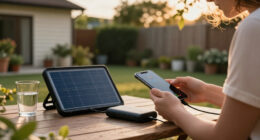
Portable solar panel chargers range from small panels for topping up phones to larger kits that pair a panel with a battery for running more demanding devices. I rank the Jackery Solar Generator 1000 v2 as the best overall for buyers who want substantial stored power and a 200W panel. The BigBlue 28W is a more compact choice for direct USB charging, while the SOKIOVOLA 100W suits buyers who want a standalone panel with weather protection and multiple connectors. The main tradeoff is portability versus power: a light panel is easier to carry, but a power station stores energy for later and adds bulk. Read on for the full comparison and guidance on matching a setup to your devices.

Get backup power and energy gear delivered free with Prime
- Fast, free delivery on millions of items
- Prime Video, Amazon Music and more included
- Member-only deals all year
Complete the kit


Key Takeaways
The Jackery bundle is the most complete power setup in this group: its 1024Wh LiFePO4 battery stores energy, while the included 200W panel supports solar recharging.
Only two picks include power stations: the Jackery and the two ZeroKor bundles. Those suit buyers who need stored power; the other six are panel chargers meant for direct device charging.
Compact USB panels favor light loads. The Foricx 30W, GEYOTO 35W, BigBlue 28W, and VTOMAN 40W prioritize foldable portability and USB charging over running appliances.
Panel wattage alone does not define a useful setup. The SOKIOVOLA 100W has an 18V output and a 4-in-1 connector, while a power station bundle adds storage and changes when you can use the collected energy.
Weather and compatibility separate specialist choices. The SOKIOVOLA lists IP68 waterproofing, and the BigBlue provides dual USB-C alongside USB-A; buyers should still match ports and connectors to their own devices.
| Jackery Solar Generator 1000 v2 with 200W Solar Panel, 1024Wh LiFePO4 Battery |  | Best Overall for High-Capacity Solar Power | Battery capacity: 1,024Wh | Battery chemistry: LFP (LiFePO4) | AC output: 1,500W | VIEW LATEST PRICE | See Our Full Breakdown |
| Foricx 30W Foldable Solar Panel Charger with USB-C and USB-A |  | Best for Lightweight USB Charging | Maximum power: 30W | Ports: USB-C and USB-A | Output voltage: 5V DC | VIEW LATEST PRICE | See Our Full Breakdown |
| ZeroKor 100W Portable Power Station with 40W Foldable Solar Panel |  | Best Compact Solar Power Station | Power station output: 100W | Included solar panel: 40W foldable monocrystalline | Solar panel conversion efficiency: 22.8% | VIEW LATEST PRICE | See Our Full Breakdown |
| SOKIOVOLA 100W Foldable Portable Solar Panel, 18V, IP68 Waterproof, with 4-in-1 Connector |  | Best Rugged Panel for Power Stations | Maximum power: 100W | Output voltage: 18V DC | Amperage capacity: 5.56A | VIEW LATEST PRICE | See Our Full Breakdown |
| ZeroKor 300W Portable Power Station with 60W Solar Panel |  | Best Value for Moderate Device Loads | Power station output: 300W maximum | Included solar panel: 60W monocrystalline | Solar conversion efficiency: 20.5% | VIEW LATEST PRICE | See Our Full Breakdown |
| GEYOTO 35W Foldable Solar Charger with USB-C and USB-A |  | Best for Rugged, Compact Charging | Maximum power: 35 W | Solar conversion efficiency: Up to 26% | Ports: 1 USB-C, 1 USB-A | VIEW LATEST PRICE | See Our Full Breakdown |
| BigBlue 28W Folding Solar Panel Charger with Dual USB-C and USB-A |  | Best for Charging Multiple Small Devices | Power: 28 W | Solar cell efficiency: 25.4% | Ports: 2 USB-C, 1 USB-A | VIEW LATEST PRICE | See Our Full Breakdown |
| VTOMAN 40W Foldable Solar Panel Charger with USB-C and USB-A |  | Best for Higher USB-C Output | Maximum power: 40 W | Solar conversion efficiency: 25% | USB outputs: 1 USB-A; 1 USB-C PD 30W | VIEW LATEST PRICE | See Our Full Breakdown |
| portable solar panel charger | Weight | Ports | Maximum power | Solar conversion efficiency |
|---|---|---|---|---|
| Jackery Solar Generator 1000 v | 23.4 lb | 2 USB-C, 1 USB-A, 1 DC car port, and 2 pure sine wave AC ports | — | — |
| Foricx 30W Foldable Solar Pane | — | USB-C and USB-A | 30W | 25%+ |
| ZeroKor 100W Portable Power St | About 3.3 lb | — | — | — |
| SOKIOVOLA 100W Foldable Portab | 4.6 lb | — | 100W | — |
| ZeroKor 300W Portable Power St | — | — | — | 20.5% |
| GEYOTO 35W Foldable Solar Char | About 1.5 lb | 1 USB-C, 1 USB-A | 35 W | Up to 26% |
| BigBlue 28W Folding Solar Pane | 1.5 lb | 2 USB-C, 1 USB-A | — | — |
| VTOMAN 40W Foldable Solar Pane | 1.8 lb | — | 40 W | 25% |
More Details on Our Top Picks
Jackery Solar Generator 1000 v2 with 200W Solar Panel, 1024Wh LiFePO4 Battery
For buyers who need more than direct USB charging, the Jackery pairs a 200W solar panel with a 1,024Wh LFP power station and 1,500W AC output. That makes it a different class of kit from the ZeroKor 300W, whose smaller output is better suited to lighter loads: the Jackery can support more demanding gear, while its 10ms UPS switchover adds backup-power flexibility. The tradeoff is bulk—the station alone weighs 23.4 pounds, before accounting for the panel—so it is less convenient on foot than either a standalone foldable charger or the 3.3-pound ZeroKor 100W kit. Its emergency 50-minute charging mode also needs to be enabled in the app, and the supplied details give conflicting standard charge times. I’d choose it for car camping or home backup, not minimalist hiking.
Pros:- Includes a 200W solar panel with a 1,024Wh power station.
- 1,500W AC output and 3,000W surge peak support more demanding devices than either ZeroKor kit.
- LFP battery is specified to retain over 70% capacity after 4,000 charge cycles.
- 10ms UPS switchover and app-controlled charging modes add backup and charging flexibility.
Cons:- The 23.4-pound station is much less portable on foot than the ZeroKor 100W kit.
- The optional 50-minute emergency charging mode must be enabled in the app.
- Product details conflict on standard full-charge time, and the station and panel ship separately.
Best for: Campers, van travelers, and households seeking a solar-equipped power station for several devices and some higher-wattage equipment.
Not ideal for: Backpackers and buyers who only need to top up phones; the 23.4-pound station is heavy for carrying, and its capacity and AC output may be more than they need.
- Battery capacity:1,024Wh
- Battery chemistry:LFP (LiFePO4)
- AC output:1,500W
- Surge peak:3,000W
- Included solar panel:200W
- UPS switchover:10ms
- Weight:23.4 lb
- Ports:2 USB-C, 1 USB-A, 1 DC car port, and 2 pure sine wave AC ports
Our verdict“Choose the Jackery for a capable solar power station for car camping or backup use, but skip it if light carry weight matters more than capacity.”
Foricx 30W Foldable Solar Panel Charger with USB-C and USB-A
The Foricx is a panel-only charger for people who want to feed compatible USB devices directly, without carrying a battery station. Its 30W maximum output, USB-C and USB-A ports, and five-panel folding design make it a straightforward alternative to the power-station kits in this roundup. Compared with the ZeroKor 100W kit, it weighs less in concept and avoids the extra battery unit, but it cannot store energy for charging after the sun drops. Adjustable kickstands and hanging loops give it more placement options than a simple panel laid flat, while its 5V output limits it to devices that can charge from that voltage. Output also depends on sunlight, so the rated maximum is not a steady guarantee. I’d pick it for daytime phone or small-device charging, not for powering AC equipment or building an energy reserve.
Pros:- USB-C and USB-A outputs let it charge compatible devices directly.
- Five-panel folding design includes straps for storage and transport.
- Adjustable kickstands and hanging loops provide flexible positioning.
- Nylon construction is designed for outdoor use.
Cons:- No built-in battery, so it cannot store solar energy for later.
- Maximum output voltage is 5V, limiting compatibility with devices that need higher voltage.
- Actual charging output varies with sunlight.
Best for: Day hikers and campers who want a foldable panel for direct USB charging of phones and other compatible 5V devices.
Not ideal for: Buyers who need stored energy, AC outlets, or equipment requiring higher voltage; unlike the ZeroKor power-station kits, this panel has no battery.
- Maximum power:30W
- Ports:USB-C and USB-A
- Output voltage:5V DC
- Maximum total output:6A
- Output per port:5V/3A
- Panel design:Five-panel foldable
- Material:Nylon
- Solar conversion efficiency:25%+
Our verdict“Choose the Foricx for direct daytime USB charging in a foldable format, but choose a ZeroKor kit if you need stored power or AC output.”
ZeroKor 100W Portable Power Station with 40W Foldable Solar Panel
The ZeroKor 100W kit sits between direct-to-device chargers such as the Foricx and larger stations like the Jackery: it adds a battery and several output types while keeping the unit to about 3.3 pounds. Its included 40W monocrystalline panel can recharge the station, and wall and car charging provide alternatives when sunlight is limited. AC, DC, USB-A, QC USB, and USB-C outputs make it flexible for small electronics, but the 100W ceiling is the defining limit. The ZeroKor 300W is a better fit for devices with higher draw; this model is for lower-power needs and easier carrying. The panel junction box is not waterproof, and the product information calls for regular recharging during storage, so it takes more care than a panel-only charger. I’d consider it for compact camping and emergency kits, not power-hungry appliances.
Pros:- Includes a foldable 40W monocrystalline solar panel.
- About 3.3 pounds, making it easier to carry than the Jackery station.
- Can recharge from a wall outlet, solar panel, or 12V car outlet.
- Offers AC, DC, USB-A, QC USB, and USB-C outputs, plus an SOS flashlight.
Cons:- Devices drawing over 100W are not supported and may damage or disable the station.
- The solar panel junction box is not waterproof.
- Requires regular recharging during storage, according to the product information.
Best for: Campers and emergency-kit builders who want a lightweight battery station with a solar panel for phones, lights, and other low-draw devices.
Not ideal for: Buyers running devices that draw over 100W or seeking a weatherproof solar setup; the AC output is limited and the panel junction box is not waterproof.
- Power station output:100W
- Included solar panel:40W foldable monocrystalline
- Solar panel conversion efficiency:22.8%
- Weight:About 3.3 lb
- AC outlets:2, 100W maximum
- USB outputs:2 USB-A, 1 QC USB, and 1 USB-C
- Charging methods:Wall outlet, solar panel, or 12V car outlet
- Protection features:Short circuit, over-current, over-voltage, overload, and overheating protection
Our verdict“Choose this kit for a compact battery-and-panel setup for low-draw devices, but opt for the ZeroKor 300W if your equipment needs more output.”
SOKIOVOLA 100W Foldable Portable Solar Panel, 18V, IP68 Waterproof, with 4-in-1 Connector
Unlike the Foricx, which charges USB devices directly, the SOKIOVOLA is an 18V panel designed for compatible portable power stations. Its 100W rating offers more panel capacity than the 40W and 60W panels bundled with the ZeroKor kits, though the station’s own input limit may prevent it from accepting the full output. The IP68 dust and water protection and ETFE surface make this a stronger match for outdoor exposure than the ZeroKor panels, whose junction boxes are specified as non-waterproof. Multiple supplied connectors broaden compatibility, but buyers still need to check their station’s input requirements before connecting it. At 4.6 pounds, it is portable for a panel of this output, yet it is not a substitute for a battery or USB charger. I’d choose it to recharge a compatible station outdoors, not as a standalone phone charger.
Pros:- 100W panel output is higher than the included panels in either ZeroKor kit.
- IP68 dust and water protection suits outdoor power-station charging.
- Four-in-one cable supports XT60, DC5521, DC7909, and Anderson connections.
- Includes an extension cable, adapters, carrying bag, and mounting buckles.
Cons:- Does not include a battery or direct USB outputs, so it is not a standalone device charger.
- A connected power station may limit how much of the panel’s rated output it can accept.
- Actual solar output depends on sunlight.
Best for: Campers and RV travelers who already own a compatible power station and want a foldable panel with broad connector options and strong dust and water protection.
Not ideal for: Buyers seeking a self-contained USB phone charger or a panel with guaranteed 100W input to their station; output depends on sunlight and the station’s input limit.
- Maximum power:100W
- Output voltage:18V DC
- Amperage capacity:5.56A
- Water and dust resistance:IP68
- Weight:4.6 lb
- Folded dimensions:14.69 × 8.67 × 1.78 in
- Included cable connectors:XT60, DC5521, DC7909 (8mm), and Anderson
- Panel materials:ETFE, UV-resistant EVA, and solar cells
Our verdict“Choose the SOKIOVOLA to recharge a compatible power station in outdoor conditions, but pick a USB-equipped panel if you need direct device charging.”
ZeroKor 300W Portable Power Station with 60W Solar Panel
The ZeroKor 300W offers a middle ground for buyers who want a battery station without the Jackery’s larger 1,024Wh capacity and 1,500W AC output. Its 300W maximum output and included 60W monocrystalline panel suit small electronics and other compatible devices, while AC, DC, and USB ports cover several charging needs. Compared with the ZeroKor 100W kit, this model allows a higher device draw and supplies a larger panel, though it remains far below the Jackery for demanding equipment and high-capacity backup. The flashlight’s reading and SOS modes add practical utility, but they do not offset the hard 300W limit. The panel junction box is not waterproof, and the station needs periodic charge-and-discharge maintenance. I’d choose it for modest camping loads, not appliances above its rating.
Pros:- Includes a 60W monocrystalline solar panel.
- 300W maximum output accommodates more device load than the ZeroKor 100W kit.
- AC, DC, and USB ports support several types of small devices.
- Built-in flashlight includes reading and SOS modes, with multiple electrical protections.
Cons:- Devices drawing over 300W are not suitable and may damage the unit.
- The solar panel junction box is not waterproof and must be kept dry.
- Periodic charging and discharging are recommended to maintain performance.
Best for: Car campers and travelers who need stored solar power for phones, tablets, laptops, and other devices within a 300W limit.
Not ideal for: Buyers powering equipment above 300W or seeking an outdoor panel assembly that can be left exposed to water; its junction box is not waterproof.
- Power station output:300W maximum
- Included solar panel:60W monocrystalline
- Solar conversion efficiency:20.5%
- AC outlets:2, 300W maximum
- DC output:9V–12.6V, 10A maximum
- USB ports:3 USB ports and 1 quick-charge USB port
- Recharging methods:AC outlet, compatible 13V–23V solar panel, or 12V car outlet
- Flashlight modes:Reading and SOS
Our verdict“Choose the ZeroKor 300W for a modest solar-powered device kit with more output than the 100W model, but skip it for higher-draw equipment.”
GEYOTO 35W Foldable Solar Charger with USB-C and USB-A
The GEYOTO earns this spot by pairing a 35W output with a compact folded shape and an IP68-rated panel surface. That combination suits hikers and campers who want a panel they can attach to gear with the included carabiners, while its USB-C and USB-A ports let it charge two compatible devices at once. Compared with the BigBlue 28W, it offers more rated power and stronger panel water-and-dust protection, though BigBlue has three ports for spreading charging across more small devices. The GEYOTO is also lighter than the VTOMAN 40W, but gives up some output and its 30W USB-C PD specification. Its main limits are familiar for direct-solar charging: output varies with conditions, and the ports themselves need to stay dry.
Pros:- Up to 35W combined output from USB-C and USB-A
- IP68-rated panel surface resists water and dust
- Compact folded dimensions and 1.5 lb listed weight suit pack carry
- Includes an extension cable, pouch, and two carabiners for setup
Cons:- Actual output changes with sunlight, weather, panel angle, and device conditions
- Charging ports should be kept dry despite the panel’s IP68 rating
- Two ports offer less device capacity than BigBlue’s three-port layout
Best for: Backpackers and campers who want a compact panel with a highly water- and dust-resistant surface and USB-C plus USB-A charging.
Not ideal for: Buyers who need to charge three devices at once or want a specified 30W USB-C PD output; BigBlue has more ports, while VTOMAN lists USB-C PD 30W.
- Maximum power:35 W
- Solar conversion efficiency:Up to 26%
- Ports:1 USB-C, 1 USB-A
- Combined output:Up to 35 W
- Panel material:Monocrystalline silicon
- Water and dust resistance:IP68-rated panel surface
- Folded dimensions:8.29 × 4.76 × 1.57 in
- Weight:About 1.5 lb
- Warranty:2 years
Our verdict“Choose the GEYOTO for compact, rugged panel charging with two ports, but pick BigBlue for more simultaneous connections or VTOMAN for its stated 30W USB-C PD output.”
BigBlue 28W Folding Solar Panel Charger with Dual USB-C and USB-A
The BigBlue is the most connection-friendly option here: two USB-C ports and one USB-A port make it useful when a group needs to top up phones, GPS units, or power banks from one panel. Its 28W rating is lower than the GEYOTO’s 35W and VTOMAN’s 40W, so I’d choose it for port flexibility rather than maximum output. The shadow-free surface and N-type cells are intended to support small-device charging in direct sunlight, but this panel has no built-in battery: it cannot collect energy for later, and connected devices still depend on changing sunlight. Its IP44 panel protection is also less robust than GEYOTO’s IP68 rating, while the USB junction box is not waterproof. It is not designed for laptops or large power stations.
Pros:- Three ports allow charging multiple compatible small devices
- Folds to a backpack-friendly 11 × 6 × 1.4 in size
- N-type cells have a stated 25.4% efficiency
- Includes a USB-C-to-USB-C cable and carabiners
Cons:- No built-in battery, so it cannot store power for later
- USB junction box is not waterproof, despite the panel’s IP44 rating
- 28W output is lower than the GEYOTO and VTOMAN, and it is not suitable for laptops or large power stations
Best for: Campers, day hikers, or small groups charging several phones, GPS devices, and power banks directly in sunny conditions.
Not ideal for: Laptop users, owners of large power stations, or anyone who needs stored power after sunset; this panel has no battery and is not intended for those loads.
- Power:28 W
- Solar cell efficiency:25.4%
- Ports:2 USB-C, 1 USB-A
- Maximum combined output:5 V/4.8 A
- Output per port:Up to 5 V/3 A
- Water resistance:IP44 panel; USB junction box is not waterproof
- Folded dimensions:11 × 6 × 1.4 in
- Weight:1.5 lb
- Battery:No built-in battery
Our verdict“Pick BigBlue when three charging ports matter more than higher output or rugged water protection, and skip it for laptop charging or stored power.”
VTOMAN 40W Foldable Solar Panel Charger with USB-C and USB-A
Among these three direct-charging panels, the VTOMAN has the highest listed capacity at 40W and a clearly specified USB-C PD 30W output. That makes it the strongest fit for compatible devices that benefit from faster USB-C charging, compared with GEYOTO’s 35W combined output and BigBlue’s 28W small-device focus. Its ETFE-coated monocrystalline panel, IP67 rating, carabiners, and corner mounting holes give it useful flexibility around a tent or emergency kit. The tradeoff is a larger, heavier carry: at 1.8 lb and about 11 × 12 inches folded, it is less compact than GEYOTO. The panel also needs direct sunlight for good performance, and its water resistance does not make it suitable for prolonged submersion.
Pros:- 40W maximum power is the highest listed among these three panels
- USB-C PD output is specified at 30W for compatible devices
- IP67-rated construction and ETFE coating resist dust, rain, and abrasion
- Carabiners and corner mounting holes support several outdoor attachment options
Cons:- At 1.8 lb, it is heavier than the GEYOTO and BigBlue
- Charging can drop substantially in shade or with partial panel coverage
- Should not be submerged for more than 30 minutes
Best for: Campers and emergency-kit owners with USB-C PD-compatible devices who want the highest stated panel output of these three options.
Not ideal for: Ultralight backpackers prioritizing the smallest, lightest pack load, or anyone who needs reliable charging in shade or while the panel is submerged.
- Maximum power:40 W
- Solar conversion efficiency:25%
- USB outputs:1 USB-A; 1 USB-C PD 30W
- Maximum voltage:16.7 V
- Output voltage:13.9 V
- Panel material:Monocrystalline silicon with ETFE laminate coating
- Water and dust resistance:IP67
- Folded dimensions:11.02 × 11.97 × 0.94 in
- Weight:1.8 lb
Our verdict“Choose the VTOMAN for its stated 30W USB-C PD output and higher 40W rating, but favor GEYOTO for a lighter, smaller carry.”

How We Picked
I compared these products by how well each fits the specific job implied by a portable solar charger: collecting usable energy outdoors without creating an awkward or incompatible kit. I weighed stated panel output, charging connections, portability cues such as foldable designs, weather protection where listed, and whether a battery is included. For the bundled systems, I also considered the practical benefit of stored energy and the tradeoff of carrying a power station.
The ranking gives the strongest position to products with a clear advantage for a distinct buyer need. Jackery leads as the most capable all-in-one option because it pairs a 200W panel with a 1024Wh LiFePO4 battery. The ZeroKor bundles follow for buyers seeking stored power at lower panel outputs, while standalone panels rank by their balance of output, ports, protection, and portability. The listed specifications do not establish real-world charging speed, so I treat wattage and feature claims as guidance rather than a guarantee of field performance.
Factors to Consider When Choosing Portable Solar Panel Chargers
Before choosing a panel, I would start with the devices you need to charge and the conditions where you plan to use it. A compact USB panel and a panel-plus-battery bundle solve different problems, even when both are described as portable solar chargers.
Choose Direct USB Charging or Stored Power
A standalone panel sends power to a connected device while sunlight is available, which can suit phones and other USB gear. A power station stores energy so you can use it after sunset or when the panel is packed away. That convenience adds weight and more components to carry, so it can be unnecessary for someone charging only a phone during daylight. Check whether the bundle includes a battery and what its capacity is; a panel’s wattage does not tell you how much energy you can save for later. For longer trips or devices with higher energy needs, storage can matter more than panel portability.
Match Output to Your Devices
Start with the input requirements listed for each device, including connector type and any supported charging rate. A panel with a higher wattage rating may offer more capacity under suitable sunlight, but it does not guarantee that every connected device will draw that amount. Small USB panels are aimed at lighter electronics, while an 18V panel such as the SOKIOVOLA may fit setups that accept that output through a compatible connector. Avoid assuming that a multi-connector kit makes every device compatible; verify the plug, voltage, and input limits. If your kit needs to charge several devices at once, check how many ports are available and whether simultaneous charging is supported.
Plan for Sunlight and Intermittent Output
Solar output changes with sunlight, panel angle, shade, and weather, so rated wattage is not a promise of steady charging. A campsite with moving shade or frequent clouds can make direct charging less predictable. A battery can buffer energy collected during brighter periods, while a direct USB panel cannot store it on its own. Think about whether you can leave the panel positioned toward the sun and keep it connected during the day. For a fixed daily charging routine, allow more capacity than your devices appear to need on paper.
Balance Folded Size Against Panel Area
Foldable panels are easier to pack, but the unfolded area still determines how much space they occupy while collecting sunlight. Compare both packed dimensions and how you will position the panel at camp, on a trail stop, or beside a vehicle. A lighter, compact panel may be the better companion for a day hike even if it takes longer to replenish a device. Larger panels can suit car camping, where setup space and carrying weight are less restrictive. Include cables and any separate battery in the packing decision rather than judging the panel alone.
Check Protection and Connector Details
Outdoor use exposes panels to dust, rain, rough handling, and repeated folding. A stated protection rating, such as the SOKIOVOLA’s IP68 listing, can help distinguish a weather-oriented panel, but it does not remove the need to protect connected electronics and cable ends. Inspect how the panel folds and whether the connectors are covered during transport. For multi-connector products, confirm that the included cable ends match the equipment you own rather than relying on a broad compatibility claim. If you expect wet conditions, check the manufacturer’s limits for the complete setup, not just the panel surface.
Decide When a Larger Kit Is Worth Carrying
A bundled power station makes sense when you need energy after daylight, want to charge devices from a central battery, or expect loads beyond small USB electronics. The tradeoff is a heavier kit with more to store and transport. A compact direct-charge panel can be simpler for occasional phone top-ups, especially when you can keep it in the sun. Consider the total system you need, including panel, battery, cables, and charging inputs, rather than comparing panel wattage by itself. Paying for a larger bundle is most useful when its stored capacity will solve a real timing or device-power problem.
Frequently Asked Questions
Can a portable solar panel charge my devices after the sun goes down?
A standalone panel cannot store energy for later, so it generally needs sunlight while a device is charging. To use collected power after dark, choose a setup with a battery such as a power station. The Jackery and ZeroKor bundles in this roundup include power stations, while the other products are standalone panels. Check the battery capacity and the input your devices require before deciding whether the added storage suits your needs.
Should I choose a 100W panel or a lower-wattage panel for camping?
Choose based on what you plan to charge, how much space you have for setup, and how reliably you can position the panel in direct sunlight. A 100W panel may suit a larger device or a setup that can use an 18V output, but it is still subject to changing sunlight and device input limits. For phone charging during daylight, a lower-wattage USB panel may be easier to pack and connect. If you need energy after sunset, a battery can matter more than increasing panel output alone.
Do the portable panels in this roundup include a battery?
The Jackery Solar Generator 1000 v2 and both ZeroKor products are bundles with power stations, so they include energy storage as part of the setup. The Foricx, SOKIOVOLA, GEYOTO, BigBlue, and VTOMAN products are panel chargers without a listed power station. That distinction affects when you can use the collected energy: direct USB panels charge devices as conditions allow, while a station can retain power for later. Confirm the full bundle contents before buying, especially if you need cables or adapters for a particular device.
Will a solar panel keep charging my phone in cloudy weather?
It may still produce some power, but output can fall when direct sunlight is reduced, and the rate may vary during the day. That can make direct charging slow or inconsistent, particularly if the phone is also in use. A battery can collect power during brighter intervals and provide a steadier source later. If your trip depends on keeping a device available, plan a backup charging method instead of relying on a panel’s rated wattage as a fixed output.
How do I know whether a panel’s ports and connectors will work with my gear?
Compare the panel’s listed ports and cable ends with each device’s charging input, then check the device’s supported voltage and power limits. USB-C and USB-A ports cover common electronics, but they do not guarantee the same charging behavior across devices. The SOKIOVOLA’s 4-in-1 connector and 18V output call for particular attention to compatibility. If you plan to use a power station, confirm that the panel connection matches the station’s solar input as well.
Conclusion
For the best overall setup, I recommend the Jackery Solar Generator 1000 v2 to buyers who want a substantial battery paired with a 200W panel. For buyers seeking a more compact value choice, compare the direct USB panels by their ports and output needs; the BigBlue stands out for dual USB-C plus USB-A, while the Foricx and GEYOTO offer straightforward smaller-panel formats. For beginners, a direct USB panel can be easier to understand and carry if the goal is phone and small-device charging in daylight. For premium weather protection or a higher-output standalone panel, the SOKIOVOLA’s 100W rating, 18V output, and IP68 listing give it a distinct role. Choose a ZeroKor power-station bundle when stored energy matters, and select among the VTOMAN, GEYOTO, Foricx, or BigBlue when a foldable USB panel better fits your pack and devices.