Among these home backup generators, I’d name the Westinghouse WGen11500TFc the best overall for its high output and three-fuel flexibility. The Generac 10 kW standby generator is the standout for automatic, permanently installed backup, while the Oxseryn 4400-Watt inverter suits buyers who need a more portable source for essential loads. The main tradeoff is between the convenience and capacity of a standby system, the fuel options and mobility of a portable generator, and the quieter, lower-output role of an inverter. I compare all 12 models by those practical differences, along with usability, safety features, and setup needs. Read on for the full breakdown and help matching a generator to your home and outage plan.

Get backup power and energy gear delivered free with Prime
- Fast, free delivery on millions of items
- Prime Video, Amazon Music and more included
- Member-only deals all year
Complete the kit


Key Takeaways
- The Westinghouse WGen11500TFc leads for flexible high-output portable backup: tri-fuel capability gives buyers more fuel choices than the lineup’s dual-fuel models, but it remains a manually managed portable generator rather than an automatic standby system.
- Standby convenience comes with a different commitment: Generac’s 10 kW whole-home system includes a transfer switch and cellular connectivity, but installation and fixed placement make it a less flexible choice than portable units.
- Fuel flexibility is not the same as equal performance on every fuel: tri-fuel and dual-fuel models broaden supply options, while buyers still need to check output ratings for their chosen fuel and plan safe storage or connections.
- The lineup spans very different power needs: the 13,000-watt-class DuroStar and DuroMax models suit larger backup loads better than the compact Oxseryn inverter generators, which are aimed at a smaller set of essentials.
- Two similar Oxseryn 4400-watt choices serve different priorities: the open-frame inverter emphasizes a portable emergency and RV role, while the gas inverter keeps the fuel configuration simpler; neither should be treated as a whole-house solution.
| Generac GP9500E Tri-Fuel Portable Generator with Electric Start |  | Best for Flexible Fuel Access | Model: 8063 | Fuel types: Gasoline, liquid propane, natural gas | Running power: 9,500 watts | VIEW LATEST PRICE | See Our Full Breakdown |
| DuroStar DS13000MX 13,000-Watt Dual Fuel Portable Generator – Gas & Propane, Remote Electric Start, Whole Home Backup, Transfer Switch Ready, RV/Emergency |  | Best for High-Load Dual-Fuel Backup | Peak wattage: 13,000 watts | Running wattage: 10,500 watts | Fuel type: Gasoline and propane | VIEW LATEST PRICE | See Our Full Breakdown |
| Westinghouse WGen10500TFc Tri-Fuel Portable Generator with Remote Electric Start |  | Best Tri-Fuel Balance | Peak wattage on gasoline: 13,500 watts | Running wattage on gasoline: 10,500 watts | Running wattage by fuel: 9,500 watts on propane; 8,500 watts on natural gas | VIEW LATEST PRICE | See Our Full Breakdown |
| Westinghouse WGen11500DFc Dual Fuel Portable Generator | 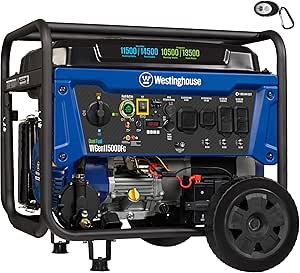 | Best for Maximum Listed Output | Peak wattage: 14,500 watts | Running wattage: 11,500 watts | Listed fuel options: Gasoline, propane, and natural gas in description; dual fuel in specs | VIEW LATEST PRICE | See Our Full Breakdown |
| Oxseryn 4400 Watt Inverter Generator – Portable Open Frame, Low Noise ECO Mode, RV Ready, Emergency Home Backup |  | Best Compact Backup for Essentials | Peak power: 4,400 watts | Running power: 3,400 watts | Fuel type: Gasoline | VIEW LATEST PRICE | See Our Full Breakdown |
| Westinghouse WGen9500DF Dual-Fuel Portable Generator, 12,500-Watt Peak |  | Best for High-Load Dual-Fuel Backup | Fuel: Gasoline or propane | Running output: 9,500 watts gasoline; 8,500 watts propane | Peak output: 12,500 watts gasoline; 11,200 watts propane | VIEW LATEST PRICE | See Our Full Breakdown |
| WEN DF475T Dual-Fuel Portable Generator with Wheel Kit and Electric Start |  | Best for Essential-Circuit Backup | Fuel: Gasoline or propane | Running output: 3,800 watts gasoline; 3,500 watts propane | Surge output: 4,750 watts gasoline; 4,350 watts propane | VIEW LATEST PRICE | See Our Full Breakdown |
| Westinghouse WGen11500TFc Tri-Fuel Portable Generator with CO Sensor |  | Best for Three-Fuel Flexibility | Fuel types: Gasoline, propane, and natural gas | Running output: 11,500 watts gasoline; 10,500 watts propane; 9,500 watts natural gas | Peak output: 14,500 watts gasoline; 13,500 watts propane; 12,000 watts natural gas | VIEW LATEST PRICE | See Our Full Breakdown |
| DuroMax XP13000HX 13,000-Watt Dual-Fuel Portable Generator |  | Best for Transfer-Switch Capacity | Fuel: Gasoline and propane | Starting output: 13,000 watts | Running output: 10,500 watts | VIEW LATEST PRICE | See Our Full Breakdown |
| Westinghouse 6500-Watt Dual-Fuel Portable Generator |  | Best Midrange Pick for Essential Loads | Fuel: Gasoline and propane | Running output: 5,300 watts gasoline; 4,800 watts propane | Peak output: 6,500 watts gasoline; 5,800 watts propane | VIEW LATEST PRICE | See Our Full Breakdown |
| Generac 10 kW Whole-Home Standby Generator with Transfer Switch and Cellular Connectivity |  | Best for Automatic Standby Backup | Output: 10,000 watts | Fuel: Natural gas or liquefied petroleum gas | Transfer switch: Automatic 16-circuit | VIEW LATEST PRICE | See Our Full Breakdown |
| Oxseryn 4400-Watt Gas Inverter Generator |  | Best Compact Supplemental Backup | Peak output: 4400 watts | Running output: 3400 watts | Fuel and tank capacity: Gasoline; 2 gallons | VIEW LATEST PRICE | See Our Full Breakdown |
| home backup generator | Engine | Running output |
|---|---|---|
| Generac GP9500E Tri-Fuel Porta | 500cc Generac OHV | — |
| DuroStar DS13000MX 13,000-Watt | — | — |
| Westinghouse WGen10500TFc Tri- | 500cc 4-stroke OHV | — |
| Westinghouse WGen11500DFc Dual | 550cc 4-stroke OHV | — |
| Oxseryn 4400 Watt Inverter Gen | — | — |
| Westinghouse WGen9500DF Dual-F | 457 cc, 4-stroke OHV | 9,500 watts gasoline; 8,500 watts propane |
| WEN DF475T Dual-Fuel Portable | 224 cc four-stroke OHV | 3,800 watts gasoline; 3,500 watts propane |
| Westinghouse WGen11500TFc Tri- | 550 cc 4-stroke OHV | 11,500 watts gasoline; 10,500 watts propane; 9,500 watts natural gas |
| DuroMax XP13000HX 13,000-Watt | 500 cc four-stroke OHV | 10,500 watts |
| Westinghouse 6500-Watt Dual-Fu | 274 cc 4-stroke OHV | 5,300 watts gasoline; 4,800 watts propane |
| Generac 10 kW Whole-Home Stand | — | — |
| Oxseryn 4400-Watt Gas Inverter | 4-stroke | 3400 watts |
More Details on Our Top Picks
Generac GP9500E Tri-Fuel Portable Generator with Electric Start
The GP9500E’s strongest home-backup advantage is three-fuel operation: gasoline, propane, or natural gas lets you adapt to what is available during an outage. Its 9,500 running watts and 50-amp outlet give it more capacity than the compact Oxseryn 4400, making it better suited to powering several household essentials or connecting to a compatible transfer setup. Compared with the Westinghouse WGen10500TFc, it has lower gasoline output and a smaller tank, so it is not the pick for buyers prioritizing longer listed runtime or more wattage. Electric start and COsense add useful convenience and a safety shutoff, but at 219 pounds, this is a substantial machine to move. Its gasoline runtime also depends on load, so extended outages call for fuel planning.
Pros:- Runs on gasoline, liquid propane, or natural gas
- 9,500 running watts and a 50-amp outlet support substantial backup loads
- Electric start, COsense shutdown, and low-oil shutdown add convenience and safety
- Wheeled steel frame aids transport despite the generator’s weight
Cons:- At 219 pounds, it is difficult to lift or reposition without help
- Gasoline runtime changes with load and requires refueling
- Lower gasoline output and a smaller tank than the Westinghouse WGen10500TFc
Best for: Homeowners who want the option to use gasoline, propane, or an available natural-gas supply and need substantial portable backup output.
Not ideal for: Buyers who need a generator they can move easily alone, or who prioritize higher output and longer listed gasoline runtime over fuel flexibility.
- Model:8063
- Fuel types:Gasoline, liquid propane, natural gas
- Running power:9,500 watts
- Starting power:12,500 watts on gasoline
- Engine:500cc Generac OHV
- Fuel tank capacity:7.5 gallons
- Gasoline runtime:Up to 9.5 hours at 50% load or 14 hours at 25% load
- Weight:219 lbs
- Safety features:COsense carbon monoxide shutdown and low-oil shutdown
Our verdict“Choose the GP9500E if access to three fuel types matters more than getting the highest output or easiest-to-move frame.”
DuroStar DS13000MX 13,000-Watt Dual Fuel Portable Generator – Gas & Propane, Remote Electric Start, Whole Home Backup, Transfer Switch Ready, RV/Emergency
The DS13000MX puts 10,500 running watts and 13,000 peak watts behind a gasoline-or-propane setup, making it a stronger fit for heavier simultaneous loads than the Generac GP9500E. Its 50-amp transfer-switch-ready outlet gives homeowners a path to connect compatible household circuits, while remote electric start means less effort when the generator is stored outside. The tradeoff is that it offers only two listed fuels, unlike the Generac and Westinghouse WGen10500TFc, both of which also support natural gas. DuroStar lists up to 17 hours at 50% load, but high demand can increase fuel use, and the substantial, all-metal unit is not an easy choice for frequent relocation. It makes the most sense when output and remote starting outweigh portability.
Pros:- 10,500 running watts and 13,000 peak watts suit heavier backup loads
- Runs on gasoline or propane
- Remote push-button electric start simplifies operation
- 50-amp transfer-switch-ready outlet supports compatible home connections
Cons:- Bulky, heavy construction makes moving and storage challenging
- Only two fuel types, unlike the tri-fuel Generac GP9500E and Westinghouse WGen10500TFc
- Fuel consumption rises under high loads
Best for: Homeowners with a compatible transfer-switch setup who need high running output and want gasoline or propane as backup fuel choices.
Not ideal for: Buyers who need natural-gas operation, frequently move their generator, or want a smaller machine for a few essential devices.
- Peak wattage:13,000 watts
- Running wattage:10,500 watts
- Fuel type:Gasoline and propane
- Engine displacement:500cc
- Tank volume:8.3 gallons
- Runtime:Up to 17 hours at 50% load
- Voltage:240 volts
- Starting system:Remote push-button electric start
- Safety feature:CO sensor shutoff
Our verdict“Pick the DS13000MX for high-output gasoline-or-propane backup when remote starting matters more than compact storage or natural-gas capability.”
Westinghouse WGen10500TFc Tri-Fuel Portable Generator with Remote Electric Start
The WGen10500TFc combines 10,500 running watts on gasoline with gasoline, propane, and natural-gas operation, giving it a useful middle ground between the lower-output Generac GP9500E and the higher-output WGen11500DFc. That spread of fuel choices can help a household keep backup plans flexible, while the listed up-to-19-hour gasoline runtime on a 9.5-gallon tank is longer than the Generac’s stated runtime. Remote, electric, and recoil starting offer alternatives if one method is inconvenient, and CO and low-oil shutdowns add protection. Output drops on propane and natural gas, however, so buyers should match expected loads to the selected fuel rather than rely on gasoline figures. It is still a heavy-duty wheeled generator, not a lightweight option for frequent solo moves.
Pros:- Supports gasoline, propane, and natural gas
- Provides 10,500 running watts on gasoline
- Listed gasoline runtime reaches up to 19 hours
- Remote, electric, and recoil starting plus CO and low-oil shutdowns
Cons:- Running wattage falls to 9,500 on propane and 8,500 on natural gas
- Heavy-duty size can make movement difficult despite the wheels
- Requires minimal assembly
Best for: Homeowners who want tri-fuel flexibility, remote starting, and substantial output without stepping up to the larger WGen11500DFc.
Not ideal for: Buyers who plan to run high loads on propane or natural gas, or who need a generator light enough to move around easily.
- Peak wattage on gasoline:13,500 watts
- Running wattage on gasoline:10,500 watts
- Running wattage by fuel:9,500 watts on propane; 8,500 watts on natural gas
- Fuel types:Gasoline, propane, natural gas
- Engine:500cc 4-stroke OHV
- Fuel tank capacity:9.5 gallons
- Maximum gasoline runtime:Up to 19 hours
- Starting methods:Remote, electric, recoil
- Safety features:CO sensor and automatic low-oil shutdown
Our verdict“Choose the WGen10500TFc if you want three fuel options and long listed gasoline runtime without needing the WGen11500DFc’s higher gasoline output.”
Westinghouse WGen11500DFc Dual Fuel Portable Generator
For buyers who want the highest stated gasoline output among these five, the WGen11500DFc leads with 11,500 running watts and 14,500 peak watts. That puts it ahead of the Westinghouse WGen10500TFc on gasoline, though the WGen10500TFc offers a more clearly specified three-fuel setup. The WGen11500DFc’s product description lists gasoline, propane, and natural gas, but its fuel-type spec also describes it as dual fuel; I would verify the supported fuels and conversion requirements before making a natural-gas connection part of an outage plan. Its less-than-5% THD and remote start add appeal for electronics and convenience, while the large 550cc engine and tank make storage and movement harder. The 19-hour figure applies to gasoline; propane runtime is listed as up to seven hours.
Pros:- 11,500 running watts on gasoline is the highest listed running output in this group
- Remote key-fob and electric starting
- Less than 5% THD is suited to powering sensitive electronics
- Includes CO sensing, low-oil shutdown, GFCI outlets, fuel gauge, and hour meter
Cons:- Fuel-type information is inconsistent: the description lists natural gas, while the spec says dual fuel
- Propane runtime is listed as up to seven hours, shorter than the gasoline runtime
- The 550cc engine and 9.5-gallon tank make storage and movement difficult
Best for: Homeowners who need high gasoline output for multiple household loads and value remote starting and low-THD power.
Not ideal for: Buyers who need confirmed natural-gas capability, long propane runtime, or a generator that is simple to store and reposition.
- Peak wattage:14,500 watts
- Running wattage:11,500 watts
- Listed fuel options:Gasoline, propane, and natural gas in description; dual fuel in specs
- Engine:550cc 4-stroke OHV
- Fuel tank capacity:9.5 gallons
- Gasoline runtime:Up to 19 hours
- Propane runtime:Up to 7 hours
- THD:Less than 5%
- Starting system:Electric start with remote key fob
Our verdict“Choose this model for its high gasoline output and low-THD specification, but verify fuel compatibility before relying on natural gas.”
Oxseryn 4400 Watt Inverter Generator – Portable Open Frame, Low Noise ECO Mode, RV Ready, Emergency Home Backup
The Oxseryn is a different kind of home-backup choice from the large-frame generators here: 3,400 running watts in a 56-pound package suits a few essentials, not broad household coverage. Its lighter build makes it far easier to position than the 219-pound Generac GP9500E or the larger DuroStar DS13000MX, and the listed up-to-14-hour runtime at 25% load can stretch a small load between refills. The 120-volt output and gasoline-only fuel system also limit its role: it cannot match the 240-volt output and higher capacity of those full-size options for larger home circuits. At under 72 dBA, it is listed as quieter than a typical high-output backup unit, but the open frame offers less weather protection. It is best treated as a portable essentials generator, with sensible shelter and load planning.
Pros:- At 56 pounds, it is much easier to move than the full-size Generac GP9500E or DuroStar DS13000MX
- 3,400 running watts offer more capacity than a basic low-output portable generator
- Listed runtime reaches up to 14 hours at 25% load with ECO mode
- Includes an RV outlet, low-oil shutdown, and overload protection
Cons:- 3,400 running watts are not suited to broad household backup
- Gasoline-only operation lacks the fuel flexibility of the tri-fuel Westinghouse WGen10500TFc
- Open-frame construction offers limited weather protection
Best for: Buyers who need portable 120-volt backup for a few essentials, such as small appliances or RV equipment, rather than whole-home coverage.
Not ideal for: Households that need 240-volt output, transfer-switch-level capacity, multiple large appliances, or protection from outdoor weather without added shelter.
- Peak power:4,400 watts
- Running power:3,400 watts
- Fuel type:Gasoline
- Tank volume:2 gallons
- Runtime at 25% load:Up to 14 hours
- Voltage:120V AC
- Noise level:Under 72 dBA at 23 feet
- Weight:56 lbs
- Outlets:2 × 120V AC, 1 × 12V DC, 1 × RV
Our verdict“Choose the Oxseryn for portable, limited-load backup if easy handling matters more than 240-volt output or whole-home capacity.”
Westinghouse WGen9500DF Dual-Fuel Portable Generator, 12,500-Watt Peak
The WGen9500DF suits households that want substantial backup output without giving up a choice of gasoline or propane. Its gasoline rating of 9,500 running watts is well above the WEN DF475T’s 3,800 watts, making it better equipped for several household circuits or larger startup loads. Remote and electric starting also reduce the effort of getting it running during an outage, while the display helps track engine hours and operating readings. The tradeoff is its heavy-duty, difficult-to-move build; wheels and a handle help, but do not make it light to reposition. Its 12-hour maximum runtime applies to a 6.6-gallon gasoline tank, so fuel planning still matters. I’d choose it over the WEN for higher-demand backup, but not if compact storage or easy solo handling matters most.
Pros:- Gasoline output reaches 9,500 running watts for substantial household loads.
- Runs on gasoline or propane, giving owners a second fuel option.
- Remote, electric, and recoil starting provide several ways to start it.
- Up to 12 hours of runtime on a 6.6-gallon gasoline tank.
Cons:- Heavy-duty size and weight can make repositioning difficult.
- Requires some assembly before use.
- Its maximum runtime depends on load and gasoline availability.
Best for: Households seeking high-output portable backup with gasoline and propane flexibility, remote starting, and transfer-switch-ready connections.
Not ideal for: Buyers who need a light generator they can regularly move alone, or who only need modest output for a few essential devices.
- Fuel:Gasoline or propane
- Running output:9,500 watts gasoline; 8,500 watts propane
- Peak output:12,500 watts gasoline; 11,200 watts propane
- Engine:457 cc, 4-stroke OHV
- Fuel tank:6.6 gallons
- Runtime:Up to 12 hours
- Starting methods:Remote, electric, and recoil
- Outlets and current:6 outlets; maximum 50 A
- Warranty:3-year limited warranty
Our verdict“Choose the WGen9500DF for high-load portable backup and dual-fuel flexibility if you can accommodate its substantial size.”
WEN DF475T Dual-Fuel Portable Generator with Wheel Kit and Electric Start
The WEN DF475T is the practical lower-output choice here for buyers who want to run selected essentials rather than power a large portion of the house. Its 3,800 gasoline running watts are far below the Westinghouse WGen9500DF’s 9,500, but that smaller capacity can suit a fridge, lights, and other prioritized loads without stepping up to a heavy-duty generator. Selectable 120V/240V output and an L14-30R connection make it relevant for transfer-switch use, while the included wheel and handle kit help with positioning. The four-gallon tank is smaller than the WGen9500DF’s, and the advertised 11-hour runtime is at half load, not full output. I’d pick the WEN for a simpler, limited-load backup plan; skip it if you expect to run multiple high-demand appliances at once.
Pros:- Gasoline and propane operation offers fuel flexibility.
- Selectable 120V/240V output supports different backup connections.
- Electric start and included wheel and handle kit simplify setup and movement.
- Up to 11 hours of runtime at half load.
Cons:- Lower running output limits the number of substantial household loads it can support.
- The four-gallon gasoline tank is smaller than the WGen9500DF’s 6.6-gallon tank.
- The 11-hour runtime figure is specified at half load.
Best for: Households planning to power selected essentials through a compatible transfer switch and wanting a comparatively modest-capacity dual-fuel unit.
Not ideal for: Owners who need to run several high-draw appliances or a broad set of household circuits simultaneously.
- Fuel:Gasoline or propane
- Running output:3,800 watts gasoline; 3,500 watts propane
- Surge output:4,750 watts gasoline; 4,350 watts propane
- Voltage:Selectable 120V/240V
- Engine:224 cc four-stroke OHV
- Gasoline tank:4 gallons
- Runtime:Up to 11 hours at half load
- Starting method:Electric start
- Warranty:2 years
Our verdict“Choose the DF475T for essential-circuit backup and manageable output needs, not for running a large household load.”
Westinghouse WGen11500TFc Tri-Fuel Portable Generator with CO Sensor
For outage plans that depend on more than one stored fuel, the WGen11500TFc stands out by running on gasoline, propane, or natural gas. Natural-gas compatibility can reduce reliance on refilling portable fuel containers, while gasoline output reaches 11,500 running watts—more than the dual-fuel WGen9500DF’s 9,500 watts. Its 9.5-gallon tank supports up to 19 hours of gasoline runtime, and remote electric start makes operation more convenient. A CO sensor adds a safety feature, but it does not make indoor operation safe: this remains a portable combustion generator that must be used outdoors according to its instructions. The main compromise is physical bulk, along with shorter stated propane runtime—up to seven hours on a 20-pound tank. This is the strongest fit here for buyers with a natural-gas connection and high backup demands, not those prioritizing easy storage.
Pros:- Three fuel choices include natural gas, gasoline, and propane.
- 11,500 gasoline running watts support higher loads than the WGen9500DF.
- Up to 19 hours of gasoline runtime from a 9.5-gallon tank.
- Remote electric start and a CO sensor are included.
Cons:- Its heavy-duty portable design can be difficult to move and store.
- Propane runtime is listed at up to seven hours on a 20-pound tank.
- The CO sensor does not remove the need for safe outdoor placement.
Best for: Homeowners with access to natural gas who want high portable backup output and the option to switch among three fuel sources.
Not ideal for: Buyers with limited storage or mobility needs, or those who do not have access to natural gas and want a small, easy-to-store generator.
- Fuel types:Gasoline, propane, and natural gas
- Running output:11,500 watts gasoline; 10,500 watts propane; 9,500 watts natural gas
- Peak output:14,500 watts gasoline; 13,500 watts propane; 12,000 watts natural gas
- Engine:550 cc 4-stroke OHV
- Fuel tank:9.5 gallons
- Gasoline runtime:Up to 19 hours
- Starting:Remote electric start
- Total harmonic distortion:Less than 5%
- Warranty:3-year limited warranty
Our verdict“Choose the WGen11500TFc if three fuel options and high output matter more than portability.”
DuroMax XP13000HX 13,000-Watt Dual-Fuel Portable Generator
The DuroMax XP13000HX is aimed at buyers who need high output and a 50A connection for a transfer-switch setup. Its 10,500 running watts exceed the WGen9500DF’s 9,500, giving it more rated gasoline capacity for larger backup loads. It also runs on gasoline or propane, has electric start, and includes CO Alert and a digital display. The listed 17-hour runtime sounds useful for longer outages, but the provided data does not specify the load or fuel conditions behind that figure, so I would not compare it directly with the Westinghouse models’ runtime claims. At 245 pounds, this is a stationary-in-practice portable generator: its size and weight complicate moving it even if the outage location changes. Choose it for connection options and output, not for frequent repositioning.
Pros:- 10,500 running watts provide more listed output than the WGen9500DF.
- Gasoline and propane operation supports two fuel plans.
- 120/240V 50A outlet is suited to compatible transfer-switch connections.
- Electric start, CO Alert, and a digital display are included.
Cons:- At 245 pounds, it is difficult to reposition.
- The supplied runtime figure does not include a stated load condition.
- The provided product data lists a 0.5-gallon tank volume, which is not enough information to plan fuel capacity confidently.
Best for: Homeowners who need high-output dual-fuel backup and a 120/240V 50A connection for a compatible transfer-switch arrangement.
Not ideal for: People who need to move their generator often, or buyers seeking clear runtime comparisons tied to a stated tank capacity and load.
- Fuel:Gasoline and propane
- Starting output:13,000 watts
- Running output:10,500 watts
- Engine:500 cc four-stroke OHV
- Voltage:240 volts
- Runtime:17 hours; load conditions not specified in supplied data
- Weight:245 pounds
- Outlets:Four 120V GFCI outlets; 120V 30A; 120/240V 30A twist-lock; 120/240V 50A
- Features:Electric start, CO Alert, digital display, transfer-switch-ready
Our verdict“Choose the XP13000HX for high output and a 50A transfer-switch connection if its weight and unclear fuel-capacity data fit your setup.”
Westinghouse 6500-Watt Dual-Fuel Portable Generator
The Westinghouse 6500-Watt Dual-Fuel offers a middle ground for buyers who need more capacity than the WEN DF475T but do not need the output or bulk of the WGen9500DF. It supplies 5,300 running watts on gasoline and 4,800 on propane, which can suit a planned group of essential circuits while keeping the generator more focused than the high-output options. The 4.7-gallon tank is rated for up to 14.5 hours of runtime, and its household, RV-ready, and transfer-switch-ready outlets broaden where it can fit. Automatic low-oil and carbon monoxide shutdown add useful safeguards, though safe outdoor placement remains necessary. Compared with the WEN, it has more running output; compared with the WGen9500DF, it gives up substantial capacity. Some assembly is required, and factory testing may leave an odor of oil or fuel.
Pros:- More running output than the WEN DF475T while remaining below the WGen9500DF’s capacity.
- Runs on gasoline or propane.
- Includes household, RV-ready, and transfer-switch-ready outlets.
- Automatic low-oil and carbon monoxide shutdown features are included.
Cons:- Its output is below the high-capacity WGen9500DF and XP13000HX models.
- Some assembly is required before operation.
- Factory testing may leave residual oil or fuel odor.
Best for: Households seeking a dual-fuel generator for a planned set of essential circuits, with RV and transfer-switch connections available.
Not ideal for: Buyers who need to power many high-demand appliances together or want a generator requiring no assembly.
- Fuel:Gasoline and propane
- Running output:5,300 watts gasoline; 4,800 watts propane
- Peak output:6,500 watts gasoline; 5,800 watts propane
- Engine:274 cc 4-stroke OHV
- Fuel tank:4.7 gallons
- Maximum runtime:Up to 14.5 hours
- Voltage:120/240 V
- Outlets:5–20R 120 V duplex; TT-30R 30 A; L14-30R 30 A
- Safety and warranty:Automatic low-oil and CO shutdown; 3-year limited service, labor, and parts coverage
Our verdict“Choose this Westinghouse for midrange essential-load backup with dual-fuel and transfer-switch flexibility, rather than maximum household capacity.”
Generac 10 kW Whole-Home Standby Generator with Transfer Switch and Cellular Connectivity
For homeowners who want backup power to start without hauling out a portable unit, this 10,000-watt standby generator is the most hands-off option in this group. It starts automatically when utility power fails and includes an automatic 16-circuit transfer switch, while natural-gas and liquid-propane compatibility gives it alternatives to stored gasoline. Compared with the portable DuroStar DS13000MX, it has less stated output, but its fixed installation and automatic operation suit a different priority: dependable backup without manual startup. Built-in cellular connectivity can support remote status checks and maintenance alerts, though Mobile Link premium requires a paid subscription. At 384 pounds and nearly four feet long, it needs a permanent installation location, and it is not a plug-and-play portable solution. I’d choose it for automatic residential coverage, not for mobility or maximum portable-generator output.
Pros:- Starts automatically when utility power fails
- Includes an automatic 16-circuit transfer switch
- Runs on natural gas or liquid propane
- Built-in cellular monitoring offers status checks and maintenance alerts
Cons:- Cellular monitoring requires a paid Mobile Link premium subscription
- Its 384-pound weight and large dimensions call for a permanent installation site
- Its 10,000-watt output is lower than the stated peak output of larger portable options such as the DuroStar DS13000MX
Best for: Homeowners seeking automatic outage startup, a fixed residential installation, and natural-gas or propane operation.
Not ideal for: Renters, buyers who need a portable generator, or homeowners unwilling to arrange a permanent installation and pay for premium cellular monitoring.
- Output:10,000 watts
- Fuel:Natural gas or liquefied petroleum gas
- Transfer switch:Automatic 16-circuit
- Connectivity:Built-in cellular; Mobile Link premium subscription required
- Voltage and frequency:120 volts; 60 hertz
- Weight:384 pounds
- Dimensions:47.3 × 25.6 × 30.7 inches
- Warranty:5-year limited warranty
Our verdict“Choose this Generac if automatic, fixed-home backup matters more than portability or the higher peak output offered by large portable units.”
Oxseryn 4400-Watt Gas Inverter Generator
This Oxseryn is a portable, lower-output backup option for keeping selected essentials running, rather than powering a whole home. Its 3,400 running watts and 30A RV outlet make it more useful for modest loads and recreational use than a small emergency-only unit, while its 57-pound weight is far easier to move than the 384-pound Generac standby model. The tradeoff is scale: unlike the Generac 10 kW, it does not start automatically, include a transfer switch, or offer a stated whole-home output level. Its two-gallon gasoline tank is listed for up to 14 hours at 25% load, but heavier use can mean more frequent refueling. ECO mode and low-oil shutdown add useful operating protections; still, a one-year warranty is shorter than the Generac’s five-year coverage. I’d treat it as a compact supplement, not a substitute for installed home standby power.
Pros:- 3400 watts of running output for selected household loads
- Includes two 120V AC outlets, a 30A RV outlet, and a 12V DC outlet
- Up to 14 hours of runtime at 25% load from its 2-gallon tank
- ECO mode, cold-start technology, overload protection, and low-oil shutdown
Cons:- Gasoline-only operation and a 2-gallon tank limit fuel flexibility and can require refueling during extended outages
- No automatic startup or transfer switch is listed, unlike the Generac 10 kW standby model
- One-year warranty is shorter than the five-year coverage listed for the Generac
Best for: Homeowners who need a movable generator for a few essential loads and want an RV outlet for occasional recreational use.
Not ideal for: Buyers seeking automatic whole-home coverage, high running output, or extended operation without refueling.
- Peak output:4400 watts
- Running output:3400 watts
- Fuel and tank capacity:Gasoline; 2 gallons
- Runtime:Up to 14 hours at 25% load
- Outlets:2 × 120V AC, 1 × 30A RV, 1 × 12V DC
- Engine:4-stroke
- Weight and dimensions:57 pounds; 19.4 × 15.2 × 19.2 inches
- Warranty:1 year
Our verdict“Pick this Oxseryn for portable support of selected essentials, but choose a standby unit like the Generac if you need automatic residential backup.”

How We Picked
I ranked these generators by how well they match real home outage plans, not by headline wattage alone. I compared stated output and fuel choices against likely buyer needs, then weighed whether each design favors automatic whole-home coverage, portable high-capacity backup, or limited-load power. Transfer-switch readiness, electric or remote starting, portability, inverter design, and stated safety features also shaped the order because they affect setup, daily handling, and the loads a generator can sensibly support.
The top position goes to a portable model with a strong balance of output and fuel flexibility; the Generac standby unit earns a distinct place for buyers who prioritize automatic operation. High-output dual-fuel units follow for households willing to manage a portable setup, while smaller and more specialized models rank lower for whole-home use but can be better fits for essentials, RV use, or simpler budgets. I also account for practical limits: a generator’s advertised wattage does not tell you how long it will run, what it can power at once, or whether a particular fuel delivers the same output.
Factors to Consider When Choosing Home Backup Generators
Choosing among home backup generators starts with your outage plan, not the biggest number on a product page. I’d decide which circuits must stay on, who will operate the generator, and how you will supply fuel before comparing models. These broader checks help prevent buying a unit that is powerful on paper but awkward or unsuitable at home.
Match Generator Capacity to Essential Loads
List the appliances and circuits you want to run at the same time, then account for the higher starting demand of equipment such as refrigerators, pumps, and air conditioners. A common mistake is adding only running watts and overlooking startup surges, which can make a generator struggle when multiple motors start together. If your plan centers on lights, refrigeration, and a few small devices, a compact inverter may be enough; larger loads call for a higher-output unit or a carefully managed circuit plan. Ask an electrician about the load calculation and transfer equipment before treating any portable generator as whole-house backup. Choosing capacity around a realistic priority list can be more useful than buying the largest generator you can accommodate.
Choose Fuel Based on Access, Storage, and Runtime
Gasoline is widely used, but keeping enough fresh fuel ready can be difficult during a long outage. Propane can be stored for longer periods when handled correctly, while natural gas can be convenient where a suitable connection is available. Dual- and tri-fuel models offer options, but output may differ by fuel, so compare the ratings for the fuel you expect to use rather than assuming every mode performs alike. Think through how you will replenish fuel if roads are blocked or a utility service is interrupted. The added flexibility is most useful when you already have a safe, practical supply plan.
Decide Between Portable Backup and Standby Operation
A portable generator can serve changing needs and can be moved or stored when it is not running, but someone must place it correctly, start it, connect it safely, and manage refueling. A permanently installed standby unit can restore selected or broader home circuits automatically when paired with compatible transfer equipment, but it requires a suitable installation and fixed location. Buyers sometimes compare their wattages as if the systems offer the same experience; the day-to-day convenience is a major difference. Consider whether anyone in the household can safely set up a portable unit during bad weather or at night. If hands-off backup matters more than mobility, the installed-system route may justify its added planning and installation demands.
Plan for Safe Placement and Electrical Connection
Portable generators produce carbon monoxide, so they must operate outdoors, well away from doors, windows, and vents, following the manufacturer’s clearance instructions. A CO sensor is a helpful safety feature, not permission to run a unit in a garage, basement, or enclosed porch. To power home circuits, use a compatible transfer switch or other code-compliant connection installed by a qualified professional; never connect a generator to a household outlet as a shortcut. Check local rules and utility requirements before installation, especially for standby systems or natural-gas connections. A safe connection plan should be part of the purchase decision rather than a task deferred until the outage begins.
Compare Operating Burden, Not Just Starting Convenience
Electric and remote starts can make startup easier, but they do not remove the need to check oil, maintain the engine, manage fuel, or follow operating instructions. Inverter models may be a better fit when portable power and lower-noise operation matter, while open-frame units can trade some refinement for a more utilitarian design. Ask who will perform maintenance and where the generator will be stored between outages. Also review the manufacturer’s guidance on run time, oil service, and storage rather than assuming features alone reduce upkeep. Paying more for convenience makes sense only when it addresses a task your household would otherwise find difficult.
Look Beyond Wattage to Setup and Ownership Fit
High-output portable generators can be heavy and need a level, outdoor operating location, adequate clearance, and a safe way to move them into position. Wheels and electric start help, but they do not make a large generator effortless to handle. Before buying, check the unit’s dimensions and weight against your storage area, access route, and the person who will set it up. For a standby system, factor in site suitability and professional installation; for portable models, plan the transfer connection and fuel logistics. A slightly lower-output generator that your household can operate safely may serve better than a larger unit that stays unused or is difficult to deploy.
Frequently Asked Questions
Can a portable generator power my whole house?
It depends on the generator’s output, the circuits you select, and the starting demands of your appliances. A large portable model may cover several important circuits, but that does not mean every household load can run at once. A transfer switch lets you connect selected circuits safely, while an electrician can help calculate what your home requires. Avoid relying on a wattage headline as proof of whole-house capacity. Decide which loads take priority and confirm the plan with a qualified professional before buying.
Is a tri-fuel generator a better choice than a dual-fuel model?
Tri-fuel capability adds another potential fuel source, which can be useful if one supply becomes difficult to obtain during an extended outage. It is not automatically the better choice if you do not have access to the additional fuel or would not use it. Compare each model’s output on the fuel you expect to run, since ratings can vary by fuel type. Also consider the safe storage, connection, and maintenance requirements for each supply. A dual-fuel generator may be the simpler fit when two available fuels already cover your plan.
Do I need a transfer switch for a portable home generator?
If you want to power household circuits from a portable generator, a properly installed transfer switch or other approved connection is the safe route. It helps prevent dangerous backfeeding into utility lines and gives you a controlled way to supply selected circuits. A generator described as transfer-switch ready still needs compatible equipment and correct installation. Ask a licensed electrician to check your panel and local requirements before choosing a connection method. Never plug a generator into a wall outlet to feed the house.
When does a standby generator make more sense than a portable one?
A standby generator is a stronger fit when automatic backup and reduced setup during an outage matter more than mobility. It is permanently installed and works with transfer equipment, so buyers should plan for site suitability and professional installation. A portable unit is more adaptable and can be useful for limited loads or other settings, but it requires manual operation and fuel management. Consider how long outages typically affect your household and whether anyone can safely deploy a portable generator when needed. The right choice is about operating routine as much as power output.
Is a 4400-watt inverter generator enough for home backup?
A 4400-watt inverter generator can suit a limited-load plan, such as keeping selected essentials running, but it is not a substitute for a high-output whole-home system. The number of appliances it can handle depends on their running and startup demands, and loads may need to be used in sequence. Check the actual output rating and your priority appliances before relying on this capacity. Inverter designs can appeal to buyers who value portability and a more refined operating profile, but their smaller output sets clear limits. If your plan includes large heating, cooling, or pump loads, calculate requirements with a qualified professional first.
Conclusion
For the broadest portable backup fit in this group, I’d start with the Westinghouse WGen11500TFc: its high output and three-fuel options give it a useful balance for households prepared to manage a portable unit. The Generac 10 kW standby generator is my best premium choice for buyers who want an installed system with automatic operation, while the DuroStar DS13000MX is a strong value-minded option for those who need substantial dual-fuel portable capacity and can handle its larger setup. Beginners with modest essential-load needs may find the Oxseryn 4400-Watt inverter easier to match to a focused plan than a high-output frame generator, though they should confirm its capacity first. For fuel flexibility, compare the Westinghouse tri-fuel options; for a simpler, smaller backup role, consider the WEN DF475T or the 6500-watt Westinghouse. I’d choose only after confirming load requirements, safe placement, fuel access, and the right electrical connection for the home.
Halloween Picks
halloween
As an affiliate, we earn on qualifying purchases.