TL;DR

Get backup power and energy gear delivered free — and shop member deals
- Fast, free delivery on millions of items
- Access to Prime Big Deal Days deals on October 6–7
- Prime Video, Amazon Music and more included
Solar-powered outdoor string lights use a small solar panel to charge a rechargeable battery that powers LED bulbs after dark. They’re convenient for decorative patio and garden lighting, but runtime and brightness depend on sunlight, battery condition, and settings, so check panel placement, weather ratings, and battery replaceability before buying.
The patio can be ready for dinner while your nearest outdoor outlet sits on the wrong side of the house. Solar-powered outdoor string lights offer a tidy fix: no outdoor extension cord to snake across the lawn, and no electricity drawn from your home while the lights run.
But the little panel does not make sunlight problems disappear. Shade, winter weather, a tired battery, or a dim setting can all change how long the bulbs stay on. This guide explains what to check before you buy, where to put the panel, how to set realistic expectations, and how to keep the lights working through the season.
Place the panel where it can get several hours of direct sunlight; a separate-panel model helps when the hanging area is shaded.
Treat stated runtime as a guide that assumes suitable charging, not a nightly guarantee.
Use decorative string lights for ambience and a dedicated light for steps, security, or detailed tasks.
Check whether the IP rating covers the panel, wiring, controller, and bulbs, and follow the manufacturer’s weather limits.
Look for a replaceable rechargeable battery, clean the panel, and inspect connections to extend useful service.
How solar string lights turn daylight into evening glow
Solar-powered outdoor string lights use a small panel to charge a rechargeable battery during the day, then power LED bulbs after dark. A light sensor or timer typically controls when the string switches on, so you can get an evening glow without plugging it into your home’s electrical supply.
That straightforward setup matters when you want lights along a fence or balcony where no outlet is nearby. For example, you can hang a short string above a small balcony table, set the panel on a sunny railing, and avoid running a cable through a doorway. The tradeoff is that the lights depend on stored solar energy; a cloudy afternoon may mean a shorter or dimmer evening.
Many products have an on/off switch, steady and flashing modes, or a timer. Read the instructions before the first night: some models need you to switch them on manually before the sensor can control them. A powered outdoor string is convenient, but convenience still depends on operating it correctly.
These lights usually suit decorative or accent lighting, not security lighting or bright task work. They can make a pergola feel warm and welcoming, but they won’t reliably illuminate the steps you need to see clearly. Think of them as candlelight overhead, not a floodlight.
solar-powered outdoor string lights
As an affiliate, we earn on qualifying purchases.
As an affiliate, we earn on qualifying purchases.
Where to place the panel for a longer evening glow
Solar-powered outdoor string lights stay on longer when their panel receives several hours of direct sunlight and remains clean. A spot that looks bright from your kitchen window may still sit in shade from a roof, tree, or neighboring building during the hours when the panel needs to charge.
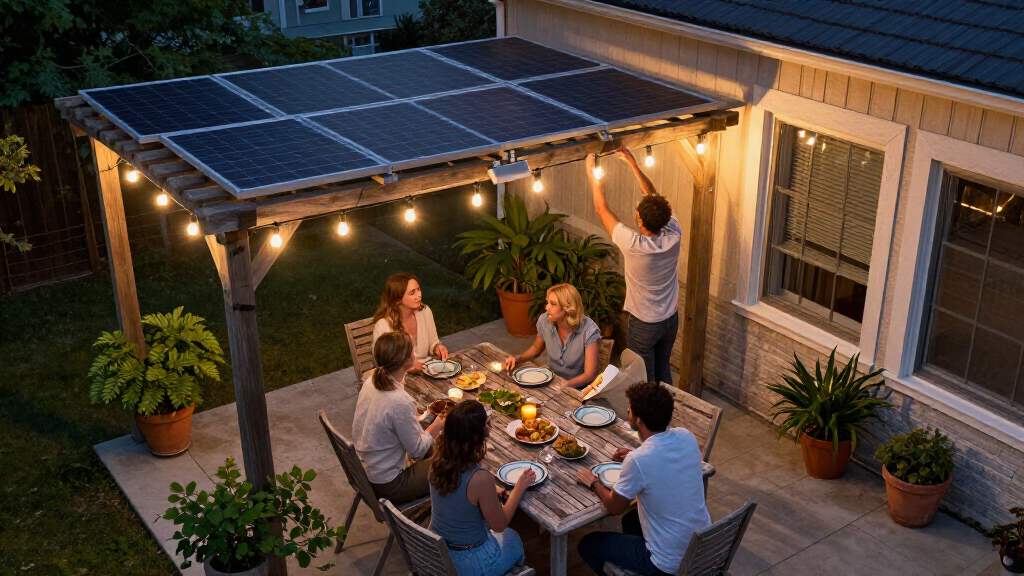
Try a simple afternoon check before you hang the string. Watch the proposed panel location over a few hours, especially between late morning and afternoon, and note where shadows fall. If your patio is shaded but the garden fence gets full sun, a model with a separate panel and connecting cable may let you hang the bulbs over the table while placing the panel in the brighter spot.
Do not count on a panel behind a window to charge like one outdoors. Glass, shade, cloudy skies, and short winter days can reduce the energy it collects. A small patch of grime can also block light; wipe the panel with a soft, damp cloth when you see dust, pollen, or bird marks.
A neighbor might hang a string under a covered porch and wonder why it fades before dinner. The problem may not be the bulbs at all: the panel could be shaded all day. Panel placement often matters more than decorative features, particularly in a garden with tall trees or deep eaves.
outdoor string lights with separate solar panel
As an affiliate, we earn on qualifying purchases.
As an affiliate, we earn on qualifying purchases.
How to judge brightness and runtime without guessing
Solar string-light runtime is not a fixed promise; it changes with the day’s sunlight, battery charge, bulb count, brightness setting, and operating mode. A manufacturer’s runtime figure describes a particular set of conditions, not a guarantee that your lights will stay bright until morning every night.
For example, a string that runs late after a sunny June day may switch off earlier after a cloudy autumn afternoon. Flashing modes or higher brightness can use energy differently from a steady, lower setting. When a product lists brightness in lumens, compare that figure with your intended task: most decorative strings add atmosphere, but they are not a substitute for a dedicated porch light when you need to read a menu or see a step.
Use this quick check before buying:
- Match the job: choose decorative bulbs for ambience, and a separate task or area light where you need dependable visibility.
- Read the runtime claim: check the stated hours and remember that good charging conditions matter.
- Check the controls: see whether you can lower brightness, set a timer, or switch off the string to save charge.
- Think about the season: weak winter sun and cold conditions can reduce charging and battery performance.
One practical setup is a string on a low brightness setting for the first part of a dinner party, paired with a proper porch fixture near the steps. You get the soft amber dots you want without asking decorative bulbs to do a safety light’s job.
As an affiliate, we earn on qualifying purchases.
Which features make a string worth buying?
The best solar string lights for your yard are the ones whose panel location, battery, brightness, and weather rating fit your actual space. A long feature list cannot make up for a panel that never gets sun or a string that does not match the job.
Compare the details that affect everyday use, not just the photos on the box. Check whether the panel is attached to the string or separate, whether the rechargeable battery is replaceable, and what controls the product offers. Some newer designs add USB backup charging, remote controls, or app settings, but features differ by model; check the manual or manufacturer specifications rather than assuming every version has them.
| Feature | What to check | Why it matters |
|---|---|---|
| Panel placement | Attached or separate, plus cable length | A separate panel can reach sun while bulbs hang in shade. |
| Battery | Type and whether it can be replaced | A replaceable rechargeable battery can extend the useful life of the string. |
| Weather rating | IP rating and which parts it covers | The bulbs, controller, wiring, and panel may have different limits. |
| Controls | Sensor, timer, switch, brightness, and modes | Controls let you manage when the lights run and how they use stored charge. |
For instance, if your bulbs hang beneath a pergola, a separate panel may solve the shade problem; if you want to repair rather than replace the string, battery access matters more. Choose for the hardest part of your setup, not the feature that looks flashiest in a product photo.
As an affiliate, we earn on qualifying purchases.
What weather ratings can—and can’t—tell you
An IP rating describes resistance to dust and water under defined test conditions; it does not mean a product can handle every storm, ice buildup, or immersion. Check the stated rating and the manufacturer’s instructions for the bulbs, controller, panel, plugs, and connections rather than assuming the entire set shares the same protection.
That difference is easy to miss when a string hangs under an eave. The bulbs might cope with rain while a control box or connector needs more shelter. Look for outdoor-use instructions before mounting the set, and do not place components in standing water or treat “weather-resistant” as permission to leave them underwater.
Local weather matters too. A mild summer shower is different from weeks of freezing rain, heavy snow, or strong wind tugging on a long span. One homeowner might leave a weather-rated string up through a dry summer, then take it down ahead of winter storms. That can be a sensible choice when the manual allows outdoor use but warns against severe conditions.
Weather-resistant does not mean weather-proof under every condition. Check the rating for each component and follow the product’s care and seasonal-storage instructions.
Mount the string using sturdy hanging points that suit the structure, and inspect the wiring and connections when you clean the panel. For electrical, roof, or structural work involved in mounting, use a qualified professional when the job exceeds simple, safe household installation. Don’t drill into unknown wiring or compromise a roof or support just to find a place for lights.
How to keep the lights useful for more than one season
A clean panel, sound connections, and a replaceable battery can help solar string lights last longer, although no maintenance routine can stop a battery from gradually losing capacity. Rechargeable batteries are consumable parts, and some models let you replace them while others seal them inside the product.
Start with a quick inspection every few weeks during regular use. Wipe off dust and pollen, check that the panel mount has not shifted, and look for frayed wire, cracked bulb covers, or loose connectors. If the string suddenly runs for much less time, first check for shade or dirt, then consult the manual about battery replacement or charging. A shorter winter day may explain the change better than a faulty bulb.
Before cold weather arrives, follow the manufacturer’s storage advice. Some lights can stay outside in suitable conditions; others benefit from being taken down and stored dry. If the panel or battery can be removed, handle it as the instructions direct. Do not throw rechargeable batteries into household rubbish where local rules prohibit it; use an appropriate battery collection or recycling service.
Solar lights draw no household electricity while operating, but that does not make their environmental impact zero. Manufacturing, battery replacement, and disposal all count. If you buy a string with a replaceable battery and maintain it instead of discarding the whole set when runtime declines, you can avoid replacing a working product just because one consumable part has aged.
Frequently Asked Questions
How many hours of sunlight do solar string lights need?
Several hours of direct sunlight usually help the panel charge well, but exact needs vary by model. Shade, cloud cover, dirt, and winter daylight can reduce charging, so check the manufacturer’s guidance and choose the sunniest practical panel location.
How long do solar string lights stay on at night?
Runtime depends on the charge collected that day, battery condition, brightness, bulb count, and operating mode. Treat the manufacturer’s stated runtime as a guide under suitable conditions, not a guarantee for every evening.
Can solar string lights work in rain?
Some outdoor-rated models can handle rain, but you need to check the IP rating and instructions for each component. A rating does not promise protection from every storm, submersion, or prolonged moisture.
Are solar string lights bright enough for a patio?
They usually work well for decorative ambience, such as a soft glow above a patio table. Most are not a replacement for task, security, or step lighting, so add a dedicated fixture where you need clear, dependable visibility.
Can I replace the battery in solar string lights?
Some models use replaceable rechargeable batteries, while others have sealed batteries. Check the product details before buying if you want to repair the lights rather than replace the entire set when battery capacity declines.
Conclusion
Choose solar string lights by starting with the place the panel will sit, not the look of the bulbs. If the panel gets sun, the battery suits your needs, and you use the string for atmosphere rather than task lighting, the setup can make an outdoor table feel inviting without a cable crossing the yard.
Give the panel a sunny perch, keep it clean, and let the warm dots of light do what they do best: turn an ordinary evening into one you want to linger in.
Halloween Picks
halloween
As an affiliate, we earn on qualifying purchases.