TL;DR

Get backup power and energy gear delivered free — and shop member deals
- Fast, free delivery on millions of items
- Access to Prime Big Deal Days deals on October 6–7
- Prime Video, Amazon Music and more included
Solar power banks for emergencies give you a portable way to recharge phones when grid power is unavailable, but their small panels usually replenish the battery slowly. Choose a model with at least 10,000 mAh, charge it from a wall outlet before an outage, and treat sunlight as a helpful top-up rather than your only power source.
A solar power bank can keep your phone alive during a blackout, but the little panel on its back is no magic refill button. Many models need 10 to 50 hours of direct sunlight to recharge fully, which is a long time when you need to call family or check an evacuation notice.
That does not make one useless. It means you should use it as a charged battery first and a solar charger second. Below, you’ll learn what capacity actually buys you, how to judge solar claims, which features help during an emergency, and how to build a sensible charging plan for a storm or outage.
Choose at least 10,000 mAh for a useful phone-charging reserve, and remember that real charging totals vary by device and losses.
Charge the bank from a wall outlet before an outage; built-in panels can take roughly 10 to 50 hours of direct sunlight to refill a depleted unit.
Check output ports, wattage, cable compatibility, and the stated weather rating before buying.
Use sunlight to stretch stored power, and keep a second charging option for cloudy weather or longer outages.
Store and use the bank within its temperature limits; stop using a swollen, cracked, or unusually hot battery.
What a solar power bank can—and can’t—do in a blackout
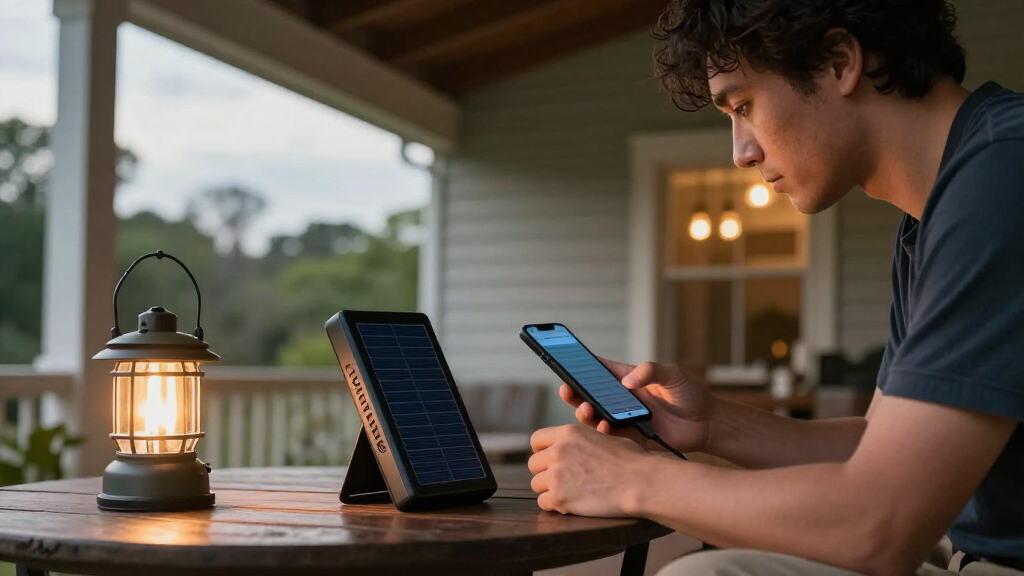
A solar power bank is a portable battery with a small solar panel that can collect sunlight and store some of that energy for charging devices. For an emergency, its clearest job is to keep a phone usable after the wall outlets go dark, not to replace your home’s electrical supply.
Think of it like a canteen with a slow trickle from a spring: the stored water is ready now, while the trickle helps extend your supply. A 10,000 mAh or larger bank can charge a typical smartphone more than once in favorable conditions, though actual results vary with the phone, cable, conversion losses, and how much battery remains. That extra charge could let you send a check-in text after a windstorm instead of watching the screen go black.
Solar panels on compact banks are small, and sunlight changes by hour, season, shade, and weather. Solar conversion efficiency for these products is generally cited around 15% to 22%, but a percentage alone does not tell you how quickly a particular bank will recharge. Cloud cover or a panel tilted away from the sun can turn a promising afternoon into a slow trickle.
So the useful distinction is simple: stored power works immediately; solar power replenishes gradually. Treat the panel as a backup source that may add charge over time. Do not count on it as your only way to power emergency communications.
10,000 mAh solar power bank for emergencies
As an affiliate, we earn on qualifying purchases.
As an affiliate, we earn on qualifying purchases.
Choose capacity and charging features that match your emergency
For most emergency kits, choose a solar power bank with at least 10,000 mAh, durable construction, and output ports that match your devices. Capacity is a starting point, not a promise of an exact number of charges: a bank’s conversion losses and your phone’s battery size affect what you get in practice.
Imagine a family waiting out a 12-hour outage. One adult needs a phone for local alerts, another needs to contact an elderly relative, and a child’s device is almost empty. A model with multiple USB outputs can serve more than one person, while fast charging may cut the time a compatible phone spends plugged in. Check the listed output wattage and device compatibility rather than relying on labels like “fast.”
| Feature | Why it helps in an emergency | What to check |
|---|---|---|
| 10,000 mAh or more | Provides a useful reserve for phones and small devices | Read capacity and output details; real-world charging is lower than the headline figure |
| Multiple USB ports | Lets you share power or charge more than one device | Check whether outputs work simultaneously and how power is divided |
| Flashlight or SOS signal | Adds light or a visible emergency signal without another device | Test the controls and learn how the SOS mode works |
| Weather-resistant body | Helps protect the bank from splashes, dust, and rough handling | Look for a stated rating; “rugged” alone is not a specific test rating |
Some larger models offer wireless charging or an AC outlet, but extra features can add weight and cost. Most compact banks suit phones better than laptops; for a tablet or laptop, check the output wattage and charging standard before buying. Pick the features you will actually use, not the longest feature list.
portable solar charger for storm outages
As an affiliate, we earn on qualifying purchases.
As an affiliate, we earn on qualifying purchases.
Prepare your bank before an outage, then use it in this order
Prepare a solar power bank by charging it from a wall outlet before an emergency, testing its cables and ports, and storing it somewhere you can reach quickly. A solar panel is a useful backup, but pre-charging gives you power on day one—when the weather may be gray and you cannot wait for sunlight.
- Charge it fully at home. Use the manufacturer’s charger and instructions. Add a calendar reminder to check the charge every few months, following the product guidance.
- Test the setup. Plug in your phone and confirm the bank, cable, and output port work together. A cable that fails during a calm weekend is annoying; during an evacuation, it wastes precious time.
- Save phone battery. Lower screen brightness, turn off features you do not need, and use low-power mode. Send a short text when a call is unnecessary; texts may get through when networks are busy.
- Use sunlight as a top-up. Place the panel in direct sun, keep it out of shade, and check it periodically. Avoid leaving the bank on a hot dashboard or in extreme heat; follow its temperature limits.
- Keep essentials together. Pack the bank with the right cables, a small flashlight, and any device-specific adapters.
For example, if a summer storm knocks power out overnight, a fully charged bank can keep your phone available while you check alerts in the morning. Set it in a sunny, safe spot during the day to add charge, then bring it back inside before evening. The sequence matters: use stored energy first and harvest sunlight when conditions allow.
solar power bank with multiple USB ports
As an affiliate, we earn on qualifying purchases.
As an affiliate, we earn on qualifying purchases.
Read solar charging claims with realistic expectations
A small panel on a portable bank usually charges much more slowly than a wall adapter, so expect sunlight to extend your reserve rather than quickly refill it. Estimates for a full solar recharge range from about 10 to 50 hours of direct sun, depending on panel size, efficiency, and conditions; those hours may be spread across several days.
That range makes sense when you picture the panel’s surface: many banks have only a few small cells, while a household solar setup uses far more collection area. Shade from a branch, a cloudy afternoon, or a panel facing the wrong direction reduces the energy coming in. Even bright daylight through a window is not the same as placing the panel in unobstructed outdoor sun.
Product claims also need context. Better photovoltaic materials and improved power-management chips can help some newer models convert and manage energy more effectively, but they cannot make a tiny panel collect energy like a large fold-out solar mat. Hybrid charging is a practical improvement: you charge from the wall before an outage and use the built-in panel as a supplementary source afterward.
Useful rule: Buy the battery capacity you need for the first hours of an outage; treat the solar panel as a way to stretch that supply, not as a guaranteed daily refill.
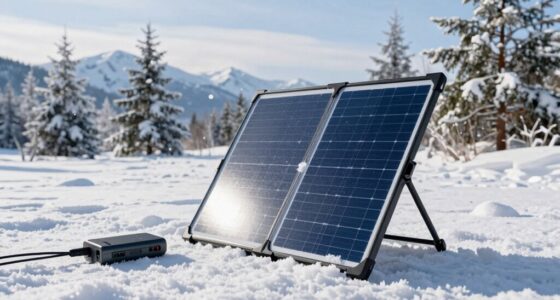
For a two-day camping trip with clear skies, slow solar input may still be worthwhile. For a winter storm with heavy cloud and short daylight, a pre-charged bank—or a larger separate solar panel—matters far more than an optimistic charging claim.
weather-resistant solar power bank
As an affiliate, we earn on qualifying purchases.
As an affiliate, we earn on qualifying purchases.
Build a backup plan that still works when the sun disappears
A reliable emergency charging plan uses more than one source of power because weather and outages rarely follow your preferred schedule. Pair a pre-charged solar bank with a car charger, a standard wall charger when power returns, or a larger compatible solar panel if you need more energy.
Consider a household whose electricity fails during a rainy weekend. The power bank can cover urgent phone use, but its small panel may add very little charge under thick clouds. A car’s USB outlet can refill the bank if travel is safe and the vehicle is outdoors; never run a vehicle in a closed garage, where exhaust can cause deadly carbon-monoxide poisoning.
Use battery power deliberately. Keep one phone designated for alerts, agree on brief check-in times, and share charging rather than letting every device run video continuously. If you need to preserve a phone for emergency calls, switch on low-power settings and download maps or key documents ahead of time, while you still have reliable internet and electricity.
- Keep cables with the bank. A charged battery is no help if the needed cable is missing.
- Check device compatibility. Tablets and small laptops may need higher output wattage than a basic phone bank provides.
- Protect the unit from heat and water. Weather resistance does not mean every model can be submerged.
- Follow manufacturer instructions. Use the specified charging method and stop using a damaged, swollen, or unusually hot battery.
Solar banks are typically compact and designed for easy transport during outdoor activities or emergencies, but pack weight and weather protection still matter. A hiker carrying one in a wet backpack needs a different level of protection than a homeowner keeping one in a dry hallway kit.
Check these safety and durability details before you rely on one
Before you trust a solar power bank in an emergency, check its stated weather rating, operating-temperature limits, warranty, and charging instructions. Water-resistant and waterproof do not mean the same thing, and “shockproof” is not a guarantee that a hard drop will leave the battery unharmed.
For example, a bank clipped to a backpack may be splashed in rain or knocked against a rock. A model with a clear ingress-protection rating gives you more useful information than a rubberized shell alone. Even then, keep the charging ports dry when possible and inspect the unit after a fall, since damage to a lithium-ion battery can create a safety risk.
Smart charging circuits in many newer models manage power and help prevent overcharging, while rugged designs may offer better dust and splash protection. Those features improve convenience, but they do not remove the need for care. Do not charge a device with a bank that is swollen, cracked, leaking, or unusually hot, and follow local guidance for battery recycling rather than putting damaged batteries in household trash.
Another important aspect is where the bank rests while it charges. Direct sun helps the panel collect energy, but a sealed bag or hot car can trap heat around the battery. Set it on a stable, ventilated surface, check it now and then, and bring it inside if its instructions call for a lower temperature range. A little attention protects both your backup power and the device you need to communicate.
Frequently Asked Questions
Can a solar power bank fully charge my smartphone?
Yes, if it has enough usable capacity and the phone and cable are compatible. A 10,000 mAh bank can often provide more than one phone charge, but conversion losses and the phone’s battery size change the result. Recharging the bank itself from its small panel can take much longer.
How long does a solar power bank take to recharge in sunlight?
A full recharge may take about 10 to 50 hours of direct sunlight, depending on panel size, efficiency, and conditions. Shade and clouds slow charging, and those hours may add up over several days. Use a wall charger to prepare the bank before an outage.
Are solar power banks worth buying for emergencies?
They can be worth it if you want a portable reserve for phone charging during an outage, a trip, or an evacuation. They work best as supplementary backup power, not as a replacement for grid electricity. A pre-charged bank is much more useful than relying on its panel to fill an empty battery during a storm.
Can a solar power bank charge a tablet or laptop?
Some high-capacity models can charge tablets or small laptops, but many compact banks are designed mainly for phones. Check the bank’s output wattage, ports, and charging standards against your device’s requirements. An AC outlet on a power bank does not automatically mean it can supply enough power for every laptop.
What features matter most when choosing one?
Start with capacity, usable output, and compatibility, then compare durability, weather ratings, and port count. A built-in flashlight or SOS signal can be handy, but only if you learn how it works and test it before an emergency. Prefer specific ratings and clear instructions over vague claims such as “all-weather.”
Can I leave a solar power bank outside while it charges?
Only if its instructions and weather rating support the conditions, and keep the unit away from excessive heat, standing water, and damaged surfaces. A splash-resistant bank may not be safe to soak, and direct sun can heat the battery even as it powers the panel. Place it on a stable, ventilated surface and check it periodically.
Conclusion
Choose a solar power bank for the stored charge, suitable capacity, and dependable ports; let the solar panel serve as a slow backup that can stretch your supply. Charge it before trouble starts, test it with your own phone, and keep the right cable beside it.
When the neighborhood goes dark, preparation should feel less like a scramble and more like reaching for a flashlight already waiting by the door.
Fall Picks
fall essentials
As an affiliate, we earn on qualifying purchases.