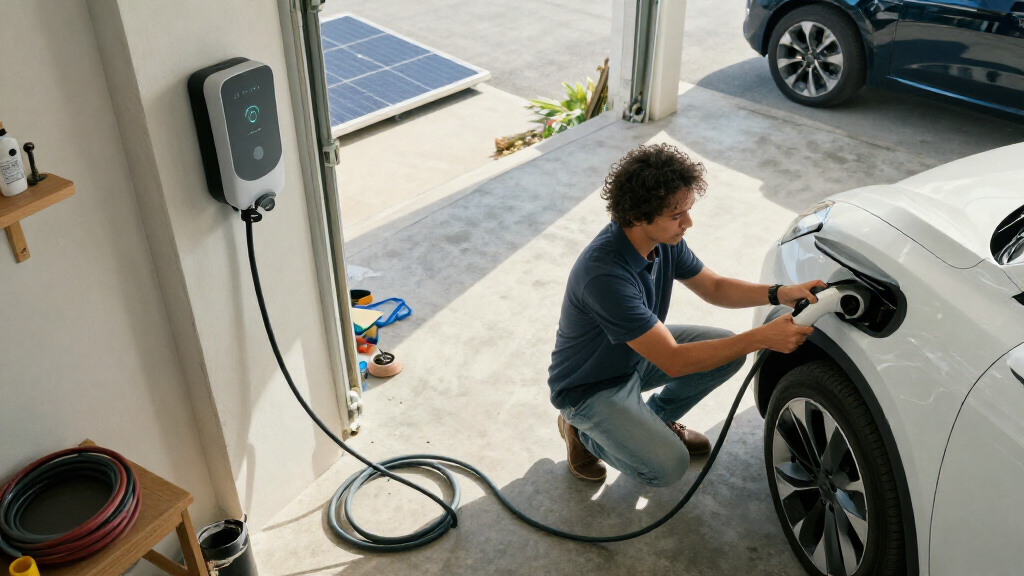
This checklist is for homeowners planning a convenient, dependable home EV charging setup, whether you’re installing your first charger or refining an existing charging area. It covers the main equipment and practical supporting items, with attention to fit, placement, and compatibility.

Get backup power and energy gear delivered free with Prime
- Fast, free delivery on millions of items
- Prime Video, Amazon Music and more included
- Member-only deals all year
The sections follow the charging setup from the Level 2 charger to cable management, mounting, outlet protection, energy monitoring, and surge protection. Some sections include a named pick; others offer selection guidance because no product was specified.
Use the checklist to confirm what your home and installation need before choosing equipment. Check your vehicle’s connector, the charger’s electrical requirements, the installation location, and any local code or electrician guidance that applies. Treat the named products as options to evaluate—not substitutes for verifying fit and suitability.
Level 2 EV Charger
A Level 2 charger is the core of a home charging setup, so the right choice depends on more than the product name. The listed pick is the Emporia Pro Level 2 EV Charger with PowerSmart, 48 A, J1772 Connector. Before selecting it, confirm that your vehicle can use a J1772 connector directly or with an appropriate adapter, and verify that the charger’s connector and cable reach the parking position without strain.
A common mistake is choosing a charger by its stated amperage without checking the home’s electrical capacity and installation requirements. Have a qualified electrician assess the circuit, wiring, breaker, and any applicable permitting or code requirements. Also check whether the charger’s installation method suits the location and whether its controls and connectivity meet your preferences. Don’t assume that a charger can deliver its full rated output on every household circuit; the final setup must be compatible with the electrical installation and vehicle.
Consider where the unit will be mounted, how the cable will hang, and whether the vehicle can park consistently within reach. Review the manufacturer’s specifications and installation instructions, especially for outdoor use. A careful compatibility check helps avoid a mismatch between vehicle, charger, and circuit.
What to look for:
- Confirm the vehicle’s connector compatibility with J1772.
- Have an electrician verify circuit capacity and installation requirements.
- Check cable length against the parking position and mounting location.
- Review whether the installation method suits indoor or outdoor placement.
- Read the manufacturer’s specifications and installation instructions.
Emporia Pro Level 2 EV Charger with PowerSmart, 48 A, J1772 Connector and 25-Foo

This 240 V home EV charger delivers up to 48 A and uses PowerSmart technology with the included Vue Home Energy Monitor to balance charging loads with household electricity use. It supports scheduled charging and real-time energy tracking through the Emporia app, and can be installed with a NEMA 14-50 plug or hardwired.
Pros:
- PowerSmart load balancing works with the existing electrical panel
- App supports charging schedules and real-time usage tracking
- Includes a home energy monitor and 25-foot charging cable
- Weather-resistant design and 3-year warranty
Cons:
- Requires a 240 V connection
- Installation may require an electrician
Best for: Drivers whose vehicle and home circuit are compatible with this J1772 charger
Not ideal for: Households that have not verified electrical capacity or connector compatibility
Bottom line: Confirm vehicle fit and electrical requirements before choosing the Emporia Pro Level 2 charger.
EV Charger Cable Holder
A cable holder gives the charging cable a consistent place to rest when it is not connected, helping keep the area organized and reducing the chance that the cable will be left across a walkway. No specific product is named for this slot, so choose a holder based on the cable and charger you already have rather than assuming one design will fit every setup.
Check the holder’s mounting method and intended location. A wall-mounted option needs a suitable surface and enough clearance for the cable to hang without sharp bends. If the cable is thick, heavy, or has a bulky connector, look for a design that can support it without forcing the connector into an awkward position. Avoid relying on a holder that leaves the cable resting on the ground or stretched tightly between the charger and the parking spot.
Measure the cable’s reach and consider the route from the charger to the vehicle before installing anything. Place the holder where it is easy to use while parked, but not where it could interfere with doors, foot traffic, or moving vehicles. For an outdoor location, check that the holder’s materials and installation method are suitable for the conditions. The best fit is the one that supports tidy, low-strain storage in your actual charging area.
What to look for:
- Check that the holder suits your cable’s thickness and connector size.
- Choose a mounting method compatible with the wall or support surface.
- Allow the cable to hang without sharp bends or tension.
- Position it clear of walkways, doors, and vehicle movement.
- For outdoor placement, verify suitability for the installation conditions.
EV Charger Pedestal
A pedestal can be useful when the charger needs a freestanding mounting point rather than a suitable wall. The listed pick is the EV Charger Pedestal Stand, Heavy-Duty Support Pole for EV Charging Sta. Its name identifies it as a stand and support pole, but does not establish compatibility with a particular charger, surface, or installation method—those details need to be checked before purchase.
A frequent buying mistake is assuming that a pedestal will work with any charger or can be installed on any surface. Verify the charger’s mounting pattern, enclosure dimensions, and cable route against the pedestal’s specifications. Confirm how the stand is intended to be secured and whether the planned location can support that installation. If electrical wiring must run through or alongside the pedestal, have a qualified electrician confirm that the arrangement is appropriate and meets applicable requirements.
Think through the vehicle’s parking position, the cable’s reach, and the space needed to connect and disconnect comfortably. The pedestal should not obstruct walking paths or expose the cable to avoidable strain. Check the product documentation for materials, dimensions, installation instructions, and suitability for the intended location. A pedestal is a better choice when it solves a real mounting or placement constraint, not simply because a freestanding stand looks convenient.
What to look for:
- Confirm the pedestal’s mounting pattern matches the charger.
- Check dimensions and cable routing against the planned installation.
- Verify the securing method and suitability of the installation surface.
- Review installation instructions and location suitability.
- Confirm electrical routing with a qualified electrician when needed.
EV Charger Pedestal Stand, Heavy-Duty Support Pole for EV Charging Station, Rein

This heavy-duty EV charger pedestal stand features a reinforced base and is suitable for indoor and outdoor use. It provides a stable, weather-resistant support for electric vehicle chargers, with easy installation and adjustable height options.
Pros:
- Durable steel construction suitable for outdoor environments
- Adjustable height options for versatile use
- Easy installation without additional drilling
- Weather-resistant design with protective features
Cons:
- Limited color options (gray only)
- No mention of weight capacity or load limits
- Potentially heavy to move without assistance
Best for: Installations without a suitable wall at the desired charger location
Not ideal for: Buyers who have not confirmed charger fit or how the stand will be secured
Bottom line: Verify mounting, dimensions, and installation details before using this pedestal with a charger.
Weatherproof Outlet Box
The listed product for this section is named Weatherproof Raised Garden Bed – HDPE Outdoor Elevated Planter Box wit. Its name describes a raised garden bed or planter box, not an electrical outlet box, so it should not be treated as a weatherproof enclosure for EV charging equipment. This is a critical category mismatch: a product name that includes “weatherproof” does not establish that a product is designed or approved to protect electrical outlets.
For an outdoor electrical installation, select an enclosure specifically intended for the outlet or electrical equipment being protected. Check the enclosure’s stated use, dimensions, opening and cover design, mounting method, and compatibility with the outlet and connected equipment. Follow the outlet and enclosure manufacturers’ instructions, and ask a qualified electrician to confirm the installation meets local code and is appropriate for the exposure at the site.
Do not try to adapt a planter or other non-electrical product as an outlet box. Make sure the selected enclosure allows the outlet and plug arrangement to fit as intended, while maintaining the protection required for its location. The right choice is an appropriately specified electrical weatherproof enclosure, not a product selected from its title alone. Because the named pick does not identify itself as an outlet box, verify the product category before proceeding.
What to look for:
- Choose an enclosure explicitly intended for electrical outlets or equipment.
- Verify the enclosure’s dimensions and compatibility with the outlet and plug.
- Check the stated use and installation instructions for the intended location.
- Follow manufacturer guidance and local electrical requirements.
- Do not use the named planter as an outlet box without explicit electrical approval.
Weatherproof Raised Garden Bed – HDPE Outdoor Elevated Planter Box with Legs, Na

This raised garden bed is constructed from high‑density polyethylene (HDPE), offering a weather‑proof, rot‑ and rust‑resistant solution for patio, deck or balcony gardening. It features built‑in drainage holes, reinforced crossbars, and comes pre‑drilled with stainless steel screws for quick single‑person assembly.
Pros:
- Durable, weather‑proof HDPE construction resists rot, rust and cracking.
- Zero‑maintenance finish; color is fade‑resistant and integrated.
- Easy single‑person assembly with pre‑drilled holes and included tools.
- Large planting volume (20.7 gal) supports heavy loads up to 300 lbs.
Cons:
- Heavy when filled, making relocation difficult.
Best for: Shoppers seeking guidance on selecting a purpose-built outdoor electrical enclosure
Not ideal for: Anyone planning to use a garden planter to enclose an outlet
Bottom line: The named raised garden bed is not identified as an electrical outlet box; choose a purpose-built enclosure instead.
EV Charging Energy Meter
An energy meter can help you understand how much electricity your home charging uses, but no specific product is named for this section. Start by deciding what information you want to see: charging energy for one circuit, broader household consumption, or data reported through a particular monitoring system. The meter must match the measurement point and system you want to observe.
A common mistake is buying a meter without checking its electrical ratings, installation method, or compatibility with the circuit and monitoring equipment. Before choosing one, identify whether it measures the charger’s dedicated circuit or another part of the electrical system, and confirm that its stated capacity suits the installation. Some meters require work inside an electrical panel; have a qualified electrician handle installation where needed and confirm that the method meets local requirements.
Consider how readings are displayed and whether the meter needs an app, network connection, or separate system to make the data useful. Review what the product actually measures and how it reports readings instead of assuming it provides every energy detail. If you mainly want charger-specific tracking, check whether the charger already offers the monitoring you need. Choose a meter for clear, relevant information, and verify the electrical fit before installation.
What to look for:
- Define whether you need charger-circuit or whole-home measurements.
- Confirm electrical ratings match the intended circuit and installation.
- Check whether installation requires work inside an electrical panel.
- Review how readings are displayed and whether additional equipment is needed.
- Compare the meter’s functions with monitoring already available from the charger.
Surge Protector for EV Charger
Surge protection is a part of planning an electrical installation, but no specific product is named for this slot. The right approach is to check the charger’s installation instructions and ask a qualified electrician whether additional surge protection is appropriate for the home and the charger circuit. Protection needs can depend on the electrical installation and equipment; a generic product label alone is not enough to establish suitability.
A common mistake is selecting a protector without confirming how it connects to the electrical system, which equipment it is intended to protect, and whether it is compatible with the charger circuit. Review the protector’s specifications, installation requirements, and the charger manufacturer’s guidance. If a device must be installed at the panel or in fixed wiring, do not improvise: have a qualified electrician evaluate and perform the work in accordance with applicable requirements.
Also clarify whether you are seeking protection for the charger, the home electrical system, or both. These are not automatically the same selection decision. Confirm the proposed device’s electrical ratings and location with the electrician, and ask how it fits into the overall installation. The goal is a compatible, properly installed solution, rather than adding a protector based only on a broad product description.
What to look for:
- Ask an electrician whether added surge protection is appropriate.
- Check the charger manufacturer’s installation guidance.
- Confirm the device is intended for the equipment and circuit being protected.
- Verify electrical ratings and installation requirements before selection.
- Use a qualified electrician for panel or fixed-wiring installation.
Start with the items that determine whether the setup can work: confirm vehicle connector compatibility, have the electrical circuit assessed, and choose a charger and mounting location that fit the parking area. Next, plan the cable route and decide whether a holder or pedestal solves a practical need. Consider an energy meter or added surge protection after you know what the installation requires, and select a purpose-built electrical enclosure for outdoor outlets.
You do not need to decide every accessory at once. Check product specifications, measure the space, and ask a qualified electrician about electrical work and local requirements. With those basics covered, you can build a safer, better-fitting charging setup one decision at a time.