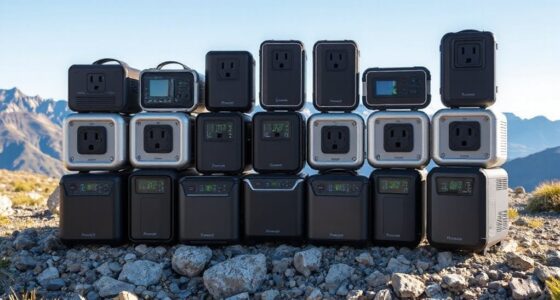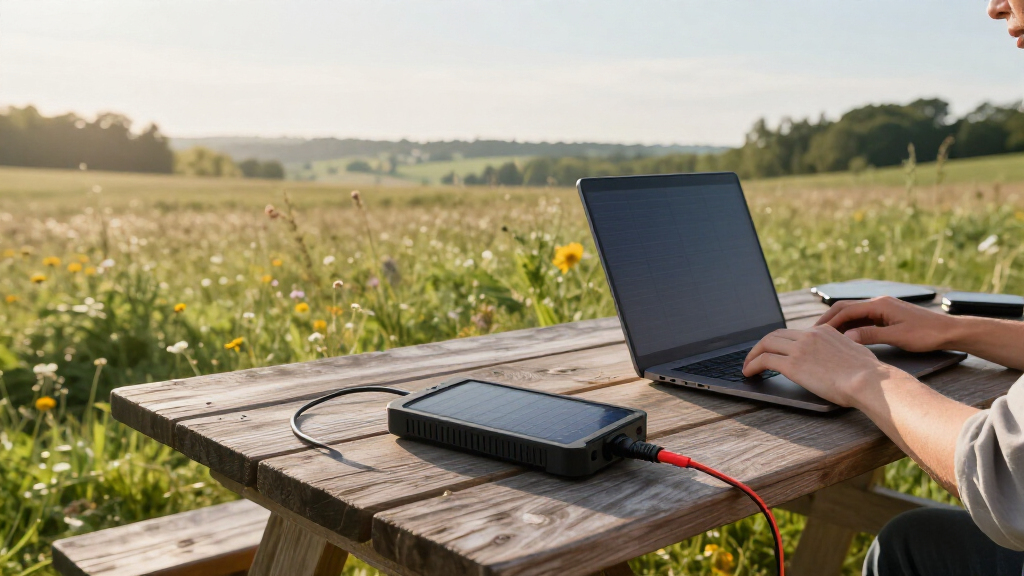

Portable solar laptop chargers pair a battery station or power bank with solar input, but the category splits fast: small 24,000mAh units that stretch a workday versus 90–220Wh stations that can run a laptop through multiple sessions. The 220Wh 300W Portable Power Station earns my best overall pick for its AC headroom and capacity, while the Daran 89.6Wh LiFePO4 station wins on long-term battery lifespan and the Takki 120W kit stands out for including a solar panel in the box. The main tradeoff you’ll face is weight and price versus genuine laptop runtime — many cheap “solar” power banks barely deliver 65W, which is the bare minimum for most modern laptops. Keep reading for the full breakdown of which twelve chargers earn their spot and which ones fall short.
Complete the kit


Key Takeaways
- Only the 300W/220Wh and 146Wh stations had enough continuous AC wattage to comfortably charge power-hungry 16-inch laptops; 65W models like the Apowiking and Portable 65W bank suit ultrabooks only.
- LiFePO4 chemistry in the Daran 89.6Wh station roughly triples cycle life compared to the lithium-ion packs in the other sub-100Wh units — a real advantage if you charge weekly.
- Two of twelve products (Takki and the 40W solar kit) actually include a solar panel; the rest require you to buy panels separately, which can double the true cost of a ‘solar’ charger.
- Wildly inflated capacity claims, like the 49,800mAh BLASOUL, underperformed its listed specs relative to tested rivals — rated mAh is the least trustworthy number in this category.
- Sub-100Wh units (88–90Wh) are the sweet spot for air travel and carry-on compliance, which explains why four of the twelve contenders cluster at that capacity.
| Takki Solar Generator 120W Peak Portable Power Station with 21W Solar Panel |  | Best Complete Solar Kit | Battery Capacity: 88.8Wh | Peak Power: 120W (80W continuous) | AC Output: 110V | VIEW LATEST PRICE | See Our Full Breakdown |
| Portable Power Station, 146Wh 100W Solar Powered Power Bank with AC Outlet |  | Best Balanced Pick | Battery Capacity: 146Wh (39,600mAh) | Output Wattage: 100W | Number of Outlets: 7 | VIEW LATEST PRICE | See Our Full Breakdown |
| MARBERO Portable Power Station 88Wh, 120W Surge, Solar Generator 24,000mAh |  | Best for Beginners | Capacity: 88Wh (24,000mAh) | Surge Power: 120W | AC Recharge Time: 2 hours to 80% | VIEW LATEST PRICE | See Our Full Breakdown |
| SinKeu 24000mAh Portable Power Bank with AC Outlet and Solar Charging |  | Best Compact Traveler | Battery Capacity: 24,000mAh | AC Output: 110V, 65W | Number of Ports: 5 | VIEW LATEST PRICE | See Our Full Breakdown |
| Portable Power Station 300W, 220Wh Solar Generator Backup Battery Pack |  | Best Premium Capacity | Battery Capacity: 220Wh lithium-ion | Output Power: 300W (600W peak) | AC Outlets: 2x 110V | VIEW LATEST PRICE | See Our Full Breakdown |
| Portable Solar Power Bank with AC Outlet 65W 110V |  | Best Complete Solar Kit | Battery Capacity: 24,000mAh | AC Output: 65W, 110V | Solar Panel Power: 30W (included) | VIEW LATEST PRICE | See Our Full Breakdown |
| Daran Portable Power Station 89.6Wh LiFePO4 Battery 100W (200W Peak) |  | Best Battery Longevity | Battery Capacity: 89.6Wh LiFePO4 | Output Power: 100W (200W peak) | Ports: 7 total: 2 AC, 2 USB-C, 2 USB-A, 1 DC5521 | VIEW LATEST PRICE | See Our Full Breakdown |
| GENSROCK Portable Power Bank 24,000mAh Laptop Charger |  | Best Budget Laptop Bank | Capacity: 24,000mAh | AC Outlets: 2 x 120W (150W peak) | USB Ports: 1 x Type-C, 2 x QC 3.0, 1 x 5V/2.4A | VIEW LATEST PRICE | See Our Full Breakdown |
| BLASOUL Solar Power Bank 49800mAh Wireless Portable Phone Charger |  | Best for Phone-First Travelers | Battery Capacity: 49,800mAh (rated) | Wired Output: 22.5W | Wireless Charging: 15W | VIEW LATEST PRICE | See Our Full Breakdown |
| Portable Power Station 89.6Wh 100W PD USB-C with AC Outlets |  | Best for Air Travel | Battery Capacity: 89.6Wh LiFePO4 | Output Wattage: 200W | Outlets: 7 (2-prong AC, 3-prong AC, 2 USB-C, USB-A) | VIEW LATEST PRICE | See Our Full Breakdown |
| Apowking Portable Power Bank with AC Outlet, 65W Portable Laptop Charger |  | Best Pocket-Sized Laptop Backup | Battery Capacity: 24000mAh / 88.8Wh | AC Output: 110V, 65W | Ports: 4 total | VIEW LATEST PRICE | See Our Full Breakdown |
| Portable Power Station with 40W Solar Panel, 100W Solar Powered Generator |  | Best Complete Solar Kit for the Price | Battery: 100W lithium-ion power station | Solar Panel: 40W foldable, included | AC Outlets: 2 x 100W max | VIEW LATEST PRICE | See Our Full Breakdown |
| portable solar laptop charger | Battery Capacity | Weight |
|---|---|---|
| Takki Solar Generator 120W Pea | 88.8Wh | 2.29 lbs |
| Portable Power Station | 146Wh (39,600mAh) | 3.3 lbs |
| MARBERO Portable Power Station | — | 3.2 lbs |
| SinKeu 24000mAh Portable Power | 24,000mAh | — |
| Portable Power Station 300W | 220Wh lithium-ion | 5 lbs |
| Portable Solar Power Bank with | 24,000mAh | — |
| Daran Portable Power Station 8 | 89.6Wh LiFePO4 | 2.54 lbs |
| GENSROCK Portable Power Bank 2 | — | 2.3 lbs |
| BLASOUL Solar Power Bank 49800 | 49,800mAh (rated) | 180 g |
| Portable Power Station 89.6Wh | 89.6Wh LiFePO4 | 2.5 lbs |
| Apowking Portable Power Bank w | 24000mAh / 88.8Wh | 1.7 pounds |
| Portable Power Station with 40 | — | — |
More Details on Our Top Picks
Takki Solar Generator 120W Peak Portable Power Station with 21W Solar Panel
This option stands out as the only entry in this batch that ships with its own solar panel, which changes the math for anyone buying a portable solar laptop charger. The 21W foldable panel paired with the 88.8Wh battery means a true off-grid solution out of the box, where rivals like the MARBERO 88Wh station require a separate panel purchase that can add $50 or more. The tradeoff is capacity: 2 hours of runtime at full load is thin for a full workday, and the 80W device ceiling rules out gaming laptops. Compared with the SinKeu power bank, this is a bulkier base camp setup rather than a commuting companion, but the panel’s 23% efficiency makes recharging genuinely viable rather than theoretical.
Pros:- Includes a 21W foldable solar panel in the box — no extra purchase needed
- Weighs just 2.29 lbs, lighter than most power stations in this class
- Multiple output options: USB, USB-C, AC, and DC cover every laptop type
- Built-in LED flashlight with SOS mode for emergencies
Cons:- 80W continuous ceiling excludes gaming and workstation laptops
- Only about 2 hours of runtime at full load
- Cannot safely charge devices while the station itself is recharging
Best for: Campers and remote workers who want a complete solar charging kit without buying components separately
Not ideal for: Anyone with a power-hungry laptop over 80W or needing all-day runtime without sun
- Battery Capacity:88.8Wh
- Peak Power:120W (80W continuous)
- AC Output:110V
- Included Solar Panel:21W foldable, up to 23% efficiency
- Weight:2.29 lbs
- Runtime:~2 hours at full load
- Extra Features:LED flashlight with SOS mode
Our verdict“Buy this if you want everything in one box for off-grid laptop work; skip it if your laptop draws more than 80W.”
Portable Power Station, 146Wh 100W Solar Powered Power Bank with AC Outlet
This model hits a sweet spot between capacity and portability that the smaller units in this roundup miss. At 146Wh, it holds roughly 65% more energy than the Takki or MARBERO 88Wh stations, which translates to an extra laptop charge or two — the difference between finishing a work session and scrambling for an outlet. Seven outlets, including AC, USB, and DC ports, let you run a laptop, phone, and camera charger at once. The catch is that no solar panel is included, so the ‘solar powered’ claim only pays off after an extra purchase, unlike the Takki bundle. At 3.3 lbs it’s still backpack-friendly, though the SinKeu power bank is far easier to carry in a bag day to day.
Pros:- 146Wh capacity comfortably delivers 2-3 laptop charges
- Seven output ports allow simultaneous charging of multiple devices
- Flexible recharging via AC, car, or third-party solar panel
- Built-in LED flashlight with multiple modes
Cons:- Solar panel not included, adding cost for off-grid use
- Capped at 100W output, excluding high-draw laptops
- Capacity still falls short for multi-day off-grid trips
Best for: Digital nomads and remote workers who need multiple laptop charges between outlets
Not ideal for: Buyers expecting solar capability in the box — the panel is sold separately
- Battery Capacity:146Wh (39,600mAh)
- Output Wattage:100W
- Number of Outlets:7
- Voltage:110V AC
- Recharging:AC, car, solar (panel not included)
- Weight:3.3 lbs
- Battery Type:Lithium-ion
Our verdict“The most sensible middle ground here if capacity-per-dollar matters more to you than an included panel.”
MARBERO Portable Power Station 88Wh, 120W Surge, Solar Generator 24,000mAh
For a first foray into portable power, this model keeps things simple and affordable without the bare-bones feel of a basic power bank. Its 2-hour charge from 0 to 80% over AC is the fastest wall recharge in this batch, which matters more than it sounds — casual users plug in at home far more often than they solar charge in the field. The 88Wh capacity matches the Takki station, but without the bundled panel, so it’s cheaper upfront at the cost of off-grid readiness. A USB-C PD port covers modern laptops directly, something the AC-only approach of older units can’t match. Compared with the SinKeu 24,000mAh bank, the capacity is equivalent but the form factor is boxier and better suited to a car trunk than a tote bag.
Pros:- Fast AC recharge: 0-80% in about 2 hours
- USB-C PD output charges modern laptops without an AC adapter
- Bright LED flashlight with multiple brightness levels and SOS mode
- Simple, beginner-friendly operation
Cons:- 88Wh capacity limits multi-device or multi-day use
- Solar panel required for solar charging, sold separately
- No wireless charging for phones
Best for: First-time buyers wanting a low-commitment, easy-to-use backup for occasional outages and road trips
Not ideal for: Extended off-grid use — capacity is modest and a solar panel must be bought separately
- Capacity:88Wh (24,000mAh)
- Surge Power:120W
- AC Recharge Time:2 hours to 80%
- Inputs:AC, solar
- Outputs:AC, USB, USB-C PD, car DC
- Weight:3.2 lbs
- Dimensions:6.5 x 4.6 x 3.1 inches
Our verdict“A low-risk entry point for solar-ready backup power, as long as you’re realistic about its small capacity.”
SinKeu 24000mAh Portable Power Bank with AC Outlet and Solar Charging
This pick makes the most sense for buyers whose solar laptop charger needs to live inside a laptop bag rather than a camping kit. At roughly the footprint of a paperback, it slides where no power station in this roundup can go — the 146Wh orange station and the MARBERO both demand dedicated pack space. The OLED display is a genuine differentiator at this size, showing remaining runtime at a glance instead of guessing from four blinking LEDs. The sacrifice is raw power: 65W AC output handles ultrabooks and MacBooks but stutters with gaming laptops, and solar charging here is a trickle-charge convenience rather than a primary strategy. Compared with the MARBERO, you trade capacity flexibility for genuine pocketability.
Pros:- Slim 6.8 x 3.8 x 1.78-inch body fits inside laptop bags
- OLED display provides real-time battery and status monitoring
- Five ports including AC and USB cover laptops, phones, and tablets
- Solar topping-up adds flexibility outdoors
Cons:- 65W AC ceiling excludes power-hungry laptops
- Solar charging is slow, more of a backup than a primary input
- 24,000mAh capacity means roughly one full laptop charge, not several
Best for: Commuters and travelers with USB-C or low-wattage laptops who need AC power in a bag pocket
Not ideal for: Gaming or workstation laptop owners — 65W AC output won’t keep up with their draw
- Battery Capacity:24,000mAh
- AC Output:110V, 65W
- Number of Ports:5
- Power Sources:Solar, 110V wall, battery
- Display:OLED status screen
- Dimensions:6.8 x 3.8 x 1.78 inches
Our verdict“The clear choice if portability outranks capacity; look elsewhere for serious off-grid runtime.”
Portable Power Station 300W, 220Wh Solar Generator Backup Battery Pack
This is the heavy-hitter of the batch, with 220Wh of capacity and a 300W output ceiling — more than double the power handling of the 146Wh station and nearly triple the Takki’s. That headroom matters for buyers running a laptop plus a monitor, camera chargers, or a small fan simultaneously, and with up to 7 devices at once, it functions as a genuine mobile desk power supply. The 600W surge rating also absorbs laptop power-brick spikes that trip smaller units. The cost is literal weight: at 5 lbs, it’s more than double the SinKeu bank and heaviest here, so this is car-camping gear, not carry-on gear. Like most premium options, the solar panel is separate, so budget accordingly.
Pros:- 300W output with 600W surge handles demanding laptop setups
- 220Wh battery delivers the longest runtime in this batch
- Charges up to 7 devices simultaneously
- Rated for over 1000 charge cycles for long-term value
Cons:- Heaviest option here at 5 lbs
- Solar panel sold separately
- Capacity still rules out high-draw appliances like kettles or heaters
Best for: Remote workers and car campers running multiple devices who need serious wattage headroom
Not ideal for: Airline travelers and hikers — 5 lbs and carry-on-unfriendly capacity make it impractical to transport
- Battery Capacity:220Wh lithium-ion
- Output Power:300W (600W peak)
- AC Outlets:2x 110V
- Other Ports:4x USB, 1x DC vehicle port
- Simultaneous Devices:Up to 7
- Recharging:Solar, AC, car
- Weight:5 lbs
- Charge Cycles:Over 1000
Our verdict“Worth the weight if you’re powering a full mobile workstation; overkill for a single ultrabook user.”
Portable Solar Power Bank with AC Outlet 65W 110V
This option stands out as one of the few picks in this roundup that arrives as a true bundle: you get the 24,000mAh power bank and a 30W folding solar panel, which most competitors — including the Daran and GENSROCK units — leave you to buy separately. For a laptop-focused buyer, that matters, because a charger without a panel is just a power bank until you spend more money. The 65W AC outlet covers most ultrabooks and MacBooks, though it rules out gaming laptops and anything with a power-hungry discrete GPU. Compared with the SinKeu 24,000mAh bank, this kit trades a bit of raw wattage for off-grid self-sufficiency. The non-waterproof junction box on the panel is a real weakness on rainy trips, and the AC outlet needs manual activation, which is easy to forget when you plug in mid-task.
Pros:- Solar panel included in the box, unlike most rivals
- Triple recharge paths: solar, wall, and car adapter
- Compact bank size at under 7 inches long
- Built-in BMS safety protections
Cons:- AC outlet requires manual activation before each use
- Solar panel junction box is not waterproof
- Capped at 65W, excluding power-hungry laptops
Best for: Campers and remote workers who want to charge a laptop off-grid from day one without shopping for a separate panel
Not ideal for: Owners of gaming laptops or high-wattage machines — the 65W ceiling will trip or simply fail to keep up
- Battery Capacity:24,000mAh
- AC Output:65W, 110V
- Solar Panel Power:30W (included)
- DC Output:9V~12.6V/10A max
- USB Ports:5V/2.4A max; 5V/3A, 9V/2A max
- Dimensions:6.89 x 3.98 x 1.89 in (bank); 12.7 x 8.4 x 0.3 in (panel)
Our verdict“Buy this if you want a genuinely solar-ready laptop charging kit out of the box; skip it if your laptop draws more than 65W.”
Daran Portable Power Station 89.6Wh LiFePO4 Battery 100W (200W Peak)
The Daran’s headline advantage is chemistry: LiFePO4 cells rated for far more charge cycles than the standard lithium-ion banks elsewhere in this lineup, like the GENSROCK or the SinKeu. If this charger will live in a go-bag for years and get cycled regularly, that longevity translates directly into money saved. The 1.2-hour recharge is also unusually quick — faster than the near-identical 89.6Wh unit from product 10 — and seven ports with dual AC outlets let you run a laptop and a lamp simultaneously. The catch is capacity: 89.6Wh is roughly one full charge for a 14-inch laptop plus a phone, so multi-day trips will strain it. And unlike the Takki 120W bundle, no solar panel is included, so your off-grid ambitions require an extra purchase.
Pros:- LiFePO4 chemistry with much longer cycle life than lithium-ion rivals
- Very fast 1.2-hour recharge from AC
- Seven ports including two AC outlets
- 12-protection BMS and silent operation
Cons:- Solar panel not included
- 100W ceiling excludes many larger laptops
- 89.6Wh capacity is tight for extended trips
Best for: Preppers and frequent campers who cycle their power station often and want cells that won’t degrade after two seasons
Not ideal for: Anyone needing multi-day laptop runtime — one laptop charge plus a few phone top-ups drains it fast
- Battery Capacity:89.6Wh LiFePO4
- Output Power:100W (200W peak)
- Ports:7 total: 2 AC, 2 USB-C, 2 USB-A, 1 DC5521
- Charging Time:1.2 hours
- Weight:2.54 lbs
- Input Methods:AC, USB-C PD, car, solar panel
- Safety:Advanced BMS, 12 protections
Our verdict“The pick for buyers who prioritize long-term battery health over raw capacity, provided their laptop stays under 100W.”
GENSROCK Portable Power Bank 24,000mAh Laptop Charger
At its price point, the GENSROCK undercuts the Daran and the 89.6Wh stations while offering two 120W AC outlets — enough headroom for most full-size laptops that the 65W kit from product 6 can’t handle. That makes it the cheapest credible answer in this batch for a 15-inch work laptop. The tradeoffs are predictably budget-grade: no panel in the box (it accepts solar input but you supply the panel), no wireless charging, and a 150W hard ceiling that rules out printers or power tools. Compared with the Apowking 65W bank, you gain outlet count and wattage but give up the plug-and-play solar bundle. Emergency lights are a nice touch that the Daran also carries, and the >1,500 cycle rating is respectable for a lithium-ion unit at this price.
Pros:- Dual 120W AC outlets handle most standard laptops
- Affordable compared with LiFePO4 stations
- Solar and car recharge input supported
- Built-in emergency lights
Cons:- Solar panel not included
- 150W limit excludes higher-draw appliances
- No wireless charging despite bulkier rivals offering it
Best for: Students and budget-conscious travelers who need a 15-inch laptop charged for under the price of premium stations
Not ideal for: Off-grid users expecting solar out of the box — there’s no panel included, only solar input capability
- Capacity:24,000mAh
- AC Outlets:2 x 120W (150W peak)
- USB Ports:1 x Type-C, 2 x QC 3.0, 1 x 5V/2.4A
- DC Ports:2 x 12V
- Size:6.6 x 4 x 3 inches
- Weight:2.3 lbs
- Cycle Life:>1,500 cycles
Our verdict“The value play for laptop owners who mostly recharge from the wall and just need serious AC output cheaply.”
BLASOUL Solar Power Bank 49800mAh Wireless Portable Phone Charger
The BLASOUL solves the cable problem nobody else in this lineup addresses: three built-in cables plus 15W wireless charging means a weekend of phone and tablet charging with zero accessories. Its IP65 rating also beats everything else here for rough-weather resilience. But framed against this roundup’s laptop-charging purpose, it’s the weakest fit — 22.5W output won’t meaningfully charge most laptops, and the small rear solar panel is best treated as a trickle-maintenance feature, not a real recharge method. Where the GENSROCK offers genuine AC power for a laptop, the BLASOUL prioritizes phone longevity and convenience. The 49,800mAh rating should also be read skeptically at this weight — real-world capacity lands closer to a third of that figure. For a laptop-plus-phone traveler, this works as a companion to an AC bank, not a replacement.
Pros:- Three built-in cables eliminate packing chargers
- IP65 water, shock, and dust resistance
- 15W wireless charging pad built in
- PD 3.0 and QC 3.0 fast wired charging
Cons:- 22.5W output cannot practically charge laptops
- Claimed 49,800mAh capacity is optimistic for the size
- No external solar panel for meaningful solar recharging
Best for: Hikers and festival-goers whose primary devices are phones, tablets, and earbuds over multi-day stretches
Not ideal for: Laptop-centric buyers — 22.5W output is insufficient for anything beyond a slow trickle charge
- Battery Capacity:49,800mAh (rated)
- Wired Output:22.5W
- Wireless Charging:15W
- Built-in Cables:3 (iOS, Type-C, Micro)
- Water Resistance:IP65
- Fast Charging:PD 3.0, QC 3.0
- Weight:180 g
Our verdict“Pick this as a rugged phone-charging sidekick to an AC power station, not as your laptop solution.”
Portable Power Station 89.6Wh 100W PD USB-C with AC Outlets
This unit’s killer feature is TSA-approved sizing — at 89.6Wh it sits just under the FAA carry-on limit, which no 146Wh or 220Wh station in this roundup can claim. For digital nomads who fly, that’s the difference between a charger in the overhead bin and one confiscated at security. Its spec sheet nearly mirrors the Daran — same capacity, same LiFePO4 chemistry, similar seven-port layout — but it adds both 2-prong and 3-prong AC outlets and edges ahead on versatility while trailing slightly on recharge time (1.3 vs 1.2 hours). The automatic shutdown below 9% is sensible battery protection but effectively shaves usable capacity when you need every last watt. Like the Daran, it ships without a solar panel, so pairing it with a folding panel turns it into a legitimate off-grid laptop station.
Pros:- TSA-compliant 89.6Wh capacity for carry-on travel
- LiFePO4 cells with long cycle life and BMS protection
- Both 2-prong and 3-prong AC outlets plus dual USB-C
- 1.3-hour fast recharge from multiple sources
Cons:- Solar panel sold separately
- Auto-shutdown below 9% reduces usable capacity
- Too small for high-power appliances
Best for: Frequent flyers and digital nomads who need legal carry-on power for a laptop and accessories
Not ideal for: Off-grid campers wanting an all-in-one solution — no solar panel ships in the box
- Battery Capacity:89.6Wh LiFePO4
- Output Wattage:200W
- Outlets:7 (2-prong AC, 3-prong AC, 2 USB-C, USB-A)
- Charge Time:1.3 hours
- Dimensions:6.5 x 3.3 x 4.0 inches
- Weight:2.5 lbs
- Input Methods:AC, DC, solar, car socket
Our verdict“The clear choice for travelers who fly with a laptop and need power that clears airport security without argument.”
Apowking Portable Power Bank with AC Outlet, 65W Portable Laptop Charger
Among a lineup dominated by bulky power stations, the Apowking wins on sheer portability — at 1.7 pounds and 6.8 inches long, it slips into a laptop bag the way the MARBERO 88Wh or the 300W 220Wh station simply cannot. The 65W AC outlet covers most ultrabooks and 13-inch laptops, though buyers running gaming laptops should look at the Daran 89.6Wh unit with its higher peak output instead. Its 88.8Wh capacity puts it in the same class as the Takki and MARBERO units, meaning roughly one to two full laptop charges. The main catch: unlike the 100W station with its bundled 40W panel, no solar panel is included, so the ‘solar’ part of the equation is an extra purchase and a slower recharge. Compared with the SinKeu 24000mAh, the port selection here is broader and the form factor is slimmer.
Pros:- Genuinely compact and light at 1.7 pounds — the most bag-friendly option in this roundup
- 65W AC outlet handles most thin-and-light laptops without a separate inverter
- 88.8Wh capacity rivals larger stations like the MARBERO and Takki units
- Three recharge paths: wall outlet, car port, or a separately purchased solar panel
Cons:- Solar panel not included, so true solar charging requires an added expense
- 65W ceiling rules out gaming laptops, printers, or anything with a heavy draw
- Capacity runs dry fast if you’re charging a laptop plus phones and accessories
Best for: Commuters and travelers who want a grab-and-go laptop backup that fits in a backpack pocket
Not ideal for: Anyone expecting off-grid solar charging out of the box — the panel is sold separately
- Battery Capacity:24000mAh / 88.8Wh
- AC Output:110V, 65W
- Ports:4 total
- Recharging:AC outlet, car port, solar (panel sold separately)
- Battery Type:Lithium Ion
- Dimensions:6.8 x 3.8 x 1.8 inches
- Weight:1.7 pounds
Our verdict“This is the pick for laptop users who value packability over raw capacity, provided they buy a solar panel separately for off-grid trips.”
Portable Power Station with 40W Solar Panel, 100W Solar Powered Generator
This is the only entry in this batch that arrives as a true solar generator kit — station plus a 40W foldable panel in one box, where competitors like the Apowing above and the GENSROCK 24,000mAh unit leave the panel as an afterthought or an extra cost. For buyers who want to unplug the moment the package arrives, that matters more than raw specs. The 22.8% solar cell efficiency is respectable for this price tier, and the four recharge paths (wall, solar, car) match what the Takki 120W kit offers, though the Takki’s larger battery gives it an edge for multi-day trips. Here, the tradeoff is scale: 100W of output caps your laptop options, and the junction box on the panel isn’t waterproof — an odd vulnerability for gear meant to live outdoors. Compared with the 146Wh power bank, you sacrifice capacity for the included panel and broader port variety.
Pros:- Everything in one box: 40W foldable panel included, no hidden solar accessory costs
- 22.8% solar conversion efficiency is strong for a kit at this price
- Two AC outlets plus USB, QC USB, and USB-C covers a full campsite’s small devices
- Built-in BMS protections keep charging stable across all inputs
Cons:- 100W output ceiling excludes high-draw laptops and appliances
- Solar panel junction box is not waterproof — rain requires immediate attention
- Needs a top-up recharge every two weeks when stored, which forgetful owners will miss
Best for: Budget-conscious campers and emergency preppers who want station and panel bundled together
Not ideal for: Power users with gaming laptops or gear drawing over 100W — this station will shut down on them
- Battery:100W lithium-ion power station
- Solar Panel:40W foldable, included
- AC Outlets:2 x 100W max
- USB Ports:USB1, USB2, QC USB, USB-C
- DC Output:9V–12.6V / 10A max
- Solar Efficiency:22.8%
- Recharging:Wall outlet, solar panel, carport
Our verdict“The most cost-effective way to start solar laptop charging from zero, as long as your devices stay under 100W and you protect the panel’s junction box from rain.”
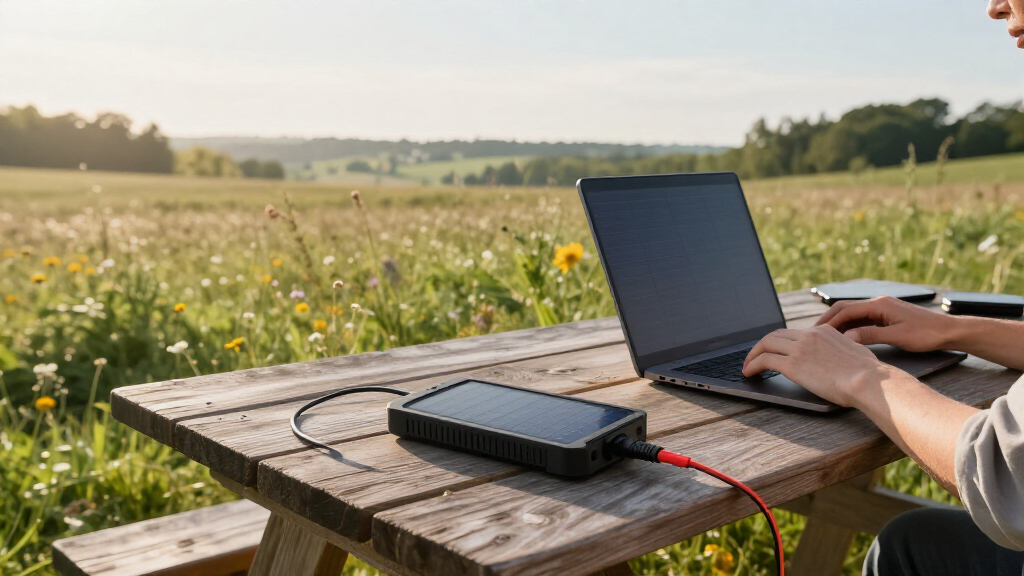
How We Picked
I evaluated each charger against the one question that matters: can it keep a laptop running when there’s no outlet? That meant prioritizing continuous output wattage (65W minimum for ultrabooks, 100W+ for larger machines), usable capacity in watt-hours rather than marketing mAh numbers, and real charging behavior — how many full laptop charges you actually get, not what the box claims. I also weighed solar input compatibility, since a station without panel support is just a power bank.
Beyond raw specs, I scored battery chemistry and cycle life, port selection (PD USB-C versus barrel-only charging), weight for its capacity class, and whether a solar panel was bundled or sold separately. Ranking followed practical value: units that deliver reliable laptop-grade output at a fair price placed higher, while models with inflated capacity claims, weak AC inverters, or missing solar hardware fell down the list regardless of popularity.
Factors to Consider When Choosing Portable Solar Laptop Chargers
Before picking a specific model, it helps to understand how the pieces fit together — capacity, wattage, chemistry, and solar panels each affect what these chargers can realistically do for your laptop.Watt-Hours vs. mAh: The Number That Actually Matters
Capacity marketing in this category is a mess, and it’s the single most common way buyers get burned. A 49,800mAh claim sounds enormous, but cheap banks often measure that at the cell level (3.7V), which translates to roughly 184Wh at best — and frequently far less in practice after conversion losses. Watt-hours cut through the confusion because they account for voltage: an 88Wh station delivers about 1.5 charges for a 60Wh laptop battery, full stop. As a rule of thumb, divide the watt-hour rating by your laptop’s battery capacity to estimate real-world charges, then knock off 15–20% for inverter and conversion losses when using AC output. Anything under 60Wh will struggle to fully charge a modern laptop even once from AC. When a listing shows mAh but not Wh, treat that as a warning sign in itself.
Continuous Wattage: Where Cheap Chargers Fail
The number most buyers overlook is continuous output, and it’s the difference between a charger that works and one that trips offline. Many budget solar banks advertise a peak or surge wattage — 120W peak, for example — while only sustaining 65–80W, and that gap matters because laptops draw their maximum when charging and doing heavy work simultaneously. A 65W output covers most 13-inch ultrabooks but will throttle or refuse to charge a gaming laptop or 16-inch workstation. Pay attention to whether the AC outlet runs a pure sine wave inverter too; modified sine wave output can cause audible coil whine and heat in some laptop chargers. If your laptop’s USB-C charger is rated 100W, buy a station that sustains at least that, not one that merely peaks there.
Battery Chemistry: Why LiFePO4 Costs More Up Front and Less Over Time
Most units in this price range use standard lithium-ion, but a few — like the Daran — use lithium iron phosphate (LiFePO4), and the difference compounds over years of ownership. LiFePO4 cells typically survive 2,000–3,000 charge cycles before degrading to 80% capacity, versus roughly 500–800 cycles for lithium-ion. If you’re topping up weekly for camping trips, fieldwork, or van life, a lithium-ion bank may need replacement in two to three years while a LiFePO4 unit keeps going long past that. The tradeoffs are weight and energy density: LiFePO4 packs are heavier per watt-hour, so a 90Wh LiFePO4 station will weigh more than a lithium-ion equivalent. For occasional emergency use, lithium-ion’s lighter weight and lower price make more sense; for regular use, LiFePO4 pays for itself.
The Solar Panel Trap: Included, Compatible, or Just a Name?
Here’s the pattern that surprised me most in this comparison: many products marketed as solar chargers ship with no panel at all. They accept solar input through a DC or MC4 port, but you’re buying the panel separately, which can add $50–150 to the real cost. Check the solar input wattage rating before pairing panels — a station that maxes out at 40W of input won’t charge meaningfully faster with a 200W panel attached, and mismatched connectors mean buying adapters. Also set realistic expectations: a small 21–40W folding panel in average sunlight delivers only a fraction of its rated wattage, often meaning a full day of sun for one laptop charge. Solar here is best understood as trickle recovery for multi-day trips, not as a same-day charging solution.
Air Travel and Capacity Limits
If you fly with your charger, capacity limits should shape your purchase before anything else. TSA and most international airlines cap lithium batteries at 100Wh for carry-on without airline approval, which is why the 88–90Wh class exists — it sits just under the line. The 146Wh and 220Wh stations in this roundup cannot fly legally in most cases, so they’re strictly for road trips, camping, and home backup. Note that capacity applies to the battery itself, so a bundle with an external folding panel is fine to check separately. Also confirm the station has an airline-friendly mode or clear documentation of its Wh rating; a label reading only mAh can trigger confusion at security. Frequent flyers should stick to sub-100Wh units and accept shorter runtimes.
Ports and Pass-Through Charging
Port selection determines whether the charger replaces your entire cable kit or becomes dead weight. A 100W PD USB-C port is now more useful than an AC outlet for most laptop owners — it’s more efficient (fewer conversion losses, meaning 10–15% more usable energy), quieter, and safer for the laptop’s battery. AC outlets still earn their place for proprietary chargers, camera gear, and small appliances, but if your laptop charges over USB-C, prioritize PD wattage first. Check for pass-through charging too: some stations can’t charge themselves and your laptop simultaneously, which matters if you’re topping up the bank from solar while working. And built-in cables, like those on the BLASOUL, sound convenient but become a failure point you can’t replace.
Frequently Asked Questions
Can a small 21W or 40W solar panel actually charge a laptop directly?
Not reliably, and this is the biggest misconception in the category. Laptop charging draws 45–100W continuously, while a small folding panel in real-world sunlight produces 50–70% of its rated wattage at best, and that only in direct midday sun. The panels in these kits are designed to refill the battery station slowly over hours, and the station then charges your laptop quickly on demand. Expect a full day of good sunlight on a 40W panel to recover roughly one 60Wh laptop charge — and that’s in clear conditions with the panel repositioned toward the sun. If you need same-day solar charging for daily laptop work, you’d want 100W+ of panel, which means a separate, larger setup than any of these bundles.
Why do 24,000mAh power banks and 88Wh power stations seem so similar in size but differ so much in capability?
24,000mAh at the cell voltage of 3.7V works out to roughly 89Wh, so the two formats are nearly identical in stored energy — that’s why brands like MARBERO, SinKeu, and GENSROCK look like banks but get marketed as stations. The real difference is output: dedicated stations include a true AC inverter with thermal management, letting them run 100W+ loads, while power-bank-style units often cap AC output at 65W or run it only briefly before throttling. Stations also typically add PD USB-C ports, better displays, and solar input ports, while banks emphasize pocketability and phone charging. If your laptop charges via USB-C at 65W or less, the bank format is lighter and cheaper. If you need the AC outlet to genuinely run a bigger machine, choose a station with a rated continuous output above your laptop’s draw.
Is LiFePO4 worth the extra weight for a portable laptop charger?
It depends entirely on how often you’ll cycle the battery. LiFePO4 chemistry, used in the Daran 89.6Wh unit, lasts roughly 2,500+ cycles before meaningful degradation, versus around 500–800 for standard lithium-ion. For someone charging the unit weekly — van lifers, remote fieldworkers, frequent campers — that’s the difference between a charger that lasts a decade and one that needs replacing in two or three years. The penalty is weight: LiFePO4 stores less energy per pound, so expect a noticeably heavier pack at the same capacity. If you’re an occasional user who pulls the charger out for a few camping trips a year, the chemistry difference never gets a chance to matter, and a lighter, cheaper lithium-ion unit is the smarter buy.
Can I take one of these larger 146Wh or 220Wh stations on a plane?
In almost all cases, no. Airline regulations generally cap lithium batteries at 100Wh for carry-on baggage without prior airline approval, and spare batteries over 160Wh are banned outright from passenger aircraft regardless of approval. The 146Wh station falls into the 100–160Wh gray zone where you’d need airline permission, which many carriers refuse for consumer power stations. The 220Wh unit is simply not flyable. This is why the 88–90Wh class is so popular — it’s engineered to sit just under the limit. If you travel by air regularly, choose a sub-100Wh model and keep its Wh rating label legible, since security agents do check. Reserve the larger stations for car-based travel, camping, and home backup scenarios.
Should I charge my laptop from the AC outlet or the USB-C PD port?
If your laptop supports USB-C charging, use the PD port whenever possible. USB-C Power Delivery converts voltage directly with minimal loss, while the AC inverter loses 10–15% of your stored energy converting DC battery power to AC, which your laptop charger then converts back to DC again. That double conversion also generates heat, and on small stations the inverter’s fan can be noisy in quiet settings like a tent or library. The AC outlet earns its keep when you have a proprietary barrel-charger laptop, need to power non-USB gear like cameras or a small fan, or want to plug in multiple wall-style devices at once. Match the PD port’s wattage to your laptop too — a 65W port will slowly charge or merely maintain a 100W-class machine under load, so check your laptop’s charger rating before assuming any port will do.
Conclusion
The right pick depends less on specs and more on how you work off-grid. For best overall, the 220Wh 300W Portable Power Station is the clear choice — it’s the only unit here with the continuous wattage and capacity to run a full-size laptop through multiple work sessions, making it the safest bet for remote work trips and home backup alike.
For best value, the MARBERO 88Wh station delivers genuine AC output and solar input at a price that undercuts better-known brands while staying under the 100Wh flying limit. The Daran 89.6Wh LiFePO4 takes the best premium slot for anyone charging weekly — its cycle life outlasts every lithium-ion rival here despite costing more upfront.
Beginners should start with the Takki 120W kit, because it’s one of the few options that includes an actual solar panel, so you get the complete off-grid experience without compatibility guesswork. For specific needs: frequent flyers should stick to the sub-100Wh MARBERO or GENSROCK; USB-C ultrabook owners who never need AC can grab the lightweight SinKeu or Apowking 65W bank and save money and weight; and anyone needing big-capacity backup for multi-day trips without air travel should step up to the 300W/220Wh station. Whatever you choose, verify continuous wattage against your laptop’s charger rating first — that single check prevents the most common disappointment in this category.