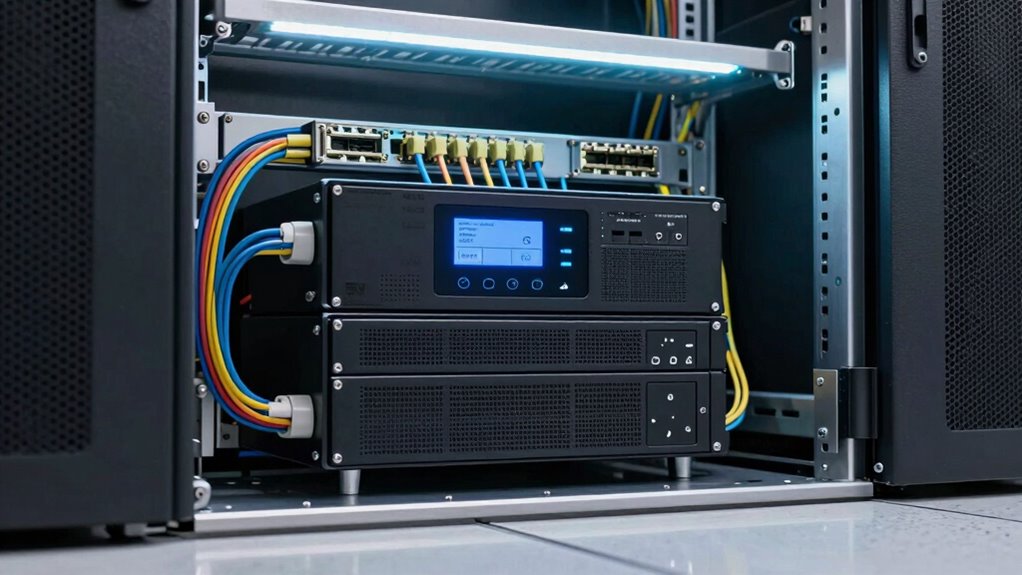

To build a network backup plan around a rackmount UPS, start by selecting a unit with enough capacity to keep critical equipment like servers and switches running during outages. Implement regular testing and monitor its health remotely to guarantee reliability. Use power management tools to optimize efficiency and extend battery life. Incorporate multiple layers of redundancy and create clear procedures for quick recovery after outages. Continuing will reveal key strategies to enhance your network’s resilience and operational stability.

Get backup power and energy gear delivered free with Prime
- Fast, free delivery on millions of items
- Prime Video, Amazon Music and more included
- Member-only deals all year
Key Takeaways
- Assess network critical components and select a rackmount UPS with adequate capacity and backup runtime.
- Implement regular testing and maintenance of the UPS to ensure reliable performance during outages.
- Integrate UPS monitoring with network management tools for real-time alerts and remote oversight.
- Develop disaster recovery procedures, including hardware shutdown and quick restoration protocols.
- Optimize power management to extend UPS battery life and enhance overall network resilience.

Have you ever experienced a sudden network outage that disrupted your business operations? It’s a stressful situation that can lead to data loss, decreased productivity, and revenue setbacks. To prevent this, building a dependable network backup plan centered around a rackmount UPS is essential. One of the key elements you need to focus on is power redundancy. Your rackmount UPS should be capable of providing continuous power, even if the main power source fails. This means selecting a UPS with enough capacity and backup runtime to keep critical network equipment—like servers, switches, and routers—operational during outages. Power redundancy isn’t just about keeping the lights on; it’s about ensuring your entire network remains functional through any power hiccup.
Power redundancy ensures your network stays operational during outages with a reliable rackmount UPS.
Incorporating an all-encompassing disaster recovery strategy is equally crucial. Your backup plan should include regular testing of your UPS system to verify it kicks in when needed. This proactive approach helps you identify potential issues before an actual outage occurs. Also, consider implementing redundant power supplies for your network hardware itself, so if one power source fails, the other seamlessly takes over. This layered approach minimizes downtime and protects your infrastructure from single points of failure. Additionally, understanding the importance of power management strategies can help you optimize your UPS deployment and further enhance your network’s resilience. Proper power management can extend the life of your UPS batteries and improve overall efficiency. Incorporating power management software can give you better control and real-time insights into your power usage. Moreover, staying informed about power quality issues can help prevent unexpected failures and ensure your backup system performs optimally.
Beyond hardware, your disaster recovery plan should specify procedures for quick restoration. In the event of a power failure, your team needs clear instructions on how to safely shut down and restart systems, preventing data corruption and hardware damage. Make sure your backup power system is integrated with your network management tools, allowing real-time monitoring and alerts. This way, you’re immediately aware of any power issues and can respond swiftly to mitigate impact.
A rackmount UPS also supports your business continuity by enabling remote management. With remote monitoring, you can keep an eye on power status, battery health, and load levels without physically being onsite. This feature is particularly useful for data centers or remote branch offices where quick intervention isn’t always feasible. By combining power redundancy, remote management, and a solid disaster recovery plan, you create a resilient network infrastructure that can withstand outages and reduce downtime.
rackmount UPS with high capacity
As an affiliate, we earn on qualifying purchases.
As an affiliate, we earn on qualifying purchases.
Frequently Asked Questions
How Often Should I Test My UPS Backup System?
You should test your UPS backup system at least monthly to guarantee battery lifespan and power redundancy. Regular testing helps identify potential issues before a real outage, maintaining reliable backup performance. During these tests, simulate a power failure to verify that your system activates correctly and supports essential equipment. Consistent testing ensures your UPS remains dependable, and you’re prepared to keep your network running smoothly during outages.
Can I Integrate Multiple UPS Units for Larger Networks?
Yes, you can integrate multiple UPS units for larger networks to guarantee UPS redundancy and improve power distribution. You should connect them in a parallel or modular arrangement, allowing one unit to take over if another fails. Properly configuring power distribution prevents overloads and maintains continuous backup power. Make certain to synchronize the units and monitor their performance regularly to optimize reliability and prevent downtime during outages.
What Are the Signs of UPS Battery Failure?
You’ll notice signs of UPS battery failure through battery degradation, which causes shorter backup times and frequent shutdowns. Fault indicators on your UPS can also alert you to issues, such as blinking lights or error messages. If your UPS’s battery isn’t holding a charge or if you see persistent fault indicators, it’s time to replace the battery. Regular maintenance and monitoring help prevent unexpected failures, ensuring your network stays protected.
How Does Environmental Temperature Affect UPS Performance?
Think of your UPS like a delicate plant; just as it needs the right environment to thrive, it relies on proper temperature regulation. When environmental temperature rises, UPS performance drops, risking failure. Environmental monitoring helps you spot temperature spikes early, ensuring peak operation. Maintaining a cool, stable environment prevents overheating, extends UPS lifespan, and guarantees your network stays protected during power fluctuations.
Is There a Recommended Maintenance Schedule for Rackmount UPS?
You should perform maintenance on your rackmount UPS every 3 to 6 months. Regularly check the battery lifespan, ensuring there are no signs of corrosion or leakage, and replace batteries as needed. Test the system to verify power redundancy, making sure it seamlessly switches to backup during outages. Keep vents clean and environmental conditions ideal to prevent overheating, which can reduce UPS performance and lifespan.
UPS monitoring software for network
As an affiliate, we earn on qualifying purchases.
As an affiliate, we earn on qualifying purchases.
Conclusion
In the end, having a solid backup plan centered around your rackmount UPS is like building a safety net—you’ll catch your data before it hits the ground. Regularly test and update your backups to stay ahead of surprises. Remember, a stitch in time saves nine; don’t wait until a disaster strikes to act. With proactive planning, you’ll keep your network running smoothly, no matter what challenges come your way.
redundant power supplies for servers
As an affiliate, we earn on qualifying purchases.
As an affiliate, we earn on qualifying purchases.
As an affiliate, we earn on qualifying purchases.
Fall Picks
fall essentials
As an affiliate, we earn on qualifying purchases.