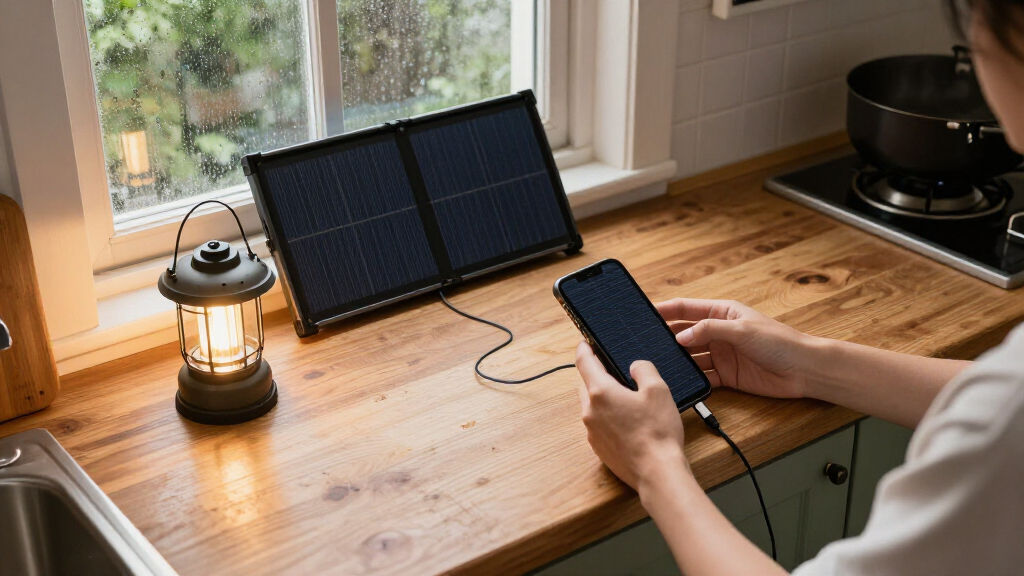

When preparing for an outage, the choice is not simply between a power bank with a solar panel and one without. It is between a small, weather-dependent source of extra energy and a larger reserve that must be charged before the grid goes down. A solar-integrated power bank can keep collecting some energy outdoors, but its built-in panel is typically too small to refill the battery quickly. A high-capacity USB power bank usually delivers more dependable phone charges and faster top-ups, provided you have charged it in advance.

Get backup power and energy gear delivered free with Prime
- Fast, free delivery on millions of items
- Prime Video, Amazon Music and more included
- Member-only deals all year

FEELLE 50,000mAh Solar Power Bank with Magnetic Wireless Charging and Hand Crank
- ✔ Stated capacity: 50,000mAh
- ✔ Battery type: Lithium polymer
- ✔ Wireless charging: Magnetic, up to 15W

SOARAISE 48,000mAh Solar Power Bank with Wireless Charging and 4 Built-In Cables
- ✔ Stated capacity: 48,000mAh
- ✔ Battery type: Lithium-polymer
- ✔ Solar panels: 4

BLAVOR 10,000mAh Solar Power Bank with Wireless Charging
- ✔ Stated capacity: 10,000mAh
- ✔ Battery type: Lithium-cobalt
- ✔ USB-C output: 20W
Choose the solar-integrated option if outages may last several days, sunlight is available, and you value any ability to replenish the bank without an outlet. Choose the USB-focused option if your priority is reliable capacity for the first day or two, quicker charging, or better value. For serious emergency readiness, neither compact bank replaces a larger foldable solar panel or a properly sized backup power station; the right choice depends on whether you need stored energy or a way to make more.
At a Glance
| Criteria | Solar-integrated power bank | High-capacity USB power bank | Winner |
|---|---|---|---|
| Emergency energy source | USB input plus a small built-in solar panel; sunlight can add energy without an outlet | USB recharge only; must be charged from an outlet, car, or separate solar panel before or during an outage | A |
| Recharge speed and reliability | Solar input is slow and varies with panel angle, weather, and season; USB recharge is usually faster | Predictable USB input is generally much quicker than a compact built-in panel | B |
| Stored capacity and phone charges | Often less stored capacity at a similar size and price; actual phone charges depend on conversion losses | Often provides more stored capacity for the money, though advertised capacity is not all delivered to devices | B |
| Portability and ruggedness | Convenient all-in-one design, but panel surface can add bulk and needs exposure to sunlight | Usually simpler and more space-efficient for its stored capacity; still check weight and durability | Depends |
| Device charging and ports | Varies by model; some include multiple ports, lights, or rugged features, but solar does not guarantee stronger output | Often offers practical USB-C and USB-A combinations; output speed depends on the specific model | Depends |
| Value for money | Pay extra for the possibility of gradual solar replenishment, not for fast solar recharging | Usually the better price-per-capacity choice if solar replenishment is not a priority | B |
| Best outage duration | Potentially useful for extended outages with sunny conditions and low daily power needs | Strong fit for short outages or when you can recharge from a vehicle or separate panel | Depends |
FEELLE 50,000mAh Solar Power Bank with Magnetic Wireless Charging and Hand Crank
FEELLE takes the top spot because it addresses more than one emergency scenario. Its 50,000mAh stated capacity is the largest in this comparison, and four built-in cables reduce the chance that a household member arrives without a compatible lead. Three ports add further connection options, while magnetic wireless charging offers a cable-free fallback for a compatible phone. That breadth makes it more adaptable than BLAVOR, whose strongest distinction is its faster specified USB-C output rather than a broad set of backup methods.The hand crank is the feature that most clearly separates FEELLE from SOARAISE. It offers a manual alternative when sunlight is limited, but we should regard it as an emergency contingency, not a convenient way to refill a large battery. The product details do not provide crank output or a recharge time, and turning it requires effort. Likewise, the solar feature is useful as a possible supplement, not a promise of prompt recovery after the bank is drained.For a power outage or a car-camping kit, the steady, SOS, and strobe flashlight modes, compass, and ruggedized description add practical utility beyond charging. The tradeoff is bulk: a high-capacity unit with cables and extra hardware is unlikely to be the lightest everyday carry. Magnetic charging may also be less effective with thick phone cases. We would choose it for flexible preparedness, not for someone who wants a slim charger or expects solar alone to supply reliable power.
Pros:
- Largest stated capacity in this comparison at 50,000mAh.
- Four built-in cables plus three ports support a variety of devices.
- Hand crank provides a manual backup method beyond solar.
- Includes magnetic wireless charging, a compass, and a three-mode flashlight.
Cons:
- Solar and hand-crank charging output and recharge times are not specified.
- Magnetic charging may be weaker through thick phone cases.
- Its capacity and extra hardware may make it bulky to carry.
Best for: Households or outdoor users who want substantial stated battery reserve, several built-in connection options, and a manual charging fallback for contingencies.
Not ideal for: People prioritizing a lightweight everyday power bank, or anyone expecting the solar panels or hand crank to quickly replenish the battery.
Bottom line: We rank FEELLE first for emergency versatility, provided we treat its solar and crank functions as contingencies rather than quick ways to refill its large battery.
“We rank FEELLE first for emergency versatility, provided we treat its solar and crank functions as contingencies rather than quick ways to refill its large battery.”
SOARAISE 48,000mAh Solar Power Bank with Wireless Charging and 4 Built-In Cables
SOARAISE is the more group-oriented alternative to FEELLE. It claims support for up to seven devices at once, combining four built-in cables with two USB-A outputs, a USB-C input/output, and wireless charging. That gives a family or small team more ways to connect without packing a separate cable for every person. The claim describes connection capacity, however, not equal charging speed across all devices; we should not assume seven phones will charge quickly together.Its four solar panels are an obvious point of difference from BLAVOR, whose solar charging rate is not specified in the supplied details. More panel area can be attractive when a bank is left in sunlight, but it still does not tell us the actual charging rate or how long replenishment will take. FEELLE remains the stronger choice for backup variety because it adds a hand crank, compass, and SOS-capable light. SOARAISE instead focuses on distributing connections among several devices.The 48,000mAh stated capacity is close to FEELLE’s, so the main question is not a dramatic difference in stored capacity but which extras matter more. If we need manual backup and emergency signaling, FEELLE has the edge. If several people are likely to share one bank, SOARAISE’s connection mix may be more useful. Its substantial capacity can also mean a bulky carry, and without dimensions or weight we cannot judge exactly how it fits into a compact kit.
Pros:
- 48,000mAh stated capacity is close to FEELLE’s larger figure.
- Four solar panels provide a broad solar-charging setup.
- Built-in cables, USB ports, USB-C, and wireless charging offer varied connection choices.
- Listed to support charging up to seven devices simultaneously.
Cons:
- Solar performance and recharge time are not specified and will depend on conditions.
- The large capacity may make it bulky to carry.
- No hand crank or emergency flashlight is listed in the supplied description.
Best for: Families, groups, and shared emergency kits where several people need access to charging connections from one power bank.
Not ideal for: Buyers who need a hand-crank fallback, want specified solar recharge performance, or prioritize a lightweight personal charger.
Bottom line: We recommend SOARAISE for shared charging access, but choose FEELLE instead if a manual backup and emergency lighting matter more than the multi-device emphasis.
“We recommend SOARAISE for shared charging access, but choose FEELLE instead if a manual backup and emergency lighting matter more than the multi-device emphasis.”
BLAVOR 10,000mAh Solar Power Bank with Wireless Charging
BLAVOR is the clear alternative when carrying a smaller emergency kit matters more than maximizing stored power. At 10,000mAh, its stated capacity is only a fraction of FEELLE’s or SOARAISE’s, so it is less suited to keeping several devices going through a prolonged outage. In exchange, its 20W USB-C output is the most clearly specified wired charging capability in this lineup. That can make it a better match for a compatible phone when we need a faster wired top-up and can recharge the bank by other means.Its outdoor details are also more specific: the product is described as IPX5-rated and includes dual flashlights and a compass carabiner. Those features help it function as an individual kit item, while FEELLE offers a broader set of emergency tools and a hand crank. BLAVOR can charge up to three devices simultaneously, but its lower capacity makes that more appropriate for sharing briefly than for sustaining several devices over an extended interruption.We should be cautious about interpreting “solar” as dependable replenishment here. The supplied information does not state the solar charging speed, and it gives no dimensions or weight, so we cannot verify the portability advantage from measurements. BLAVOR is best understood as a lower-capacity, outdoor-oriented backup bank with useful wired output, not a replacement for a high-capacity outage reserve. Choose it if a lighter kit is the priority; skip it if several days of charging flexibility are the goal.
Pros:
- Specified 20W USB-C output is the strongest stated wired output in this comparison.
- Wireless charging and support for up to three devices provide connection flexibility.
- IPX5-rated design and dual flashlights suit outdoor preparedness.
- Compass carabiner adds a practical navigation-oriented extra.
Cons:
- 10,000mAh capacity is much lower than the FEELLE and SOARAISE models.
- Solar charging speed is not specified.
- Dimensions and weight are not provided, limiting portability comparisons.
Best for: Individuals building a more compact-minded outdoor or emergency kit who value a specified 20W USB-C output and weather-conscious features over maximum capacity.
Not ideal for: Households preparing for extended outages, or buyers who need high stored capacity, a hand crank, or a known solar recharge rate.
Bottom line: BLAVOR is the most sensible choice for a smaller personal kit and specified fast USB-C, but its lower capacity makes it the weakest option here for prolonged shared backup.
“BLAVOR is the most sensible choice for a smaller personal kit and specified fast USB-C, but its lower capacity makes it the weakest option here for prolonged shared backup.”
As an Amazon Associate we earn from qualifying purchases.
Key Differences
The main tradeoff is replenishment versus dependable stored energy. A solar-integrated bank can collect power when the grid and outlets are unavailable, but its small panel generally adds energy slowly. Sun angle, cloud cover, shade, temperature, and how the bank is positioned all affect output. It is best treated as a way to extend a reserve over time, not as a device you can set outside for an afternoon and expect to refill. The USB-focused bank cannot make its own energy, but it can often be charged quickly from a wall outlet, car adapter, or separate solar panel before an outage.
That difference shapes the value decision. For the same budget, the non-solar model often offers greater capacity, while the solar model charges a premium for independence from outlets. If a blackout is short and you can keep the bank charged, extra capacity and charging speed are usually more useful than a small panel. If outages may continue for days and you can expose the panel to direct sun, the solar feature may help maintain a minimal supply. People who need dependable solar replenishment should compare a separate foldable panel and USB power bank, which gives more panel area and flexibility than most built-in designs.
Emergency performance also depends on the details: usable output, USB-C power delivery, input speed, cable availability, battery condition, and the devices you need to keep running. A phone, headlamp, and small radio have different energy needs from a tablet or hotspot. Neither type is a substitute for a tested emergency plan. Keep the bank charged, store the required cables with it, and verify that its output supports your devices before an outage.
Detailed Comparison
Emergency energy source (Solar-integrated power bank wins — moderate)
A wins for independence; the gap is moderate. The integrated solar panel gives the bank a way to collect some energy when no outlet or vehicle is available. That can matter during a prolonged outage in a sunny location. But the panel is small, so it should be treated as a slow trickle rather than a reliable daily refill. B has no built-in generation and depends on stored charge or another power source.
Recharge speed and reliability (High-capacity USB power bank wins — major)
B wins; the gap is major for time-sensitive charging. A USB power bank can generally recharge from a suitable wall adapter much faster and more consistently than a compact built-in panel can recharge from sunlight. Solar performance changes with clouds, shade, season, and panel orientation. A can still be topped up by USB, but its solar feature does not make the charging process fast. If you can charge before an expected storm or outage, B is the more predictable choice.
Stored capacity and phone charges (High-capacity USB power bank wins — moderate)
B usually wins on value and capacity; the gap is moderate, but model specifications matter. Manufacturers advertise battery capacity in milliamp-hours, yet conversion from the internal battery to a phone loses energy. Compare watt-hours when available, output specifications, and credible estimates of device charges rather than assuming every advertised milliamp-hour reaches your phone. At a similar budget, a USB-focused bank commonly puts more of the cost into stored energy instead of a solar panel.
Portability and ruggedness (minor difference)
This is model-dependent; there is no universal winner. A combines charging and solar collection in one package, which reduces the need to carry a separate panel. Its panel can add surface area and may be more exposed to scratches or damage, depending on construction. B can be simpler and compact for its capacity, though high-capacity models may be heavier. Compare measured weight, water resistance, drop protection, and whether the panel can be positioned safely in the sun.
Device charging and ports (moderate difference)
Depends on the exact model; the difference is usually moderate. A solar label does not indicate how quickly a bank can charge a phone. Check USB-C output, supported charging standards, port count, and whether multiple connected devices reduce speed. The same checks apply to B. For emergency use, a model with a suitable USB-C output and enough capacity for your essential devices is more useful than an extra feature you may rarely use.
Value for money (High-capacity USB power bank wins — moderate)
B wins for most buyers; the gap is moderate. If the built-in panel is rarely used, paying more for it means spending less of the budget on stored capacity. A earns its premium only when collecting some energy without an outlet is a meaningful part of your emergency plan. Compare the price difference with the cost of a separate panel: a larger external panel may produce more useful solar input, though it adds gear to carry and set up.
Best outage duration (major difference)
Depends on access to sunlight and other charging sources; the difference is major for multi-day outages. For a short outage, B’s larger stored reserve and predictable charging are usually more helpful. In a longer outage with reliable sun, A can potentially add energy over time, but the amount may be modest and should not be the sole plan. If you expect several days without grid power, a separate panel with more surface area is generally a stronger solar setup than relying only on a built-in panel.
Solar-integrated power bank: Pros and Cons
Pros:
- Can collect some charge without an outlet when usable sunlight is available
- Combines storage and solar collection in one item
- May extend a small-device reserve during a prolonged outage
Cons:
- Built-in panel is generally slow and weather-dependent
- Often offers less stored capacity for the price than a USB-focused bank
- Panel exposure, positioning, and durability need attention
High-capacity USB power bank: Pros and Cons
Pros:
- Usually gives more stored capacity per dollar
- USB recharge is quicker and more predictable when a power source is available
- Often a straightforward choice for phones and other small devices
Cons:
- Cannot replenish itself without an outlet, vehicle, or separate panel
- Needs to be charged before an outage to provide its full reserve
- A larger-capacity model can be heavier and take longer to recharge
Who Should Choose What
Choose Solar-integrated power bank if:
- You may face multi-day outages and have dependable direct sunlight where you can safely place the bank
- You want one compact item that can collect a little energy without carrying a separate panel
- You accept slow, variable solar charging and value it as a backup rather than a primary recharge method
Choose High-capacity USB power bank if:
- Most of your concern is a short outage and you can charge the bank in advance
- You want the largest practical stored reserve for your budget
- You can recharge from a car, generator, outlet, or separate solar panel
Skip both if: Skip both as your only backup if you need to power high-draw equipment, run devices for several days without sunlight, or keep essential medical equipment operating; look at a properly rated power station and suitable charging source.
Value for Money
For most households, a high-capacity USB bank is the better value: it directs more of the purchase price toward stored energy, and its charge level is easier to restore quickly before an outage. Paying more for an integrated solar panel makes sense only if you expect to use it in sustained, sunny conditions and cannot rely on outlets or a vehicle. Even then, do not interpret the panel as a fast refill system. If solar charging is central to your plan, compare the bank with a separate foldable panel; its larger area may provide more practical input, though it costs more, takes up space, and requires setup. The best-value choice is the least expensive setup that reliably meets your charging needs, not the one with the most features.
Final Verdict
For most emergency kits, choose a high-capacity USB power bank. It is the stronger choice for predictable phone charging, stored energy, and value when you can charge it before an outage. Choose a solar-integrated bank if your outages may last several days, you have reliable direct sun, and slow trickle charging is still useful to you. The deciding factor is whether you need a larger reserve now or a limited way to add energy later. If you need meaningful solar recharging rather than a small emergency supplement, buy a USB bank paired with a separate panel instead of relying on a tiny built-in one.
Frequently Asked Questions
Can a solar power bank recharge fully from its built-in panel?
It may recharge over time in strong, direct sunlight, but the process is usually slow and variable. Clouds, shade, poor panel angle, and short winter days can reduce input. Treat the panel as a way to add some energy, not as a guaranteed full recharge.
Is a solar power bank better than a regular power bank for a blackout?
Not for every blackout. A regular USB bank is often better for a short outage because it tends to offer more stored capacity for the price and can be charged quickly in advance. A solar-integrated model has an advantage when an outage lasts longer and sunlight is available, but its panel may provide only a gradual top-up.
How much capacity should an emergency power bank have?
Start with the devices you need to keep running and how often you can recharge them. Check watt-hours or realistic device-charge estimates, not just the advertised milliamp-hour figure. A phone-only kit has different needs from one that also supports a hotspot, tablet, or several family members.
Should I buy a built-in solar bank or a separate solar panel?
A built-in panel favors convenience and fewer pieces of gear. A separate panel generally offers more surface area and can be positioned toward the sun while the bank stays protected. If solar replenishment is a central requirement, compare the panel’s actual output and USB compatibility; a separate panel and USB bank are often the more practical setup.
Fall Picks
fall essentials
As an affiliate, we earn on qualifying purchases.