
Solar-powered security cameras can reduce charging and wiring, but the right choice depends on coverage, storage, and how much setup you want. My best overall pick is the aosu D1 Max 4-Camera 4K System for a multi-camera setup with sharp video, while the eufy SoloCam E42 Kit stands out for buyers who want 4K cameras paired with HomeBase 3. For a single viewpoint with broader coverage, I’d also look at the eufy SoloCam S340, which combines dual lenses with solar power. The main tradeoffs are resolution versus the number of cameras, local storage versus system flexibility, and fixed views versus pan-and-tilt coverage. Read on for the full breakdown and a guide to matching a camera system to your property.

Get backup power and energy gear delivered free with Prime
- Fast, free delivery on millions of items
- Prime Video, Amazon Music and more included
- Member-only deals all year
Key Takeaways
- Multi-camera kits lead this lineup for whole-property coverage: the aosu D1 Max, eufy SoloCam E42 kit, and aosu D1 Classic each bundle four cameras, but their video and hub setups differ.
- Resolution alone does not determine the best fit: 4K options such as the D1 Max and SoloCam E42 prioritize detail, while 2K and 4MP models can make more sense when coverage or camera count matters more.
- Pan-and-tilt cameras trade installation simplicity for adjustable views: options from Wyze, SEHMUA, and several generic kits can cover more ground from one mounting point, but depend on movement and tracking features rather than multiple fixed viewpoints.
- Storage choices separate system-style kits from stand-alone cameras: the eufy E42 pairs with HomeBase 3, while two listed 4-camera or 2-camera systems specify 128GB local storage; buyers should check exactly how recordings are accessed and retained.
- Solar support is not a substitute for placement planning: integrated panels keep installation compact, while a camera’s sun exposure, viewing angle, and mounting position still affect whether a site is practical for a solar setup.
| aosu D1 Max 4-Camera 4K Solar Wireless Outdoor Security Camera System |  | Best for High-Detail, Multi-Area Coverage | Camera count: 4 | Resolution: 4K UHD, 8 MP | Coverage: 360° PTZ with auto tracking | VIEW LATEST PRICE | See Our Full Breakdown |
| AlkiVision Solar-Powered 2K Outdoor Security Camera with Color Night Vision |  | Best Single-Camera Deterrence Setup | Resolution: 2K (2304 × 1296 pixels) | View: 360° panoramic; 120° adjustable case | Power: Solar panel and built-in 5000 mAh battery | VIEW LATEST PRICE | See Our Full Breakdown |
| Cinnado S1 Wireless Outdoor Security Cameras with Integrated Solar Panels, 4-Pack |  | Best for a Simple Four-Camera Solar Setup | Camera count: 4 | Resolution: 2K; 3 MP photo sensor | Power: Solar with integrated panels | VIEW LATEST PRICE | See Our Full Breakdown |
| Solar-Powered 2K Outdoor Pan/Tilt Security Camera |  | Best for Adjustable Single-Camera Coverage | Resolution: 2K (2304 × 1296 pixels) | Rotation: 355° horizontal and 120° vertical | Power: Rechargeable battery with 2W solar panel | VIEW LATEST PRICE | See Our Full Breakdown |
| 4MP Wireless Solar Security Camera System with 4 Cameras and 128GB Local Storage |  | Best for Subscription-Free Local Recording | Camera count: 4 | Resolution: 4MP | Local storage: 128GB encrypted base storage | VIEW LATEST PRICE | See Our Full Breakdown |
| eufy Security SoloCam E42 4-Camera Kit with HomeBase 3, 4K Solar Security Cameras |  | Best for Whole-Property Coverage | Camera count: 4 SoloCam E42 cameras | Video resolution: 4K UHD | Coverage: 360° pan and tilt | VIEW LATEST PRICE | See Our Full Breakdown |
| eufy Security SoloCam S340 3K Dual-Lens Solar Security Camera |  | Best for Long-Range Single-Camera Viewing | Camera type: Dual-lens | Video resolution: 3K + 2K | Zoom: 8× hybrid zoom | VIEW LATEST PRICE | See Our Full Breakdown |
| GALAYOU R6 Solar-Powered Outdoor Security Camera, 1-Pack |  | Best for Backup Charging Flexibility | Video resolution: 1296p | Still image resolution: 3 MP | Power: Solar panel with USB-C backup charging | VIEW LATEST PRICE | See Our Full Breakdown |
| Wyze Solar Cam Pan 2K Outdoor Security Camera |  | Best for Active Deterrence | Resolution: 2K | Coverage: 360° pan and 70° tilt | Power: Solar-powered; maximum power 1.8 W | VIEW LATEST PRICE | See Our Full Breakdown |
| SEHMUA 2K Solar-Powered Outdoor Security Cameras, 2-Pack with Pan/Tilt, Color Night Vision and Two-Way Audio |  | Best Two-Camera Starter Set | Camera quantity: 2 | Video resolution: 2K capture; listed effective resolution is 1080p | Power: Solar-powered with 6000 mAh batteries | VIEW LATEST PRICE | See Our Full Breakdown |
| 8MP Triple-Lens Solar Outdoor Security Camera with Wi-Fi, PTZ, Color Night Vision, and Two-Way Audio (Black, 2-Pack) |  | Best for Maximum Coverage per Camera | Resolution: 8MP, 3840 x 2160 | Lens design: Triple lens | Pan and tilt: 360° horizontal, 90° vertical | VIEW LATEST PRICE | See Our Full Breakdown |
| aosu D1 Classic 4-Camera Wireless Outdoor Security Camera Kit with Solar Power | 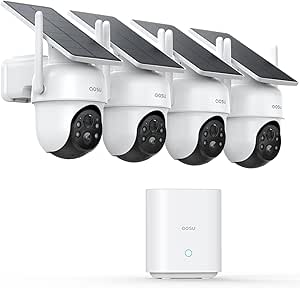 | Best for Subscription-Free Four-Camera Coverage | Camera count: 4 | Video resolution: 2K / 3MP | Storage: 32GB local storage in base | VIEW LATEST PRICE | See Our Full Breakdown |
| Wireless Outdoor Security Camera System, 2-Camera Kit with Solar Power, 4MP Video, 360° PTZ, and 128GB Local Storage |  | Best for High-Capacity Local Storage | Camera count: 2 | Video resolution: 4MP | Local storage: 128GB in 4-channel base unit | VIEW LATEST PRICE | See Our Full Breakdown |
| 4-Pack 2K Solar Wireless Outdoor Security Cameras with Pan-Tilt, AI Detection, and Two-Way Audio |  | Best Four-Camera Pick for Spotlight Night Monitoring | Camera count: 4 | Video resolution: 2K | Power: Solar panel and built-in backup battery | VIEW LATEST PRICE | See Our Full Breakdown |
| solar powered security camera | Power | Night vision | Storage | Weather resistance |
|---|---|---|---|---|
| aosu D1 Max 4-Camera 4K Solar | Solar | Full-color and infrared black-and-white; 33 ft range | 32GB included; expandable to 1TB | IP65 |
| AlkiVision Solar-Powered 2K Ou | Solar panel and built-in 5000 mAh battery | Color night vision with spotlight | MicroSD up to 128GB, not included, or subscription-based cloud storage | IP67 |
| Cinnado S1 Wireless Outdoor Se | Solar with integrated panels | Spotlight-activated color night vision | TF card, not included, or optional cloud storage | IP65 |
| Solar-Powered 2K Outdoor Pan/T | Rechargeable battery with 2W solar panel | — | MicroSD up to 256GB, not included, and 7-day rolling cloud storage | IP65 |
| 4MP Wireless Solar Security Ca | 8000mAh battery and 5W solar panel | Color; up to 65 ft | — | IP66 |
| eufy Security SoloCam E42 4-Ca | — | — | — | — |
| eufy Security SoloCam S340 3K | Solar-powered with removable solar panel | Color | Built-in 8 GB | — |
| GALAYOU R6 Solar-Powered Outdo | Solar panel with USB-C backup charging | — | TF card up to 128 GB, not included; optional paid cloud storage | IP65 |
| Wyze Solar Cam Pan 2K Outdoor | Solar-powered; maximum power 1.8 W | Full-color | microSD up to 512 GB, sold separately; optional cloud recording | IP65 |
| SEHMUA 2K Solar-Powered Outdoo | Solar-powered with 6000 mAh batteries | Color night vision with spotlight and infrared LEDs | Memory card up to 128 GB, not included; optional cloud storage | — |
| 8MP Triple-Lens Solar Outdoor | Solar powered with built-in battery | Three modes; color night vision up to 65 ft | — | IP66 |
| aosu D1 Classic 4-Camera Wirel | Integrated solar panels | Full-color and infrared | 32GB local storage in base | — |
| Wireless Outdoor Security Came | — | — | — | IP66 |
| 4-Pack 2K Solar Wireless Outdo | Solar panel and built-in backup battery | Color with built-in motion-activated spotlight | Optional microSD card or cloud storage; card not included | IP65 |
More Details on Our Top Picks
aosu D1 Max 4-Camera 4K Solar Wireless Outdoor Security Camera System
For buyers covering several outdoor zones, the aosu D1 Max pairs four 4K cameras with 360° pan-and-tilt coverage and auto tracking. That combination makes it a stronger fit for following activity across open areas than the fixed-view Cinnado S1, while on-device person and vehicle detection keeps recognition features available without relying on a subscription. The included base stores footage locally, with room to expand from 32GB to 1TB, which suits households that want centralized recording. Solar power helps avoid routine battery charging, but performance still depends on sunlight and placement. The main compromise is 15 fps recording, which is less fluid than higher-frame-rate footage, and the cameras depend on the aosuBase for connectivity and storage.
Pros:- Four 4K cameras provide detailed coverage across multiple areas.
- 360° pan-and-tilt with auto tracking can follow activity around a camera.
- Included 32GB local storage expands up to 1TB without a required subscription.
- Solar power and wire-free cameras allow flexible outdoor placement.
Cons:- Recording is limited to 15 frames per second.
- The aosuBase is required for camera connectivity and local storage.
- Solar charging depends on sufficient sunlight at the installation site.
Best for: Homeowners who need four solar-powered cameras to monitor broad outdoor areas and want expandable local recording without a subscription.
Not ideal for: Buyers who need smooth, high-frame-rate footage or want cameras to connect directly without a required base station.
- Camera count:4
- Resolution:4K UHD, 8 MP
- Coverage:360° PTZ with auto tracking
- Night vision:Full-color and infrared black-and-white; 33 ft range
- Detection:On-device AI person and vehicle detection
- Storage:32GB included; expandable to 1TB
- Power:Solar
- Video frame rate:15 fps
- Weather resistance:IP65
Our verdict“Choose the aosu D1 Max if you want four detailed, tracking solar cameras with expandable local storage and can accommodate its base station and 15 fps video.”
AlkiVision Solar-Powered 2K Outdoor Security Camera with Color Night Vision
The AlkiVision is the single-camera pick for buyers who want more than alerts: its spotlight, siren, and two-way audio offer several ways to respond to activity from the Vicohome app. Its 360° panoramic view can cover a broad area, while the IP67 rating gives it a higher stated water-resistance rating than the IP65 Cinnado S1 and the aosu D1 Max. The tradeoff is that its AI recognition features require a subscription, and local recording means supplying a microSD card yourself. Compared with the four-camera aosu system, AlkiVision is a simpler one-camera setup rather than a coordinated multi-area kit; it makes more sense for one entryway or yard than a whole property. It also relies on 2.4 GHz Wi-Fi.
Pros:- 2K video and color night vision support monitoring in low light.
- Spotlight, siren, and two-way audio provide multiple ways to respond to activity.
- 360° panoramic view covers more of a single location than a fixed-view camera.
- IP67 water resistance is higher than the IP65 rating on the Cinnado S1 and aosu D1 Max.
Cons:- AI recognition features require a subscription.
- A microSD card for local recording is not included.
- Connects only to 2.4 GHz Wi-Fi.
Best for: People who want one solar camera for an entryway or yard, with app-based talk and built-in light and siren deterrents.
Not ideal for: Households that need several camera views, subscription-free AI recognition, or a camera operating on 5 GHz Wi-Fi.
- Resolution:2K (2304 × 1296 pixels)
- View:360° panoramic; 120° adjustable case
- Power:Solar panel and built-in 5000 mAh battery
- Detection:AI detection for people, vehicles, pets, and packages; AI recognition requires subscription
- Night vision:Color night vision with spotlight
- Storage:MicroSD up to 128GB, not included, or subscription-based cloud storage
- Connectivity:2.4 GHz Wi-Fi
- Audio and alarm:Two-way audio, siren, and spotlight
- Weather resistance:IP67
Our verdict“Pick AlkiVision for a single solar-powered monitoring point where active deterrence matters more than multi-camera coverage or subscription-free AI recognition.”
Cinnado S1 Wireless Outdoor Security Cameras with Integrated Solar Panels, 4-Pack
The Cinnado S1 offers a straightforward way to place four solar cameras around a property, with panels integrated into each camera rather than supplied as separate units. That design keeps installation cordless, though each camera still needs useful sunlight. The cameras record event-based 2K video with spotlight color night vision, two-way audio, and a siren. Compared with the aosu D1 Max, this kit trades 4K footage, 360° PTZ, and expandable base storage for integrated solar panels and a simpler event-camera approach. It also differs from the AlkiVision, which is a single camera with a higher IP67 rating; Cinnado’s four cameras are rated IP65. There is no continuous recording, and local storage requires a separately supplied TF card.
Pros:- Four cameras with integrated solar panels support cordless placement around a property.
- 2K video and spotlight-activated color night vision provide useful event detail.
- Two-way audio and a siren offer ways to communicate or respond.
- Supports local TF card storage or optional cloud storage.
Cons:- Records event-based clips rather than continuous video.
- Requires 2.4 GHz Wi-Fi and does not support 5 GHz.
- TF cards for local recording are not included.
Best for: Homeowners who want four independently placed solar cameras for event-based monitoring and can provide 2.4 GHz Wi-Fi and local storage cards.
Not ideal for: Buyers who need continuous recording, 5 GHz Wi-Fi, or pan-and-tilt tracking to follow movement.
- Camera count:4
- Resolution:2K; 3 MP photo sensor
- Power:Solar with integrated panels
- Recording:Event-based; no continuous recording
- Detection:PIR sensing with AI threat detection
- Night vision:Spotlight-activated color night vision
- Storage:TF card, not included, or optional cloud storage
- Connectivity:2.4 GHz Wi-Fi; 5 GHz not supported
- Weather resistance:IP65
Our verdict“Choose the Cinnado S1 for four solar-powered event cameras with integrated panels, but skip it if you need continuous recording or pan-and-tilt coverage.”
Solar-Powered 2K Outdoor Pan/Tilt Security Camera
This camera suits buyers who want to steer one solar-powered view around a yard or driveway: its 355° horizontal and 120° vertical rotation cover a wide area without requiring a multi-camera kit. Color night vision, two-way talk, a siren, and a flashing LED give it more on-camera response options than the Cinnado S1, whose four-camera setup prioritizes coverage across locations rather than rotating one view. Against the AlkiVision, this model’s stated horizontal rotation is slightly narrower than a full 360° panoramic view, but it supports a microSD card up to 256GB alongside rolling cloud storage. The important limits are event-only recording and no motion tracking; the camera can turn, but it will not automatically follow a moving subject. Some AI and cloud features require a subscription.
Pros:- 355° horizontal and 120° vertical rotation let one camera cover a broad area.
- 2K video and color night vision support monitoring after dark.
- Two-way talk, siren, and flashing LED provide response and deterrence options.
- Supports microSD storage up to 256GB as well as rolling cloud storage.
Cons:- Records motion events rather than continuous 24/7 footage.
- Does not automatically track moving subjects.
- MicroSD card is not included, and some AI recognition and cloud features require a subscription.
Best for: People monitoring one open outdoor area who want adjustable pan-and-tilt framing, local card storage, and active audio or light deterrents.
Not ideal for: Buyers seeking automatic motion tracking, continuous recording, 5 GHz Wi-Fi, or subscription-free access to every AI and cloud feature.
- Resolution:2K (2304 × 1296 pixels)
- Rotation:355° horizontal and 120° vertical
- Power:Rechargeable battery with 2W solar panel
- Night vision range:33 ft
- Recording:Event recording; no 24/7 continuous recording
- Storage:MicroSD up to 256GB, not included, and 7-day rolling cloud storage
- Connectivity:2.4 GHz Wi-Fi only
- Detection:PIR motion detection with AI recognition
- Weather resistance:IP65
Our verdict“Choose this model for manually adjustable coverage of one broad area, not for automatic tracking or continuous recording.”
4MP Wireless Solar Security Camera System with 4 Cameras and 128GB Local Storage
The clearest reason to choose this four-camera system is its 128GB encrypted local-storage base: recordings can be viewed and played back remotely without a required subscription. Its four solar-powered cameras combine 4MP video, pan-and-tilt coverage, and color night vision, while dual-band Wi-Fi gives it a connection option the 2.4 GHz-only Cinnado S1 and pan/tilt camera lack. Compared with the 4K aosu D1 Max, this system records at a lower stated resolution, but includes more base storage than the aosu’s 32GB out of the box. Setup choices matter: auto tracking must be enabled in the app, and the default human-only recording setting must be changed for broader motion capture. The claimed loop-recording duration can also vary with activity and settings.
Pros:- 128GB encrypted local storage supports remote viewing and playback without a required subscription.
- Four solar-powered cameras pair an 8000mAh battery with a 5W solar panel.
- 4MP video, color night vision, and pan-and-tilt coverage provide flexible monitoring.
- Dual-band 2.4 GHz and 5 GHz Wi-Fi offers more network flexibility than the 2.4 GHz-only Cinnado S1.
Cons:- Auto tracking must be enabled in the app rather than being active by default.
- Human-only recording is the default; broader motion detection requires changing a setting.
- The system’s single four-channel base supports up to four cameras, so expansion beyond this kit is not supported.
Best for: Households wanting four solar cameras, substantial encrypted local storage, and remote playback without a required recording subscription.
Not ideal for: Buyers who want 4K footage, automatic tracking enabled by default, or a setup that captures motion beyond people without changing app settings.
- Camera count:4
- Resolution:4MP
- Local storage:128GB encrypted base storage
- Power:8000mAh battery and 5W solar panel
- Coverage:Pan and tilt; 360° coverage stated
- Night vision:Color; up to 65 ft
- Detection:PIR and AI human detection
- Connectivity:2.4 GHz and 5 GHz Wi-Fi
- Weather resistance:IP66
Our verdict“Pick this system for four solar cameras and subscription-free encrypted local recording if you are willing to adjust tracking and motion settings during setup.”
eufy Security SoloCam E42 4-Camera Kit with HomeBase 3, 4K Solar Security Cameras
I’d rank the SoloCam E42 kit highest for buyers who want four solar cameras working as one local-storage system. Its 4K video, pan-and-tilt coverage, AI tracking, facial recognition, and motion-triggered strobe and siren give it a broader security feature set than the single-camera eufy SoloCam S340. HomeBase 3 also provides a central place to store footage, with expansion support that can suit a multi-camera setup better than the S340’s built-in 8 GB.
The tradeoff is the kit’s larger installation commitment: four screw-in cameras need useful mounting positions and reliable sun, with the charging design calling for two hours of direct sunlight daily. HomeBase starts with 16 GB, and microSD cards are not included. I’d choose this for broad coverage and flexible local storage, not for a small area or a shaded property.
Pros:- Four 4K cameras make it easier to cover multiple sides of a property.
- HomeBase 3 storage can expand up to 16 TB, alongside support for microSD cards in each camera.
- Pan-and-tilt, AI detection and tracking, and facial recognition offer more event detail than basic motion alerts.
- Solar charging is designed to support continuous operation with two hours of direct sunlight daily.
Cons:- MicroSD cards are not included, and HomeBase 3 comes with 16 GB before expansion.
- Solar performance depends on sufficient direct sunlight at the camera locations.
- Installing and positioning four screw-in cameras takes more planning than a one-camera setup.
Best for: Homeowners who want four solar-powered views, AI tracking, and expandable local storage without relying on cloud recording.
Not ideal for: Renters or owners of heavily shaded properties who cannot screw-mount several cameras or provide enough direct sunlight.
- Camera count:4 SoloCam E42 cameras
- Video resolution:4K UHD
- Coverage:360° pan and tilt
- Detection:AI motion detection, tracking, and facial recognition
- Solar charging:SolarPlus 2.0; designed for 2 hours of direct sunlight daily
- Local storage:HomeBase 3 includes 16 GB and supports expansion up to 16 TB; up to 128 GB microSD per camera
- Connectivity:Wireless Wi-Fi
- Included components:HomeBase 3 and 4 removable solar panels
Our verdict“Choose the E42 kit if you need multi-area 4K coverage and expandable local recording; skip it if your site is shaded or only needs one camera.”
eufy Security SoloCam S340 3K Dual-Lens Solar Security Camera
The SoloCam S340 makes the most sense when one camera needs to cover a broad outdoor area. Its dual-lens 3K + 2K system, 8× hybrid zoom, and 360° pan-and-tilt let a buyer scan more of a yard and inspect distant activity without installing several fixed cameras. The included removable solar panel also gives more flexibility when the best camera position and the sunniest panel position are not identical.
Compared with the four-camera eufy SoloCam E42 kit, this is simpler and more focused, but it does not provide the same multi-camera coverage or HomeBase storage expansion. Its built-in 8 GB avoids a separate card purchase, though that capacity is limited, and Wi-Fi is required. Motion-only alerts may also be less selective than a system with more specific detection features. I’d pick it for a single large viewing area, not a whole-property installation.
Pros:- Dual lenses and 8× hybrid zoom help inspect distant activity as well as broad areas.
- 360° pan-and-tilt coverage can reduce blind spots from a single mounting position.
- Removable solar panel allows more flexible positioning for sunlight.
- Built-in 8 GB storage and no monthly fee avoid a required cloud plan.
Cons:- Built-in storage is limited to 8 GB, with no larger local-storage option listed in the provided specifications.
- Wi-Fi is required for connectivity.
- Motion-only alerts offer less event-specific filtering than the E42 kit’s listed detection features.
Best for: Homeowners who need one wire-free camera to scan a driveway, yard, or other wide area and zoom in on activity.
Not ideal for: Buyers covering multiple buildings or needing extensive local recording capacity, since this is a one-camera unit with 8 GB built-in storage.
- Camera type:Dual-lens
- Video resolution:3K + 2K
- Zoom:8× hybrid zoom
- Coverage:360° field of view with pan and tilt
- Power:Solar-powered with removable solar panel
- Storage:Built-in 8 GB
- Night vision:Color
- Detection:Motion detection, AI detection, and tracking
Our verdict“Choose the S340 for one wide area where zoom and pan-and-tilt matter more than multi-camera coverage or high storage capacity.”
GALAYOU R6 Solar-Powered Outdoor Security Camera, 1-Pack
The GALAYOU R6 stands out for a practical power fallback: its solar panel is the primary source, while USB-C backup charging gives owners another option during extended cloudy stretches. That distinction matters for buyers who cannot count on uninterrupted sunshine. It also combines 1296p video, automatic pan-and-tilt tracking, color night vision, two-way audio, and a siren in a single-camera package.
Compared with the Wyze Solar Cam Pan 2K, the R6 offers similar broad pan-and-tilt monitoring and two-way audio, but Wyze lists AI person tracking, a spotlight, and a louder, specified 105 dB siren. The R6’s local TF-card option supports up to 128 GB, but the card is not included; cloud backup requires a paid plan. Its 2.4 GHz Wi-Fi requirement and 26-foot night-vision range also narrow its fit. I’d favor it where backup charging is a priority, rather than for distant detail or 5 GHz networks.
Pros:- USB-C backup charging provides another way to power the camera when solar input is insufficient.
- Automatic pan-and-tilt tracking covers a broad area from one mounting point.
- Color night vision, two-way audio, and a remotely triggered siren add useful response options.
- Supports local TF-card recording up to 128 GB as an alternative to cloud storage.
Cons:- Requires 2.4 GHz Wi-Fi.
- TF card is not included, and cloud storage requires a paid plan.
- Solar charging may need USB-C backup during extended cloudy periods.
Best for: Owners of a single outdoor area who want solar as the main power source plus USB-C backup charging for cloudy periods.
Not ideal for: Households with only 5 GHz Wi-Fi or buyers who need longer-range night vision and included local storage.
- Video resolution:1296p
- Still image resolution:3 MP
- Power:Solar panel with USB-C backup charging
- Connectivity:2.4 GHz Wi-Fi
- Pan and tilt:344° horizontal and 85° vertical
- Night vision range:26 feet
- Storage:TF card up to 128 GB, not included; optional paid cloud storage
- Weather resistance:IP65
Our verdict“Choose the R6 if you want a pan-and-tilt solar camera with a USB-C power fallback and can accept separate storage purchases.”
Wyze Solar Cam Pan 2K Outdoor Security Camera
I’d choose the Wyze Solar Cam Pan when the goal is not just to record movement but to respond to it. Its motion-activated spotlight and 105 dB siren pair with AI person tracking, color night vision, and two-way audio, giving owners several ways to monitor or discourage activity. The 360° pan range also helps one camera follow a person across a wide outdoor space.
Against the GALAYOU R6, Wyze specifies a much louder siren and AI person tracking, while the R6 offers USB-C backup charging. That makes the R6 the more flexible pick during low-sun periods; Wyze is the stronger fit for active deterrence. Wyze supports microSD cards up to 512 GB, but the card is separate, and cloud recording is optional. It also works only on 2.4 GHz Wi-Fi, so buyers with a 5 GHz-only setup should skip it.
Pros:- AI person tracking and 360° pan help follow activity across a wide area.
- Motion-activated spotlight and 105 dB siren provide active deterrence.
- Color night vision and two-way audio support nighttime monitoring and communication.
- Supports microSD storage up to 512 GB.
Cons:- Supports 2.4 GHz Wi-Fi only; 5 GHz is not supported.
- MicroSD card is sold separately, and cloud recording is optional.
- Compared with the GALAYOU R6, the listed specifications do not include USB-C backup charging.
Best for: Homeowners who want person tracking, a spotlight, and a loud siren to actively respond to movement around an entry or yard.
Not ideal for: Buyers whose outdoor Wi-Fi is 5 GHz-only or who want local storage or cloud recording included without separate purchases.
- Resolution:2K
- Coverage:360° pan and 70° tilt
- Power:Solar-powered; maximum power 1.8 W
- Motion tracking:AI person tracking
- Night vision:Full-color
- Deterrence:Motion-activated spotlight and 105 dB siren
- Storage:microSD up to 512 GB, sold separately; optional cloud recording
- Weather resistance:IP65
- Smart home compatibility:Alexa, Google Assistant, and IFTTT
Our verdict“Choose Wyze for a solar pan camera that pairs person tracking with a spotlight and loud siren, provided your network supports 2.4 GHz.”
SEHMUA 2K Solar-Powered Outdoor Security Cameras, 2-Pack with Pan/Tilt, Color Night Vision and Two-Way Audio
The SEHMUA two-pack is a straightforward way to cover two separate outdoor positions without moving up to a four-camera system. Both cameras pair solar power with 6000 mAh batteries, app-based access, pan-and-tilt control, color night vision, and two-way audio. For a buyer watching a front entry and a side gate, two cameras can offer more useful coverage than a single rotating unit such as the Wyze Solar Cam Pan.
The tradeoff is less clarity about image detail: although the listing describes 2K video capture, the effective resolution is stated as 1080p. That makes it a less compelling choice for identifying distant details than the 4K eufy SoloCam E42. SEHMUA also requires 2.4 GHz Wi-Fi, and memory cards are not included. I’d treat it as a practical two-location starter set, not a high-detail system for large properties.
Pros:- Two cameras cover separate locations without relying on one camera to rotate between them.
- Solar power and 6000 mAh batteries support outdoor operation.
- Pan-and-tilt control, color night vision, and two-way audio are included.
- IP65-rated construction is designed for outdoor weather.
Cons:- The stated effective video resolution is 1080p despite the 2K capture claim.
- Supports 2.4 GHz Wi-Fi only; 5 GHz is not supported.
- Memory cards are not included, and optional cloud storage has a 30-day trial.
Best for: First-time buyers who want two solar-powered cameras for separate entry points and value broad app-controlled coverage over maximum detail.
Not ideal for: Buyers who need verified high-resolution detail, 5 GHz Wi-Fi support, or included local-storage cards.
- Camera quantity:2
- Video resolution:2K capture; listed effective resolution is 1080p
- Power:Solar-powered with 6000 mAh batteries
- Pan and tilt:Pan-and-tilt control with 360° field of view
- Night vision:Color night vision with spotlight and infrared LEDs
- Detection:PIR motion detection
- Audio:Two-way audio
- Connectivity:2.4 GHz Wi-Fi
- Storage:Memory card up to 128 GB, not included; optional cloud storage
Our verdict“Choose the SEHMUA two-pack for basic solar coverage at two locations, but look to the E42 if sharper 4K detail is your priority.”
8MP Triple-Lens Solar Outdoor Security Camera with Wi-Fi, PTZ, Color Night Vision, and Two-Way Audio (Black, 2-Pack)
For buyers who want each camera to cover a broad area, this two-pack combines triple lenses with 360° horizontal rotation and 90° vertical tilt. That mix is more coverage-focused than the fixed camera viewpoints in many solar kits, while 8MP resolution gives it a higher stated resolution than the 2K cameras in the aosu D1 Classic kit. Solar charging and a built-in battery keep installation cable-free, and dual-band Wi-Fi offers more network flexibility than kits limited to one band.
The tradeoff is that its wide-ranging features come with details worth checking: the listing gives unusually small dimensions, and its 6K label conflicts with the specified 3840 x 2160 resolution. I’d choose this pair for areas where flexible viewing matters, but would favor the aosu D1 Classic if included local storage and four-camera coverage matter more.
Pros:- Triple lenses and 360° horizontal rotation with 90° tilt are designed to cover wide areas.
- Solar charging and a built-in battery support cable-free installation.
- Dual-band Wi-Fi and dual PIR sensors provide flexible connectivity and motion detection.
- Color night vision, auto tracking, and two-way audio support interactive monitoring.
Cons:- The stated dimensions are unusually small for an outdoor security camera and may need verification.
- The 6K label conflicts with the listed 3840 x 2160 resolution.
- No included local-storage capacity is specified.
Best for: Homeowners who need two cable-free cameras to monitor broad outdoor areas and value remote pan-and-tilt coverage.
Not ideal for: Buyers who want included local storage, four-camera coverage, or unambiguous product dimensions and resolution labeling.
- Resolution:8MP, 3840 x 2160
- Lens design:Triple lens
- Pan and tilt:360° horizontal, 90° vertical
- Power:Solar powered with built-in battery
- Wi-Fi:2.4GHz and 5GHz
- Night vision:Three modes; color night vision up to 65 ft
- Motion detection:Dual PIR sensors, auto tracking, customizable zones
- Weather resistance:IP66
Our verdict“Choose this pair for broad, adjustable coverage, but pick the aosu D1 Classic instead if four cameras and included local storage are higher priorities.”
aosu D1 Classic 4-Camera Wireless Outdoor Security Camera Kit with Solar Power
The aosu D1 Classic is a strong fit for buyers who want four solar-powered cameras and a defined local-storage setup in one system. Its base includes 32GB of storage for event-based, loop recording, so it does not require a subscription for that recording setup. By comparison, the 4-pack 2K solar cameras offer optional microSD or cloud storage, with the card sold separately; the D1 Classic gives buyers a specified storage capacity from the start.
Each camera adds 360° pan and tilt, automatic tracking, and color or infrared night vision, making the kit more flexible than a fixed-view system. The main installation compromise is the base: it connects to the router by Ethernet, even though the cameras connect to it wirelessly. Solar charging also depends on direct, unobstructed sunlight. I’d choose this over the two-camera 4MP hub kit when four viewpoints matter more than its larger 128GB storage capacity.
Pros:- Four cameras and a base with 32GB of local storage are included.
- Integrated solar panels reduce the need for separate panels and power cables.
- 360° pan and tilt with automatic tracking can follow activity across a scene.
- Color and infrared night vision plus two-way audio support day-and-night monitoring.
Cons:- The base must connect to the router by Ethernet.
- The base has no HDMI or TV output for live multi-camera viewing.
- Solar charging works best with unobstructed direct sunlight.
Best for: Households seeking four solar-powered camera viewpoints with included local event recording and no required subscription.
Not ideal for: Buyers who cannot run Ethernet to the base, need a TV or HDMI display connection, or have camera locations with little direct sunlight.
- Camera count:4
- Video resolution:2K / 3MP
- Storage:32GB local storage in base
- Recording:Event-based loop recording; about 120 days stated
- Power:Integrated solar panels
- Camera-to-base connection:Wireless
- Base-to-router connection:Ethernet
- Night vision:Full-color and infrared
Our verdict“Pick the D1 Classic for four-camera coverage and included local recording, but choose a Wi-Fi-connected-base kit if Ethernet placement is a problem.”
Wireless Outdoor Security Camera System, 2-Camera Kit with Solar Power, 4MP Video, 360° PTZ, and 128GB Local Storage
This two-camera kit is aimed at buyers who want solar power without relying on a cloud plan: its hub includes 128GB of local storage, four times the stated capacity of the aosu D1 Classic’s 32GB base. The cameras pair that storage with 4MP video, 360° auto-tracking, and color night vision, while the 5W panels and 8000mAh batteries support wireless placement. Unlike the D1 Classic, the hub can connect to a router over Ethernet or Wi-Fi, giving more options for where it sits.
There is some setup friction. Auto-tracking is disabled by default, and recording is set to human-only, so buyers who want activity from vehicles or animals need to change app settings. The listed 5GHz Wi-Fi option may also have weaker reach at longer distances than 2.4GHz. I’d choose this over the D1 Classic when storage capacity and flexible hub networking beat having four cameras.
Pros:- The hub includes 128GB of local storage.
- Solar panels and 8000mAh batteries support wire-free camera placement.
- 4MP video, color night vision, and 360° tracking provide useful viewing features.
- The hub supports Ethernet or Wi-Fi router connections.
Cons:- Auto-tracking must be enabled manually in the app.
- Human-only recording is enabled by default, so other motion types require a setting change.
- 5GHz Wi-Fi may offer weaker coverage at longer distances than 2.4GHz.
Best for: Homeowners who want two solar cameras, substantial included local storage, and the option to connect the hub by Wi-Fi.
Not ideal for: Buyers who need four camera viewpoints or want tracking and recording of all motion to work without changing app defaults.
- Camera count:2
- Video resolution:4MP
- Local storage:128GB in 4-channel base unit
- Solar panel:5W
- Battery capacity:8000mAh
- Pan and tilt:360°
- Wi-Fi:2.4GHz and 5GHz
- Weather resistance:IP66
Our verdict“Choose this kit for two cameras and generous local storage, but opt for the aosu D1 Classic if four-camera coverage matters more.”
4-Pack 2K Solar Wireless Outdoor Security Cameras with Pan-Tilt, AI Detection, and Two-Way Audio
This four-camera set suits buyers who want multiple solar-powered viewpoints with a visible nighttime deterrent: each camera combines 2K video with color night vision and a motion-activated spotlight. That differs from the aosu D1 Classic, which also supplies four cameras but specifies both color and infrared night vision and includes a base with 32GB of local storage. Here, storage is optional through microSD or cloud service, so the buyer must choose and provide a recording method.
Remote pan-and-tilt control, AI human detection, alerts, and two-way audio add ways to respond to activity. Dual-band Wi-Fi can help with network compatibility, while the IP65 housing is a step below the IP66 rating listed for the D1 Classic and the 4MP hub kit. I’d pick this set for spotlight-assisted color viewing, but not for someone who expects local storage to come in the box.
Pros:- Four cameras provide multiple outdoor monitoring viewpoints.
- Solar panels and built-in backup batteries support wire-free installation.
- Color night vision with a motion-activated spotlight can illuminate activity.
- AI human detection, alerts, and two-way audio support remote response.
Cons:- A microSD card is not included, and cloud storage is optional.
- The IP65 weather-resistance rating is lower than the IP66 ratings listed for some competing kits.
- The listed 328-foot night-vision range may not describe practical identification distance.
Best for: Homeowners who need four solar-powered camera positions and want motion-triggered spotlights with color night vision.
Not ideal for: Buyers who want included local storage, infrared night vision, or a specified included recording capacity.
- Camera count:4
- Video resolution:2K
- Power:Solar panel and built-in backup battery
- Field of view:360° pan-tilt coverage
- Night vision:Color with built-in motion-activated spotlight
- Night-vision range:328 feet listed
- Detection:PIR and AI human detection
- Storage:Optional microSD card or cloud storage; card not included
- Weather resistance:IP65
Our verdict“Choose this four-pack for spotlight-assisted color night monitoring, but select the aosu D1 Classic if included local storage is a priority.”
How We Picked
I ranked these solar-powered security cameras by how well their stated designs address common outdoor monitoring needs: useful video detail, coverage per camera, solar installation practicality, recording and storage options, and features that help a person respond to activity. I gave more weight to clear system-level advantages—such as a four-camera kit, a named hub, or stated local storage—than to feature lists that do not explain how the system handles recordings. I also separated fixed-view cameras from pan-and-tilt and multi-lens designs, since a wider movable view is not interchangeable with several cameras watching separate areas.
The ranking reflects the information available in each product description, not hands-on testing or a guarantee of performance at a particular property. The aosu D1 Max leads for its four-camera 4K system balance; the eufy SoloCam E42 is a strong alternative for buyers who want a named hub-based kit; and the SoloCam S340 serves a different, single-camera coverage need. The remaining picks rank by how clearly their described camera count, resolution, movement, and storage suit a specific buyer. I treat vague or unspecified capabilities as unknown rather than assuming they match the better-documented systems.
Factors to Consider When Choosing Solar Powered Security Cameras
Before choosing a model, I’d match the system to the site rather than start with the largest resolution or most features. Solar cameras vary in what they cover, how they save footage, and how much sunlight their mounting position gets. These broader checks can prevent a camera that looks capable on paper from being awkward to use at home.
Match Camera Count to the Areas You Need to Watch
Start by listing the actual viewpoints: entrances, driveways, side paths, and detached structures may each need a separate angle. Several fixed cameras can watch distinct areas at once, while one pan-and-tilt model can redirect its view but cannot show every direction simultaneously. A multi-lens camera may provide more than one view from a single mount, though its coverage is still tied to that location. A common mistake is to buy a movable camera for a long, narrow property and expect it to monitor both ends at once. If you need simultaneous coverage, prioritize separate cameras; if you need to inspect a broad area from one convenient point, movement may be more useful.
Treat Solar Exposure as a Site Constraint
A solar camera needs a mounting spot that receives useful sunlight, and the best camera angle may not be the sunniest one. Shaded eaves, tree cover, and seasonal changes can make a seemingly suitable location less reliable over time. Check whether the panel is integrated or can be positioned separately before choosing a model, since those designs offer different placement flexibility. Avoid mounting a camera high or far from the property simply to reach better sun if that leaves blind spots or makes maintenance difficult. If the intended view is shaded, compare the manufacturer’s charging and battery guidance before treating solar operation as maintenance-free.
Choose Resolution for the Distance You Need to Identify
Higher resolution can preserve more detail, but its value depends on what the camera sees and how far away the subject is. 4K may help with detail across a wider scene, while 2K or 4MP can be a sensible fit for closer views or a larger number of cameras. Framing, lighting, and image processing also affect whether a recording is useful; a higher resolution label alone does not settle that question. Think about the identification task: a front-door camera has different demands from one watching a distant driveway. Do not pay for more pixels if the mounting angle or available light is the bigger limit.
Check How Recordings Are Stored and Retrieved
Solar power addresses charging, not recording access or retention. Before buying, find out whether footage is saved to a hub, to local storage in the camera or system, or through a subscription-based service, and check what is included. Local storage can reduce reliance on cloud plans, but it still matters how footage is protected, searched, and accessed if a camera or hub is damaged. A named base station may also shape where equipment must sit and how the system connects to the network. Confirm recording length, event history, and any ongoing service requirements rather than assuming that “local storage” means every feature is included without limits.
Decide Whether Pan-and-Tilt Fits Your Monitoring Habits
Pan-and-tilt can help one camera cover a larger area, especially when you want to change the view remotely or follow activity. Movable coverage is not the same as continuous coverage: when the camera points elsewhere, another part of the scene may be out of view. Fixed cameras avoid that tradeoff when each one is aimed at a specific approach or entrance. Check whether movement is manual, automated, or tied to detection, and whether the camera returns to a useful default position. Buyers who mainly want a stable recording of an entrance may be better served by a fixed view than by extra controls they rarely use.
Plan for Network Reach, Mounting, and Upkeep
Outdoor placement can put a camera farther from the router than expected, and walls, garages, and outbuildings can weaken a connection. Check Wi-Fi coverage at the intended mount before deciding that a wireless camera will work there; wireless power does not remove network limits. Also think through how you will reach the panel and camera for cleaning, repositioning, or troubleshooting. A difficult mounting spot can turn a low-maintenance design into a recurring chore, particularly where dust, leaves, or winter conditions affect the panel. Favor a secure, reachable position with a clear view and dependable signal over a high perch that is hard to service.
Frequently Asked Questions
Can a solar security camera keep recording through cloudy weather?
Cloud cover does not automatically stop a camera, because many solar models also use a rechargeable battery, but the battery and charging behavior vary by product. Extended periods with limited sunlight can reduce the energy available, especially if the camera records frequent activity or uses power-intensive features. Check the manufacturer’s guidance for operating conditions and battery support rather than assuming the panel alone supplies uninterrupted power. Placement matters too: a panel in open sky generally has a better chance of receiving useful light than one beneath an overhang or dense foliage. For a shaded site, compare a camera’s backup-power details before relying on solar as its only charging plan.
Should I choose a four-camera kit or a single pan-and-tilt camera?
Choose based on whether you need to monitor several places at the same time. A four-camera kit can keep separate views on different entrances or sides of a property, while a pan-and-tilt camera lets you redirect one viewpoint across a wider area. A movable camera cannot show every direction at once, so it may miss activity outside its current view. On the other hand, a single camera can mean fewer mounting points and less equipment to manage. Sketch your blind spots first, then decide whether simultaneous views or a flexible viewpoint solves the bigger problem.
Is 4K worth choosing over 2K or 4MP for outdoor monitoring?
4K is most useful when you need more image detail across a scene or want to inspect footage from a distance, but it is not automatically the better fit for every camera position. A close view of a doorway may be adequately served by a lower-resolution model, while a broad driveway can make extra detail more helpful. Resolution also does not compensate for poor lighting, an obstructed lens, or a weak camera angle. Compare storage and network requirements as well, since higher-detail footage can change how much recording space and bandwidth a system uses. I’d pay for 4K when the viewing distance and identification task justify it, not just because the number is larger.
Do solar security cameras need Wi-Fi?
Most wireless outdoor cameras still depend on a network connection for live viewing, alerts, or remote access, even though their power comes from solar charging. A system with a hub may handle camera connections differently from a stand-alone Wi-Fi model, so check the product’s network requirements before choosing a mounting location. Local storage can preserve recordings without relying on a cloud service, but it does not necessarily remove the need for a network to manage the system. Measure or test signal strength where each camera will sit, especially near detached garages and exterior walls. If that location has unreliable coverage, resolve the connection issue before buying.
What should I check about local storage before buying?
Confirm where footage is saved, how much storage is included, and whether the system overwrites older clips when space fills. Also check whether recordings remain available if the camera loses its network connection, and whether the app can search or export the clips you need. A stated capacity such as 128GB is useful information, but by itself it does not tell you how long footage will be retained; recording frequency and settings matter. For hub-based systems, account for where the hub sits and how it connects to the router. Read the storage and service terms together so you know which features require an account or ongoing plan.
Conclusion
For most buyers seeking a multi-camera solar setup with high-detail video, I’d start with the aosu D1 Max as the best overall pick. The aosu D1 Classic is my best value-oriented choice for shoppers who want a four-camera solar kit without making 4K the deciding factor, while the eufy SoloCam E42 kit is the best premium fit for people drawn to 4K cameras and a HomeBase 3 system. Beginners who prefer a single-camera setup can look to the eufy SoloCam S340 for its dual-lens design, while buyers who need adjustable coverage should compare the Wyze Solar Cam Pan with the SEHMUA and pan-and-tilt kits. If your priority is recorded capacity, consider the listed systems specifying 128GB local storage, and verify how that storage works before committing. Choose by the number of simultaneous viewpoints, available sunlight, and recording setup—not by resolution alone.