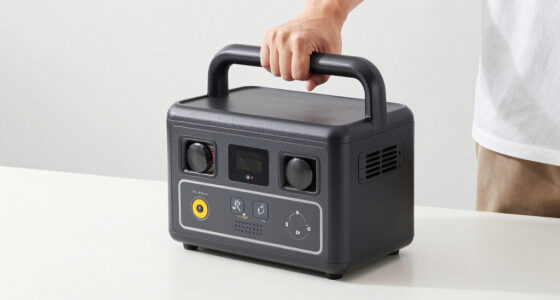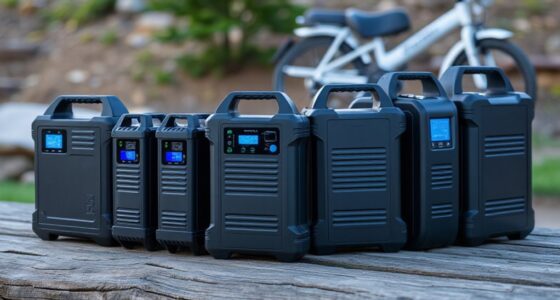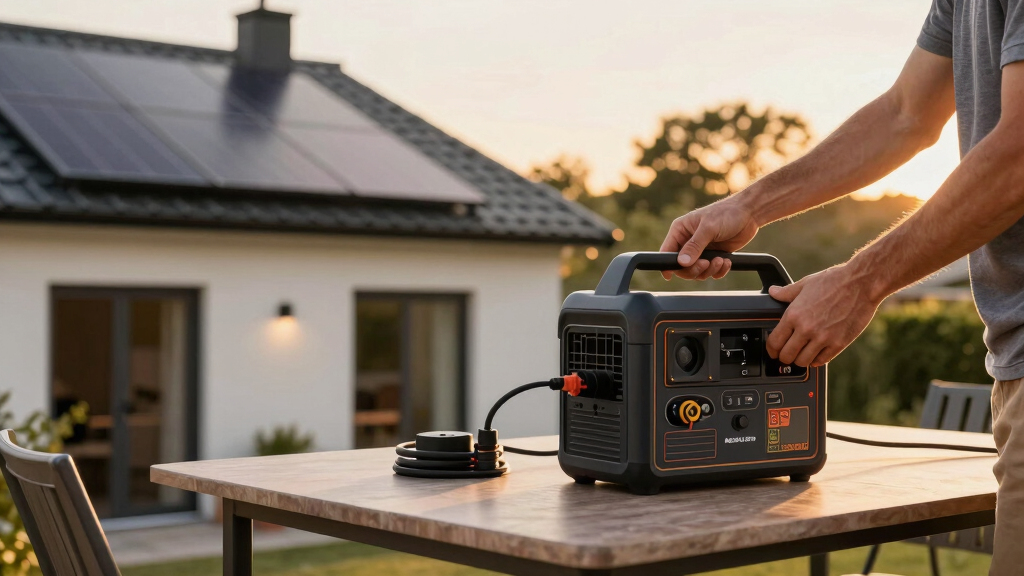

When choosing solar generators for backup power, the goal is reliable, clean energy that can keep your essentials running during outages. The best options balance capacity, portability, and recharge speed, but tradeoffs often involve size or cost. The Jackery Explorer 1000 v2 stands out for its balance of power and portability, while the Anker SOLIX C2000 Gen 2 offers high capacity for home backup. Smaller models like the Jackery Solar Generator 300 are perfect for camping but may fall short during extended outages. Continue reading for a detailed breakdown of the top options to help you find the right backup power solution for your needs.

Key Takeaways
- High-capacity models like the Jackery Solar Generator 5000 Plus excel for long-term backup needs, despite their larger size and weight.
- Fast recharge times are critical for minimizing downtime, especially with larger units that take longer to replenish.
- LiFePO4 batteries provide longer lifespan and safer operation, making them a preferred choice for prolonged backup use.
- Portability varies widely; smaller units are ideal for emergencies and camping, while larger units suit home backup.
- Cost varies significantly, with premium models offering more features but at a higher price point—buyers should match features with their specific backup requirements.


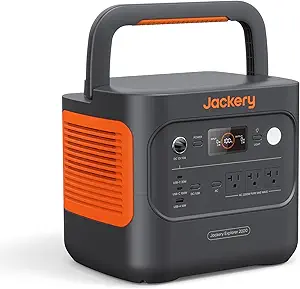
| solar generators for backup power | Weight | Capacity |
|---|---|---|
| Jackery Solar Generator 300 | — | — |
| Anker SOLIX C2000 Gen 2 Portab | 41.7 lbs | — |
| Jackery HomePower 3600 Plus Po | Approximately 43 lbs | 3584Wh |
| EF ECOFLOW Portable Power Stat | — | — |
| Jackery Explorer 1000 v2 Porta | 23.8 lbs | 1070Wh |
| Anker SOLIX S2000 Portable Pow | 35.7 lbs | — |
| Anker SOLIX C1000 Portable Pow | — | — |
| Jackery Solar Generator 5000 P | — | 5040Wh |
| Jackery HomePower 3000 Portabl | — | 3072Wh |
| Anker SOLIX C1000 Gen 2 Portab | — | — |
| Jackery Solar Generator 1000 V | 23.8 lbs | 1070Wh |
| Jackery Explorer 2000 v2 Porta | 39.5 lbs | 2042Wh |
More Details on Our Top Picks
Jackery Solar Generator 300, 292Wh Portable Power Station with 40W Solar Panel for Camping and Outdoors
The Jackery Explorer 300 stands out for its portability, making it an excellent choice for outdoor enthusiasts who prioritize ease of carry over high power output. Compared to the larger Jackery Explorer 1000, it offers less wattage, limiting its ability to run high-power appliances, but its compact size and weight (7.5 lbs) make it ideal for backpacking and short trips. The inclusion of a 40W solar panel enables quick recharging off-grid, although the total output of 300W restricts its use to smaller devices. The LiFePO4 battery chemistry ensures over 4,000 charge cycles, promising long-term reliability. However, the product description’s conflicting weight figures may cause some confusion, and solar panels are sold separately, adding to the initial cost. Overall, this is best suited for lightweight outdoor use, not for powering larger appliances or emergency home backup.
Pros:- Extremely portable at only 7.5 lbs
- Multiple charging options including AC, USB, and car port
- LiFePO4 battery with over 4,000 charge cycles
Cons:- Limited to 300W rated output, not suitable for heavy appliances
- Conflicting weight info and heavier than stated in specs
- Solar panels sold separately
Best for: Campers and outdoor travelers needing lightweight, reliable power for phones, lights, and small devices
Not ideal for: Home emergency power or running high-wattage appliances due to its limited 300W output
- Wattage:300 watts
- Battery Chemistry:LiFePO4
- Total Power Outlets:3
- Charge Time:Approximately 2.8 hours to 80% with 100W panel
- Item Weight:7.5 lbs
- Size:15.43″L x 9.92″W x 11.89″H
Our verdict“This model makes the most sense for outdoor users who need lightweight, portable backup power for small devices.”
Anker SOLIX C2000 Gen 2 Portable Power Station, 2400W (Peak 4000W), 2048Wh LiFePO4 Battery, Fast Recharge in 58 Min, Solar Generator for Home Backup and Camping
The Anker SOLIX C2000 Gen 2 offers impressive peak power of 4000W, making it a strong contender for users who need to run multiple large appliances simultaneously, unlike the smaller Jackery Explorer 300. Its 2048Wh LiFePO4 battery supports extended use, and the rapid recharge time of just 58 minutes via AC or solar is a significant advantage for emergency situations. While heavier at 41.7 lbs, its compact dimensions contribute to relative portability for a unit of this capacity. The device’s expandability to 4kWh allows for longer backup durations, but its higher price and limited details on solar panel compatibility may be a concern for budget-conscious buyers. It’s best suited for homeowners seeking reliable, high-capacity backup power or outdoor adventurers with high power needs.
Pros:- High peak power of 4000W supports multiple appliances simultaneously
- Fast recharge in just under an hour
- Expandable capacity up to 4kWh for longer runtime
Cons:- Relatively heavy for frequent portable use
- Higher cost limits accessibility for casual users
- Limited info on solar panel compatibility
Best for: Homeowners and campers who require high power output and expandability for multiple appliances
Not ideal for: Lightweight travelers or those with limited space, due to its weight and size
- Battery Capacity:2048Wh
- Peak Power:4000W
- Recharge Time:58 minutes
- Weight:41.7 lbs
- Dimensions:18.1 x 9.8 x 10.1 inches
- Expandable Capacity:Up to 4kWh
Our verdict“This unit is ideal for serious backup power needs where high capacity and quick recharging are priorities, despite its weight and cost.”
Jackery HomePower 3600 Plus Portable Power Station with 2 Solar Panels
The Jackery HomePower 3600 Plus provides a substantial 3584Wh capacity and 3600W output, making it an excellent choice for whole-house backup or extensive emergency scenarios. Its lithium iron phosphate (LFP) battery ensures a lifespan of over 6,000 cycles, promising durability for long-term use. The unit’s portability is enhanced by wheels and a telescopic handle, despite its weight of around 43 lbs, which is still manageable for moving around a property. It can expand up to 21kWh with multiple units, offering scalable power for large homes. While the solar panels are sold separately and may arrive separately, the quick hybrid charging and multiple input options add flexibility. This generator is best for users who want a portable yet powerful backup solution capable of supporting large loads.
Pros:- High capacity and expandability for whole-house backup
- Durable LFP batteries with long lifespan
- Wheels and handle for easier mobility
Cons:- Solar panels are sold separately and may arrive separately
- Heavy despite portability features
- Requires multiple units for larger expansion
Best for: Large households or small businesses needing scalable, reliable backup power
Not ideal for: Small apartments or users seeking lightweight, portable solutions for occasional camping
- Power Output:3600W (7200W in parallel)
- Capacity:3584Wh
- Expandable Capacity:Up to 21kWh
- Charge Time:2 hours via hybrid AC+DC
- Weight:Approximately 43 lbs
- Dimensions:Luggage style with wheels and telescopic handle
Our verdict“This generator is best suited for those needing scalable, high-capacity backup power with long-term durability.”
EF ECOFLOW Portable Power Station DELTA 2, 1024Wh LiFePO4 Battery, 1800W AC/100W USB-C, Solar Generator for Home Backup, Camping & RVs
The EcoFlow DELTA 2 offers a balanced mix of capacity (1024Wh) and power (1800W), making it suitable for both camping and home backup. Its fast charging speed—reaching 80% in just 50 minutes—outperforms many competitors like the Jackery Explorer 1000, which takes longer to recharge. The capacity can be expanded up to 3kWh, providing flexibility for various needs. Its USB-C port with 100W output caters to modern devices, and solar input supports off-grid use. However, the base capacity might be limiting for longer outages without expansion, and its higher cost compared to smaller portable units could be a barrier. This makes it ideal for users wanting quick, reliable power for essential devices, with room to grow.
Pros:- Fast charging in just 50 minutes from 0-80%
- Expandable capacity up to 3kWh
- Supports solar input for off-grid use
Cons:- Limited base capacity without expansion
- Higher price for its size
- Requires additional batteries for larger capacity
Best for: RV owners and homeowners wanting fast, expandable backup power for essential appliances
Not ideal for: Users needing large capacity for extended outages or running high-wattage appliances continuously
- Battery Capacity:1024Wh
- AC Output:1800W
- USB-C Output:100W
- Input Power:Up to 500W solar
- Cycle Life:3000+ cycles
- Expandable Capacity:1-3kWh
Our verdict“This model suits users seeking quick, reliable, and expandable backup power for essential devices and off-grid camping.”
Jackery Explorer 1000 v2 Portable Power Station, 1070Wh LiFePO4 Battery, 1500W AC/100W USB-C, Fast 1-Hour Charge, Solar Generator for Camping, Emergency, RV, Off-Grid
The Jackery Explorer 1000 v2 combines a substantial 1070Wh lithium iron phosphate battery with 1500W AC output, making it well-suited for camping, emergency power, and off-grid living. Its fast charging capability — reaching 80% in just one hour — surpasses many competitors like the EcoFlow DELTA 2, which takes longer to recharge. The unit’s lightweight design at 23.8 lbs, along with a foldable handle, enhances portability. It also offers multiple output ports, including USB-C and USB-A, catering to a variety of devices. A notable drawback is that solar panels are not included, requiring an additional purchase. This makes it a versatile choice for users needing reliable, high-capacity power on the go, with fast recharge times.
Pros:- High-capacity 1070Wh battery with long lifespan
- Fast 1-hour recharge capability
- Multiple ports including USB-C and AC outlets
Cons:- Solar panels sold separately
- Limited to Jackery-compatible solar panels
- Price can be high for some budgets
Best for: Outdoor enthusiasts and emergency preppers who want high capacity and rapid recharging in a portable package
Not ideal for: Users seeking integrated solar charging or who prefer a more budget-friendly, smaller unit
- Capacity:1070Wh
- AC Output:1500W
- USB-C Ports:2
- Charge Time:1 hour
- Weight:23.8 lbs
- Material:Plastic
Our verdict“This device is ideal for those who need a high-capacity, fast-charging portable power station for outdoor and emergency use.”
Anker SOLIX S2000 Portable Power Station, 1500W Solar Generator with 2,010Wh Battery
The Anker SOLIX S2000 stands out for its high-capacity 2,010Wh battery and impressive 10,000-cycle lifespan, making it a reliable choice for extended backup scenarios. Compared to the Jackery Explorer 1000, it offers more battery capacity and longevity, though it sacrifices some high-wattage output, limited to 1500W continuous. Its portability at just 35.7 pounds and multiple recharging options, including solar, make it versatile for both home and outdoor use. However, the absence of a 12V DC port limits some vehicle or off-grid applications and it requires an additional solar panel for solar charging. This model suits those who prioritize long-term durability and portability for emergency or outdoor use.
Pros:- High-capacity 2,010Wh battery with 10,000-cycle lifespan
- Lightweight and portable at 35.7 lbs
- Multiple recharging options including solar, AC, and vehicle
Cons:- Limited to 1500W continuous power, restricting high-wattage devices
- No 12V DC port available
Best for: Individuals needing a portable, high-capacity backup with long cycle life, such as campers or emergency prepper households.
Not ideal for: Users requiring high-wattage appliances or dedicated vehicle power, as it cannot sustain continuous loads over 1500W and lacks a 12V DC port.
- Power Output:1500W continuous, 3000W peak
- Battery Capacity:2,010Wh
- Battery Type:LFP (Lithium Iron Phosphate)
- Cycle Life:10,000 cycles
- Weight:35.7 lbs
- Dimensions:8.2 x 11.1 x 12.7 inches
Our verdict“This is ideal for those seeking a durable, portable power station with long-term cycle life and flexible recharging options for moderate power needs.”
Anker SOLIX C1000 Portable Power Station, 1800W (Peak 2400W), 1056Wh LiFePO4 Battery, Solar Generator for Home Backup and Camping
The Anker SOLIX C1000 offers a compelling blend of fast recharge times—under one hour—and a high surge capacity of 2400W, making it suitable for sudden power needs. While the Jackery Explorer 1000 provides a slightly lower surge capacity, the C1000’s rapid recharging and 3,000-cycle LiFePO4 battery give it an edge in long-term reliability. The device’s compact size and solar compatibility support outdoor and backup use, but it demands an app for optimal setup, which could be inconvenient for some. Its price is not specified, but the premium features may reflect a higher cost. Best suited for users who need quick recharging, high surge power, and long-lasting batteries for intermittent use.
Pros:- Recharge in under an hour, enabling quick turnaround
- High surge capacity of 2400W for demanding appliances
- Long-lasting LiFePO4 battery with 3,000 cycles
Cons:- Requires a smartphone app for optimal setup and operation
- Limited details on total port count
Best for: Campers or homeowners who need rapid recharging and high surge capacity for sudden power demands.
Not ideal for: Those on a strict budget or who dislike app-based controls, since setup and management rely on smartphone connectivity.
- Battery Capacity:1056Wh
- Peak Power:2400W
- Recharge Time:Under 1 hour
- Cycle Life:3,000 cycles
- Size:15% smaller than comparable units
Our verdict“This model is best for power users who need rapid recharge and high surge capacity in a portable form for intermittent, demanding loads.”
Jackery Solar Generator 5000 Plus with 2x 200W Solar Panels, 5040Wh LiFePO4 Portable Power Station
The Jackery Solar Generator 5000 Plus is designed for serious power needs, with a massive 5040Wh battery and an incredible 7200W rated output capable of running most home appliances. Its expandable capacity up to 60kWh makes it ideal for prolonged outages or off-grid living. While the enormous capacity and fast 2-hour solar recharge make it stand out, its weight and size are significant—less suited for frequent portability. The price is higher, but its durability and power output justify the investment for those with demanding backup needs. Compared to smaller models like the Jackery Explorer 1000, this generator is for those prioritizing long-term, high-power backup over portability. This unit caters to users needing extended, reliable power for large appliances and whole-home backup scenarios.
Pros:- Massive 5040Wh capacity suitable for prolonged outages
- Supports up to 7200W power draw for heavy appliances
- Expandable up to 60kWh for long-term backup
Cons:- Large and heavy, less portable for frequent moving
- Higher price point reflecting its extensive capacity
Best for: Homeowners and off-grid enthusiasts who require extended, reliable backup power for major appliances and long-term use.
Not ideal for: Individuals seeking a lightweight or highly portable solution for occasional or short-term use, as its size and weight are substantial.
- Capacity:5040Wh
- Expandable Capacity:up to 60kWh
- AC Power Output:7200W
- Solar Input:up to 4000W
- Recharge Time:about 2 hours
- Battery Type:LiFePO₄
Our verdict“Best suited for those who need a robust, expandable backup power system capable of supporting an entire home for extended periods.”
Jackery HomePower 3000 Portable Power Station with 2x 200W Solar Panels
The Jackery HomePower 3000 offers a balanced mix of high capacity, with 3072Wh and a 3600W rated output, making it suitable for powering essential home appliances during outages. Its rapid recharging—1.7 hours via hybrid AC/DC or 2.2 hours via AC—compared to similar models like the Anker SOLIX C1000, provides quick turnaround times. Its extensive port selection supports multiple device types, and LiFePO₄ batteries ensure long cycle life. However, it ships separately from its solar panels, which could complicate setup, and its weight might be less ideal for frequent portability. It’s a solid pick for those who want substantial power with quick recharge capabilities for emergency preparedness. This generator is ideal for users wanting high capacity and fast recharging for home backup and outdoor use.
Pros:- High capacity of 3072Wh with long cycle life
- Fast recharging via hybrid AC/DC in under 2 hours
- Multiple ports for versatile device charging
Cons:- Solar panels shipped separately, adding complexity
- Relatively high weight for frequent portability
Best for: Homeowners or emergency planners needing a high-capacity, fast-recharging unit for reliable home backup and outdoor use.
Not ideal for: People seeking a lightweight, highly portable unit with minimal setup, as this model is relatively heavy and ships separately from solar panels.
- Capacity:3072Wh
- Surge Power:7200W
- Rated Power:3600W
- Recharging Time:1.7 hours via hybrid AC/DC
- Ports:Multiple including AC, USB-C, USB-A, DC
- Battery Type:LiFePO₄
Our verdict“This unit is best for those who need a high-capacity, fast-recharging backup system for home or outdoor emergencies with reliable long-term performance.”
Anker SOLIX C1000 Gen 2 Portable Power Station, 2000W (Peak 3000W), 1024Wh LiFePO4 Battery, Fast Recharge, Solar Compatible
The Anker SOLIX C1000 Gen 2 combines a 1024Wh LiFePO₄ battery with an impressive 2000W continuous power, and the ability to surge up to 3000W. Its ultra-fast recharge in just 49 minutes makes it a standout for rapid turnaround, especially compared to slower models like the Jackery Explorer 1000. Additionally, its UPS backup capability and app-controlled smart power management make it appealing for off-grid and home backup scenarios. The model is slightly smaller and lighter than comparable units, but its 600W solar input limit could be restrictive for those relying solely on solar. The app adds convenience but may be a barrier for less tech-savvy users. This generator is well-suited for users prioritizing rapid recharge, smart control, and reliable power for sensitive electronics.
Pros:- Fast recharge in under 50 minutes
- Supports UPS backup for critical devices
- Compact, lightweight design suitable for portability
Cons:- Limited to 600W solar input, restricting solar-only recharging
- Requires app for full control, which may not appeal to all users
Best for: Tech-savvy homeowners or campers seeking fast recharging, smart management, and UPS backup for sensitive devices.
Not ideal for: Users who want maximum solar input capacity or prefer simple, app-free operation, as it relies on an app for advanced features.
- Battery Capacity:1024Wh
- Power Output:2000W
- Recharge Time:49 minutes
- Peak Power:3000W
- Cycle Life:4000 cycles
- Portability:14% smaller and lighter than similar models
Our verdict“This model is ideal for power users wanting quick recharging, smart management, and reliable backup for sensitive electronics in a portable package.”
Jackery Solar Generator 1000 V2 with 200W Solar Panel, 1070Wh Portable Power Station with LiFePO4 Battery, 1500W AC/100W USB-C Output, Fast 1-Hour Charging for Outdoor, Off-Grid Living, RV, Emergency
The Jackery Solar Generator 1000 V2 stands out for its combination of power, portability, and advanced battery chemistry. Its 1070Wh LiFePO4 battery offers long-lasting reliability, surpassing the capacity of smaller units like the Jackery Solar Generator 300, making it ideal for running multiple appliances during outages or extended outdoor trips. The 1500W AC output provides ample power for essentials, while the fast 1-hour charging with AC or solar ensures minimal downtime. Compared to the Jackery Explorer 2000 v2, it’s lighter and easier to carry, though it sacrifices some capacity. The device’s app control and foldable handle enhance user convenience, but the solar panel ships separately, adding to initial costs. Its lightweight build (23.8 lbs) makes it suitable for camping, RVing, and emergency setups, but it’s limited to specific shipping addresses. Overall, this makes the most sense for users needing a portable, reliable backup with quick recharge times.
Pros:- Powerful 1500W AC output suitable for most appliances
- Fast 1-hour charging minimizes downtime
- Lightweight and portable with an ergonomic foldable handle
- Long-lasting LiFePO4 battery with over 10 years lifespan
Cons:- Separate purchase required for solar panel increases upfront cost
- Limited shipping options exclude PO Box addresses
Best for: Outdoor enthusiasts, RV users, and emergency preparedness households needing a versatile, portable power source.
Not ideal for: Small-scale users or those seeking an all-in-one package, since the solar panel is sold separately and app setup is required.
- Capacity:1070Wh
- Battery Type:LiFePO4
- AC Output:1500W
- Surge Peak:3000W
- USB-C Ports:2
- Weight:23.8 lbs
- Charging Time:1 hour (fast charge)
Our verdict“This generator excels for users who prioritize portability, quick charging, and reliable power during outdoor activities or emergencies.”
Jackery Explorer 2000 v2 Portable Power Station, 2042Wh LiFePO4, 2200W Solar Generator, USB-C PD 100W Fast Charging
The Jackery Explorer 2000 v2 is tailored for those who require extended backup power, offering a substantial 2042Wh LiFePO4 battery that outpaces many competitors like the Jackery Solar Generator 1000 V2. Its 2200W AC output can handle heavier loads, making it suitable for backup during prolonged outages or demanding outdoor projects. The unit’s fast charging capabilities, with AC recharge in under 70 minutes, and solar charging in approximately 6 hours, make it reliable for unpredictable power needs. Despite being only slightly heavier (39.5 lbs), its compact design still makes it manageable for most users. The ultra-quiet operation (less than 30dB) is a clear advantage over noisier models. However, its delivery restrictions to PO boxes and higher weight reduce portability for some users. This pick makes the most sense for households or professionals needing extended power autonomy without sacrificing portability.
Pros:- Large 2042Wh capacity supports long-term backup needs
- High 2200W AC output handles heavier appliances
- Fast recharge times with AC and solar options
- Ultra-quiet operation suitable for indoor use
Cons:- Relatively high weight limits portability for some
- Cannot be shipped to PO Box addresses
Best for: Homeowners, campers, or small business operators seeking long-lasting backup power with quick recharging options.
Not ideal for: Users seeking ultra-lightweight or highly portable solutions, due to its weight and size.
- Capacity:2042Wh
- Battery Type:LiFePO4
- AC Output:2200W
- Charging Time (AC Fast):66 minutes
- Noise Level:Less than 30dB
- Weight:39.5 lbs
- Solar Charging Time:6 hours with 400W panels
Our verdict“This power station is ideal for those needing dependable, long-duration backup power without frequent recharges, especially in home or remote work environments.”
How We Picked
To determine the best solar generators for backup power, I focused on multiple criteria that matter in real-world scenarios. Performance was assessed through capacity (Wh), power output, and recharge speed, ensuring the units can reliably power essential devices during outages. Usability factors like size, weight, and ease of recharge influence everyday convenience, especially in emergency situations. Build quality and battery lifespan, particularly with LiFePO4 technology, were prioritized for long-term durability. Finally, value was considered by weighing features against price, aiming to recommend options that suit different budgets while meeting essential backup needs.Factors to Consider When Choosing Solar Generators For Backup Power
Choosing the right solar generator for backup power involves balancing capacity, portability, and recharge speed. Beyond the specs, understanding how these factors fit your specific needs can prevent costly mistakes and ensure reliable performance during outages. Consider the typical duration of power outages in your area, the devices you need to run, and whether portability or maximum capacity is more important. Knowing these broader considerations helps in selecting a unit that provides peace of mind without overspending on unnecessary features.Capacity and Power Output
Capacity, measured in watt-hours (Wh), determines how long your generator can power devices before needing a recharge. For backup power, aim for at least 1,000Wh if you want to run essential appliances for an extended period. Power output, indicated in watts (W), limits what devices you can connect simultaneously. High-wattage appliances like refrigerators require larger units with 1,500W or more. Matching capacity and output to your power needs prevents frustration during outages.
Recharge Speed and Solar Compatibility
Fast recharge times reduce downtime, especially when grid power is unavailable for days. Units with quick charging capabilities or high solar input ratings can replenish faster, keeping your backup ready when needed. Solar compatibility is equally critical; look for generators that accept high wattage input from multiple panels. This ensures you can harness sunlight efficiently, especially in prolonged outages or remote locations where grid power isn’t an option.
Portability and Size
Size and weight influence how easily you can move your generator during emergencies or outdoor activities. Smaller, lightweight models are best for camping or quick emergency use, but they often have limited capacity. Larger units with higher capacity tend to be heavier and less portable but excel for home backup. Consider your typical use case—if you need to move the generator frequently, prioritize lighter, more compact options.
Battery Technology and Longevity
LiFePO4 batteries have become the standard for backup generators due to their longer lifespan, safety, and better thermal stability. While they cost more upfront, these batteries typically last 3,000 to 5,000 cycles, compared to 500-1,000 cycles in older lithium-ion models. Investing in LiFePO4 technology can save money over time by reducing replacement frequency and enhancing safety during extended use.
Cost and Value
Price varies significantly across models, reflecting differences in capacity, features, and build quality. While high-capacity, fast-recharging units come at a premium, they often provide better long-term value for home backup. Conversely, more affordable models suit light outdoor use or short-term emergencies. Assess your backup power needs carefully and avoid overpaying for features you won’t utilize, but also be cautious of very cheap options that may lack durability or sufficient capacity.
Frequently Asked Questions
How long can a solar generator power my home during an outage?
The duration a solar generator can power your home depends on its capacity and your energy consumption. For example, a 1,000Wh unit might run a small refrigerator for about 8-10 hours, but larger appliances like air conditioners require significantly more power and capacity. To estimate your needs, list essential devices and total their wattage, then divide the generator’s Wh by that total. For extended outages, larger units with 3,000Wh or more are preferable, or consider integrating multiple units and solar panels for continuous supply.
Is it worth paying extra for faster recharge times?
Faster recharge times can be highly beneficial in emergency situations, especially if you experience multiple outages or want to replenish your generator quickly after use. Units with rapid charging or high solar input capabilities reduce downtime and increase reliability. However, they tend to cost more, so if your backup needs are infrequent or short-term, investing in a slower but more affordable model might make more sense. For critical backup, prioritizing recharge speed can improve overall reliability and peace of mind.
Can I run my entire house on a portable solar generator?
Running an entire house from a portable solar generator is challenging due to capacity limits. Most portable units are designed for essential devices and small appliances. For full-home backup, you need a high-capacity system with at least 3,000Wh and substantial continuous power output—often integrated with a home transfer switch. Portable generators are better suited for powering critical devices like refrigerators, lights, and communication devices during outages, rather than an entire household.
How many solar panels do I need to recharge a generator in a day?
The number of panels required depends on the generator’s capacity and the panels’ wattage. For example, a 1,000Wh generator paired with 100W panels may need 8-10 hours of peak sunlight to recharge fully. If your panels produce more wattage, fewer are needed, or recharge time decreases. Keep in mind that weather, panel orientation, and shading can affect efficiency. Planning for backup recharging capacity ensures your generator remains ready, even during cloudy days or shorter daylight hours.
Are solar generators safe for long-term outdoor use?
Yes, many solar generators are designed for outdoor use, especially models with rugged enclosures and LiFePO4 batteries known for thermal stability and safety. These units can withstand typical outdoor conditions and are less prone to overheating or thermal runaway. However, it’s important to protect them from extreme weather—such as heavy rain or snow—and to store them properly when not in use. Regular maintenance and choosing weather-resistant models can extend their lifespan and ensure safe operation over years of outdoor use.
Conclusion
For those seeking an all-around reliable backup solution, the Jackery Explorer 1000 v2 offers a balanced mix of capacity, portability, and fast charging, making it ideal for most households. If you prioritize long-term, heavy-duty backup power and are willing to invest, the Anker SOLIX C2000 Gen 2 stands out for its high capacity and rapid recharge. Beginners or those with limited space will find the Jackery Solar Generator 300 or Explorer 2000 v2 better suited. Budget-conscious buyers should consider smaller units, but for critical backup needs, spending more on higher-capacity, durable models pays off. Ultimately, matching your specific power needs and mobility requirements will lead to the best choice.